
Textured Taper Haircut: 59+ Styles & Complete Guide for Men
The textured taper haircut is one of the most versatile men’s hairstyles for creating a clean, modern appearance while keeping natural movement and volume on top. It combines a textured crop, quiff, fringe, curly top, or longer layered hairstyle with gradually shortened hair around the temples, sideburns, and neckline. The result is a balanced haircut that can look sharp and professional or relaxed and intentionally messy.
A low textured taper haircut offers subtle definition without removing too much hair from the sides, while mid and high tapers create stronger contrast. Men with straight hair can add separation through point cutting and lightweight styling products, while naturally wavy, curly, and coily hair can use existing texture to achieve movement with less manipulation. The best style depends on hair density, head shape, growth direction, and how much time you want to spend styling.
In this guide, you’ll explore 59 textured taper haircut styles, low-to-high taper comparisons, practical barber instructions, cutting techniques, product recommendations, and maintenance advice. You’ll also learn how to choose the right haircut, manage cowlicks and double crowns, avoid common cutting mistakes, and maintain your textured top between barber appointments.
Table of Contents
- Textured Taper Haircut: Complete Overview
- Understanding Textured Taper Haircut Types and Fade Variations
- Best Textured Taper Haircut Styles for Men
- Textured Taper Haircut Before and After: 360° Visual Comparisons
- How to Choose the Right Textured Taper Haircut
- Textured Taper Haircut Length, Shape and Hair Growth
- How Barbers Create a Textured Taper Haircut
- How to Ask Your Barber for a Textured Taper Haircut
- How to Style a Textured Taper Haircut at Home
- Best Styling Products for a Textured Taper Haircut
- Textured Taper Haircut vs Similar Hairstyles
- Common Textured Taper Haircut Problems, Mistakes and Solutions
- Textured Taper Haircut Maintenance and Haircare
- Textured Taper Haircut Cost and Professional Barber Services
- Frequently Asked Questions About Textured Taper Haircuts
- Final Thoughts: Choosing Your Ideal Textured Taper Haircut
1. Textured Taper Haircut: Complete Overview
1.1 What Is a Textured Taper Haircut?
A textured taper haircut combines a layered or naturally textured top with a gradual reduction in hair length around the sides and neckline.
The textured top creates movement, separation, and volume. The taper provides a cleaner outline without necessarily creating the strong contrast associated with a full skin fade.
Unlike a haircut defined by only one top shape, a textured taper can incorporate a short crop, messy fringe, quiff, side part, curly top, or longer flowing hairstyle.
The key is the relationship between the two sections. The hair on top remains long enough to show visible texture, while the sides transition smoothly into shorter hair around the temples and nape.
For additional haircut ideas, explore the men’s grooming guides at Taper Haircut Hub.
1.2 What Is a Textured Taper Fade?
A textured taper fade is a variation that combines visible hair texture on top with a gradually blended perimeter.
The fade may extend from very short hair near the sideburns and neckline into longer hair above.
Barbers often use terms such as low taper fade, mid taper fade, and high taper fade to describe the relative height of the shortened sections.
A taper fade does not require shaving every faded area down to bare skin. Some versions retain a small amount of visible hair at the shortest point.
1.3 What Does Texture Mean in Men’s Haircuts?
In barbering, texture describes visible movement, strand separation, layering, and variation within a hairstyle.
Hair texture can come from two sources.
Natural texture includes waves, curls, coils, and the way individual strands grow. Created texture comes from cutting techniques such as point cutting, layering, slide cutting, and controlled weight removal.
For example, straight hair may look flat when cut to one uniform length. Adding carefully positioned layers can help individual sections move more freely.
A textured haircut does not necessarily mean messy hair. Texture can also appear in a polished quiff, professional side part, or neatly brushed-back hairstyle.
1.4 How Does a Taper Work With Textured Hair?
A taper controls the perimeter of the haircut while allowing the textured top to remain the main visual feature.
Shortening the hair around the temples can make the upper section appear more prominent. Maintaining some weight above the ears prevents the haircut from becoming excessively disconnected.
With curly hair, a taper can emphasize natural curl volume. With straight hair, it creates a cleaner contrast against deliberately layered strands.
The taper should complement the top rather than dictate its shape.
1.5 Why Are Textured Taper Haircuts Popular in 2026?
Textured taper haircuts remain popular in 2026 because they combine modern barbering with more natural-looking hair movement.
They offer an alternative to extremely short skin fades, heavily gelled hairstyles, and rigidly structured cuts.
Men can choose subtle low tapers for professional settings or stronger high tapers for a more noticeable appearance.
The haircut also supports many current styling preferences, including matte finishes, fluffy volume, messy crops, natural curls, and medium-length layered tops.
Our taper haircut 2026 guide explores additional contemporary haircut ideas.
1.6 Benefits and Drawbacks of a Textured Taper Haircut
The biggest benefit of a textured taper is versatility. It works with many hair lengths, hair types, and styling directions.
A properly designed haircut can also help thick hair feel less bulky, give suitable fine hair more apparent movement, and create a cleaner outline around the ears.
Another advantage is styling flexibility. The same textured top may be worn forward, upward, sideways, or in a deliberately messy finish.
However, some variations require daily styling, particularly fluffy quiffs and high-volume crops.
A sharply defined taper may need regular touch-ups, while excessive thinning can create problems for fine or curly hair.
The best haircut balances appearance with natural hair behavior and maintenance requirements.
1.7 Who Should Consider a Textured Taper Haircut?
A textured taper is worth considering if you want a modern haircut without completely removing the hair around the sides.
It may be suitable for men who prefer:
- A clean perimeter with natural volume on top
- Flexible styling for professional and casual settings
- Short, medium, or longer textured hairstyles
- A haircut that follows existing curls or waves
- Subtle fades instead of aggressive skin-close cutting
The style can also work for men growing out a previous fade or transitioning toward longer hair.
1.8 Textured Taper Haircut at a Glance
Hair Length, Taper Height, Texture and Styling Requirements
| Feature | General recommendation |
| Top length | Approximately 1–5 inches, depending on style |
| Side length | Shortened gradually around the perimeter |
| Taper height | Low, mid, or high |
| Natural hair types | Straight, wavy, curly, and coily |
| Main cutting techniques | Point cutting, layering, clipper blending |
| Popular finishes | Matte, natural, messy, and lightly defined |
| Daily styling | Approximately 2–10 minutes |
| Barber maintenance | Commonly every 2–6 weeks |
| Styling products | Matte clay, texture powder, mousse, curl cream |
| Main advantage | Clean edges with flexible textured styling |
These values are general guidance rather than universal haircut requirements.
Top 5 Textured Taper Styles: Quick Comparison
| Style | Appearance | Best suited to |
| Low taper textured crop | Short and clean | Everyday styling |
| Messy textured taper | Relaxed and separated | Natural movement |
| Textured quiff taper | Lifted and voluminous | Medium-length hair |
| Curly textured taper | Defined curls | Naturally curly hair |
| Textured side part | Controlled and polished | Professional settings |
Best Hair Types, Face Shapes and Maintenance Levels
The haircut can be adapted to different face shapes because the top length and side volume are adjustable.
Straight hair may need added layers, while curly and coily hair already provide natural texture.
Short crops and soft tapers generally require less styling than long, voluminous hairstyles with sharp fades.
For broader inspiration, browse our collection of Hairstyles with taper.
2. Understanding Textured Taper Haircut Types and Fade Variations
The taper determines how much hair remains around the sides and how much contrast appears beneath the textured top.
Understanding fade placement is essential before choosing a hairstyle.
2.1 Low Textured Taper Haircut
A low textured taper concentrates the shortest hair near the lower temples, sideburns, and neckline.
Most of the surrounding side hair remains relatively full.
This makes it a practical option for men who want natural-looking texture with subtle definition.
Classic Low Textured Taper
The classic low taper features a gradual, restrained transition around the perimeter.
It pairs well with textured crops, soft quiffs, layered side parts, and natural waves.
The haircut maintains enough side weight to create a balanced silhouette.
Low Taper Fade With Textured Top
A low taper fade with a textured top creates a slightly sharper transition while preserving most of the hair above the ears.
It is particularly effective when the top features visible choppy layers or natural curls.
2.2 Mid Textured Taper Haircut
A mid textured taper extends the blended area farther upward around the temple region.
It produces more contrast than a low taper without necessarily removing as much side hair as a full mid fade.
Mid Taper With Natural Texture
This variation combines moderate fade placement with natural curls, waves, or a lightly layered top.
It offers a balanced appearance for men who want noticeable definition without a dramatically short side profile.
Mid Taper vs Mid Fade With Textured Hair
A mid taper usually focuses on localized areas around the temples and neckline.
A full mid fade generally blends a broader section of the sides and back.
Both can support the same textured hairstyle, but the overall silhouette will differ.
2.3 High Textured Taper Haircut
A high textured taper places the graduated transition higher around the temples.
This creates a bold contrast against the longer top.
High Taper With Textured Top
A high taper works with elevated quiffs, spiky tops, bold crops, and hairstyles with noticeable crown volume.
The stronger contrast draws attention to the texture above.
High Taper vs High Fade
A high taper can remain localized around the temple and neckline areas.
A full high fade usually removes more hair across the upper sides.
The high fade generally produces a stronger, more continuous contrast.
2.4 Temple Taper With Textured Hair
A temple taper focuses on shortening the hair directly around the temples and sideburns.
The rest of the sides may remain comparatively full.
This creates subtle definition without making a major change to the haircut’s overall shape.
It works especially well with natural waves, medium-length layers, and professional hairstyles.
2.5 Low Drop Taper With Textured Top
A low drop taper follows a curved transition that becomes lower toward the back of the head.
The shape can complement a rounded crown or curly top.
It is particularly useful when the barber wants to maintain fullness around the upper sides while refining the lower perimeter.
2.6 Burst Fade With Textured Top
A burst fade creates a curved faded area around the ear.
It differs from a conventional taper because the fade forms a more noticeable arc.
This variation can complement textured mullets, faux hawks, and longer upper sections.
2.7 Skin Taper vs Shadow Taper With Textured Hair
A skin taper reaches exposed skin at its shortest point.
A shadow taper retains visible hair throughout the blended section.
The skin version creates greater contrast, while the shadow version provides a softer appearance.
Men who prefer a natural grow-out or who experience discomfort from close shaving may favor the guarded shadow finish.
2.8 Taper Fade vs Full Fade vs Traditional Taper
| Haircut type | Main cutting area | Visual contrast |
| Traditional taper | Gradual reduction near perimeter | Low |
| Taper fade | Short blended temples and neckline | Low to moderate |
| Full fade | Larger portions of sides and back | Moderate to strong |
| Skin taper | Localized transition reaching skin | Strong at the perimeter |
| Shadow taper | Localized transition retaining visible hair | Soft |
Barber terminology varies, so reference photographs are more reliable than haircut names alone.
2.9 Textured Taper vs Disconnected Undercut
A textured taper usually maintains a gradual transition between the top and sides.
A disconnected undercut creates a more obvious separation between longer hair and short sides.
The undercut produces a stronger contrast, while a textured taper generally looks softer and more blended.
2.10 Understanding Taper Placement, Height and Hair Coverage
Taper height affects where the shortest hair appears, while taper coverage determines how much of the surrounding hair is blended.
A low taper can still have a sharp skin-close finish, and a high taper does not necessarily require a full high fade.
The barber should also consider the parietal ridge, the area where the upper head begins curving into the sides.
Preserving sufficient weight around this area helps prevent the haircut from looking unbalanced.
2.11 Low vs Mid vs High Textured Taper: Which Is Better?
Differences in Fade Placement and Hair Length
| Feature | Low taper | Mid taper | High taper |
| Placement | Lower perimeter | Middle temple area | Higher temple area |
| Side weight | Mostly preserved | Moderately reduced | More visibly reduced |
| Contrast | Subtle | Balanced | Bold |
| Common pairing | Crop, waves, side part | Curly top, quiff | Spikes, high-volume top |
| Grow-out visibility | Usually less abrupt | Moderate | More noticeable |
Subtle vs High-Contrast Haircut Results
Choose a low taper for a softer appearance, a mid taper for moderate definition, or a high taper for stronger emphasis on the textured top.
Choosing a Taper Based on Styling and Maintenance
A soft guarded taper is a sensible starting point if you want a haircut that can grow out without immediately losing its shape.
A skin-close or higher taper may require more frequent maintenance to preserve the contrast.

3. Best Textured Taper Haircut Styles for Men
The following 59 hairstyle ideas demonstrate how a textured top can be combined with different taper heights, cutting techniques, lengths, and styling directions.
Some variations share similar foundations but produce distinct results through their texture, proportions, or finishing details.
3.1 Short Textured Taper and Crop Haircuts
1. Classic Textured Crop With Low Taper
A classic textured crop features short, layered hair on top with a gradual low taper around the temples.
The top is usually styled forward with natural separation rather than forming one flat section.
This haircut suits men who want a clean appearance with minimal daily effort.
2. Short Choppy Crop Taper
The short choppy crop uses uneven, point-cut ends to create visible movement.
The taper keeps the perimeter neat without removing excessive side volume.
A small amount of matte clay can emphasize the separated sections.
3. Textured Buzz Taper Haircut
A textured buzz taper keeps the top very short but may retain slightly more length than a traditional uniform buzz cut.
Subtle length differences and a clean taper produce a compact, structured appearance.
It offers a useful starting point for men who prefer extremely short hair. Explore our Buzz Taper Haircut guide for more variations.
4. Textured Crew Cut With Low Taper
A textured crew cut maintains short hair through the top, often with slightly more length toward the front.
Light point cutting introduces movement, while the low taper creates a refined perimeter.
The result is practical for professional settings and active lifestyles.
For a related version, see our Taper Haircut Crew Cut Low Fade guide.
5. Textured Ivy League or Princeton Taper
An Ivy League or Princeton-style haircut retains enough length at the front to create a side part.
Adding subtle texture produces a more relaxed finish than a heavily combed traditional style.
A classic taper maintains the haircut’s polished appearance.
6. Caesar Cut Textured Taper
The Caesar haircut features a relatively short, forward-directed top.
Texturizing the front creates separated ends without dramatically changing the compact silhouette.
This style is suitable for men who want a short haircut with a defined forward direction.
7. Textured French Crop With Low Taper
A French crop combines a short forward fringe with a compact top.
Adding point-cut layers makes the hair appear softer and less uniform.
The low taper keeps the sides clean while preserving the crop’s characteristic shape.
Our french crop taper haircut men guide explores this style in greater detail.
8. Blunt-Edge Textured Crop Taper
This variation has a relatively straight front outline with texture throughout the top.
The contrast between the structured fringe and separated layers creates a modern appearance.
It suits men who prefer a defined shape without a completely flat finish.
9. Razor-Edged Textured Crop With Taper
A razor-textured crop features softer, feathered ends.
The technique can create movement in suitable hair, although it may be less appropriate for fragile or highly frizz-prone strands.
A subtle taper supports the softer top.
10. Short Spiky Textured Top With Taper
This haircut uses short, upward-directed sections to create controlled spikes.
The taper provides a clean foundation beneath the textured top.
It works particularly well on hair that can hold a short, structured shape.
3.2 Textured Fringe and Forward-Styled Taper Haircuts
11. Textured Fringe With Low Taper
A textured fringe falls toward the forehead in separated, layered strands.
The low taper creates definition without dramatically changing the side shape.
It works especially well with medium-length straight or wavy hair.
For a full guide to this particular style, read our textured fringe taper haircut article.
12. Micro Fringe Low Textured Taper
A micro fringe sits noticeably above the eyebrows.
Its short length creates a compact front profile, while the taper emphasizes the side outline.
This version is useful for men who want a fringe without hair regularly touching their eyes.
13. Angular Fringe Low Taper
An angular fringe follows a diagonal line across the forehead.
The shape creates asymmetry and can be combined with a low taper for a balanced appearance.
For a stronger, more defined fringe alternative, the Edgar taper haircut uses a noticeably different front outline.
14. Forward-Swept Textured Crop Taper
A forward-swept crop directs the top hair toward the forehead.
The barber creates separation through light layering rather than relying on excessive styling product.
This is a practical option for hair that naturally grows forward.
15. Curtain Fringe With Low Taper
A curtain fringe separates near the middle and falls toward both sides of the forehead.
The taper keeps the temples clean while the longer front frames the face.
It generally needs more length than a short textured crop.
16. Side-Swept Textured Fringe Taper
A side-swept fringe moves diagonally across the forehead.
This creates a softer, asymmetrical outline and can accommodate a natural off-center growth direction.
For additional fringe and taper combinations, explore our fringe taper haircut guide.
17. Curly Textured Fringe With Taper
Natural curls create volume and definition at the front.
A taper maintains clean edges while allowing the curls to retain their natural shape.
The barber should account for shrinkage before deciding on the final fringe length.
18. Heavy Coarse-Hair Fringe With High Taper
This hairstyle retains substantial weight through the fringe while using a higher taper for stronger contrast.
It works best when dense hair is carefully shaped to prevent excessive bulk.
A sharper alternative can be seen in the low taper haircut edgar cut and mid taper haircut edgar variations.
3.3 Wavy, Curly and Naturally Textured Taper Haircuts
19. Straight Hair Textured Top With Low Taper
Straight hair often benefits from deliberate layering and point cutting.
The low taper creates a refined outline, while styling products can help individual strands separate.
Avoid removing excessive weight from fine straight hair.
20. Natural Wavy Hair With Low Textured Taper
Natural waves provide movement without requiring heavy cutting.
The barber can use the existing wave direction to build a relaxed silhouette.
A low taper keeps the haircut clean while allowing the upper section to remain soft.
21. Defined Curls With Low Taper Fade
A curly textured top can be paired with a low taper for a compact, controlled appearance.
The curls remain prominent, while the perimeter receives a gradual blend.
Light curl-defining products help maintain shape without flattening natural volume.
22. Curly Top With Drop Taper
A drop taper follows the head’s curvature and can emphasize a rounded curly crown.
It works particularly well when the barber wants to preserve volume around the upper sides.
23. Coily Sponge-Twist Top With Taper
Sponge twists create defined small sections in suitable coily hair.
A taper provides clean temple and neckline edges while the top retains a dense, textured appearance.
Appropriate moisture and gentle handling help maintain the pattern.
24. Afro Puff With Low Taper
An Afro puff retains substantial natural volume through the top.
A low taper subtly defines the sideburns and neckline.
This haircut emphasizes the natural silhouette rather than reducing the hair into an aggressive fade.
25. Short 4C Textured Crop With Taper
A short 4C crop uses naturally tight coils to create compact texture.
The top can be shaped with careful cutting and an appropriate moisture routine.
A guarded taper may be preferable for people sensitive to very close shaving.
26. Loose Ringlet Curls With Low Taper
Loose ringlets create a softer, flowing appearance.
The low taper prevents excess bulk near the perimeter while retaining enough side hair for a natural silhouette.
27. Shaggy Layered Waves With Taper
This haircut incorporates longer, uneven layers through the top and crown.
The taper adds neatness beneath the relaxed upper shape.
It is suitable for men who want movement without a tightly structured finish.
28. Long Wavy Textured Flow With Taper
A longer wavy top creates flowing movement toward the sides or back.
The taper keeps the temples and neckline tidy without eliminating the hairstyle’s length.
For longer variations, explore our Flow Taper Haircut guide.
29. Permed Waves With Textured Taper
A perm can introduce waves into hair that is naturally straighter.
Combining those waves with a taper creates more movement above a clean perimeter.
Chemical processing requires suitable hair assessment because it can cause dryness or damage.
Our taper haircut perm guide covers additional options.
3.4 Messy, Fluffy and Voluminous Textured Taper Styles
30. Messy Bedhead Textured Taper
A messy bedhead taper creates an intentionally relaxed finish with strands pointing in slightly different directions.
The haircut depends on controlled layering rather than simply leaving the hair uncombed.
For more casual variations, see our messy taper haircut guide.
31. Fluffy Textured Taper Flow
This hairstyle combines airy volume with a softer flowing top.
It is especially attractive on medium-length hair that responds well to gentle blow-drying.
A light styling mousse may help maintain root lift.
32. Tousled Textured Top With Low Taper
The tousled style emphasizes irregular strand separation.
A low taper keeps the haircut balanced and prevents the messy top from appearing neglected.
It works naturally with wavy hair and lightly layered straight hair.
33. Textured Quiff With Low Taper
A textured quiff directs the front hair upward while retaining separated ends.
The low taper keeps the sides restrained and allows the quiff to remain the focal point.
For more ideas, explore our taper fade haircut quiff guide.
34. High Taper With Voluminous Textured Quiff
A high taper creates stronger side contrast beneath an elevated quiff.
This variation is bold and works best when the top has enough length to create a stable shape.
For another volume-focused hairstyle, consider the high top taper haircut.
35. Textured Blowout Taper Haircut
A textured blowout uses root lift and controlled airflow to create significant volume.
The top remains airy rather than heavily slicked into place.
Our Blowout Taper Haircut guide provides additional styling inspiration.
36. Volume-Forward Textured Top With Taper
This style directs the hair forward while retaining volume behind the fringe.
It produces a rounded, full upper shape that differs from a flat forward crop.
The taper keeps the perimeter defined.
37. Medium-Length Layered Textured Taper
Medium-length layers allow the hair to move naturally in several directions.
This haircut can be styled forward, sideways, or loosely backward.
Color can further emphasize the layered effect, as shown in lighter styles such as a taper haircut blonde.
3.5 Classic, Executive and Professional Textured Taper Haircuts
38. Traditional Textured Side Part Taper
This haircut maintains a recognizable side part while introducing subtle texture through the top.
The taper creates a professional outline.
For more defined parting styles, explore our side part taper haircut guide.
39. Textured Comb Over With Low Taper
A textured comb over directs the upper hair across the head while retaining strand separation.
It appears less rigid than a heavily pomaded traditional comb over.
See our Comb Over Taper Haircut guide for related looks.
40. Hard Part Comb Over Textured Taper
A hard part creates a clearly defined separation line between sections.
The textured comb over adds movement above the sharper detail.
This combination suits men who prefer precision barbering.
41. Diagonal Side-Swept Textured Taper
This hairstyle directs the top diagonally across the head.
The result is more relaxed than a formal side part but retains a controlled appearance.
42. Textured Brush-Back Taper
A textured brush-back pushes the hair backward without making every strand lie perfectly flat.
The natural separation creates movement while maintaining a neat overall shape.
43. Disconnected Textured Slick Back Taper
This variation combines backward-directed hair with a more noticeable separation from the sides.
The finish is bolder than a traditional smooth taper.
For a softer version, our slick back taper haircut guide provides additional inspiration.
44. Textured 1-2 Taper Executive Haircut
A textured 1-2 taper may use #1 and #2 clipper guards as part of the blending sequence.
The top remains neatly layered, with enough movement to avoid a rigid finish.
Exact guard combinations vary according to the barber’s method.
45. Business Regular Textured Taper
A business regular haircut features a classic, understated shape.
Light texturizing adds movement while preserving a professional appearance.
For another polished men’s grooming direction, explore the Drake Taper Haircut.
46. Soft Scissor-Tapered Gentleman Haircut
A scissor taper uses gradual length changes rather than relying entirely on close clipper work.
The result can appear softer and more natural.
This is suitable for men who prefer traditional barbering with a modern textured finish.
47. Vintage Contour Textured Scissor Taper
This style emphasizes classic head-contour shaping.
The upper hair is layered subtly, while the sides follow a smooth, traditional progression.
It combines old-school grooming with modern texture.
3.6 Bold, Creative and High-Contrast Textured Taper Styles
48. Gen Z Textured Middle Part Taper
A textured middle part divides the hair near the center and creates movement toward both sides.
A taper keeps the temples clean beneath the longer top.
Our middle part taper haircut guide explores this styling direction.
49. Modern Textured Mullet Taper
A textured mullet keeps additional length toward the back while adding layers through the crown.
The taper creates definition around the temples.
For more variations, see our mullet taper haircut guide.
50. Layered Textured Faux Hawk Taper
A faux hawk concentrates volume toward the center of the head.
Textured layers create separation, while the taper provides a cleaner side profile.
This style is closely related to the fohawk taper haircut.
51. Textured Pompadour With Drop Taper
A pompadour creates a substantial elevated front section.
Adding texture softens the appearance, while the drop taper provides a shaped lower silhouette.
This version generally requires more daily styling than a short crop.
52. Burst-Arc Textured Taper
This haircut incorporates a rounded burst-fade pattern near the ear.
The textured top can be short and spiky or longer and layered.
The curved fade is its defining visual feature.
53. Geometric Hard-Part Textured Taper
A geometric hard part adds a deliberately shaved design or sharply defined parting line.
The textured top provides contrast against the precise detail.
It is suitable for men who prefer bold, creative barber work.
54. Textured Locs and Twists With Taper
Locs and twists create visible texture through the upper hair.
The taper refines the sideburns and neckline without disturbing the main hairstyle.
For related protective and natural-hair styling options, explore our taper haircut braids and taper haircut dreads guides.
55. Disconnected Textured Top Knot Taper
A top knot gathers longer upper hair while the taper creates a shortened perimeter.
The disconnected structure produces strong contrast between the tied hair and sides.
For a related long-hair option, see our taper haircut ponytail guide.
56. Sharp Line-Up Taper With Textured Top
A line-up defines the hairline with precise edges.
The textured top adds movement above the geometric front and temple outline.
The barber should avoid unnecessarily pushing the natural hairline backward.
57. Beard-Blended Textured Taper
This haircut connects the tapered sideburns into the beard.
The gradual transition creates a consistent outline between the haircut and facial hair.
It is particularly effective with quiffs, crops, and curly tops.
58. Low Skin Taper With Textured Top
A low skin taper creates strong contrast near the perimeter while preserving most of the surrounding side hair.
The textured top provides balance and visual interest.
This style is well suited to men who prefer sharp, freshly barbered edges.
59. Shadow Taper With Textured Top
A shadow taper retains visible short hair rather than fading completely to skin.
It creates a softer result and can be easier to grow out naturally.
The textured top may be styled as a crop, side part, messy quiff, or curly hairstyle.

4. Textured Taper Haircut Before and After: 360° Visual Comparisons
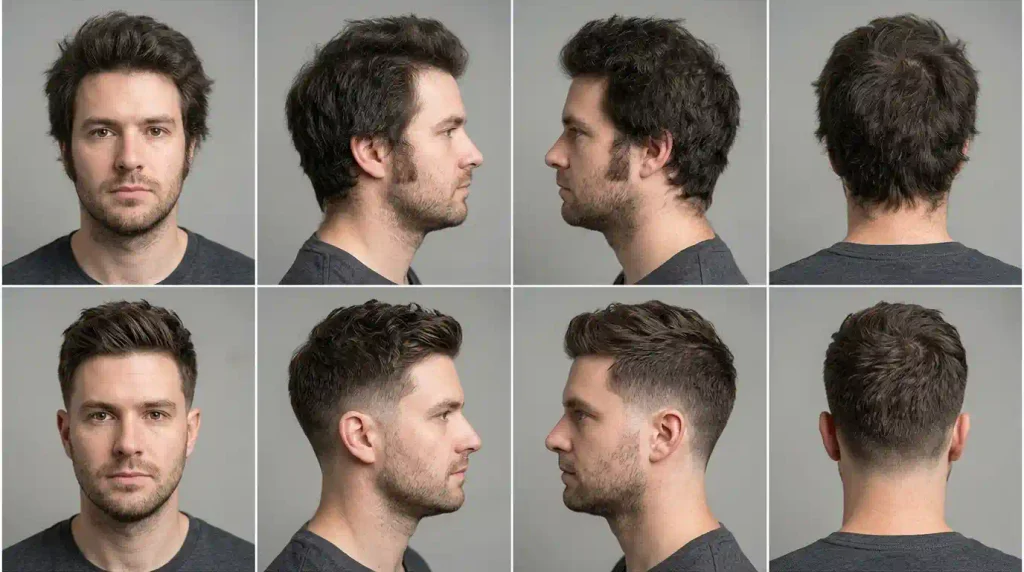
A before-and-after haircut gallery is useful because the front view alone rarely shows how much a taper changes the shape.
For accurate comparisons, use the same model, lighting, camera position, and hair condition.
4.1 Front View: Hair Texture and Hairline Changes
The front view shows how layering changes the hair’s movement and separation.
A heavy, unlayered top may appear flat or blocky. After careful texturizing, individual sections can become more visible.
The hairline may also look cleaner when the taper and edge details are refined.
4.2 Side View: Low vs Mid vs High Textured Taper
The side profile reveals the taper height and how much side weight remains.
A low taper maintains a fuller silhouette, while mid and high tapers create more noticeable contrast.
This view is particularly helpful when selecting a haircut for your head shape.
4.3 Back View: Neckline and Crown Shape
The back view shows whether the crown transitions naturally into the neckline.
A well-blended taper should follow the head’s contour without leaving obvious unintended lines.
The neckline may be natural, rounded, or more sharply defined.
4.4 Before and After Adding Texture to Straight Hair
Straight hair may initially lie in a uniform direction.
Point cutting and controlled layering create variation in strand length and movement.
The finished haircut should maintain enough density to avoid appearing thin.
4.5 Before and After Removing Bulk From Thick Hair
Thick hair can become difficult to style when excessive weight accumulates through the crown.
Removing selected internal weight can improve movement and reduce unwanted bulk.
The goal is balance, not maximum thinning.
4.6 Freshly Styled vs Naturally Air-Dried Textured Taper
A haircut may appear significantly different after professional blow-drying.
A freshly styled version can have extra root lift, deliberate separation, and stronger hold.
The naturally air-dried version reveals how the haircut behaves without intensive styling.
Both views are useful when deciding whether a style fits your daily routine.
4.7 What Changes Most After Getting a Textured Taper?
Hair Volume and Texture Definition
The biggest difference is often how hair weight and movement are distributed.
Taper Placement and Side Profile
The taper changes the outline around the temples and lower sides.
Overall Haircut Shape and Balance
A successful haircut creates a coordinated relationship between the crown, top, sides, and neckline.
5. How to Choose the Right Textured Taper Haircut
A good textured taper should match your natural hair behavior rather than fight against it.
Hair type, density, head shape, and lifestyle all affect the most suitable variation.
5.1 Best Textured Taper Haircut for Your Hair Type
Straight Hair
Straight hair benefits from deliberate layering and strand separation.
A textured crop, quiff, or side part can create movement without requiring excessive length.
Wavy Hair
Wavy hair already contains natural texture.
A low or mid taper allows the existing wave pattern to remain prominent.
Curly Hair
Curly hair can create excellent volume and definition.
The barber should account for shrinkage and avoid removing excessive weight.
Coily and Afro-Textured Hair
Coily hair supports compact crops, sponge twists, and rounded high-volume tops.
A taper can define the perimeter without reducing the natural texture above.
Thick and Coarse Hair
Thick hair provides fullness but may become bulky.
Controlled internal layering can improve shape and movement.
Fine or Thin Hair
Fine hair needs sufficient density.
Light texturizing and a conservative taper are often preferable to aggressive thinning.
5.2 Best Textured Taper Haircut for Your Face Shape
Face-shape recommendations are visual guidelines rather than fixed rules.
Personal preference, natural hair direction, and facial features also matter.
Round Face
A textured quiff or hairstyle with controlled crown height may create a more elongated appearance.
Avoid excessive side volume if a slimmer visual silhouette is your goal.
Oval Face
Oval faces can accommodate many textured taper variations.
Choose according to hair type and preferred styling effort.
Square Face
A textured crop or slightly messy quiff can soften strong facial angles.
A low or mid taper provides a balanced frame.
Long or Oblong Face
A fringe or moderately full side profile may help balance a longer face.
Excessive height can further emphasize facial length.
Heart-Shaped Face
A side-swept textured top can complement a wider forehead and narrower lower face.
Diamond Face
Maintaining some volume around the upper sides may help balance prominent cheekbones.
5.3 Choosing a Textured Taper Based on Hair Density
How Density Affects Texture and Volume
Hair density describes how closely hair follicles are distributed.
A full head of dense hair may support significant debulking, while sparse hair usually requires more cautious cutting.
Preserving Fullness in Fine Hair
Avoid excessive texturizing shears and aggressive internal weight removal.
The haircut should retain enough hair to create a cohesive top.
Reducing Excess Weight in Thick Hair
Controlled layering can make thick hair easier to shape.
The barber should preserve the intended outer silhouette.
5.4 Best Textured Taper Haircuts for Short, Medium and Long Hair
Short hair works well with textured crops, buzz tapers, and crew cuts.
Medium hair offers more options, including quiffs, side parts, messy tops, and curly fringes.
Long hair supports textured flows, mullets, top knots, and layered brush-back styles.
The best choice depends on how much length you are comfortable maintaining.
5.5 Best Textured Taper Haircuts for Cowlicks and Double Crowns
Cowlicks affect the natural direction of hair growth.
A haircut that ignores them may look uneven or become difficult to style.
Understanding Single vs Double Crown Growth Patterns
A single crown commonly contains one visible swirl.
A double crown has two distinct growth centers, which can cause hair to separate or rise in different directions.
How to Style a Textured Top With a Front Cowlick
Work with the natural growth direction when possible.
A slightly longer front section may provide enough weight to control the cowlick.
How Much Length to Keep Around a Double Crown
Avoid cutting the crown excessively short without considering the growth pattern.
Sufficient length helps prevent unwanted sections from standing upright.
Why Some Textured Haircuts Stick Up at the Back
Short hair around a crown swirl may naturally project outward.
Uneven layering can make the effect more noticeable.
Choosing a Taper That Works With Your Natural Hair Growth Direction
A barber should inspect how the hair grows near the parietal ridge, crown, and neckline.
The fade placement should support the natural silhouette.
5.6 Choosing a Textured Taper Based on Head Shape
Textured Taper for a Flat Back of the Head
A hairstyle with controlled crown volume can create the appearance of a more rounded back profile.
Avoid removing too much weight from the upper rear section.
Textured Taper for a Prominent Crown
A prominent crown may need softer layering to prevent excessive height.
The barber can preserve a balanced transition into the sides.
Balancing a Narrow or Wide Head Shape
Fuller sides may visually broaden a narrow head shape.
A closer taper may create a narrower appearance on a wider head.
How Crown Volume Changes the Side Profile
Crown volume influences the entire haircut silhouette.
A well-shaped crown should connect naturally to the front and neckline.
5.7 Best Textured Taper Haircuts for Men Who Wear Glasses
Low vs High Taper With Eyeglass Frames
A low taper creates subtle definition around the temples.
A high taper produces a cleaner, more exposed area near the upper sides.
Neither is universally better for glasses.
Styling the Temples Around Glasses
Keep the hair near the frame arms manageable.
Excessive side bulk may become uncomfortable under certain glasses.
Textured Fringe vs Brush-Back With Glasses
A fringe creates forehead coverage, while a brush-back keeps the front open.
Choose based on comfort and visibility.
Choosing a Haircut That Does Not Interfere With Frames
Avoid unnecessary bulk directly around the frame arms.
Ask the barber to check the hairstyle while you are wearing your glasses.
5.8 Textured Taper Haircuts for Black Men and 4C Hair
A textured taper can complement natural curls, coils, twists, and locs.
The barber should consider shrinkage, scalp sensitivity, and preferred styling methods.
A short 4C crop may require relatively little daily shaping, while defined twists or longer curls can require a more detailed care routine.
5.9 Can Women Wear a Textured Taper Haircut?
Yes. A textured taper is not limited to men’s hairstyles.
The same principles of layered tops and graduated perimeter cutting can be adapted for different lengths and preferences.
Short Textured Tapers for Women
Short layered crops can combine a textured crown with clean temples.
Curly and Coily Tapered Hairstyles for Black Women
Natural curls and coils can create a full upper silhouette with tapered sides and neckline.
5.10 Textured Taper Haircuts for Professional Settings
A low taper with a controlled crop, side part, or soft brush-back can suit many workplaces.
Avoid excessive product shine if you prefer a natural appearance.
5.11 Textured Tapers for Men With Thinning Hair
A short textured crop may help create the appearance of movement when some density remains.
However, aggressive thinning can expose sparse areas.
A haircut cannot reverse hair loss, so realistic length and coverage are important.
5.12 Textured Taper With Beard: Choosing the Right Blend
A beard blend connects the sideburn taper to the facial hair.
The barber can adjust the gradient based on beard thickness and the desired jawline definition.
5.13 Choosing a Haircut Based on Your Lifestyle
Daily Styling Time
Short crops usually require less styling than large quiffs or long layered tops.
Barber Visit Frequency
Sharper fades may require more frequent maintenance.
Workplace and Casual Styling
A textured top can often be styled neatly during the workweek and more loosely on weekends.
Low-Maintenance vs High-Maintenance Preferences
Choose a hairstyle that looks acceptable in its natural state if you prefer minimal daily effort.
5.14 Textured Taper Hairstyle Selection Chart
Best Styles by Hair Type and Length
| Hair type | Short style | Medium or long style |
| Straight | Textured crop | Quiff or brush-back |
| Wavy | Choppy taper | Textured flow |
| Curly | Curly crop | Defined curl top |
| Coily | Short coil taper | Twists or Afro puff |
| Fine | Soft crop | Light side part |
| Thick | Debulked crop | Layered textured top |
Best Styles by Face and Head Shape
The ideal combination depends on your preferred visual balance rather than strict facial rules.
Best Styles by Texture, Volume and Maintenance
A short low taper crop is a practical low-maintenance choice.
A voluminous quiff or long flow generally requires more styling and reshaping.
6. Textured Taper Haircut Length, Shape and Hair Growth
Hair length changes how visible the texture becomes and how much styling flexibility the haircut offers.
6.1 How Long Should Your Hair Be for a Textured Taper?
A textured taper can work with relatively short hair, but more length provides greater opportunities for movement.
Short crops may need roughly 1–2 inches on top, while quiffs and medium-length styles commonly require more.
These are approximate starting points, not fixed requirements.
6.2 Short vs Medium vs Long Textured Tops
Short tops create compact texture and generally require less styling.
Medium tops support quiffs, side parts, and messy layers.
Long tops allow flowing movement, brush-back styling, and tied hairstyles.
6.3 How Much Hair Should Be Left on the Sides?
Enough hair should remain above the taper to create a balanced connection with the top.
The exact length depends on taper height, head shape, and the intended hairstyle.
6.4 Understanding Hair Weight, Volume and Natural Movement
Hair weight determines how sections fall.
Too much weight may create a flat appearance, while excessive thinning can cause separation and frizz.
Controlled layering balances volume and movement.
6.5 Natural Hair Texture vs Texture Created by Cutting
Naturally wavy, curly, and coily hair already contains visible movement.
Straight hair may need point cutting and styling to create similar visual separation.
A good barber works with the existing texture instead of trying to make every hair type behave identically.
6.6 Wet vs Dry Textured Taper Haircut: Why the Final Length Changes
How Wet Hair Changes the Appearance of Texture
Wet hair may appear longer and flatter because the strands are stretched or weighed down.
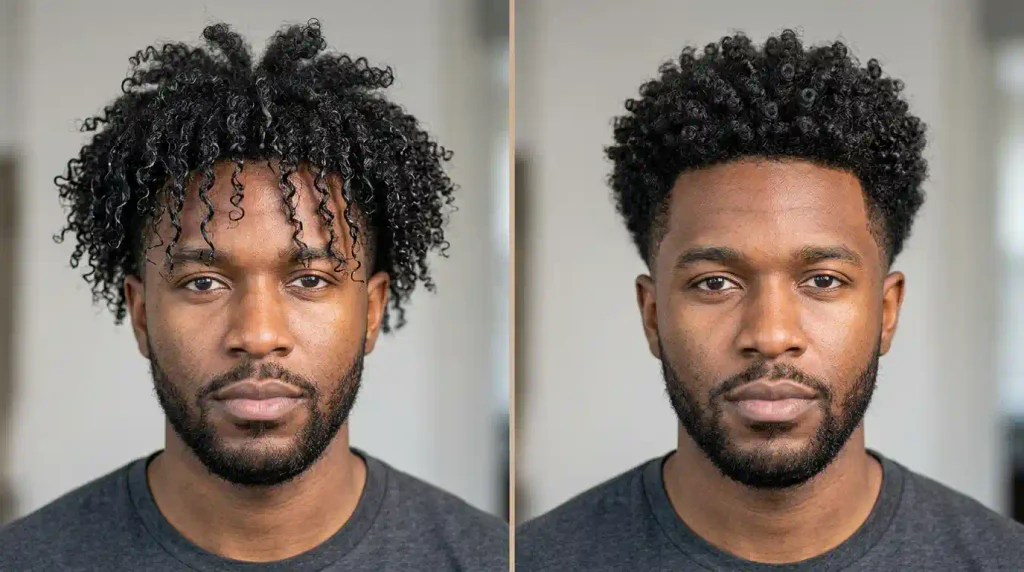
Curl Shrinkage in Wavy, Curly and Coily Hair
As hair dries, waves and curls return toward their natural shape.
This can make the finished top appear shorter.
Why the Crown and Fringe May Look Shorter When Dry
Curl formation and natural growth direction influence the final resting position.
When a Barber Should Check the Haircut Dry
Dry assessment is especially useful for curly hair, prominent cowlicks, and styles requiring precise front length.
Wet vs Dry Hair Length Comparison Chart
| Hair condition | Typical appearance | Main cutting consideration |
| Wet straight hair | Flatter, sometimes longer-looking | Check natural direction after drying |
| Dry straight hair | True resting shape | Evaluate separation |
| Wet curly hair | Stretched curls | Avoid cutting too short |
| Dry curly hair | Natural shrinkage | Check final silhouette |
| Dry coily hair | Compact natural shape | Account for significant shrinkage |
6.7 How Long Does It Take to Grow a Textured Top?
Scalp hair commonly grows around half an inch per month on average, although individual growth rates vary.
Moving from a short buzz cut to a medium-length textured top may take several months.
6.8 How to Maintain Balance as the Textured Top Grows
Keep the sides and neckline tidy while allowing the top to gain length.
Ask the barber to adjust the layers gradually rather than repeatedly shortening the entire hairstyle.
6.9 What to Consider Before Growing Out the Top
Longer hair generally requires more care.
Consider natural growth patterns, styling time, and whether your hair tends to become heavy or flat at greater lengths.
6.10 How to Transition From Other Haircuts to a Textured Taper
Growing a Textured Taper From a Buzz Cut
Allow the top to gain enough length for visible layering.
Maintain the perimeter conservatively during the transition.
Transitioning From a Skin Fade to a Low Taper
Let the upper side hair regrow before reshaping the fade boundary.
Repeatedly cutting the same high fade can delay the transition.
Converting a Crew Cut Into a Textured Crop Taper
Grow the top slightly, then introduce point-cut texture while maintaining a low taper.
Growing a Short Fringe Into a Longer Textured Top
Allow the front and crown to gain length together.
Avoid trimming the fringe at every appointment unless needed for comfort.
Moving From a Slick Back to a Messy Textured Taper
The barber may introduce internal layers to create more natural movement.
Styling products can gradually shift from smooth pomades to lighter matte finishes.
Managing Uneven Lengths During the Transition
Side-sweeping and controlled blow-drying can help disguise temporary differences.
6.11 How to Grow Out a Textured Taper Without Losing Shape
Keep the neckline and temples clean while avoiding excessive cutting of the longer sections.
Schedule occasional reshaping rather than automatically returning to the original haircut length.
7. How Barbers Create a Textured Taper Haircut
A professional textured taper depends on technical cutting, controlled weight distribution, and accurate blending.
7.1 Understanding the Anatomy of a Textured Taper
The Textured Top and Crown
The top provides the main hairstyle shape and movement.
The Transition Between Top and Sides
The transition determines whether the haircut appears smoothly connected or deliberately disconnected.
The Tapered Temples and Neckline
These areas create the clean perimeter and define the taper height.
7.2 Step-by-Step Textured Taper Haircut Process
Step 1: Hair Consultation and Hair-Type Assessment
The barber examines hair density, natural texture, crown growth, and head shape.
Reference photographs help clarify the desired result.
Step 2: Selecting the Taper Height and Hair Length
The barber agrees on low, mid, or high taper placement and the amount of length to retain on top.
Step 3: Establishing the Initial Clipper Guidelines
The first cutting guidelines help establish the fade’s position and length progression.
Step 4: Creating the Fade Gradient
Different guard settings and clipper adjustments gradually blend the short and longer sections.
Step 5: Cutting and Layering the Textured Top
Scissors are used to establish the main length and introduce movement.
Step 6: Blending the Upper Sides Into the Taper
The barber connects the longer upper hair with the shorter perimeter.
Step 7: Refining the Hairline, Sideburns and Neckline
Detail work improves the final outline without unnecessarily altering the natural hairline.
Step 8: Drying, Styling and Checking the Final Shape
The hair is dried and assessed for symmetry, movement, and balance.
7.3 Haircut Techniques Used to Create Texture
Point Cutting for Choppy Texture
Point cutting uses the scissor tips to soften the ends and create separation.
Slide Cutting for Natural Movement
Slide cutting removes selected weight along sections of hair.
It requires careful control to avoid uneven density.
Razor Cutting for Soft, Textured Ends
Razor cutting creates feathered ends on suitable hair.
It may be less appropriate for fragile or highly frizz-prone strands.
Scissor-Over-Comb Technique
Scissor-over-comb cutting helps refine transitions around the sides.
Texturizing Shears and Controlled Thinning
Texturizing shears remove selected weight without shortening every strand equally.
Overuse can make hair appear sparse or uneven.
Internal Weight Removal and Layering
Internal layering reduces bulk within thick hair while preserving the outer shape.
Creating Texture Without Removing Too Much Density
The barber should prioritize movement rather than maximum thinning.
7.4 Textured Taper Haircut Clipper Guard Numbers
Understanding #0, #0.5, #1, #2, #3 and #4 Guards
Clipper guards control approximate cutting length.
Common standard measurements include about 1/8 inch for #1, 1/4 inch for #2, 3/8 inch for #3, and 1/2 inch for #4.
Measurements for #0 and #0.5 vary more by clipper and attachment system.
What Is a Textured 1-2 Taper Haircut?
A 1-2 taper commonly refers to using #1 and #2 guard lengths within the fade.
It does not define one universal haircut shape.
Choosing Between Skin-Close and Guarded Finishes
Skin-close finishes create stronger contrast.
Guarded tapers preserve visible short hair and produce a softer appearance.
Selecting Guard Lengths for Different Taper Heights
The barber should adjust guard lengths according to the starting hair length, fade placement, and desired finish.
7.5 Essential Barbering Tools for a Textured Taper
Hair Clippers and Detail Trimmers
Clippers establish the main taper, while detail trimmers refine edges.
Cutting Scissors and Texturizing Shears
Scissors shape the top and create controlled layers.
Straight Razor and Foil Shaver
These tools can create very close finishes, but they may be unsuitable for irritated or sensitive skin.
Combs, Brushes and Sectioning Clips
These tools help maintain accurate cutting sections and consistent hair direction.
Blow Dryer and Diffuser
A blow dryer helps reveal the finished shape.
A diffuser can preserve natural curls during drying.
7.6 Cutting a Textured Taper on Straight vs Curly Hair
Straight hair may reveal blunt cutting lines more clearly, making careful point cutting important.
Curly hair requires attention to curl direction, shrinkage, and dry length.
7.7 Creating Texture Without Styling Products
A well-cut textured top should have some natural separation even without styling products.
Cutting techniques provide the foundation, while products enhance the finish.
7.8 Common Technical Mistakes During the Haircut
Common errors include over-thinning, cutting the taper too high, removing excessive side weight, and ignoring cowlicks.
The barber should check the hairstyle dry before completing the haircut.

8. How to Ask Your Barber for a Textured Taper Haircut
Clear instructions help prevent misunderstandings about top length, taper height, and texture.
8.1 What Exactly Should You Tell Your Barber?
Explain the top hairstyle first, followed by the taper height and desired finish.
Mention whether you want a crop, quiff, side part, messy top, or naturally curly style.
8.2 Standard Textured Taper Barber Request Script
You can say:
“I want a low taper around the temples and neckline, with enough length on top for visible texture. Please use light layering and point cutting to create movement, preserve enough density so the top does not look thin, and keep the fade low rather than taking it too high.”
8.3 How to Request a Low, Mid or High Textured Taper
Show the barber where you want the taper to begin.
A reference photograph is more useful than simply naming the fade height.
8.4 How to Describe Top Length, Texture and Hair Direction
Explain whether the top should fall forward, rise into a quiff, sweep sideways, or follow natural curls.
Use a dry-length reference if the front must finish at a particular position.
8.5 How to Request Specific Textured Taper Styles
Textured Crop and Fringe
Ask for a compact layered top with visible separation.
Textured Quiff and Blowout
Request enough front length to create root lift and upward movement.
Textured Side Part and Comb Over
Ask for a clearly established styling direction with light texture.
Curly, Wavy and Coily Textured Tops
Ask the barber to preserve the natural curl pattern and account for shrinkage.
8.6 How to Explain Your Preferred Hairline and Neckline
Specify whether you want a natural outline, soft taper, or sharper line-up.
Avoid unnecessarily pushing the natural hairline backward.
8.7 How to Use Haircut Reference Photos Effectively
Front View
Shows the top shape, fringe, and hairline.
Side View
Reveals taper height, side weight, and crown volume.
Back View
Shows neckline shape and blending.
8.8 Questions to Ask Before Your Barber Starts Cutting
Ask whether your current length supports the style, whether internal weight removal is necessary, and how the haircut will look without products.
8.9 Common Misunderstandings Between Clients and Barbers
Terms such as textured, messy, and low taper may be interpreted differently.
Visual references and specific instructions reduce confusion.
8.10 Textured Taper Haircut Consultation Checklist
Confirm the top length, taper height, fringe direction, neckline finish, and styling requirements before cutting.
8.11 How to Check Your Textured Taper Before Leaving the Barbershop
Check the Top Length and Texture When Dry
Make sure the hair sits at the agreed length after drying.
Inspect the Left and Right Taper for Symmetry
Compare both temple areas and the fade progression.
Check the Back, Crown and Neckline
Use a mirror to inspect the rear silhouette.
Confirm That the Top Blends Into the Sides
Look for unwanted shelves, harsh lines, or disconnected sections.
Check the Haircut Without Excessive Styling Product
A good haircut should retain a reasonable natural shape.
Ask Your Barber to Demonstrate the Styling Routine
Watch how the barber directs the roots and applies products so you can repeat the process at home.
9. How to Style a Textured Taper Haircut at Home
Styling should enhance the natural haircut rather than force the hair into an unsuitable shape.
9.1 Step-by-Step Daily Textured Taper Styling Routine
Step 1: Start With Clean, Slightly Damp Hair
Slightly damp hair is easier to redirect than flattened, completely dry hair.
Step 2: Apply a Lightweight Pre-Styling Product
Use a suitable mousse, spray, or light cream depending on your hair type.
Step 3: Blow-Dry for Direction and Root Volume
Direct airflow toward the desired style while lifting the roots if additional volume is needed.
Step 4: Create Separation and Texture
Use your fingers to separate small sections.
Step 5: Set the Hairstyle With a Natural Finish
Finish with a small amount of matte or flexible-hold product.
9.2 How to Style a Textured Taper Based on Hair Type
Straight Hair Styling Routine
Apply a light pre-styler to damp hair, blow-dry for direction, and finish with a small amount of matte clay.
Wavy Hair Styling Routine
Scrunch the natural waves gently and allow them to air-dry or use a diffuser.
Curly Hair Styling Routine
Apply curl cream or lightweight gel while damp, then allow the curls to form naturally.
Coily and Afro-Textured Hair Styling Routine
Use appropriate moisture and curl-definition products while avoiding unnecessary manipulation.
Fine Hair Styling Routine
Prioritize lightweight products and root lift.
Avoid heavy waxes and excessive thinning.
Thick Hair Styling Routine
Control bulk with suitable cutting and moderate styling products.
9.3 How to Create a Messy Textured Taper
Arrange small sections in different directions using your fingers.
Keep enough structure so the haircut looks intentional.
9.4 How to Style a Textured Quiff
Lift the front hair during blow-drying.
Direct the roots upward and slightly backward, then separate the ends with a lightweight styling product.
9.5 How to Style a Textured Crop
Direct the hair forward while preserving visible strand separation.
Use minimal product to avoid flattening the top.
9.6 How to Style a Side-Swept Textured Top
Establish the natural parting direction and move the upper hair diagonally.
A light paste can help maintain control.
9.7 How to Create a Natural, Product-Free Finish
Style the hair while damp and allow it to follow its natural growth direction.
A well-cut hairstyle should retain some movement without additional product.
9.8 How to Add Volume Without Making Hair Stiff
Use gentle blow-drying and lightweight mousse or texture powder.
Avoid excessive strong-hold products.
9.9 How to Prevent the Textured Top From Going Flat
Flatness may result from heavy products, insufficient layering, or natural growth direction.
Try lightweight products and gentle root lift.
9.10 How to Maintain a Textured Taper in Different Weather and Activities
Styling a Textured Taper in Hot and Humid Weather
Humidity may increase frizz or change curl definition.
Use lightweight products and avoid excessive buildup.
Preventing Flat Hair After Wearing a Helmet or Cap
Headwear can compress the roots.
Lightly dampen and rearrange the hair after removing it.
How to Restyle a Textured Top After Working Out
Remove excess sweat, allow the hair to dry, and restyle with your fingers or a small amount of product.
Managing Wind and Frizz Without Heavy Products
A flexible-hold styling product can maintain the shape without making the hair excessively rigid.
Quick Five-Minute Haircut Refresh Routine
Lightly dampen the top, redirect the roots, create strand separation, and finish with minimal product.
10. Best Styling Products for a Textured Taper Haircut
Products should support the haircut’s natural shape.
Choose them according to hair density, desired finish, and styling time.
10.1 Matte Hair Clay
Matte clay creates separation and a relatively dry finish.
It works well for choppy crops, quiffs, and messy styles.
10.2 Texture Powder
Texture powder can add root lift and make hair appear fuller.
Use it sparingly to avoid residue.
10.3 Sea Salt Spray
Sea salt spray can enhance wave definition and create a rougher texture.
Some hair types may feel dry with frequent use.
10.4 Lightweight Styling Paste
Styling paste provides flexible control and visible separation.
It is useful for medium-length textured hair.
10.5 Hair Wax vs Pomade
Wax often creates separation and hold.
Pomade may produce a smoother or shinier appearance depending on the formula.
10.6 Curl Cream and Curl-Defining Products
Curl creams help maintain natural curl patterns and manage frizz.
Choose a formula suitable for your hair’s moisture needs.
10.7 Volumizing Mousse
Mousse provides lightweight support and root volume.
It can be useful before blow-drying.
10.8 Flexible-Hold Hairspray
A flexible hairspray helps retain the finished shape without excessive stiffness.
10.9 Pre-Styling and Heat-Protectant Products
Pre-styling products help prepare the hair for shaping.
Heat protectants may reduce heat-related damage during styling.
10.10 Understanding Styling Product Ingredients and Finishes
Matte vs Glossy Finish
Matte products produce a less reflective appearance.
Glossy products create more visible shine.
Lightweight vs Heavy Formulas
Lightweight products are generally preferable for fine hair.
Heavier formulas may provide more control for some thick or coarse hair types.
Flexible vs Strong Hold
Flexible hold allows movement.
Strong hold maintains a more rigid shape.
Product Buildup and Hair Texture
Excessive product can make hair greasy, stiff, or flat.
Regular cleansing helps remove residue.
10.11 Best Products for Different Hair Types
| Hair type | Useful product | Main benefit |
| Straight | Matte clay | Separation |
| Fine | Texture powder | Root lift |
| Wavy | Sea salt spray | Wave definition |
| Curly | Curl cream | Curl control |
| Coily | Suitable curl or twisting cream | Pattern definition |
| Thick | Lightweight styling paste | Shape control |
10.12 Textured Taper Styling Product Comparison Chart
| Product | Finish | Typical use |
| Matte clay | Matte | Choppy crops |
| Texture powder | Dry | Root volume |
| Sea salt spray | Natural | Wavy texture |
| Styling paste | Flexible | General texture |
| Pomade | Often smoother | Side parts |
| Curl cream | Natural | Curly tops |
| Mousse | Lightweight | Blowouts |
| Hairspray | Variable | Finishing hold |
10.13 Common Styling Product Mistakes to Avoid
Avoid using excessive product, choosing formulas that are too heavy, applying products incorrectly, and relying on high heat every day.
Start with a small amount and add more only if needed.
11. Textured Taper Haircut vs Similar Hairstyles
The term textured taper describes a combination of texture and perimeter cutting.
Other hairstyle names often refer primarily to the shape or direction of the top.
11.1 Textured Taper vs Textured Crop
A textured crop describes the upper haircut shape.
A textured taper describes how that top works with tapered sides.
The two can be combined.
11.2 Textured Taper vs French Crop
A French crop usually has a compact forward fringe.
A textured taper can incorporate many top styles, including a French crop.
11.3 Textured Taper vs Textured Fringe
A textured fringe emphasizes the hair falling toward the forehead.
A textured taper may feature a fringe, quiff, side part, or another top shape.
11.4 Textured Taper vs Layered Haircut
Layering creates movement and changes hair weight.
A textured taper combines those cutting effects with a shortened perimeter.
11.5 Textured Taper vs Classic Crew Cut
A crew cut is typically short and compact.
A textured taper may preserve more length and styling flexibility.
11.6 Textured Taper vs Buzz Cut
A buzz cut has very short hair on top.
A textured taper often retains enough length for more visible separation.
11.7 Textured Taper vs Textured Quiff
A quiff directs the front hair upward.
A textured taper may include a quiff but is not limited to that styling direction.
11.8 Textured Taper vs Pompadour
A pompadour emphasizes substantial front volume.
A textured taper can have a much shorter or flatter top.
11.9 Textured Taper vs Slick Back
A slick back directs the hair backward with a relatively controlled finish.
A textured taper can be styled backward while retaining more visible strand separation.
11.10 Textured Taper vs Textured Flow
A textured flow generally uses longer hair and more natural movement.
A textured taper may retain that length while keeping the perimeter short.
11.11 Textured Taper vs Textured Mullet
A mullet retains more length at the back.
A textured taper does not require that front-to-back length difference.
11.12 Textured Taper Haircut Comparison Chart
Differences in Length, Texture and Shape
| Haircut | Main defining feature |
| Textured taper | Layered or naturally textured top with tapered perimeter |
| Textured crop | Short layered top |
| French crop | Compact forward fringe |
| Crew cut | Short, gradually shaped top |
| Quiff | Elevated front hair |
| Pompadour | High-volume front |
| Slick back | Backward-directed hair |
| Flow | Longer natural movement |
| Mullet | Extra length toward the back |
Differences in Styling and Maintenance
Short crops often need less styling.
Long quiffs, pompadours, and flowing hairstyles generally require more attention.
Which Haircut Is Best for Your Hair Type?
Choose a haircut based on your natural density, growth direction, and available styling time rather than its name alone.
12. Common Textured Taper Haircut Problems, Mistakes and Solutions
A textured taper can look different from the reference photograph when the hair type, cutting technique, or styling routine does not match.
12.1 Choosing the Taper Before Planning the Textured Top
The top hairstyle should determine the surrounding fade.
Choose the intended crop, quiff, fringe, or curl shape before selecting taper height.
12.2 Cutting the Taper Too High
A taper placed higher than requested may remove important side weight.
Regrowth is often the most practical correction.
12.3 Removing Too Much Weight From Fine Hair
Over-thinning can make fine hair appear sparse.
Preserve density and introduce texture carefully.
12.4 Leaving Thick Hair Too Heavy
Thick hair may become bulky without sufficient layering.
Ask the barber for controlled internal weight removal.
12.5 Cutting the Fringe Too Short
A short fringe may not fall in the intended direction.
The best correction is usually allowing it to regrow.
12.6 Choosing a Texture That Does Not Match Your Hair Type
A style designed for thick, wavy hair may behave differently on fine, straight hair.
Adapt the haircut to your natural texture.
12.7 Using Too Much Styling Product
Excessive product can make hair greasy or stiff.
Use smaller quantities and avoid heavy buildup.
12.8 Why Does a Textured Taper Look Flat?
Flatness may result from insufficient layering, heavy products, or naturally low volume.
Try lighter products and gentle root lift.
12.9 How to Fix an Uneven Taper Fade
A barber may be able to refine the fade gradient.
Avoid aggressive DIY corrections.
12.10 Managing Frizz and Unwanted Puffiness
Use appropriate conditioning and avoid excessive heat.
A small amount of lightweight styling cream may improve control.
12.11 How to Fix Poor Hair Blending
Visible shelves or harsh transition lines may require professional correction.
The barber should assess the overall shape before removing more hair.
12.12 Why Does My Textured Taper Look Different After the First Wash?
Barbershop Styling vs Natural Hair Texture
The barber may have used blow-drying and products to create additional volume.
How Product Removal Changes Volume and Separation
Washing removes styling support, allowing the hair to return toward its natural shape.
Why the Top Loses Its Shape After Washing
The natural growth pattern may not support the styled direction without additional work.
How to Recreate the Barber’s Finish at Home
Repeat the demonstrated drying direction and use suitable lightweight products.
When the Problem Is the Cut Instead of the Product
If the hair cannot maintain a reasonable shape without extensive styling, the haircut may need adjustment.
12.13 When Should You Return to the Barber for Corrections?
Return for clear technical problems such as uneven blending, significant asymmetry, or unwanted bulk.
12.14 When Is Growing Out a Bad Textured Taper the Better Option?
Growing out is often preferable when excessive hair has already been removed.
Further cutting may make the problem worse.
13. Textured Taper Haircut Maintenance and Haircare
The haircut’s appearance changes gradually as hair grows.
A consistent maintenance routine keeps the style balanced.
13.1 How Often Should You Trim a Textured Taper?
Many men maintain their haircut approximately every three to six weeks.
Shorter, sharper styles may require more frequent appointments.
13.2 How Often Should You Refresh the Fade?
A defined taper may need refreshing every two to four weeks.
Softer styles can often grow longer between visits.
13.3 Daily vs Weekly Haircare Routine
Daily care focuses on styling and cleanliness.
Weekly care includes appropriate washing, conditioning, and checking for product buildup.
13.4 How to Wash and Condition Textured Hair
Use shampoo based on your scalp’s needs and conditioner appropriate for your hair type.
Avoid leaving heavy residue near the roots.
13.5 Maintaining Volume and Separation Between Haircuts
Lightweight styling and careful drying can restore volume.
Avoid excessive product accumulation.
13.6 Keeping the Hairline, Sideburns and Neckline Clean
Follow the established perimeter rather than repeatedly moving the cutting boundary.
13.7 Maintaining Natural Curls and Waves
Use curl-friendly conditioning and gentle handling.
Avoid unnecessary brushing after the curls have dried.
13.8 How to Prevent Heavy Product Buildup
Use products sparingly and cleanse according to your hair and scalp needs.
A clarifying shampoo may be useful occasionally when suitable for your hair type.
13.9 Textured Taper Haircut After 1, 2 and 4 Weeks
Freshly Cut Textured Taper Appearance
The fade gradient is sharp, and the top retains its intended shape.
One-Week Regrowth and Styling Changes
The shortest areas begin to soften slightly.
Two-Week Fade and Hairline Changes
The taper becomes less defined as the sideburns and neckline grow.
Four-Week Textured Top and Taper Appearance
The top may become heavier, and the taper may lose some contrast.
When to Schedule Your Next Barber Appointment
Book when the top becomes difficult to style or the perimeter no longer has the desired definition.
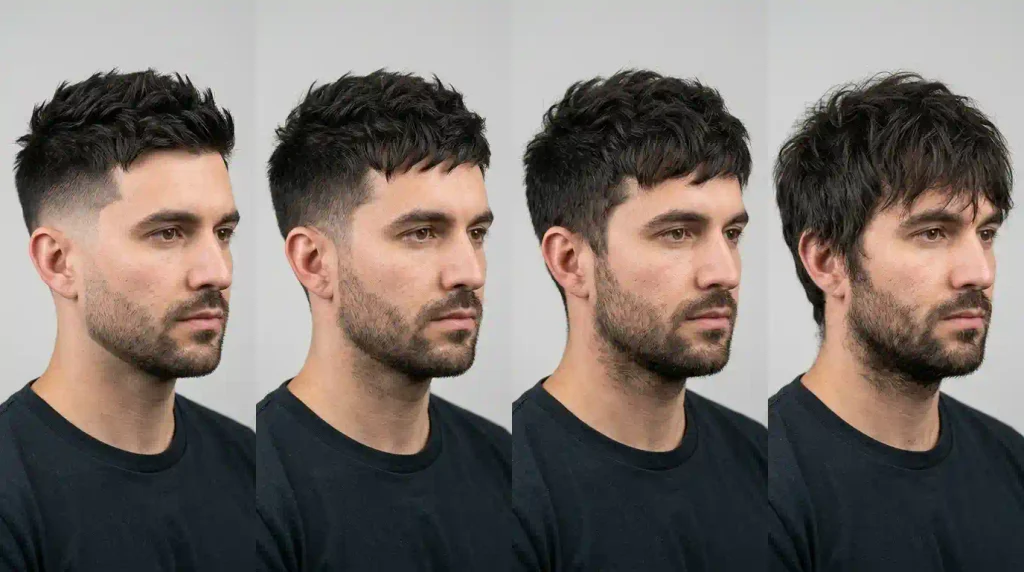
13.10 How to Keep a Textured Taper Looking Natural as It Grows
Maintain the shape through occasional trimming rather than repeatedly removing large amounts of length.
13.11 How to Prevent Your Textured Taper From Getting Higher at Every Haircut
Understanding the Original Taper Boundary
Identify where the original fade begins and ends.
Why Repeated Touch-Ups Can Change Taper Placement
Repeatedly cutting slightly above the previous boundary can gradually make the taper higher.
How to Keep the Same Taper Height
Ask the barber to preserve the original placement.
Using Previous Haircut Photos for Consistency
Reference photographs can help maintain the same proportions across appointments.
What to Do When a Taper Has Already Been Cut Too High
Allow regrowth before requesting a lower taper.
13.12 Textured Taper Haircuts for Sensitive Skin and Razor Bumps
Skin Taper vs Guarded Taper for Sensitive Skin
A guarded taper leaves more hair above the skin and may be more comfortable for people who experience irritation from close shaving.
Why Close Shaving Can Cause Razor Bumps
Very close shaving can contribute to irritation and ingrown hairs in susceptible individuals.
Preventing Irritation Around the Neckline
Avoid unnecessary repeated razor passes and consider using a guarded finish.
Managing Bumps After a Fresh Taper Fade
Avoid shaving over irritated skin and use gentle skincare.
When to Avoid Skin-Close Shaving
Avoid close shaving over broken, inflamed, or significantly irritated skin.
When to Consult a Dermatologist
Seek professional advice for persistent painful bumps, infection symptoms, or recurrent irritation.
13.13 Can Textured Taper Styling Products Cause Forehead Acne or Scalp Irritation?
Some haircare products can contribute to breakouts around the hairline when they repeatedly contact the skin.
How Pomades, Waxes and Oils Can Contribute to Clogged Pores
Certain oily products can transfer onto the forehead and contribute to clogged pores.
Choosing Non-Comedogenic Styling Products
Look for products labeled non-comedogenic, oil-free, or won’t clog pores if you are prone to breakouts.
Preventing Product Buildup Around the Hairline
Apply products mainly to the hair rather than directly onto the forehead.
Cleaning Brushes, Hats and Pillowcases
Regular cleaning can help reduce the transfer of product residue.
When to Change Your Styling Products
Consider changing products if breakouts repeatedly appear after using a particular formula.
The American Academy of Dermatology explains how haircare products can contribute to forehead and hairline acne.
13.14 Textured Taper Maintenance Schedule and Checklist
| Frequency | Maintenance task |
| Daily | Light styling and scalp cleanliness |
| As needed | Shampoo and condition appropriately |
| Weekly | Check for buildup and dryness |
| Every 2–4 weeks | Refresh a sharper taper if desired |
| Every 3–6 weeks | Reshape the textured top as needed |
| Every appointment | Confirm taper height and haircut balance |
14. Textured Taper Haircut Cost and Professional Barber Services
Prices vary across the United States based on location, barber experience, appointment length, and service complexity.
14.1 How Much Does a Textured Taper Haircut Cost in the USA?
A textured taper haircut may cost approximately 30–70 at many US barbershops, with budget services sometimes costing less and premium appointments costing considerably more.
These are illustrative budgeting ranges, not verified nationwide averages.
14.2 What Factors Affect the Haircut Price?
Factors include the barbershop location, barber experience, cutting time, additional beard services, and the complexity of the fade and layering.
14.3 Basic Taper vs Detailed Textured Haircut Pricing
| Service | Illustrative US price range |
| Basic men’s haircut | 25–50 |
| Standard taper or fade | 30–65 |
| Detailed textured taper | 40–80 |
| Premium haircut and styling | 60–100+ |
| Haircut with beard service | 50–90+ |
14.4 Monthly and Annual Textured Taper Maintenance Budget
At $40 per haircut, appointments every four weeks would total approximately $520 annually.
At six-week intervals, the annual haircut budget would be approximately $347, excluding tips and styling products.
14.5 Professional Barber vs DIY Textured Taper
DIY trimming can save money but requires experience with clipper blending and texturizing techniques.
Professional cutting is generally preferable for complex fades, double crowns, and major reshaping.
14.6 How to Choose a Barber Experienced With Textured Haircuts
Review examples of the barber’s work featuring similar hair types.
Look for balanced crown shaping, consistent taper gradients, and clean results from multiple angles.
15. Frequently Asked Questions About Textured Taper Haircuts
15.1 What Is the Difference Between a Taper and a Fade?
A taper usually shortens selected perimeter areas, while a full fade generally blends a larger section of the sides and back.
15.2 What Is the Best Textured Taper Haircut for Thick Hair?
A layered textured crop or quiff with controlled internal weight removal is a good option.
15.3 Can You Get a Textured Taper With Thin or Fine Hair?
Yes, but preserve density and avoid excessive thinning.
15.4 Does a Textured Taper Work With Naturally Curly Hair?
Yes, a taper can define the perimeter while preserving natural curls.
15.5 Can You Get a Textured Taper With Straight Hair?
Yes, point cutting and layering can create visible movement in straight hair.
15.6 What Is the Minimum Hair Length for a Textured Taper?
Short textured styles can work with roughly one inch on top, depending on the desired finish.
15.7 What Clipper Guards Are Best for a Textured Taper?
Barbers commonly use multiple guards such as #0.5, #1, and #2, depending on the fade.
15.8 How Often Does a Textured Taper Need Maintenance?
Many men refresh the haircut every two to six weeks, depending on the style.
15.9 Is a Textured Taper Haircut Professional Enough for Work?
Yes, a low taper with a controlled textured top can look polished and professional.
15.10 Can You Get a Textured Taper With a Beard?
Yes, the taper can blend naturally into the beard through the sideburns.
15.11 Can You Style a Textured Taper Without Hair Products?
Yes, especially when the haircut follows your natural hair texture and growth direction.
15.12 Can You Change a Textured Taper Into Another Haircut?
Yes, the top can gradually be reshaped into a crop, quiff, slick back, flow, or other hairstyle.
16. Final Thoughts: Choosing Your Ideal Textured Taper Haircut
The textured taper haircut offers a versatile combination of natural movement, clean barbered edges, and modern styling. Whether you prefer a short crop, messy quiff, curly top, classic side part, or longer textured flow, the best haircut is one that works with your hair type, head shape, and daily routine.
16.1 Best Textured Taper Haircuts for a Clean, Professional Appearance
Choose a low taper with a textured crop, Ivy League, or controlled side part.
16.2 Best Textured Taper Haircuts for a Messy, Modern Appearance
Consider a fluffy top, choppy crop, textured quiff, or relaxed wavy taper.
16.3 Best Low-Maintenance Textured Taper Styles
A short textured crop or soft guarded taper is a practical choice for easy daily styling.
16.4 Final Barber Consultation and Haircare Checklist
Before your appointment, select reference photographs, decide on taper height, discuss your natural hair growth patterns, and confirm the final top length. Save your favorite styles from this guide and use them when consulting your barber. With the right cutting technique and a manageable care routine, a textured taper can stay balanced, comfortable, and stylish throughout its grow-out.