Middle Part Taper Haircut: Curtain Styles & Tips
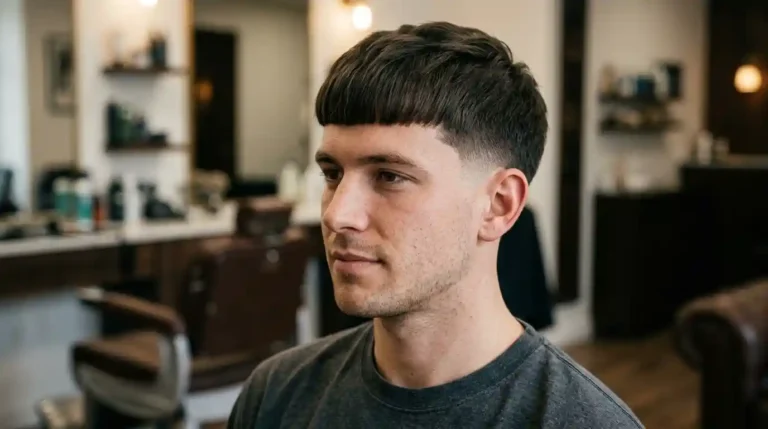
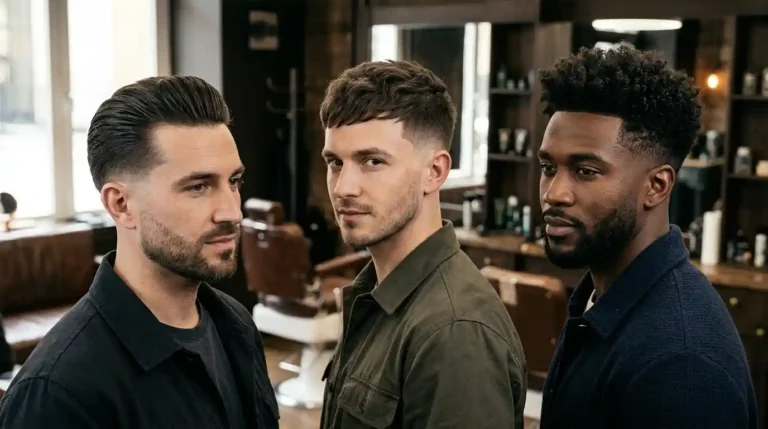
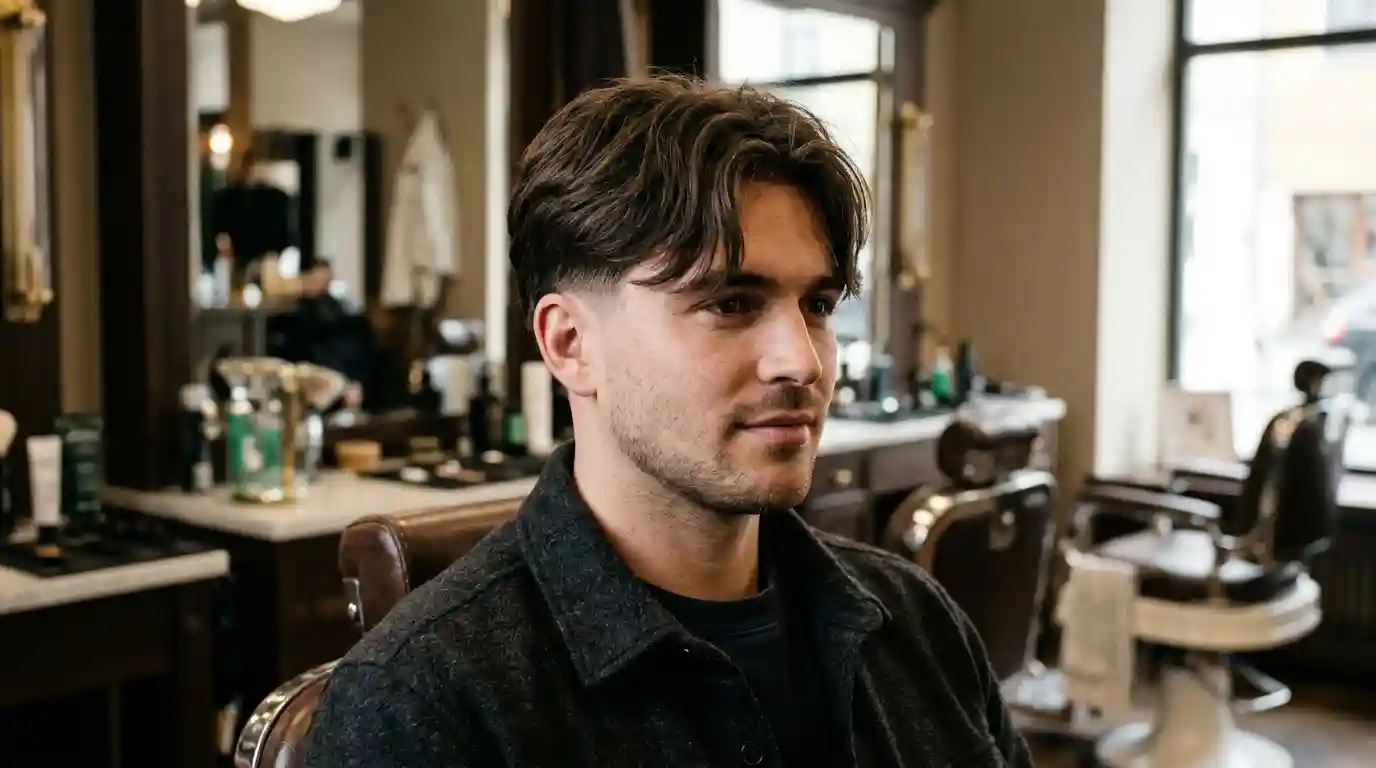
A middle part taper haircut combines a clean, gradually shortened taper around the temples and neckline with longer hair parted down the center. The result is a versatile hairstyle that balances the natural movement of curtain bangs with the neat appearance of a modern men’s haircut. Whether you prefer a low taper with soft, flowing curtains, a textured mid taper, a fluffy Korean-inspired hairstyle, or a sharper skin taper, the right combination can complement your hair texture, face shape, and personal style.
The best middle part taper haircuts maintain enough length on top to create visible separation while keeping the sides controlled without removing too much volume. Straight hair produces a sleek curtain shape, wavy hair creates effortless movement, and curly hair adds definition and texture. This guide explores 45 middle part taper styles, front and back views, haircut lengths, clipper guards, estimated U.S. barbershop prices, styling products, and maintenance techniques. You’ll also learn exactly what to tell your barber, how to find your natural center part, and how to avoid common haircut mistakes.
Table of Contents
- Middle Part Taper Haircut: Quick Overview
- Best Middle Part Taper Haircut Styles for Men
- Middle Part Taper Haircut: Front, Side, and Back Views
- Middle Part Taper Haircut Length and Clipper Guard Chart
- How to Choose the Right Middle Part Taper Haircut
- How to Find Your Natural Middle Part
- How Much Does a Middle Part Taper Haircut Cost in the USA?
- How to Ask Your Barber for a Middle Part Taper Haircut
- How to Check the Quality of Your Middle Part Taper
- How to Style a Middle Part Taper Haircut at Home
- Best Hair Products for a Middle Part Taper Haircut
- How to Keep a Middle Part Taper Looking Good in Different Weather
- How to Maintain a Middle Part Taper Haircut
- Middle Part Taper Haircut Growth Timeline
- At-Home Middle Part Taper Touch-Ups Between Barber Visits
- Common Middle Part Taper Haircut Mistakes and How to Fix Them
- Middle Part Taper vs. Similar Haircuts
- Frequently Asked Questions About Middle Part Taper Haircuts
- Final Thoughts: Choosing the Best Middle Part Taper Haircut
Middle Part Taper Haircut: Quick Overview
What Is a Middle Part Taper Haircut?
A middle part taper haircut features a center-parted top with gradually shorter hair around the sideburns, temples, and nape. Unlike a full fade, which may remove considerable length across the sides, a traditional taper concentrates the shortest transition near the hairline.
The longer upper section allows the hair to separate into two sections, creating curtain bangs or a natural middle part flow. This combination offers a balanced silhouette with soft face-framing layers and a controlled hair perimeter.
A typical middle part taper includes approximately 3–6 inches of top hair, depending on texture and the desired curtain effect. The taper itself can be low, mid, or high, with a soft natural finish or a sharper skin-close blend.
The terms taper haircut middle part, curtain taper haircut, and taper haircut curtains often describe this same overall hairstyle, although individual versions differ in fringe length, side weight, and fade intensity.
For more haircut inspiration, explore Taper Haircut Hub, which covers traditional and modern taper variations.
Why Is the Middle Part Taper Haircut So Popular?
The hairstyle combines the relaxed appeal of longer hair with the practical neatness of short, tapered edges. Its biggest advantage is flexibility: it can look casual and textured during the day or more polished with a little styling cream.
Middle part hairstyles also draw inspiration from 1990s curtain haircuts, contemporary Korean hairstyles, and modern barbering trends. These influences have helped create versions ranging from natural curtain flow to high-volume E-boy hairstyles.
Another advantage is the ability to customize the cut. A low taper preserves side weight for a subtle appearance, while a higher taper introduces more contrast and exposes more of the temples.
The style works especially well when the top retains enough length to move naturally instead of standing upright.
Pros and Cons of a Middle Part Taper
| Advantages | Limitations |
| Works with straight, wavy, curly, and some coily hair patterns | Requires enough top length for a visible part |
| Combines neat sides with longer hair | The center part may need daily styling |
| Offers many low, mid, and high taper variations | Strong cowlicks can make a precise center part difficult |
| Can suit casual and professional settings | Short tapers lose their crisp definition as hair grows |
| Allows matte, textured, or glossy finishes | Blow-drying and styling products may be necessary |
| Can grow into a longer curtain hairstyle | Excessive thinning or poor layering can spoil the flow |
A middle part taper is relatively easy to maintain when the haircut follows your natural growth pattern. However, someone with very short hair or a strong cowlick may need additional growing time or a slightly off-center part.
Middle Part Taper Haircuts at a Glance
Compare Styles by Taper Height, Hair Length, Texture, and Maintenance
| Haircut style | Taper placement | Suggested top length | Best hair texture | Styling effort |
| Classic middle part taper | Low to mid | 4–6 inches | Straight, wavy | Low–medium |
| Low taper middle part | Low | 4–6 inches | Most textures | Low |
| Mid taper middle part | Mid | 3–5 inches | Straight, wavy, curly | Medium |
| High taper middle part | High | 3–5 inches | Thick, straight, wavy | Medium |
| Curly middle part taper | Low to mid | 4–7 inches stretched | Curly | Medium |
| Textured middle part | Low to mid | 3–5 inches | Straight, wavy | Medium |
| Fluffy curtain taper | Low | 4–6 inches | Fine to medium | Medium–high |
| Long middle part flow | Low | 5–8 inches | Straight, wavy | Medium |
| Skin taper middle part | Variable | 3–6 inches | Most textures | High upkeep |
These lengths are starting points rather than strict barbering rules. Hair density, curl shrinkage, and the desired fringe position can change the ideal measurements.
Top Picks for Classic, Modern, Textured, and Professional Looks
For a timeless appearance, the classic low taper middle part is a strong choice because it preserves a soft curtain silhouette without creating excessive contrast.
A textured middle part taper works well for casual styling, while a Korean two-block version gives the hairstyle a contemporary, layered appearance.
Men wanting a neater office-friendly look can choose a subtle shadow taper with brushed curtains. Those who prefer a bolder silhouette may favor a high taper or skin-close transition.
Best Middle Part Taper Haircut Styles for Men
The following 45 variations show how taper height, hair length, fringe shape, and styling finish can change the appearance of a center-parted haircut.
Classic and Subtle Middle Part Taper Styles
Classic Middle Part Taper
The classic middle part taper keeps approximately 4–6 inches of hair on top, allowing the fringe to divide naturally toward either side of the forehead. A soft taper around the temples and neckline creates a neat outline while preserving enough side weight to maintain the curtain shape.
This style works particularly well with straight or slightly wavy hair. Ask your barber for gentle layering rather than aggressive thinning, which can make the fringe appear uneven.
Low Taper Middle Part
A low taper middle part concentrates the graduated blend near the bottom of the sideburns and neckline. Most of the hair above the ears remains relatively full, creating a smooth transition into the longer curtain sections.
It is ideal for anyone who wants subtle grooming rather than a dramatic fade. For a different, more structured fringe shape, compare the low taper haircut edgar cut with this softer curtain version.
Mid Taper Middle Part
The mid taper middle part starts the taper transition higher than a low taper, producing a cleaner side profile while keeping sufficient top length for natural movement.
It works especially well with dense straight hair and loose waves because the slightly shorter sides reduce unnecessary bulk. If you prefer a sharply defined, forward-facing fringe instead of curtains, the mid taper haircut edgar offers an alternative silhouette.
High Taper Middle Part
A high taper middle part introduces a more noticeable transition around the upper temples while retaining a defined center-parted top.
The stronger contrast emphasizes the hair’s volume and shape, making it suitable for thick hair or individuals seeking a modern appearance. Make sure the barber does not remove so much side weight that the curtains appear disconnected from the rest of the haircut.
Subtle Shadow Taper Middle Part
A shadow taper gradually shortens the hair while leaving visible stubble rather than exposing bare skin. The blend looks softer than a skin taper and often grows out with less dramatic contrast.
This understated version suits professional settings and anyone who prefers a natural finish around the earline and nape.
Scissor-Cut Middle Part Taper
A scissor-cut taper uses barber shears and scissor-over-comb techniques to remove bulk and shape the sides without relying entirely on close clipper work.
It produces a softer transition, making it suitable for longer curtains and natural flow hairstyles. The result typically looks less sharply defined than a clipper taper but can preserve movement particularly well.
Fade and High-Contrast Middle Part Taper Styles
Middle Part Taper Fade
A middle part taper fade combines the center-parted top with a shorter, more visible graduated blend at the temples and neckline.
The result provides a polished contrast between flowing hair and closely trimmed edges. Specify the exact fade height because the phrase “taper fade” can be interpreted differently by individual barbers.
Skin Taper Middle Part
A skin taper brings a small portion of the temple or neckline transition down to bare or nearly bare skin. The upper section remains long enough to form curtains.
This style creates sharp definition but requires more frequent cleanup. People prone to razor bumps or scalp irritation may prefer a slightly longer guard instead of an extremely close finish.
Zero Taper Middle Part
A zero taper uses a very short clipper setting or zero-gap cutting approach near the hairline, although the actual length depends on the equipment and barber’s terminology.
It creates a crisp transition without necessarily requiring a foil-shaver finish. Ask the barber to explain the shortest length before cutting.
Drop Taper Middle Part
A drop taper follows a curved blending pattern toward the back of the head, emphasizing the natural head shape.
Combined with a middle part, it creates an interesting side profile while preserving a rounded, flowing top. It works especially well when the crown and back need additional shape without removing too much hair.
Burst Taper Middle Part
A burst taper creates a curved transition around the ear, leaving more visible length toward the back.
With a center-parted top, the style appears modern and distinctive. Keep the transition restrained if you want the final haircut to read as a taper rather than a full burst fade.
Temple Taper Middle Part
A temple taper concentrates the shortening around the temples and sideburns, allowing the remainder of the sides to maintain their natural density.
This is a good option for men who like longer curtain hair but want cleaner facial framing. A controlled temple blend also works with curly and coily textures.
Disconnected Middle Part Taper
A disconnected taper creates a pronounced difference between the longer upper section and shorter sides, with a less gradual transition than a conventional taper.
The contrast emphasizes the center part and longer fringe. However, this haircut requires careful barbering to avoid an accidental shelf or harsh horizontal line.
Middle Part Taper Haircuts by Hair Texture
Straight Hair Middle Part Taper
Straight hair creates a sleek, clearly defined center part. Light layering and a round-brush blowout can prevent the fringe from hanging completely flat.
A lightweight styling cream or texturizing spray helps maintain movement without producing greasy roots.
Wavy Middle Part Taper
Wavy hair is particularly well suited to curtain tapers because the natural bends create volume and movement around the forehead.
Ask for layers that follow your wave pattern rather than excessive thinning. A small amount of sea salt spray or light mousse can emphasize natural texture.
Curly Middle Part Taper
A curly middle part taper preserves defined curls on top and blends the temples into shorter hair.
Curl shrinkage makes length planning important. A barber experienced with curly hair can assess the fringe in its natural state and avoid cutting it shorter than intended.
Coily Middle Part Taper
Coily hair can support a structured middle part with short tapered sides, especially when sufficient length is retained above the forehead.
The center separation may be created through finger parting, controlled styling, or natural curl placement. Men who prefer more vertical volume can compare the silhouette with a high top taper haircut.
Loose Curl and Ringlet Middle Part Taper
This style features soft ringlets separating near the forehead while the sides remain neatly tapered.
Light curl cream and gentle scrunching help define the ringlets without flattening them. Avoid brushing dry curls aggressively because it can disturb curl definition and increase frizz.
Textured and Voluminous Middle Part Taper Styles
Textured Middle Part Taper
A textured middle part uses point cutting or carefully placed layers to create visible separation and movement.
It looks less formal than a sleek curtain haircut and works especially well with medium-density straight or wavy hair. Matte styling paste adds definition without creating excessive shine.
Messy Middle Part Taper
The messy middle part taper has a relaxed, intentionally imperfect finish. The fringe separates near the center, but individual strands fall in slightly different directions.
This style pairs well with natural waves and lightweight texturizing products. For more casual haircut variations, explore the messy taper haircut.
Fluffy Middle Part Taper
A fluffy middle part taper creates soft root volume and airy curtains that lift away from the forehead.
Blow-drying the roots upward with a vent brush can help produce this shape. Use lightweight mousse or texturizing powder sparingly to avoid stiffness.
Blowout Middle Part Taper
The blowout version emphasizes volume, making the center-parted hair appear fuller and more lifted.
Unlike a flat curtain style, the hair moves outward from the part before falling toward the sides. The Blowout Taper Haircut offers additional inspiration for creating volume with neatly tapered edges.
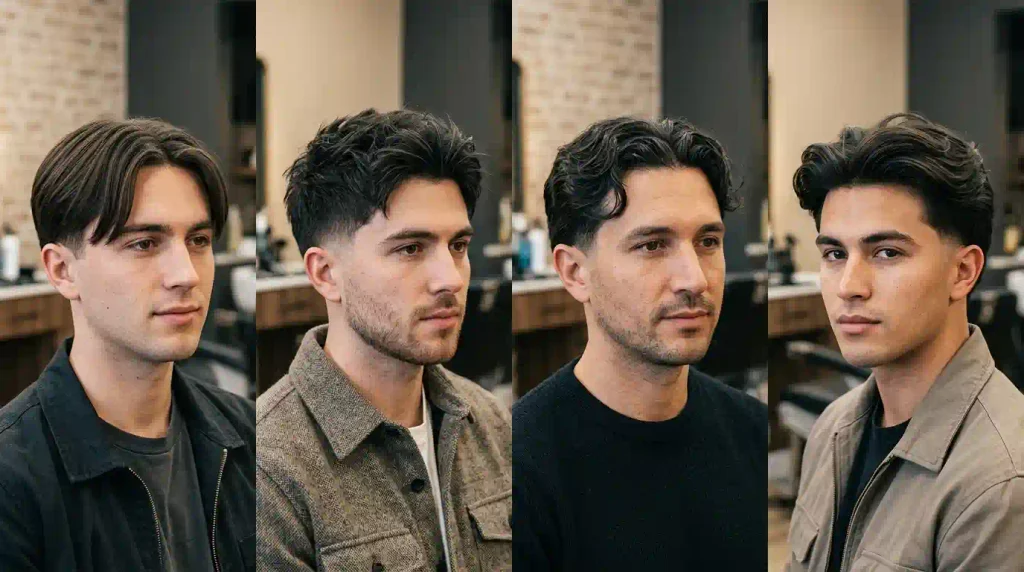
Feathered Middle Part Flow Taper
Feathered layers create a soft, sweeping appearance with movement through the sides and fringe.
This variation looks particularly natural on medium-length wavy hair. The longer Flow Taper Haircut follows a similar principle but emphasizes movement throughout the entire top and back.
Sleek and Polished Middle Part Taper Styles
Slicked Middle Part Taper
This haircut features a clearly defined center part with hair directed backward and outward using a comb or styling cream.
The finish looks controlled and elegant, particularly on straight or slightly wavy hair. A small amount of medium-hold pomade helps maintain separation without making the top excessively rigid.
Wet-Look Middle Part Taper
The wet-look variation uses a glossy styling product to make the curtains appear sleek and defined.
Water-based gel or shine-enhancing pomade can create the effect. Apply product evenly to damp hair and avoid excessive buildup near the scalp.
Brushed Middle Part Taper
A brushed middle part uses a comb or styling brush to direct hair diagonally away from the center.
It offers a neat alternative to messy curtains and works well for formal occasions. Maintain some root volume so the upper section does not appear pressed flat against the head.
Middle Part Taper Styles by Hair Length and Fringe
Short Middle Part Taper
A short middle part taper keeps approximately 3–4 inches of top length, depending on texture and growth direction.
The fringe may separate into shorter sections instead of full-length curtains. Men wanting a simpler, closer-cut alternative can consider a Buzz Taper Haircut or a Taper Haircut Crew Cut Low Fade.
Long Middle Part Taper with Flow
Long curtains create movement around the cheekbones and sometimes extend toward the jawline.
The taper remains concentrated around the lower edges, preserving the flowing shape. This option is ideal for someone growing out a shorter haircut while maintaining a clean neckline.
Layered Middle Part Taper
A layered middle part taper uses different top lengths to control weight distribution and create movement.
Internal layers can remove unwanted bulk from thick hair, while subtle face-framing layers help the front sections fall naturally. Avoid over-thinning fine hair, as this can reduce the appearance of fullness.
Middle Part Taper with Curtain Bangs
Curtain bangs form the defining feature of this hairstyle. The fringe opens near the center and sweeps toward each side of the face.
The length can fall near the eyebrows, eyes, or cheekbones depending on the desired appearance. For alternative front-focused hairstyles, see the fringe taper haircut.
Middle Part Taper with Soft Fringe
This variation features a gentler, less sharply defined center separation. The fringe has a soft edge and can be styled slightly off-center.
It suits anyone who finds a perfectly symmetrical middle part difficult to maintain or prefers a relaxed, face-framing appearance.
Blunt Middle Part Taper
A blunt middle part retains a more defined weight line through the fringe, creating a fuller-looking front section.
It can work well on medium-density straight hair. However, an overly blunt edge may restrict movement, so some internal layering may still be useful.
Cropped Middle Part Taper
A cropped middle part features a shorter, textured top with a subtle central separation.
Because the fringe is relatively short, the haircut often looks closer to a textured crop than traditional curtains. Keep enough length at the front to make the center part visible.
Middle Part Taper Mullet
A middle part taper mullet combines a center-parted fringe with longer hair at the back and tapered areas around the temples.
The contrast produces a fashion-forward silhouette. Maintain proportion between the crown, sides, and rear length so the hairstyle looks intentional.
Korean and Modern Middle Part Taper Hairstyles
Korean Two-Block Middle Part Taper
A Korean two-block-inspired taper features a longer upper section over shorter sides, often with a rounded fringe and defined central separation.
The resulting shape emphasizes softness and volume. The transition may be more disconnected than a traditional taper, depending on the haircut.
Korean S-Wave Middle Part Taper
The S-wave style features gently curved curtains that sweep away from the forehead.
Natural waves, careful blow-drying, or professional styling techniques can create the shape. It works particularly well when the top reaches approximately eyebrow length or longer.
K-Pop Volume Middle Part Taper
This hairstyle emphasizes controlled root volume, soft layers, and a polished curtain shape.
The sides remain neat without excessive skin exposure. Lightweight mousse and directional airflow help lift the roots while keeping the fringe flexible.
E-Boy Middle Part Taper
The E-boy variation features longer curtain bangs, relaxed texture, and a noticeable center separation.
The hair may fall closer to the eyes or cheekbones, creating a youthful appearance. The taper keeps the sides tidy without disrupting the longer fringe.
1990s-Inspired Middle Part Taper
Inspired by classic 1990s curtain hairstyles, this cut maintains longer side-swept sections and a softer silhouette.
Unlike many modern high-contrast versions, the 1990s-inspired style generally avoids extremely short sides. Gentle layering and minimal product help preserve the natural flow.
Creative and Specialty Middle Part Taper Variations
Middle Part Taper Undercut
A middle part taper undercut combines long center-parted hair with significantly shorter sides.
The undercut introduces stronger separation than a normal taper, creating a bolder appearance. It is best for individuals comfortable with visible contrast and regular maintenance.
Asymmetrical Middle Part Taper
This version uses slightly different fringe lengths or an off-center separation to produce controlled asymmetry.
It may be useful when a natural cowlick prevents a perfectly centered part. The taper itself can remain symmetrical while the top follows the hair’s growth pattern.
Razor-Line Middle Part Taper
A razor-line design introduces a narrow shaved detail near the taper or parting area.
The line adds a decorative element but requires careful placement and regular upkeep. Avoid using a razor on irritated skin or areas prone to razor bumps.
Braided Middle Part Taper
This hairstyle incorporates small braids or braided sections along the center-parted top while maintaining short tapered edges.
It is more practical on hair with sufficient length and density for comfortable braiding. Braids should not be installed so tightly that they pull painfully on the scalp or hairline.
Middle Part Taper with Beard Blend
A beard blend connects the sideburns to facial hair through a gradual transition.
This can create a balanced appearance by linking the temple taper with the beard. For a different celebrity-inspired combination of clean tapering and facial hair, explore the Drake Taper Haircut.
Executive and Professional Middle Part Taper
The executive version uses controlled layering, subtle tapering, and a tidy curtain shape.
It works well in professional environments because the center part can be styled neatly without excessive volume. Men preferring a more dramatic, upward-swept silhouette may consider a fohawk taper haircut instead.
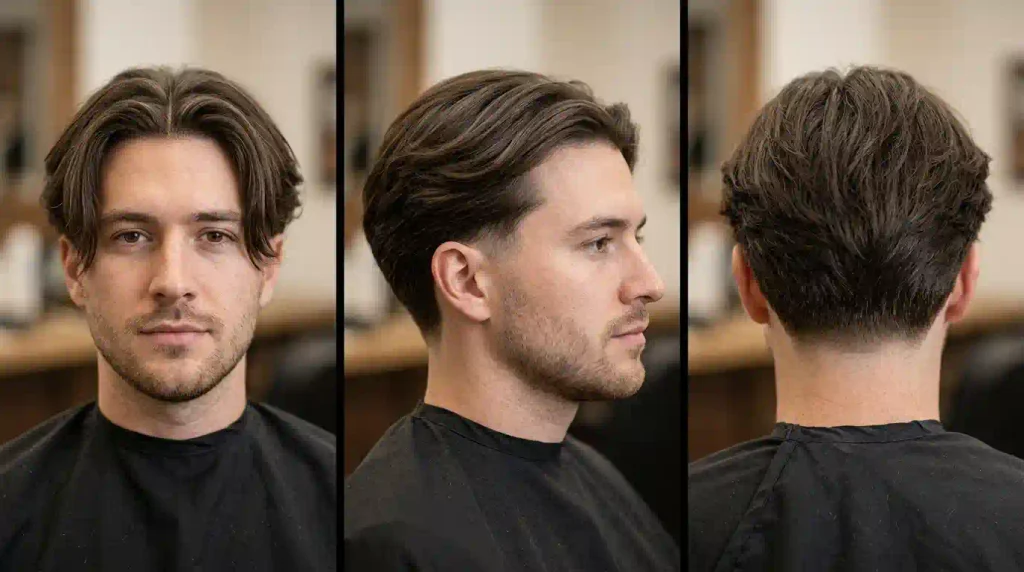
Middle Part Taper Haircut: Front, Side, and Back Views
Understanding the haircut from multiple angles is essential before visiting a barber. A style may look excellent from the front while having an unwanted neckline shape or excessive bulk behind the ears.
Front View: Center Part, Fringe, and Volume
From the front, the middle part should create two balanced sections of hair framing the forehead.
The appearance depends on fringe length, hair density, and natural growth direction. A defined center part creates a symmetrical look, while a slightly off-center part can accommodate a cowlick.
For fuller-looking curtains, ask the barber to preserve enough weight near the front. Extremely short layers may cause the hair to stand upright rather than fall naturally.
Side View: Temple Taper and Hair Length Transition
The side view reveals the taper height and the relationship between the shorter edges and longer upper hair.
A low taper maintains fullness above the ear, while a mid or high taper exposes more of the side profile. The blend should follow a controlled progression rather than displaying an accidental harsh line.
The side profile also shows how well the fringe connects to the rest of the haircut.
Back View: Neckline Shape and Nape Taper
The back view highlights the crown, nape, and neckline.
A soft neckline taper keeps the lower hair controlled without creating an unnatural block. A rounded neckline may complement a softer curtain shape, while a more squared outline can appear structured.
Ask your barber to account for natural growth patterns at the nape, particularly if the hair grows in multiple directions.
How the Haircut Looks Fresh vs. Grown Out
A freshly cut middle part taper usually displays clear temple definition and a neat neckline.
After several weeks, the shortest areas become less distinct, and the longer upper hair may gain additional movement. Low shadow tapers often appear softer during grow-out than skin-close versions.
A well-balanced haircut should remain wearable even when the taper begins losing sharpness.
Middle Part Taper Haircut Length and Clipper Guard Chart
Choosing appropriate lengths is one of the most important parts of getting this hairstyle right.
The top must be long enough to create separation, while the tapered sections should remain proportionate to the rest of the haircut.
Recommended Top Lengths for Different Middle Part Styles
| Desired style | Approximate top length | Typical appearance |
| Short middle part | 3–4 inches | Short, subtle curtains |
| Classic curtains | 4–6 inches | Balanced center separation |
| Textured middle part | 3–5 inches | Defined texture and movement |
| Fluffy middle part | 4–6 inches | Airy volume around the forehead |
| Long curtain flow | 5–8 inches | Longer face-framing sections |
| Curly middle part | 4–7 inches stretched | Curl-dependent fringe length |
| Korean-inspired curtains | 4–6 inches | Soft, shaped fringe |
These measurements refer to the top or front sections, not the tapered sides. Hair length should be checked in its natural state, especially with curls.
Understanding Clipper Guard Numbers and Taper Lengths
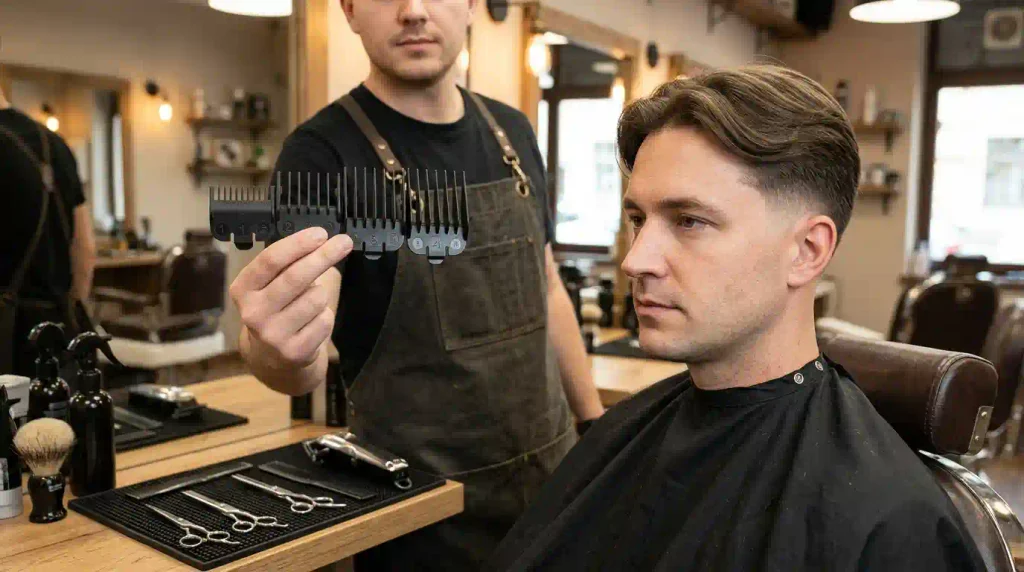
Clipper guards help control the shortest length left during a haircut. Common U.S. guard sizes include:
| Clipper guard | Approximate cutting length | Typical purpose |
| #0.5 | 1/16 inch (1.5 mm) | Very short taper detailing |
| #1 | 1/8 inch (3 mm) | Short temple and neckline areas |
| #1.5 | 3/16 inch (4.5 mm) | Transition blending |
| #2 | 1/4 inch (6 mm) | Softer taper sections |
| #3 | 3/8 inch (10 mm) | Longer, natural-looking blends |
| #4 | 1/2 inch (13 mm) | Retaining additional side weight |
Actual cutting lengths may vary slightly with the clipper brand, blade design, and lever position. A closed clipper blade without a guard is also not identical to a #0.5 guard.
A successful taper rarely uses just one guard. Barbers combine multiple lengths and adjust the clipper lever to create a smooth graduated blend.
How Curl Shrinkage Affects the Finished Haircut
Curly and coily hair can look significantly shorter when dry than when stretched or wet.
For example, a curl measuring six inches when gently stretched may hang much higher on the forehead once it returns to its natural pattern. The amount of shrinkage varies widely.
Ask the barber to evaluate your natural curl pattern before deciding how much length to remove. Dry cutting or a final dry-shape adjustment may be useful for some textures.
How to Choose the Right Middle Part Taper Haircut
The best haircut depends on hair texture, density, growth direction, face shape, and the amount of styling effort you are comfortable with.
Choosing a Middle Part Taper by Hair Type and Density
Hair type influences how the upper section falls and how much weight the sides should retain.
Straight hair generally needs deliberate shaping to produce movement, while naturally wavy and curly hair already contains bends that can support a curtain silhouette.
Best Options for Fine or Thin Hair
Fine hair benefits from lightweight layers and modest root volume.
Avoid aggressive thinning shears because they can make already fine sections appear sparse. A soft low taper with controlled top length often creates a fuller appearance than an extremely high-contrast cut.
Lightweight mousse or texture spray can add lift without pulling the hair down.
Best Options for Thick and Dense Hair
Thick hair can support larger curtain shapes but may develop excessive side bulk.
A mid taper with carefully placed internal layers can reduce weight without destroying the hairstyle’s structure.
Point cutting, scissor-over-comb techniques, and controlled debulking help distribute volume. The goal is to preserve the curtain shape rather than remove as much hair as possible.
Best Middle Part Taper Haircuts by Face Shape
Face-shape guidelines are styling suggestions, not strict rules. Your haircut should also account for your forehead, hairline, features, and personal preference.
Oval Face Shape
Oval faces generally accommodate many curtain lengths and taper heights.
A classic middle part with moderate volume usually provides a balanced appearance. Experiment with low and mid tapers to find your preferred level of contrast.
Round Face Shape
A round face may benefit from additional height at the roots and slightly longer face-framing curtains.
Avoid excessive outward bulk near the cheeks if your goal is a more elongated appearance.
Square Face Shape
Soft curtains can balance prominent jawlines and angular facial proportions.
A textured mid taper or slightly longer fringe adds movement while retaining a defined masculine silhouette.
Heart-Shaped Face
Heart-shaped faces often have a relatively wider forehead and narrower chin.
Medium-length curtains can frame the temples and create visual balance. A softer low taper may look more proportional than an extremely high skin taper.
Long and Rectangular Face Shapes
Longer face shapes often benefit from curtains that fall naturally near the forehead or cheekbones.
Excessive vertical root volume can visually exaggerate facial length. A controlled, lower-volume curtain style may create better balance.
Diamond Face Shape
Diamond face shapes typically feature prominent cheekbones with relatively narrower forehead and jaw areas.
Face-framing layers and a soft curtain shape can complement the cheekbones. Avoid removing too much hair from the upper sides if you want to preserve width near the forehead.
How Hairline, Cowlicks, and Head Shape Affect the Cut
Natural growth patterns can determine where the center part sits.
A crown cowlick may lift the back section, while a strong front cowlick may push one curtain higher than the other.
A widow’s peak or receding hairline can also change how a middle part frames the forehead. In these cases, a slightly off-center part may appear more natural.
Head shape influences taper placement as well. A knowledgeable barber adjusts the blend to avoid emphasizing unwanted flatness or protrusions.
Best Middle Part Taper Haircuts by Age and Lifestyle
Teenagers and Students
Textured curtains, fluffy middle parts, and low tapers offer a relaxed hairstyle that can be adapted for school or casual settings.
Lightweight styling products help maintain movement without requiring elaborate daily grooming.
Young Men
Mid taper curtains, Korean-inspired styles, and blowout variations are suitable for men who enjoy experimenting with texture and volume.
A medium-length fringe offers flexibility between polished and intentionally messy finishes.
Working Professionals
A classic low taper with brushed curtains can create a neat appearance suitable for many offices.
The key is controlled length, a tidy neckline, and enough styling hold to keep the fringe from repeatedly falling into the eyes.
What Hair Length Is Needed for a Middle Part Taper?
Minimum Top Length for a Defined Middle Part
Around three inches may be enough to establish a visible part in some straight hair types.
However, a more traditional curtain effect generally benefits from additional length.
Ideal Length for Curtain Bangs and Natural Flow
Approximately four to six inches is a useful starting point for medium-length curtains.
Longer sections allow the fringe to fall naturally toward the sides rather than standing upright.
How to Grow Your Hair Into a Middle Part Taper
Grow the front and top while maintaining only the lower sideburns and neckline.
Avoid repeatedly cutting the upper sides too short, as those sections help connect the curtains to the taper.
As the fringe becomes longer, ask the barber for light shaping instead of removing substantial length.
How to Find Your Natural Middle Part
A center-parted hairstyle looks best when it works with the hair’s natural growth direction.
Perfect Center Part vs. Slightly Off-Center Part
A perfect center part divides the hair into approximately equal left and right sections.
A slightly off-center part follows a nearby natural separation and may be easier to maintain when one side grows differently.
Both approaches can create an attractive curtain hairstyle. The goal is a balanced look rather than mathematical precision.
How to Test Your Natural Hair Part at Home
Start with clean, damp hair and comb the top backward.
Use your fingers to gently separate the hair near the center of the forehead, then observe where it naturally falls.
Try shifting the part slightly left or right and compare the amount of volume on each side. Allow the hair to partially air-dry before deciding which position looks most comfortable.
When a Natural Growth Pattern Makes a Center Part Difficult
Strong cowlicks may cause one side to lift, separate unpredictably, or resist the desired shape.
Instead of forcing the hair with heavy products, use a slightly modified part and controlled blow-drying.
If the hair is too short to cooperate, growing the fringe longer often provides more styling flexibility.
How Much Does a Middle Part Taper Haircut Cost in the USA?
A middle part taper generally falls within the price range of a standard men’s haircut or a more detailed scissor-and-clipper service.
Haircut Price Differences by Barbershop and Location
The following figures are illustrative planning ranges for U.S. barbershop visits, not fixed nationwide prices or quotes for this specific haircut.
| Barbershop type | Illustrative haircut budget |
| Budget haircut chain | 20–35 |
| Neighborhood barbershop | 30–55 |
| Experienced barber or specialized fade service | 45–80 |
| Premium salon or detailed styling appointment | 70–120+ |
Pricing can vary substantially between cities, neighborhoods, and individual professionals.
A simple taper cleanup may cost less than a complete haircut involving extensive layering, scissor work, and styling.
Factors That Affect the Cost of a Middle Part Taper
The main factors include location, barber experience, appointment length, and the complexity of the requested haircut.
A detailed skin taper with long curtain layers may require more time than a straightforward low taper.
Additional services such as shampooing, beard shaping, and blowout styling may also increase the final bill.
Monthly Haircut and Maintenance Budget
A client paying $45 every three weeks spends approximately $65 per month on average before tips and additional services.
At $60 every four weeks, the average monthly haircut cost is also approximately $65.
A useful strategy is to alternate full haircuts with simpler taper cleanups when your barber offers that option.
How to Ask Your Barber for a Middle Part Taper Haircut
Clear communication helps prevent the barber from cutting the fringe too short or taking the taper higher than intended.
What to Tell Your Barber
Describe the top length, fringe shape, taper height, and neckline preference separately.
Avoid asking only for a “middle part fade,” because the barber may interpret that as a much shorter haircut along the sides.
Ready-to-Use Barber Request Script
“I want a middle part taper with about four to five inches left on top. Please keep enough length in the front for natural curtain bangs. I prefer a low taper around the temples and neckline, with a soft blend rather than a high skin fade. Add light texture so the hair separates naturally, but don’t remove too much weight from the sides.”
Adjust these measurements and details according to your preferred style.
Style-Specific Instructions for Low, Mid, and High Tapers
| Taper style | What to ask your barber |
| Low taper | Keep the taper close to the sideburns and nape |
| Mid taper | Begin the blend around the middle temple area |
| High taper | Create a higher, more visible temple transition |
| Shadow taper | Maintain visible stubble at the shortest point |
| Skin taper | Blend a small lower section to skin while preserving the upper side weight |
Choosing the Right Taper Placement
Temple and Sideburn Taper Placement
The temple taper should complement the top rather than create an unnatural separation.
If you want softer curtains, keep some hair weight above the ears.
For a sharper appearance, the barber can shorten the lower temple area while maintaining a smooth transition.
Neckline and Nape Taper Placement
A clean nape taper prevents the back of the haircut from appearing overgrown.
A natural neckline generally grows out more softly than a sharply squared outline, although the best choice depends on your hair growth pattern and preferred finish.
Explaining the Top Length, Layers, and Fringe
Specify whether you want the fringe near your eyebrows, eyes, or cheekbones.
Ask for subtle face-framing layers and enough retained weight to preserve the center-part shape.
For thick hair, controlled internal layering may help. For fine hair, ask the barber to avoid excessive texturizing or thinning.
Using Reference Photos to Communicate the Haircut
Bring front, side, and back reference photos whenever possible.
Ideally, choose examples featuring hair texture similar to yours. A straight-haired reference may not accurately show how the same length will behave on tightly curled hair.
Explain what you like in each photograph instead of expecting the barber to reproduce every detail exactly.
Step-by-Step Barbering Process and Essential Tools
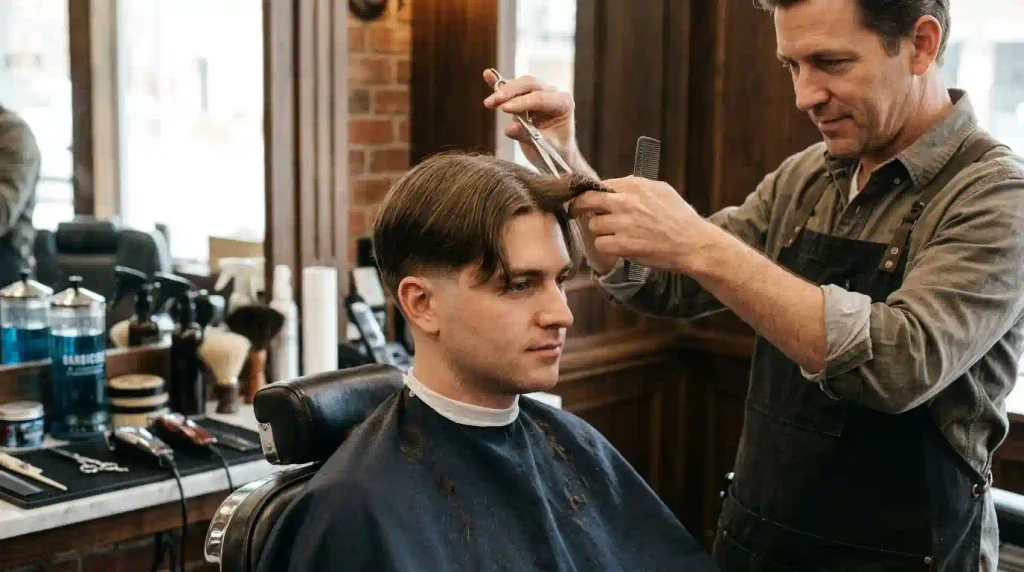
A typical haircut begins with a consultation and an assessment of natural hair growth.
The barber then sections the top, establishes the desired length, and shapes the fringe using scissors or suitable texturizing techniques.
Next, hair clippers and adjustable guards create the tapered transition. A detail trimmer may refine the sideburns and neckline.
Finally, the barber checks the blend, cross-checks the layers, and styles the upper section using a blow dryer, brush, or appropriate product.
How to Check the Quality of Your Middle Part Taper
A haircut should be evaluated from multiple angles before leaving the barbershop.
Checking Taper Symmetry on Both Sides
Compare the left and right temple transitions.
They should look intentionally balanced, although natural differences in head shape, hair density, and growth patterns may require small adjustments.
Identifying Harsh Blend Lines and Uneven Transitions
Look for unintended dark patches or obvious horizontal lines where the clipper lengths change.
A smooth taper should progress gradually from shorter hair to longer hair, unless you deliberately requested a disconnected style.
Checking the Back, Crown, and Neckline
Use a handheld mirror to inspect the rear of the haircut.
Check whether the neckline follows the desired shape and whether the crown contains unnecessary bulk or uneven cutting.
What to Ask Your Barber to Adjust Before Leaving
If one side appears heavier, request a small balance adjustment.
If the fringe falls awkwardly, ask the barber to style it before removing more length. Sometimes the issue is growth direction rather than an incorrect cut.
How to Style a Middle Part Taper Haircut at Home
A good haircut provides the foundation, but proper styling determines whether the curtains remain defined throughout the day.
Step-by-Step Middle Part Styling Tutorial
Step 1: Wash and Prepare Your Hair
Start with clean or lightly damp hair.
If your hair is dry or curly, use an appropriate conditioner to maintain softness. Gently blot away excess water instead of rubbing aggressively with a towel.
Step 2: Create a Defined Center Part
Use a fine-tooth comb or your fingers to separate the hair near the middle of your forehead.
Follow the natural part line whenever possible. For a softer appearance, create the separation with your fingers instead of drawing an extremely sharp line.
Step 3: Blow-Dry and Build Volume
Direct warm or cool airflow toward the roots while lifting the front sections with a vent brush or round brush.
Guide each curtain outward and slightly backward.
Avoid keeping concentrated heat on one area for too long. A controlled, low-to-medium setting is generally preferable to excessive heat.
Step 4: Add Texture and Shape
Once the hair is mostly dry, use your fingers to separate the curtains and adjust their movement.
For wavy hair, light scrunching can emphasize natural texture.
If you prefer a polished appearance, smooth the sections with a brush rather than creating an intentionally messy finish.
Step 5: Apply Styling Product and Finish the Look
Apply a small amount of suitable product, beginning with less than you think you need.
Work it through the mid-lengths and ends before adding more near the roots.
Finish by checking the center separation, side volume, and overall balance.
How to Style a Middle Part Taper Without Heat
Heat-free styling works well when your hair naturally separates near the center.
After washing, create the part while the hair is damp. Apply a small amount of leave-in conditioner or lightweight styling cream.
Gently shape the curtains with your fingers and let the hair air-dry.
Avoid repeatedly touching the fringe while drying because this can disturb its natural formation.
How to Create a Natural Curtain Flow
Natural curtain flow depends on adequate length and controlled weight distribution.
Start with a soft center separation and direct the hair outward instead of straight down.
A small amount of root volume helps the fringe move away from the forehead before falling toward the cheeks.
For longer curtains, gentle layering can prevent the front from looking heavy.
How to Style Wavy and Curly Middle Part Hair
Wavy hair often requires less deliberate shaping than straight hair.
Apply lightweight styling cream to damp hair, scrunch gently, and allow the waves to form naturally.
For curls, use a curl cream or leave-in conditioner and consider a diffuser on low heat and airflow. Avoid rough brushing after the curls dry.
How to Achieve a Quick 90-Second Daily Style
When the haircut already has the right shape, a quick refresh may be enough.
Lightly dampen the fringe, re-establish the center separation with your fingers, and apply a small amount of lightweight product.
Use brief airflow to lift flat roots if necessary, then direct the curtains outward.
This works best as a refresh rather than a full wash-and-style routine.
How to Prevent Heat Damage While Styling
Frequent exposure to excessive heat can weaken hair and contribute to dryness, breakage, and split ends.
Use low or medium heat when possible, avoid holding the dryer too close to the hair, and apply an appropriate heat protectant.
The American Academy of Dermatology’s healthy hair recommendations emphasize gentle handling, conditioning, and limiting excessive heat exposure.
Best Hair Products for a Middle Part Taper Haircut
The best products depend on hair texture, density, desired hold, and styling finish.
Choosing Styling Products by Hair Type
Products for Straight and Fine Hair
Fine hair typically benefits from lightweight mousse, texturizing spray, or a small quantity of matte styling paste.
Avoid applying excessive heavy wax or oil near the roots because it can make the curtains appear flat.
Products for Thick and Wavy Hair
Thick or wavy hair may benefit from styling cream, flexible-hold paste, or light pomade.
These products can reduce frizz and provide definition while preserving natural movement.
Products for Curly and Coily Hair
Curly hair often responds well to hydrating leave-in conditioner, curl cream, or suitable lightweight gel.
Products containing conditioning ingredients such as shea butter or argan oil may help with softness, although the ideal formulation depends on the individual’s hair needs.
Comparing Styling Products by Hold and Finish
Matte Clay and Texturizing Paste
Matte clay helps create separation and a low-shine finish.
Some formulas use ingredients such as kaolin clay or bentonite clay to provide texture and grip.
Texturizing paste can offer a similar appearance with varying levels of flexibility.
Sea Salt Spray and Volumizing Mousse
Sea salt spray can enhance visible texture, particularly on straight or slightly wavy hair.
Volumizing mousse is useful when the goal is airy root lift.
Sea salt products may feel drying on some hair types, so use them moderately and maintain a suitable conditioning routine.
Pomade and Styling Cream
Pomade is useful for sleek curtains, brushed-back styles, and glossy finishes.
Styling cream typically produces a softer, more flexible result.
Water-based pomades and gels differ in hold and shine, so choose according to the appearance you want.
Heat Protectant and Lightweight Finishing Products
Heat protectant is useful when regularly blow-drying or using heated styling tools.
A small amount of lightweight hair serum may help manage flyaways, while hairspray can maintain a finished style in windy conditions.
How Product Ingredients Affect Texture, Volume, and Hold
Product performance depends on the entire formulation rather than a single ingredient.
Clays and powders often increase grip and matte texture. Conditioning agents can improve smoothness, while styling polymers help provide hold.
A high-shine pomade produces a different result from a matte clay, even if both offer similar advertised hold.
Choose the least amount of product needed to achieve the desired finish.
How to Keep a Middle Part Taper Looking Good in Different Weather
Weather can affect the volume, texture, and definition of curtain hairstyles.
Preventing Flat Hair in Humid Weather
Humidity can change how hair holds its shape.
Use lightweight, humidity-resistant styling products and avoid overloading the roots with heavy creams.
For naturally wavy or curly hair, maintaining moisture balance can help reduce unwanted frizz.
Keeping Your Middle Part in Place on Windy Days
A flexible-hold styling product can help the curtains return to their intended position after exposure to wind.
Avoid relying exclusively on strong, stiff hairspray, which may make the hair appear unnatural.
Refreshing Your Hair After Sweating or Exercising
After exercise, let the scalp cool and the hair dry before restyling.
If the roots are damp with sweat, lightly rinsing or washing as appropriate may be more effective than layering additional product onto dirty hair.
Restoring Your Middle Part After Wearing a Hat or Helmet
A hat or helmet may flatten the roots and disturb the center part.
Lightly dampen the fringe, lift the roots with your fingers, and reshape the curtains.
If necessary, use brief cool airflow to restore volume.
How to Maintain a Middle Part Taper Haircut
Routine care helps preserve the haircut’s proportions and keeps the longer top manageable.
Daily Hair Care and Styling Routine
Check the center part each morning and restore the fringe’s natural direction.
Use lightweight products where possible and avoid repeatedly pulling the hair into tight positions.
How Often Should You Wash a Middle Part Taper?
Washing frequency depends on scalp oil production, activity level, and hair texture.
Straight or oily hair may require more frequent shampooing than dry, curly, or coily hair.
Apply shampoo primarily to the scalp and use conditioner where needed.
How Often Should You Get a Taper Touch-Up?
A close taper may start losing its sharp definition within one to two weeks.
Many people schedule cleanup appointments approximately every two to four weeks, although softer low tapers can remain presentable longer.
When to Trim the Top and Remove Split Ends
The longer top usually requires less frequent cutting than the tapered edges.
A light trim approximately every six to ten weeks may help maintain shape, depending on growth rate and styling preferences.
How to Preserve Volume and Natural Movement
Avoid excessive product buildup, heavy root application, and unnecessary heat styling.
Preserve enough top length for the curtains to move naturally, and ask the barber to maintain balanced layers during appointments.
Middle Part Taper Haircut Growth Timeline
The following timeline illustrates how a typical middle part taper may change after a haircut. Individual results depend on hair growth rate, cut length, and taper height.
Week 1: Fresh Haircut and Initial Styling
The taper looks sharp, the neckline is clean, and the fringe retains its intended shape.
This is the best time to photograph the haircut for future barber appointments.
Week 2: Growing Sideburns and Neckline
The shortest sections begin looking softer.
The overall hairstyle often remains balanced, although close skin tapers may show more noticeable regrowth.
Week 3: Losing Taper Definition
The temple transition becomes less distinct, and the nape may appear fuller.
Some people choose a short cleanup appointment at this stage rather than a complete haircut.
Week 4: Deciding Between a Touch-Up and Full Haircut
By the fourth week, the taper may have lost much of its original contrast.
If the curtains still fall correctly, a neckline and sideburn cleanup may be sufficient. If the top has become bulky or unbalanced, consider a full reshape.
At-Home Middle Part Taper Touch-Ups Between Barber Visits
Basic grooming can extend the haircut’s tidy appearance, but detailed blending is usually best left to a trained barber.
Safe Sideburn and Neckline Cleanup
Use a suitable detail trimmer only on clearly visible stray hairs outside the intended haircut outline.
Work slowly and avoid cutting into the established taper.
Tools for Basic At-Home Haircut Maintenance
A handheld mirror, comb, quality detail trimmer, and adequate lighting can help with minor grooming.
For larger adjustments, professional hair clippers, guards, and barber shears require skill to avoid uneven results.
What Not to Trim or Reshape Yourself
Avoid attempting to recreate the complete taper blend without proper experience.
Do not aggressively cut the center fringe, remove large sections near the crown, or shave over irritated skin.
When to Book a Professional Barber Instead
Visit a barber if the taper looks patchy, the neckline has become uneven, or the upper section requires significant reshaping.
A professional correction is usually easier when sufficient hair remains to work with.
Common Middle Part Taper Haircut Mistakes and How to Fix Them
Even a well-designed haircut can look unbalanced when the part placement, layers, or taper height are incorrect.
Uneven or Poorly Positioned Middle Part
A center part may look uneven because of growth patterns, an unsuitable part location, or unbalanced fringe length.
Try adjusting the part slightly before requesting more cutting.
Middle Part Falling Flat or Losing Volume
Flat curtains often result from insufficient root lift, excessive product, or hair that is too heavy at the front.
Use a lightweight volumizing product and direct airflow toward the roots while styling.
Excessive Frizz and Uncontrolled Texture
Frizz may increase with dry hair, aggressive brushing, humidity, or unsuitable styling techniques.
Use conditioner appropriate for your hair texture and avoid disturbing curls after they have dried.
Taper Too High, Too Short, or Poorly Blended
An overly high taper can remove essential side weight and make longer curtains appear disconnected.
If the cut is already too short, growing the sides out may be necessary. If the issue is uneven blending, an experienced barber may be able to refine the transition.
Using Too Much Styling Product
Heavy application can cause greasy roots, stiff curtains, and visible product buildup.
Start with a small quantity and add more only when necessary.
Overstyling and Heat Damage
Repeated high-temperature styling may contribute to dryness and breakage.
Reduce heat exposure, avoid pulling aggressively on damp strands, and maintain a conditioning routine.
Choosing the Wrong Top Length or Fringe Shape
A fringe that is too short may stand upright rather than forming curtains.
A fringe that is excessively long may cover the eyes or feel heavy.
Choose a length that suits your hair’s natural movement and adjust it gradually rather than making a drastic change.
Middle Part Taper vs. Similar Haircuts
Understanding related hairstyles helps you choose the correct cut and communicate it clearly to your barber.
Middle Part Taper vs. Middle Part Fade
A middle part taper primarily shortens the hair around the temples and neckline.
A middle part fade may extend the graduated shortening across a larger portion of the sides.
A taper generally retains more side weight, while a full fade often creates stronger contrast.
Low vs. Mid vs. High Middle Part Taper
| Feature | Low taper | Mid taper | High taper |
| Blend placement | Lower temple and nape | Middle temple region | Higher temple region |
| Contrast | Subtle | Moderate | More pronounced |
| Retained side weight | More | Moderate | Less |
| Overall appearance | Natural and classic | Balanced and modern | Sharper and bolder |
| Visible grow-out | Often softer | Moderate | Often more noticeable |
A low taper is generally a good starting point when you are unsure how much side hair to remove.
Middle Part Taper vs. Regular Taper Haircut
A regular taper describes the gradual shortening of hair without specifying the top hairstyle.
A middle part taper adds the defining center separation and longer curtain-style top.
Both cuts can use similar clipper techniques.
Middle Part Taper vs. Side Part Taper
A middle part separates the hair near the center, directing the front sections toward both sides.
A side part creates a more asymmetrical shape by directing greater volume toward one side.
If you prefer a traditional side-swept appearance, the Comb Over Taper Haircut is a useful alternative.
Middle Part Taper vs. Classic Curtain Haircut
A classic curtain haircut emphasizes longer center-parted hair and may have relatively full sides.
A middle part taper adds a shorter, more structured transition around the lower edges.
The taper version can appear neater around the ears and neckline.
Middle Part Taper vs. Slick Back
A middle part taper divides the hair into two sections that move outward from the forehead.
A slick back directs most of the top hair backward without emphasizing a central split.
The slick back generally produces a more uniformly controlled shape.
Middle Part Taper vs. Two-Block Haircut
A two-block haircut usually features a longer upper section over significantly shorter lower sides.
A middle part taper generally emphasizes a smoother transition between lengths.
The two styles can overlap when a Korean-inspired two-block haircut includes gradual tapering.
Middle Part Taper vs. Middle Part Undercut
An undercut produces a stronger separation between the long top and short sides.
A taper preserves a more gradual transition.
Choose an undercut for greater contrast or a traditional taper for softer blending.
Taper Fringe vs. French Crop
A taper fringe can refer to several hairstyles with a shorter tapered edge and a prominent front fringe.
A French crop typically features a shorter, forward-directed textured top, often with a relatively blunt or broken fringe.
For further comparisons, explore the french crop taper haircut men and the Edgar taper haircut. Both feature more forward-directed fringe shapes than traditional middle part curtains.
Frequently Asked Questions About Middle Part Taper Haircuts
Can You Train Your Hair to Stay in a Middle Part?
Yes, repeated gentle styling can help establish a consistent part, although natural growth patterns may limit the result.
Does a Middle Part Taper Work with a Receding Hairline?
Yes, depending on hair density and recession pattern; longer, softly positioned curtains may provide a balanced appearance.
Is a Middle Part Taper Suitable for Thinning Hair?
It can be, especially with lightweight layering and a soft taper that preserves the appearance of fullness.
Is the Middle Part Taper Still in Style in 2026?
Yes, center-parted curtain hairstyles and modern taper variations remain relevant men’s grooming options in 2026.
Final Thoughts: Choosing the Best Middle Part Taper Haircut
The middle part taper haircut offers an appealing balance between relaxed curtain bangs and clean, modern barbering. From subtle low tapers and textured middle parts to Korean-inspired curtains, curly variations, and sharp skin tapers, there is a version for many different hair types and styling preferences.
For the best results, choose a taper height that complements your head shape, preserve enough top length for natural movement, and work with your hair’s growth direction rather than against it. Bring clear reference photos to your barber, explain the desired fringe shape, and maintain the cut with appropriate styling products and periodic touch-ups.
Explore more Hairstyles with taper to compare different looks and find the style that best matches your hair texture, lifestyle, and personal preferences.