

Messy Taper Haircut: 14 Fluffy & Textured Styles
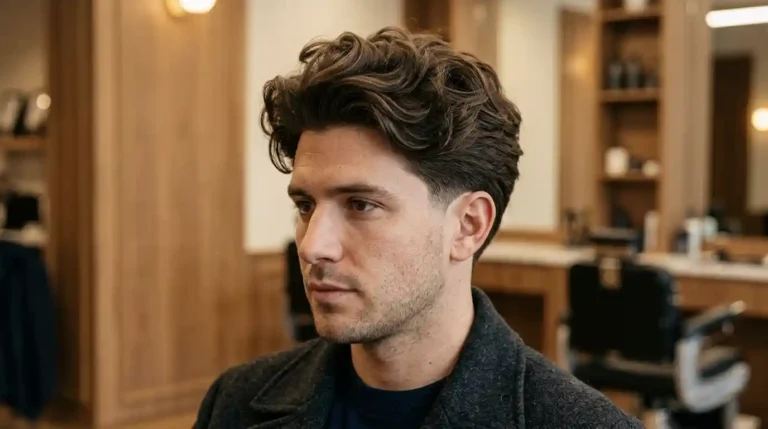
The messy taper haircut combines a clean, gradually shortened hairline with a textured, deliberately tousled top that looks relaxed without appearing unkempt. Instead of slicking every strand into place, this hairstyle uses movement, uneven layers, natural volume, and soft separation to create an effortless finish. The taper keeps the temples, sideburns, and neckline neat, while the longer hair on top can be styled into a messy fringe, fluffy quiff, textured crop, loose waves, or natural curls. It is a versatile choice for men who want a modern haircut without committing to a perfectly structured hairstyle.
Whether you have straight, fine, thick, wavy, curly, or coily hair, the right taper height, top length, and styling products can make a noticeable difference. Some versions take only a few minutes to style, while high-volume fluffy haircuts require blow-drying and more deliberate shaping. This guide explores 14 messy taper haircut styles, explains how to choose one for your hair type and face shape, and provides practical barber instructions, product recommendations, styling techniques, and maintenance tips.
Table of Contents
- What Is a Messy Taper Haircut?
- Why Choose a Messy Taper?
- Which Messy Taper Style Should You Choose?
- Messy Taper Haircut Styles
- Choosing a Messy Taper for Your Hair Type
- Choosing the Taper and Top for Your Face Shape
- How to Ask Your Barber for a Messy Taper
- How a Barber Creates the Cut
- How to Style a Messy Taper at Home
- Messy Taper Maintenance
- Common Messy Taper Mistakes to Avoid
- Frequently Asked Questions
- Final Thoughts
What Is a Messy Taper Haircut?
A messy taper haircut is a men’s hairstyle with a textured, casually styled top and gradually shorter hair around the temples, sideburns, and neckline. Its defining feature is the combination of deliberately irregular movement above and controlled, blended edges below.
The top can be short and choppy, medium-length and fluffy, or long enough to fall naturally across the forehead. The sides remain connected to the longer sections unless the haircut intentionally includes disconnection.
Unlike a traditional neat side part or slick back, a messy taper does not require every strand to follow the same direction. Instead, the barber builds texture into the haircut so that individual sections can separate, lift, bend, or fall naturally.
The finished appearance can range from a subtle, casual haircut to a high-volume hairstyle with dramatic contrast.
A typical messy taper includes:
- A textured top with natural-looking separation.
- Gradually shortened hair around the temples and sideburns.
- A clean, blended neckline.
- Enough length on top to create movement.
- Soft or choppy layers based on hair density.
- A low, mid, or high taper depending on the desired contrast.
- A matte, flexible, or lightly defined finish rather than an excessively rigid shape.
The hairstyle works particularly well when the haircut follows the person’s natural hair growth pattern.
How the Taper and Textured Top Work Together
The taper and textured top serve different purposes, but both are important to the overall appearance.
The taper controls the outline. It gradually reduces hair length around selected parts of the sides and back, creating a clean transition toward the natural hairline.
The textured top creates personality.
Instead of leaving the upper hair as a heavy, uniform section, the barber introduces carefully placed layers and texture to encourage separation.
These shorter and longer sections interact to produce movement.
For example, a man with straight, dense hair might need selective weight removal to prevent the top from falling into a solid block. Someone with naturally wavy hair may already have enough movement and need only light shaping.
The relationship between the top and sides also affects the haircut’s proportions.
A low taper retains more fullness around the sides, producing a soft, natural appearance.
A high taper removes more side weight and makes the textured top appear more prominent.
The right balance depends on head shape, hair density, and personal preference.
Messy Taper vs. Taper Fade
The terms messy taper and messy taper fade are often used interchangeably, but the finished haircuts can differ.
A classic taper usually concentrates gradual shortening near the temples, sideburns, and nape while preserving more length across the upper sides.
A fade generally creates a broader transition across the sides and back, sometimes reaching very short stubble or bare skin.
However, barbershop terminology varies. Some professionals use taper fade to describe a very short, localized taper, while others use it for a more noticeable fade.
| Feature | Messy Taper | Messy Taper Fade |
| Top | Textured and tousled | Textured and tousled |
| Sides | More natural length retained | Often stronger length contrast |
| Shortest areas | Usually temples, sideburns, and nape | May extend farther around the sides |
| Skin exposure | Not required | Possible, depending on finish |
| Overall appearance | Relaxed and understated | Sharper and more defined |
| Grow-out | Often softer and less noticeable | Shorter sections may need more frequent cleanup |
| Best for | Natural, subtle styling | More visible contrast |
A low taper fade can still be relatively subtle, while a high skin fade produces a much stronger distinction between the top and sides.
If you want to preserve more fullness around the ears, a classic low taper is usually a sensible starting point.
Should You Ask for a Taper or a Taper Fade?
The best choice depends on how much contrast you want between the textured top and the sides.
Choose a traditional taper when you prefer a soft silhouette, slightly longer sides, and a haircut that grows out gradually.
Choose a taper fade when you want the transition to appear sharper, particularly around the temples and neckline.
If you like exposing the skin around the hairline, ask whether the barber can create a skin taper without carrying the shortest section too high.
Avoid relying on the word fade alone.
Instead, tell your barber how high you want the taper to rise, where the shortest hair should begin, and whether the upper sides should retain visible length.
This is especially important for fluffy hairstyles because removing too much side weight can dramatically change the finished shape.
What Makes the Top Look Deliberately Messy?
A messy top should look textured, balanced, and intentional rather than simply uncombed.
The difference comes from the haircut’s shape and how the strands are styled.
Professional texturizing techniques may include point cutting, layered cutting, and selective weight removal.
These techniques create small variations in length, allowing some strands to rise while others fall or move sideways.
Styling then emphasizes those differences.
A matte clay or paste can separate sections, while a lightweight mousse can provide lift without excessive weight.
The key is controlled irregularity.
If every section is identical, the haircut may look overly uniform. If the hair is completely uncontrolled, it may appear shapeless.
A successful messy taper has enough structure to maintain a recognizable silhouette while allowing the top to move naturally.
Why Choose a Messy Taper?
The messy taper is popular because it combines practical grooming with a relaxed appearance.
It can work with short or medium-length hair, accommodate different textures, and be adjusted for casual or polished settings.
Versatility for Casual and Professional Settings
A messy taper does not have to look excessively informal.
For casual styling, you can let the fringe fall naturally, separate the hair with your fingers, and use a small amount of matte paste.
This produces a lived-in appearance suitable for everyday outfits.
For smart-casual occasions, you can guide the front slightly upward or sideways while keeping the texture softer.
A low taper with a controlled messy quiff can also work in professional environments where longer or textured hairstyles are acceptable.
The important factor is keeping the haircut’s outline clean.
Even when the top looks intentionally tousled, neatly blended sideburns and a well-maintained neckline create a finished appearance.
For more traditional styling, a subtle side-swept messy taper offers an alternative to a highly structured side part.
Styling Effort and Upkeep
Not every messy taper requires the same amount of styling.
A short textured crop may need only two or three minutes of finger styling.
A medium-length fluffy taper might need blow-drying to achieve the desired root volume.
A high-volume quiff can require additional shaping and product application.
The maintenance requirement also changes with taper height.
A soft low taper often grows out more naturally, while a high skin taper may show regrowth sooner.
Choosing a style that matches your available time can make everyday grooming significantly easier.
If you prefer minimal effort, select a cut that follows your natural texture rather than one that needs extensive blow-drying to maintain its shape.
How the Cut Can Add Movement and the Look of Volume
Texture can make hair appear fuller by creating separation, lift, and variation in direction.
For example, fine straight hair sometimes looks flat when cut into a uniform length.
Carefully placed layers and lightweight styling products can help the roots lift and create a more dimensional appearance.
Thick hair presents the opposite challenge.
Without appropriate shaping, dense hair may look bulky or mushroom-shaped.
Selective layering can reduce unnecessary weight and allow sections to move independently.
However, texturizing does not actually increase the number of hairs on the scalp.
It changes how existing hair is arranged.
For men with genuinely thinning hair, the barber should preserve enough weight to avoid exposing the scalp unnecessarily.
Which Messy Taper Style Should You Choose?
The best messy taper is the one that complements your hair’s natural characteristics and fits your preferred grooming routine.
Start with three decisions: hair texture, desired length and contrast, and daily styling effort.
Choose a Style Based on Your Hair Texture
| Hair Texture | Recommended Messy Taper | Styling Approach |
| Straight hair | Textured crop or fluffy fringe | Matte paste and root lift |
| Fine hair | Short messy low taper | Lightweight mousse or texture powder |
| Thick straight hair | Choppy textured mid taper | Selective weight removal and matte clay |
| Naturally wavy hair | Messy fringe or textured brush back | Styling cream or light mousse |
| Loose curly hair | Curly messy taper | Curl cream and diffuser |
| Coily hair | Longer textured top with temple taper | Leave-in conditioner and curl definition |
| Coarse hair | Medium layered messy taper | Directional blow-drying and flexible cream |
| Thinning hair | Controlled textured crop | Conservative layering and lightweight products |
If your natural hair already forms waves or curls, use that movement rather than trying to create straight, fluffy sections.
For straight hair, the haircut may need additional layered texture and styling assistance.
Choose a Style Based on Top Length and Desired Contrast
Top length determines how much movement the haircut can produce.
| Top Length | Approximate Range | Suitable Styles |
| Very short | 1–2 inches | Subtle textured or spiky top |
| Short | 2–3 inches | French crop, textured crop, short messy fringe |
| Medium | 3–5 inches | Fluffy taper, messy quiff, blowout, brush back |
| Longer | 5–7+ inches | Long messy top, loose flow, tapered mullet |
These are approximate lengths, not rigid rules. Curly and coily hair may appear considerably shorter than its stretched length.
For subtle contrast, choose a low taper with a medium-length top.
For more visible contrast, consider a mid taper with a fluffy fringe or messy quiff.
A high taper may suit someone who wants a stronger emphasis on the textured top.
Choose a Style Based on Styling Time and Maintenance
Your daily routine matters as much as the reference photograph.
| Style | Typical Daily Styling Time | Effort |
| Short messy low taper | 2–4 minutes | Low |
| Messy French crop | 2–5 minutes | Low |
| Natural wavy messy taper | 3–6 minutes | Low to moderate |
| Mid taper with messy fringe | 4–7 minutes | Moderate |
| Fluffy high-volume taper | 5–10 minutes | Moderate |
| Messy quiff | 5–10 minutes | Moderate |
| Textured blowout | 7–12 minutes | Moderate to higher |
| Long messy top | 5–10 minutes | Varies by texture |
These are practical estimates rather than fixed styling requirements.
A haircut that works with your natural growth pattern generally requires less effort.
A style that depends on changing your hair’s direction may take longer and require heat styling.
Messy Taper Haircut Styles
A messy taper can be adapted into many hairstyles by changing the top length, taper height, fringe shape, and layering pattern.
The following 14 styles cover natural, fluffy, cropped, voluminous, and more dramatic variations.
1. Low Taper With Natural Messy Texture
The low taper with natural messy texture is one of the easiest versions to wear.
The taper stays near the sideburns, temples, and neckline, while most of the sides retain their natural length.
On top, soft layers create separation without making the haircut look aggressively choppy.
This combination produces a relaxed hairstyle that works for everyday wear.
The top typically measures around 2–4 inches, depending on how much movement you want.
Straight hair can be styled into loose, irregular sections, while wavy hair may naturally create enough separation.
The barber should avoid cutting the upper sides too short because a soft, connected silhouette is the main attraction.
For styling, apply a small amount of matte paste or lightweight cream to slightly damp or dry hair.
Move the hair into position with your fingers instead of using a fine-tooth comb.
The finished result should look natural and flexible.
This is also a practical choice if you are growing out a shorter haircut.
Best for: Straight, wavy, fine-to-medium-density hair.
Barber request: “Keep the taper low, leave some fullness above the ears, and add soft texture to the top without making it too short.”
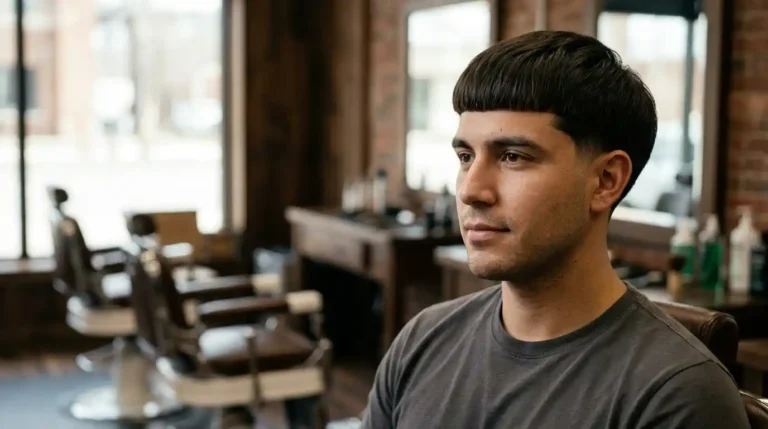
2. Low Taper With a Messy Crop or French Crop
A messy French crop combines a short, textured top with a fringe that falls toward the forehead.
The taper keeps the lower edges clean while the upper hair creates a casual, slightly uneven finish.
Unlike a traditional French crop with a straight, carefully defined fringe, the messy version uses irregular lengths and separation.
The fringe may be broken into small textured sections rather than forming one solid horizontal line.
This is particularly effective for straight or slightly wavy hair.
A top length of approximately 1.5–3 inches can provide enough hair for controlled texture.
The barber may use point cutting to soften the fringe and reduce a blunt appearance.
For styling, rub a small amount of matte clay between your palms and work it through the hair.
Push the fringe forward, then separate selected sections using your fingertips.
If you prefer a heavier, straighter, and more defined fringe, compare this look with an Edgar taper haircut, which typically uses a more structured front edge.
Best for: Straight, thick, or slightly wavy hair; men wanting a low-maintenance crop.
Barber request: “Give me a textured French crop with a broken, messy fringe and a subtle low taper around the temples and neckline.”
3. Low Taper With a Messy Fringe
The low taper messy fringe features longer front hair that falls naturally over part of the forehead.
The sides remain relatively full, while the taper cleans up the lower hairline.
The fringe may be straight, slightly curved, wavy, or separated into irregular sections.
This version is especially appealing for men who want a youthful, casual hairstyle with visible movement.
The top often needs around 3–5 inches of length, depending on whether the fringe should reach the eyebrows or remain above them.
For thick hair, the barber can remove selected bulk to help the fringe fall naturally.
Fine hair usually benefits from softer layering rather than aggressive thinning.
Apply a lightweight texture spray or matte paste, then direct the fringe forward and slightly to one side.
Avoid forcing every strand into the same position.
A little irregularity creates the intentionally messy finish.
Best for: Straight, wavy, or medium-density hair.
Barber request: “Keep enough length for a loose textured fringe, add natural separation, and use a low taper without removing too much side weight.”
4. Mid Taper With a Messy Fringe
A mid taper messy fringe creates a more noticeable contrast than the low taper version.
The shorter transition begins higher around the temples, making the longer fringe stand out.
This can produce a sharper, more contemporary appearance while preserving the casual texture on top.
The fringe may be styled forward, diagonally, or slightly upward.
For naturally wavy hair, the movement often develops without excessive styling.
Straight hair may require layered cutting and a lightweight product to prevent the fringe from falling into one heavy section.
A top length of approximately 3–4 inches gives the barber enough room to create varied movement.
Ask for a natural transition between the longer crown and the shorter sides unless you specifically want disconnection.
For styling, use a small amount of texturizing cream or matte paste.
Lift selected strands near the roots and allow the ends to fall irregularly.
Best for: Men wanting a defined taper with a relaxed, forward-styled top.
Barber request: “Give me a mid taper with a longer textured fringe. Keep the crown connected and make the top look naturally messy.”
5. High Taper With a Textured or Spiky Top
A high taper with a textured top is a bolder version of the messy taper haircut.
The transition rises higher around the temples, reducing more side weight and emphasizing the top.
The hair above can be styled into short, irregular spikes or a separated textured shape.
Unlike older rigid spiky hairstyles, the modern version uses softer, more flexible sections.
A top length around 2–4 inches works for many variations.
Thick, straight hair often holds the texture well, while fine hair may need lightweight mousse or root-lifting products.
The barber should retain enough length through the crown to prevent the top from appearing isolated from the back.
A high taper can be confused with a high fade, so explain how much of the sides you want shortened.
For styling, use matte paste or clay and pinch small sections upward.
Avoid forming identical, evenly spaced spikes.
Best for: Thick or straight hair, short textured styles, and men wanting visible contrast.
Barber request: “Keep a textured, slightly spiky top with a high taper, but preserve a natural connection through the crown.”
6. Messy Quiff With a Mid Taper
The messy quiff combines lifted front hair with a clean mid taper.
Unlike a slick pompadour, this hairstyle emphasizes loose volume, irregular texture, and flexible movement.
The front is longer than the surrounding sections, allowing it to rise and bend backward.
A typical messy quiff may require approximately 3–5 inches of front length.
The barber uses layers to control weight, especially around the crown.
A mid taper adds definition without necessarily removing the entire side panel.
To style the quiff, apply lightweight mousse or a suitable pre-styling product to damp hair.
Blow-dry the front upward and backward using a vent brush or fingers.
Once dry, work a small amount of matte paste through the hair to create separation.
The aim is lift without a perfectly polished shape.
If the hair naturally grows forward, a strong quiff may require additional styling time.
Best for: Straight or wavy hair with enough front length for volume.
Barber request: “Keep extra length in the front for a messy quiff, layer the top for movement, and create a balanced mid taper.”
7. Messy Brush Back With Tapered Sides
The messy brush back moves the longer hair away from the forehead without forcing it into a slick, rigid shape.
The top remains loose, textured, and slightly uneven.
A low or mid taper gives the sides a neat finish while preserving enough length to support the backward movement.
This style works well when the hair naturally grows toward the crown or can be redirected easily.
Medium-length straight and wavy hair are especially suitable.
The barber may use longer layers to create separation and keep the top from appearing too heavy.
For daily styling, begin with damp hair.
Apply a small amount of lightweight cream or mousse, then blow-dry backward using your fingers.
Finish with a flexible product if additional control is needed.
Avoid using large amounts of wet-look gel because this can remove the soft, tousled appearance.
Best for: Medium-length straight or wavy hair and men wanting an open forehead.
Barber request: “Leave the top long enough to brush backward naturally, add soft layers, and keep the tapered sides blended.”
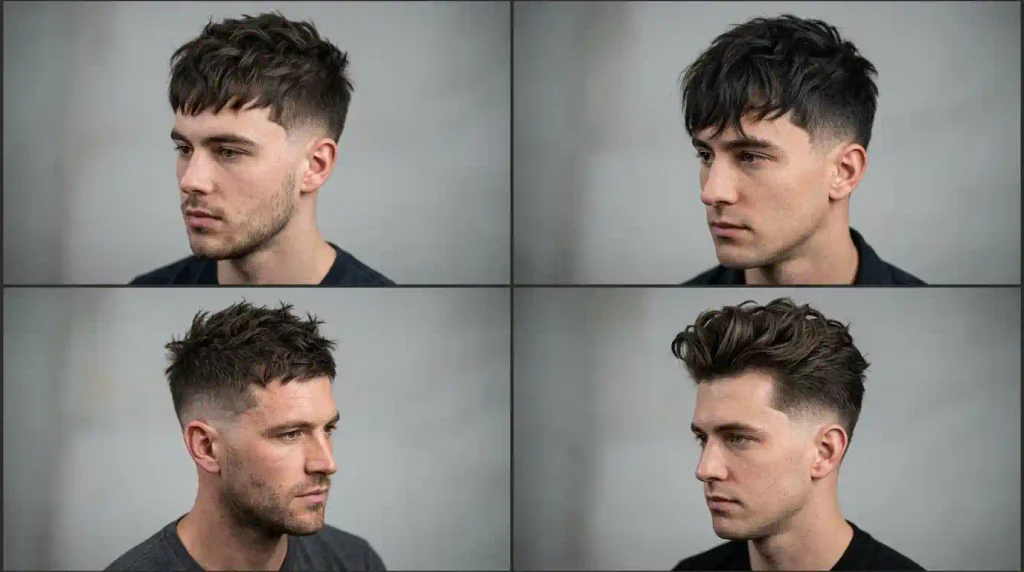
8. Messy Side-Swept Style or Comb Over
A messy side-swept taper combines the direction of a classic comb over with softer texture.
The top is parted loosely and guided diagonally across the head.
Instead of a sharp line and perfectly combed strands, the hair retains small variations in height and direction.
A low taper creates a natural appearance, while a mid taper adds more contrast.
The longer front sections may be allowed to fall slightly forward or rise gently above the forehead.
This is a good option for men who want a versatile haircut that can look relaxed during the day and more polished when necessary.
For styling, apply a small amount of cream or flexible matte paste to towel-dried hair.
Establish a loose side part with your fingers and let the strands settle naturally.
For a more structured version, explore the Comb Over Taper Haircut and compare how the two styles handle the parting and top movement.
Best for: Straight, wavy, fine-to-medium-density hair.
Barber request: “Keep enough length for a relaxed side sweep, add subtle texture, and use a low taper with a natural side part.”
9. Textured Blowout With a Taper
The textured blowout is designed around noticeable root lift and a full, airy silhouette.
The hair rises away from the scalp, creating a fluffy appearance that can move backward or outward.
A low or mid taper defines the edges while leaving the volume concentrated on top.
Compared with a regular messy crop, the blowout usually requires more length and more intentional styling.
Medium-length hair around 3–5 inches is often suitable, although thicker or more resilient hair may achieve visible volume at shorter lengths.
The barber may use layered scissor cutting to reduce excessive weight without thinning the ends too much.
For styling, apply mousse or lightweight volumizing spray to damp hair.
Blow-dry upward using a vent brush, lifting sections from the roots.
Finish with a small amount of matte paste or texture powder.
A blowout should look airy rather than stiff.
For more styling variations, see the Blowout Taper Haircut guide.
Best for: Straight, thick, wavy, or medium-density hair that can hold root volume.
Barber request: “Keep enough top length for a textured blowout, preserve volume through the crown, and add a clean low or mid taper.”
10. Fluffy or High-Volume Top With a Taper
The fluffy taper is one of the most recognizable high-volume variations of the messy taper haircut.
It features a soft, airy top with lifted roots and loosely separated strands.
The hair often bends upward and forward, creating a rounded, full silhouette.
Unlike a rigid quiff, a fluffy top should move naturally and retain a lightweight appearance.
This haircut works particularly well with medium-length straight or slightly wavy hair.
A low taper preserves side fullness, while a mid taper can make the top appear more pronounced.
The barber should use layers carefully.
Too much thinning can remove the weight needed for a balanced fluffy shape, while too little shaping may cause the hair to collapse into a solid mass.
A round brush, vent brush, or fingers can be used during blow-drying.
Lightweight mousse or texturizing powder can help support root lift.
Avoid applying heavy oils or thick wax near the roots because they may flatten the hairstyle.
The phrase fluffy taper haircut men commonly describes this soft, voluminous look with clean tapered edges.
Best for: Straight, lightly wavy, and medium-density hair.
Barber request: “I want a fluffy, high-volume textured top with enough length for lift, and a low taper that keeps the sides neat.”
11. Messy Faux Hawk With a Low Taper
The messy faux hawk creates a loose central section of lifted hair without the extreme shaved sides of a traditional mohawk.
The top may be pushed upward and slightly toward the center, creating a subtle peak or textured ridge.
A low taper maintains a cleaner, more natural perimeter.
The barber can leave the crown and central top slightly longer, allowing the hair to form the desired shape.
This version works best when the top has enough length to lift but is not so heavy that it collapses.
Thick straight hair may hold the shape with minimal effort.
Fine hair may require mousse, texture powder, or a lightweight matte paste.
Unlike a highly structured faux hawk, the messy version should not form a rigid, narrow strip.
For a stronger variation, compare it with the fohawk taper haircut, which emphasizes a more recognizable central silhouette.
Best for: Short-to-medium hair and men wanting a slightly bold, textured style.
Barber request: “Leave a little extra length through the center of the top, add irregular texture, and use a soft low taper.”
12. Disconnected Messy Taper
A disconnected messy taper emphasizes the contrast between the longer top and shorter sides.
Instead of blending every section seamlessly, the haircut retains a more visible difference in length.
The top may overhang the shorter side panel or form a stronger weight line around the parietal ridge.
This creates a bold, contemporary silhouette.
The messy texture softens the contrast by adding movement above the disconnected area.
A high taper or shortened side section can make the disconnection particularly noticeable.
However, it is important to understand that this is less traditional than a classic taper.
If the barber takes the sides extremely short, the result may resemble a disconnected undercut rather than a subtle taper.
For styling, use a lightweight matte product to separate the top into loose sections.
Keep the sides clean so the contrast looks deliberate.
Best for: Thick or medium-density hair and men who prefer a defined, high-contrast haircut.
Barber request: “Keep a longer, messy textured top with visible contrast to the shorter sides. Show me where the disconnection will begin before cutting.”
13. Messy Taper Mullet
The messy taper mullet combines a textured front and crown with additional length through the back.
The taper usually cleans up the sideburns and areas around the ears.
Unlike a traditional short-back haircut, the longer nape is an important part of the silhouette.
The top may contain choppy layers, a loose fringe, or lifted texture.
A soft low taper produces a more natural appearance, while a burst-style taper can emphasize the curved area around the ears.
The barber should preserve enough length through the back for movement.
If the neckline is tapered too high, the mullet shape may disappear.
This hairstyle works well with straight, wavy, and curly hair.
Waves and curls can make the longer back look especially textured.
For styling, use a small amount of cream or mousse and allow the hair to dry naturally.
A diffuser can help maintain curls and waves.
Best for: Men who want a distinctive longer-back hairstyle with clean edges.
Barber request: “Keep a messy layered top and extra length at the back, with a subtle taper around the ears and sideburns.”
14. Long Messy Top With a Clean Taper
A long messy top with a taper provides more movement and styling flexibility than the shorter variations.
The top may measure 5–7 inches or longer, allowing the hair to sweep backward, fall toward the face, or separate into loose sections.
A low taper keeps the perimeter clean without removing unnecessary length.
The barber should create soft layers that prevent the hair from becoming heavy and shapeless.
For thick hair, carefully placed layers can distribute the weight.
For fine hair, retaining sufficient fullness around the ends may be more important than extensive texturizing.
This style works well for men transitioning toward longer hairstyles.
It can be worn naturally tousled, loosely side-swept, or brushed backward.
If you prefer a longer hairstyle built around flowing movement rather than shorter choppy texture, the Flow Taper Haircut is a closely related option.
For daily styling, apply a lightweight cream to damp hair, guide it into position with your fingers, and allow it to air-dry.
Best for: Medium-to-long straight, wavy, or curly hair.
Barber request: “Keep most of the length on top, use soft layers for natural movement, and clean up the sideburns and neckline with a low taper.”
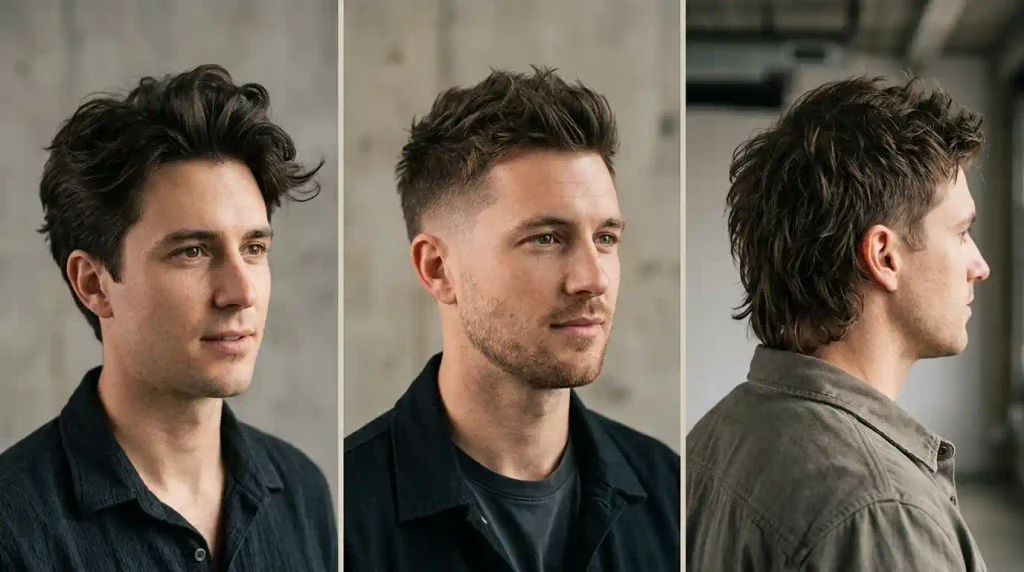
Choosing a Messy Taper for Your Hair Type
Hair type significantly influences the way a messy taper behaves.
A hairstyle that looks effortlessly fluffy on one person may require considerable styling on someone with a different texture or growth pattern.
The goal is not to force every hair type into the same shape, but to select a variation that uses its natural characteristics.
Messy Taper for Straight or Fine Hair
Straight hair can produce sharp, attractive texture, but it sometimes falls flat when the top is too heavy.
For fine hair, a short or medium-length textured top is often easier to manage than an extremely long, dense fringe.
The barber should use controlled layering rather than excessive thinning.
Too many short layers can make the ends appear sparse.
A low taper preserves fullness around the sides, while a mid taper can create stronger visual contrast.
For daily styling, lightweight products are usually preferable.
Mousse can support root lift, while a small amount of matte paste can help create separation.
Texture powder may also help with volume, but applying too much can make hair feel dry or rough.
Blow-drying the front upward and slightly backward can increase the appearance of fullness.
If your hair is very short and you prefer minimal styling, a Buzz Taper Haircut may be easier to maintain than a fluffy textured top.
Messy Taper for Wavy Hair
Wavy hair naturally creates bends and directional changes, making it especially suitable for a messy taper.
A loose fringe, textured brush back, or medium-length low taper can work with the existing wave pattern.
The barber should shape the hair while considering how the waves settle when dry.
Over-thinning may disrupt the wave pattern or produce unnecessary frizz.
Soft layers generally help maintain movement without removing excessive weight.
For styling, apply a lightweight cream or mousse to damp hair.
Use your fingers to distribute the product and gently scrunch the waves.
Air-drying often produces a relaxed result.
If you prefer additional volume, use a diffuser on a low or medium heat setting.
Avoid brushing the hair repeatedly once dry, as this can separate the waves and create a less defined appearance.
Messy Taper for Curly or Coily Hair
Curly and coily hair can create a distinctive textured taper with natural volume and definition.
The messy appearance comes from the arrangement of curls or coils rather than artificially producing straight, spiky strands.
A low temple taper can keep the edges clean while retaining substantial volume above.
A mid taper can create more contrast if that suits the desired silhouette.
The barber should account for curl shrinkage before deciding how much length to remove.
Hair that appears long when wet or stretched may look considerably shorter once dry.
A shape check in the hair’s natural state can help prevent uneven proportions.
For styling, use leave-in conditioner, curl cream, or another product appropriate for your texture.
Gently define curls with your fingers, and use a diffuser or air-drying method according to your hair’s needs.
Coily hair can also be styled into textured twists or shaped longer sections with a tapered perimeter.
Avoid assuming that every curly or coily haircut requires aggressive thinning.
Preserving curl structure and moisture is usually more important than forcing uniform separation.
Messy Taper for Thick Hair
Thick, dense hair can support impressive volume, but it may also become bulky.
Without proper shaping, a fluffy top can look excessively wide or heavy.
A barber can use layered cutting and selective weight removal to improve movement.
The amount of thinning should depend on hair density, strand diameter, and natural texture.
For some thick straight hair, point cutting can create separation without removing too much structural weight.
For thick wavy or curly hair, excessive thinning may increase frizz.
A mid taper can reduce some of the visual width around the temples.
A low taper works well if you prefer more side fullness.
For styling, use products that provide flexible control without excessive buildup.
A small amount of matte clay can help thicker straight hair maintain texture.
Styling cream may be more suitable for thick wavy or dry hair.
If your hair naturally stands outward, use blow-drying to guide the roots rather than adding more product.
How Cowlicks and Hair Growth Patterns Affect the Cut
A cowlick is an area where the hair grows in a different direction from the surrounding strands.
Hair whorls around the crown and directional growth near the forehead can strongly influence a messy taper.
For example, a front cowlick may cause the fringe to rise instead of falling evenly.
Rather than attempting to flatten it completely, the barber can sometimes use the natural lift to create a textured quiff.
A crown whorl may cause one section to stick upward if it is cut too short.
Leaving slightly more length around that area can help the hair settle.
A strong natural side part may also make a side-swept messy taper easier to style than a centered fringe.
Before cutting, the barber should examine the hair while it is dry and lying naturally.
This reveals growth patterns that may be less obvious when the hair is wet.
The best haircut generally works with those patterns rather than relying on heavy styling products to hide them.
Choosing the Taper and Top for Your Face Shape
Face shape can help guide haircut proportions, but it should not determine the style on its own.
Hairline, forehead height, head shape, texture, and personal preference all affect the finished result.
Low, Mid, or High Taper Placement
The taper height changes how much weight remains around the sides of the head.
Low taper: The shortest transition stays near the sideburns and neckline. It creates a softer silhouette and preserves more side fullness.
Mid taper: The transition begins higher around the temples, creating a more visible contrast between the upper hair and shorter edges.
High taper: The short transition rises farther up the sides, emphasizing the top and reducing more side weight.
| Taper Placement | Visual Effect | Suitable Messy Styles |
| Low taper | Natural and understated | Messy crop, soft fringe, long messy top |
| Mid taper | Balanced contrast | Messy quiff, textured fringe, brush back |
| High taper | Stronger top emphasis | Spiky top, disconnected messy taper |
A high taper should not automatically become a high fade.
If you want the shortest sections confined to specific areas, explain this before the barber begins.
Similarly, a skin fade may create more contrast than intended for a soft, fluffy top.
Top Length and Texture
Top length changes how the haircut frames the face.
A short textured top creates a compact silhouette with limited movement.
A medium-length top provides more opportunities for fringe styling, root lift, and a messy quiff.
A longer top can create flowing movement but may also add visual weight around the forehead and temples.
For a round face, a little more height on top may create the appearance of additional length.
For an oblong face, excessive vertical volume may make the face appear longer.
The amount of texture also matters.
Soft separation produces a subtle finish, while choppy layers create a more energetic appearance.
A fringe can change the visible proportions of the forehead, while a brush back exposes more of the face.
These are styling choices rather than fixed rules.
Face Shapes and Proportions to Consider
Oval face: An oval face can accommodate a wide range of messy taper variations. A low taper with a fluffy top, side-swept fringe, or textured quiff can all work depending on hair texture.
Round face: A mid taper with moderate height on top may create a more elongated appearance. Avoid excessive width around the temples if a narrower silhouette is your goal.
Square face: Soft texture can complement a defined jawline. A messy fringe, layered crop, or natural low taper provides movement without making the haircut overly rigid.
Oblong face: A textured fringe or medium-length side-swept top can reduce the appearance of excessive vertical length. Very tall quiffs may emphasize facial length.
Heart-shaped face: A soft fringe and balanced sides can complement a wider forehead and narrower jaw. Avoid removing too much side weight if it makes the upper face appear disproportionately broad.
Receding hairlines also influence style selection.
A textured crop may help soften a visible recession, while a deliberately styled quiff can work for someone comfortable exposing the forehead.
For a shorter, more controlled hairstyle, a Drake Taper Haircut can provide inspiration for clean, structured taper proportions.
The most useful approach is to compare reference photographs with similar hair density, growth patterns, and facial proportions.
How to Ask Your Barber for a Messy Taper
Clear communication is essential because the words messy and taper leave considerable room for interpretation.
One barber might imagine a short textured crop, while another might picture a longer fluffy fringe with a skin taper.
Explaining the details before the haircut reduces the risk of getting a style that looks very different from your reference.
Describe the Taper Height and Neckline Finish
Start by telling the barber whether you want a low, mid, or high taper.
Next, explain how short the hair should become near the sideburns and neckline.
If you prefer a subtle haircut, ask for a low taper that retains visible hair at the lower edges.
If you want stronger contrast, discuss a taper fade or skin taper.
Also specify how you want the neckline finished.
A natural tapered neckline usually blends gradually into the surrounding hair.
A sharply lined or blocked neckline creates a more defined outline but may become noticeably uneven during grow-out.
For a relaxed messy haircut, a natural tapered neckline often complements the overall style.
If you wear a beard, ask whether the barber can blend the sideburns into the beard.
Explain the Top Length and Texture You Want
Avoid simply asking the barber to make the top messy.
Describe the amount of length you want to retain.
For example, a short textured crop may need approximately two inches of top length, while a fluffy fringe may require four inches or more.
Explain whether you want the hair to move forward, upward, backward, or diagonally.
Then describe the texture.
Soft, blended layers produce a natural appearance.
Choppy layers can create stronger separation.
A heavily thinned top may look wispy, particularly on fine hair.
If your hair is already curly or wavy, ask the barber to preserve its natural pattern rather than introducing unnecessary texture.
The most useful instruction is to request enough structure for the hairstyle to look balanced when it is not perfectly styled.
What to Tell Your Barber About the Sides, Back, and Top
Different sections of the haircut need different instructions.
| Haircut Area | What to Request | What to Avoid |
| Top | Enough length for movement and texture | Excessively short, uniform cutting |
| Fringe | Natural or choppy separation | Unwanted blunt fringe |
| Crown | Connected layers | Cutting too short around a whorl |
| Upper sides | Balanced weight | Removing too much fullness |
| Temples | Low, mid, or high taper | Unspecified fade height |
| Sideburns | Clean gradual blend | Harsh steps or uneven taper |
| Neckline | Natural or clearly defined finish | Unwanted high fade |
| Back | Balanced connection to the top | Excessive bulk or disconnection |
For a classic messy taper, preserving a smooth connection between the longer top and upper sides is usually important.
For a disconnected version, the barber can intentionally leave a stronger difference in length.
Make sure both of you understand which appearance you want.
Bring a Reference Photo and Discuss Your Hair’s Growth Pattern
Reference photographs are especially helpful for textured hairstyles.
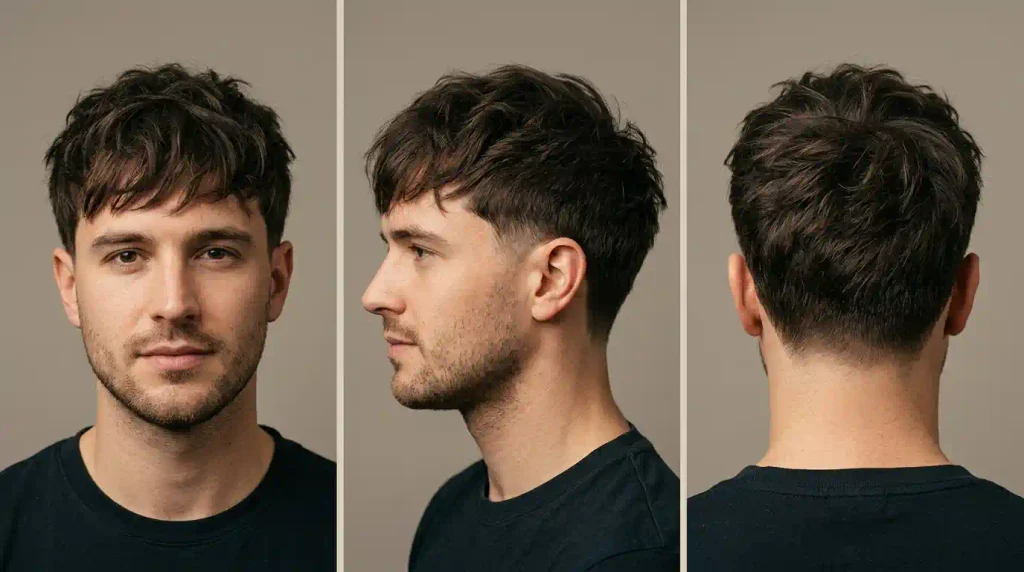
Bring a front view to show the fringe, top volume, and overall silhouette.
Bring a side view to demonstrate taper height and how much hair remains above the ears.
A back view helps communicate the neckline and crown shape.
Try to find reference photos featuring hair similar to your own.
A fluffy hairstyle shown on thick, naturally wavy hair may not behave the same way on very fine straight hair.
Ask your barber whether the style is realistic for your current length, density, and growth direction.
A skilled professional can often suggest adjustments that preserve the overall appearance while making the haircut easier to maintain.
Example Barber Script
You can use the following description during your appointment:
“I want a messy taper haircut with a textured, natural-looking top. Please keep around three to four inches on top, depending on what works for my hair, and create soft, uneven layers so the hair has movement. I want a low taper around the temples, sideburns, and neckline, but I don’t want the fade carried too high. Keep enough weight above the ears and through the crown so the top looks full. I want to style it with a matte product and my fingers, without making it look stiff or overly neat.”
For a fluffy variation, add:
“Please leave enough length at the front and roots for blow-dried volume, and avoid thinning the top so much that it looks sparse.”
For a curly variation, add:
“Please work with my natural curl pattern and consider how much my curls shrink after drying.”
This gives the barber a much clearer starting point than asking for a generic messy haircut.
How a Barber Creates the Cut
The cutting process depends on the chosen variation and hair texture.
However, most messy tapers involve establishing the overall shape, creating a controlled taper, and adding enough top texture for natural movement.
Sectioning the Top and Sides
The barber begins by examining hair density, length, growth direction, and head shape.
The upper hair may be separated from the sides using clips or sectioning lines.
This helps preserve the intended top length while the taper is created.
For short textured crops, the barber might establish a guide length across the top and use scissors to connect the sections.
For medium-length fluffy hair, the front may be left longer than the crown to allow for lift and movement.
The upper sides must also be considered carefully.
If too much weight is removed near the parietal ridge, the top may overhang the sides rather than blending naturally.
The correct sectioning plan depends on whether the haircut should be connected or disconnected.
Building the Taper and Weight Line
The taper is usually created with clippers and progressively adjusted cutting lengths.
A barber may use different clipper guards, lever positions, and clipper-over-comb techniques to produce a smooth transition.
A low taper concentrates the shortest lengths near the temples, sideburns, and nape.
A mid or high taper extends the blend farther upward.
The weight line is the area where longer hair transitions into shorter hair.
For a classic messy taper, this line should usually be softened so that the sides connect naturally to the top.
For a disconnected version, the weight line may remain more noticeable.
The barber should check both sides for balance while respecting natural differences in head shape and hair growth.
The neckline may be softly tapered or given a sharper outline depending on your preference.
Adding Texture and Checking the Finished Shape
After establishing the main haircut, the barber refines the top.
Point cutting can soften blunt ends and create subtle variation in length.
Deep point cutting may remove more internal weight, but it should be used carefully because excessive removal can weaken the shape.
Layering can distribute weight and encourage movement through the top and crown.
Razor cutting may create soft texture on appropriate hair types, but it is not ideal for every texture or hair condition.
Thinning shears can reduce bulk in selected areas, although overuse may create short internal pieces and unwanted frizz.
The barber should check the finished shape when the hair is styled in the direction you intend to wear it.
This helps reveal whether the fringe, crown, and sides work together.
A good messy taper should retain a recognizable structure even if the top is styled loosely.
Tools and Techniques Used
Common barbering tools include clippers, clipper guards, a trimmer, scissors, combs, and sometimes thinning shears or razors.
| Tool or Technique | Main Purpose |
| Clippers | Create shorter, blended taper sections |
| Clipper guards | Control cutting length |
| Trimmer | Refine edges and hairline details |
| Scissors | Establish top length and shape |
| Point cutting | Add separation and soften ends |
| Deep point cutting | Remove selected internal weight |
| Thinning shears | Reduce density in suitable areas |
| Razor cutting | Create softer texture on appropriate hair types |
| Scissor-over-comb | Refine transitions and bulky areas |
| Vent brush | Direct hair while blow-drying |
| Round brush | Encourage root lift and curved volume |
| Diffuser | Dry waves and curls with less disruption |
The quality of the haircut depends more on the barber’s judgment than on any single tool.
A well-designed shape should account for density, texture, growth patterns, and the way you intend to style your hair.
How to Style a Messy Taper at Home
Styling is where the haircut’s texture becomes visible.
The goal is to create controlled movement without making the hair stiff, greasy, or overly uniform.
A simple routine is often enough, especially when the haircut is designed around your natural hair texture.
Styling Steps for a Natural, Tousled Finish
Step 1: Start with clean or lightly refreshed hair.
Your hair does not have to be freshly shampooed every day.
If it already feels clean, misting it lightly with water may be enough to reset the shape.
For a natural messy finish, slightly damp or towel-dried hair is often easier to work with than completely wet hair.
Step 2: Choose a product suited to your hair type.
Fine hair may benefit from lightweight mousse or styling spray.
Thick straight hair may respond well to matte paste or clay.
Wavy hair may need only a small amount of cream.
Curly or coily hair may benefit from leave-in conditioner and curl cream.
Step 3: Apply the product evenly.
Start with a small amount.
For creams and pastes, spread the product across your palms and fingers before touching your hair.
Focus on the areas that need control or texture.
Avoid depositing all the product in one section.
Step 4: Create movement with your fingers.
Lift sections, push selected strands forward or sideways, and allow others to fall naturally.
Do not try to make every strand follow the same direction.
For a messy fringe, guide the front forward and separate a few sections.
For a quiff, lift the front and move it slightly backward.
Step 5: Blow-dry if you need more volume.
Use a low or medium heat setting and a heat protectant when appropriate.
A vent brush or fingers can help establish root lift.
For curly hair, a diffuser can preserve definition.
Step 6: Finish with controlled texture.
Once the hair is dry, make small adjustments using your fingertips.
Add a very small amount of matte paste or texture powder only if necessary.
Stop before the hairstyle becomes overly separated or stiff.
Step 7: Check the sides and neckline.
The longer top can remain deliberately messy, but the taper should retain its intended outline.
Smooth down obvious stray hairs around the upper sides without flattening the entire hairstyle.
How to Style a Messy Taper for Your Hair Texture
Different hair textures respond to styling products and drying methods differently.
Straight Hair
Straight hair often needs help creating texture.
Apply lightweight mousse or texturizing spray to damp hair.
Blow-dry while lifting sections in different directions.
Once dry, use a small amount of matte paste to create separation.
Avoid pressing the hair flat with your palms.
Fine Hair
Fine hair benefits from products that provide lift without adding excessive weight.
Use lightweight mousse near the roots and blow-dry gently.
If additional hold is needed, use a small amount of texture powder or a lightweight paste.
Heavy waxes and thick oils may cause the top to collapse.
Thick Hair
Thick hair may already have enough volume but need more control.
Use a small amount of styling cream before drying.
Direct the hair according to the desired shape.
After drying, add matte clay or paste to selected sections.
Avoid applying large amounts of product throughout the roots.
Wavy Hair
Apply styling cream or light mousse to damp hair.
Scrunch gently to encourage the wave pattern.
Allow the hair to air-dry or use a diffuser.
Once dry, separate only a few sections with your fingers.
Excessive brushing can disrupt the waves and increase frizz.
Curly and Coily Hair
Apply leave-in conditioner or curl cream while the hair is damp.
Distribute the product gently without pulling the hair excessively.
Define curls or coils using your fingers or an appropriate styling method.
Air-dry or diffuse according to your hair’s needs.
A messy finish can be created through natural variation in the curls rather than deliberately making them frizzy.
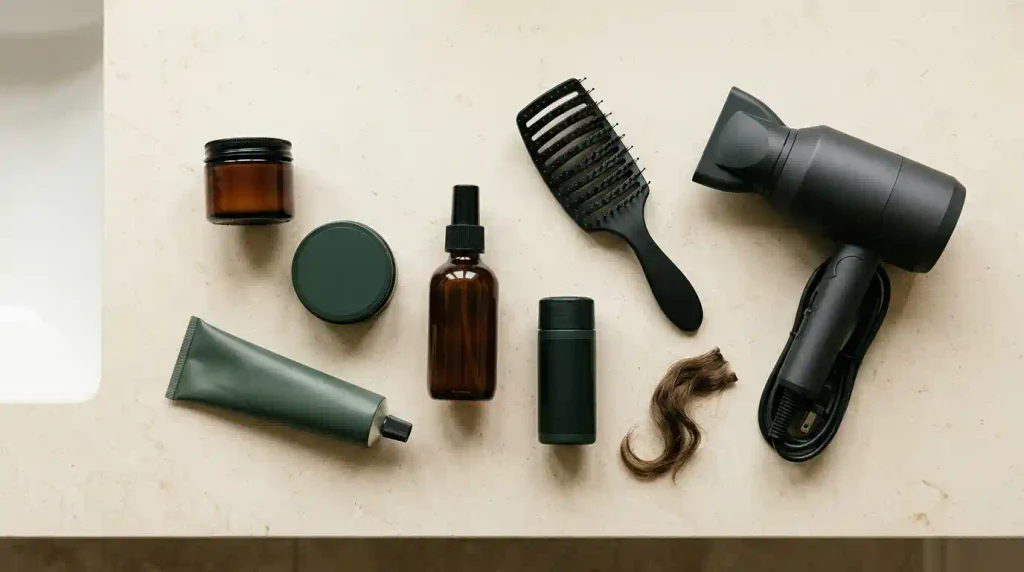
Choosing a Product for Your Hair Type
The ideal styling product depends on hair density, texture, length, and the amount of hold you want.
| Styling Product | Best For | Finish | Hold |
| Matte clay | Thick straight hair, short textured top | Matte and separated | Medium to strong |
| Matte paste | Most short-to-medium messy styles | Natural matte texture | Light to medium |
| Styling cream | Wavy, medium, or dry hair | Soft and flexible | Light |
| Texturizing cream | Natural movement and separation | Flexible texture | Light to medium |
| Sea salt spray | Suitable straight or wavy hair | Tousled, slightly gritty | Light |
| Texturizing powder | Fine or flat hair | Dry, airy volume | Light to medium |
| Mousse | Fine or medium hair needing root lift | Lightweight volume | Light to medium |
| Curl cream | Curly and coily hair | Defined curls | Varies |
| Leave-in cream | Dry or longer hair | Moisturized and soft | Minimal |
| Pomade | Controlled brush back or side sweep | Smooth or shiny | Varies |
| Wax | Short textured sections | Defined separation | Medium to strong |
| Gel | Structured or wet-look styling | Firm or shiny | Varies |
These are general product categories. Individual formulations may behave differently.
A product described as matte clay may feel lightweight in one formula and heavy in another.
Similarly, some styling creams provide only softness, while others offer noticeable hold.
When trying a product, begin with less than you think you need.
You can always add more, but removing excess often requires washing the hair.
When to Use Matte Clay, Paste, Cream, or Sea Salt Spray
Matte Clay for Controlled Texture
Matte clay works well for short-to-medium textured hairstyles, particularly when the hair is thick enough to support separation.
It can create visible definition and a relatively dry finish.
However, heavy formulations may not suit fine or dry hair.
Start with a small amount and apply it mainly to dry hair.
Matte Paste for Flexible Messiness
Matte paste is one of the most versatile products for a messy taper.
It helps separate strands without necessarily creating a hard, glossy finish.
It is useful for textured crops, messy fringes, and short quiffs.
For a softer result, use a small amount rather than coating the entire top.
Styling Cream for Natural Movement
Styling cream is suitable when you want a relaxed appearance with minimal stiffness.
It works especially well for medium-length or wavy messy tapers.
It can help control flyaways while preserving movement.
For fine hair, choose a lightweight formulation.
For dry or coarse hair, a richer cream may be more suitable.
Sea Salt Spray for Tousled Texture
Sea salt spray can add a slightly gritty texture that makes some straight and wavy hair easier to separate.
It is often used for surfer-inspired or casual messy hairstyles.
However, salt-based products can leave certain hair types feeling dry.
If your hair is already dry, curly, or prone to frizz, a moisturizing cream may be a better starting point.
Avoid treating sea salt spray as a necessary product for every fluffy hairstyle.
Texturizing Powder for Root Volume
Texturizing powder can be useful for fine or flat hair because it adds grip near the roots.
Apply a small amount to dry hair and distribute it with your fingertips.
Excessive powder can make hair feel rough or leave visible residue, especially on dark hair.
Use it sparingly and remove product buildup through an appropriate cleansing routine.
Messy Taper Maintenance
The messy taper needs regular attention to preserve its balance between a textured top and neat edges.
However, it does not necessarily require the same maintenance schedule as a sharp skin fade.
How Often to Get the Taper Trimmed
A taper cleanup every 2–4 weeks is a practical starting point for many men.
The ideal interval depends on your hair growth rate and how defined you want the shortest areas to remain.
A low taper with a natural finish can often grow out more forgivingly.
A high taper or skin taper may show regrowth sooner.
The longer top may not need trimming at every visit.
For many short-to-medium messy styles, checking the top’s shape approximately every 4–8 weeks can help preserve the intended proportions.
If you are growing the top longer, discuss that goal with your barber so the maintenance appointment does not remove unnecessary length.
Washing and Conditioning Textured Hair
Styling products, scalp oil, sweat, and environmental buildup can make textured hair feel heavy.
Choose a washing routine based on how quickly your scalp becomes oily or your hair accumulates product.
Straight hair with an oily scalp may need more frequent shampooing.
Dry, curly, or coily hair may benefit from a different washing schedule and greater emphasis on conditioning.
Apply shampoo primarily to the scalp rather than aggressively scrubbing the entire length.
Use conditioner suited to your hair type.
Fine hair may need conditioner concentrated on the ends, while dry or curly hair can benefit from conditioning more of the hair length.
Detangle gently and avoid rough towel rubbing.
For further guidance, the American Academy of Dermatology’s healthy hair tips explain how washing, conditioning, gentle handling, and limiting excessive heat help maintain hair condition.
Healthy-looking hair is easier to style because breakage, dryness, and excessive frizz can interfere with the intended texture.
Keeping the Top’s Shape Between Barber Visits
The messy top will gradually change as it grows.
Short textured crops may become heavier around the fringe.
Fluffy tops may lose some lift as the hair becomes longer.
Quiffs may need more drying time once the front gains weight.
Instead of automatically cutting everything shorter, identify which area is causing the problem.
If the fringe becomes too heavy, ask for limited shaping.
If the crown looks bulky, the barber may redistribute weight through selective layering.
If the sides begin puffing outward, a small scissor adjustment may be enough.
For a longer messy style, maintaining the overall length may be more important than preserving a perfectly fresh haircut.
How a Messy Taper Grows Out
A soft low taper often transitions gradually as the shorter sections grow.
The difference between the top and edges becomes less obvious over time.
High tapers and skin tapers can develop a more noticeable grown-out appearance because the shortest areas gain length against a contrasting upper section.
The top may also change shape.
A short messy fringe can become a longer forward-swept style.
A textured quiff may become a medium-length brush back.
If you prefer a shorter, more structured alternative during grow-out, a Taper Haircut Crew Cut Low Fade offers a different balance of short length and clean edges.
Otherwise, regular perimeter cleanup and occasional top shaping can help the messy taper develop naturally.
Common Messy Taper Mistakes to Avoid
The difference between an attractive messy taper and an unbalanced haircut often comes down to small decisions about taper height, layering, and styling.
Taking the Taper Too High
One of the most common mistakes is allowing the taper to extend farther upward than intended.
A high transition can remove the side weight that supports a fluffy or naturally messy top.
This may create an unwanted mushroom-like silhouette or make the top appear disconnected.
If you want a soft haircut, request a low taper and explain how much fullness should remain above the ears.
Bring side-view reference photographs so the barber understands the intended height.
A high taper is not necessarily wrong, but it should be a deliberate styling choice.
Removing Too Much Length or Weight From the Top
Texture does not mean the barber should aggressively thin every section.
Excessive thinning can make the hair appear sparse, especially if it is already fine.
It can also produce short internal strands that stick outward or create frizz.
Removing too much front length may eliminate the ability to form a fluffy fringe or quiff.
Before cutting, explain how you plan to style the top.
Ask the barber to preserve enough length for the intended direction and movement.
A carefully layered haircut is usually more useful than indiscriminate thinning.
Using Too Much Product
Heavy product buildup can flatten the hairstyle and make the texture look greasy.
Applying too much clay may cause the hair to clump together.
Excessive wax can produce a stiff finish.
Large amounts of sea salt spray or texture powder may leave the hair feeling dry.
Start with a small amount and increase gradually.
For most messy styles, the goal is enough hold to support separation while allowing natural movement.
If your hair feels sticky or heavy, the problem may be product quantity rather than the haircut.
Making the Texture Look Overly Uniform
A messy taper is intended to have variation.
If every strand is brushed forward in a straight line, the haircut may resemble a neat crop instead of a tousled style.
If every section is lifted into identical spikes, it can appear overly deliberate.
Create movement in several directions.
Allow some strands to rise, others to fall, and a few to move sideways.
Use your fingers for the final styling rather than repeatedly combing every section into the same shape.
At the same time, avoid excessive random movement that destroys the overall silhouette.
Controlled irregularity is what gives the messy taper its relaxed appearance.
Frequently Asked Questions
Is a messy taper suitable for fine or straight hair?
Yes, a messy taper works with fine or straight hair when the top has suitable layers and lightweight styling products provide separation without excessive weight.
Which taper height works best with a messy top?
A low taper is a versatile choice for natural texture, while a mid or high taper creates progressively stronger contrast.
Can you get a messy taper with curly hair?
Yes, curly hair works well with a messy taper when the barber preserves the natural curl pattern and accounts for shrinkage.
What should you tell your barber?
Ask for a specific taper height, your preferred top length, and natural-looking texture while explaining whether you want a fringe, quiff, crop, or brush-back shape.
How often should you trim a messy taper?
A taper cleanup every 2–4 weeks is a useful starting point, with top trims scheduled according to length, growth rate, and desired shape.
Which styling product works best for a messy taper?
Matte paste is a versatile option, but fine hair may benefit from mousse, thick hair from clay, and wavy or curly hair from styling or curl cream.
Final Thoughts
The messy taper haircut offers a practical combination of clean edges, natural movement, and modern texture. Whether you prefer a low taper with a casual messy fringe, a mid taper with a fluffy quiff, or a bold textured blowout, the best result depends on your hair type, face shape, top length, and styling routine.
For a versatile everyday look, start with a low taper and soft textured layers. If you want stronger contrast, experiment with a mid or high taper while preserving enough length for movement. Use lightweight products, avoid excessive thinning, and communicate your preferred shape clearly to your barber.
For additional haircut inspiration and grooming advice, explore Taper Haircut Hub and discover more Hairstyles with taper to find a style that suits your hair and personality.



5 Comments