

Buzz Taper Haircut: Short Styles & Guard Choices
The buzz taper haircut combines the clean, practical appearance of a buzz cut with a gradual taper around the temples, sideburns, and neckline. Unlike a traditional buzz cut that uses one clipper guard across the entire head, a buzz taper creates subtle or noticeable contrast while keeping the overall hairstyle short and easy to maintain. Whether you prefer a low buzz taper with a #3 guard, a balanced mid taper with a #2 top, or a sharper skin taper with a #1 buzz, the right combination depends on your hair texture, head shape, hairline, and personal preferences. It’s a popular choice for men who want a neat haircut without spending much time styling, but understanding guard lengths and taper placement is essential before visiting the barber. This guide explores the most practical buzz taper styles, compares taper and fade variations, explains clipper guard sizes, and provides barber instructions, home-cutting techniques, maintenance advice, and scalp-care tips to help you choose a haircut that suits you.
Table of Contents
- Buzz Taper at a Glance
- What Is a Buzz Taper Haircut?
- Buzz Taper vs. Similar Haircuts
- Buzz Taper Styles and Variations
- Choosing a Buzz Taper for Your Hair and Features
- How to Preview a Buzz Taper Before Committing
- What to Tell Your Barber
- How to Cut a Buzz Taper at Home
- How to Fix a Buzz Taper That Didn’t Turn Out Right
- Maintenance and Grow-Out
- Scalp Care and Risks of a Very Short Cut
- Frequently Asked Questions
- Conclusion
Buzz Taper at a Glance
A buzz taper is a short haircut featuring closely cropped hair on top and a progressively shorter finish around the perimeter.
The top is usually clipped to a uniform length, although some variations retain slightly more hair toward the front or crown. The taper creates a clean transition without necessarily removing most of the side hair.
| Feature | Buzz Taper Haircut Details |
| Haircut category | Short men’s haircut |
| Main feature | Buzzed top with tapered temples and neckline |
| Common top guards | #1, #2, #3, and #4 |
| Popular taper heights | Low, mid, and high |
| Shortest finish | Short clipper cut, zero guard, or skin |
| Hair types | Straight, wavy, curly, and coily |
| Styling effort | Usually minimal |
| Typical maintenance | Every 2–4 weeks |
| Professional appearance | Generally suitable for many workplaces |
| Home cutting | Possible, although blending takes practice |
| Main consideration | Head shape, scalp visibility, and guard length |
A #2 or #3 top with a low taper is often a reasonable starting point for someone trying this haircut for the first time.
It provides a recognizable buzz cut while retaining enough coverage to avoid the extremely close appearance of an induction cut.
For more contrast, a mid taper or shorter perimeter can make the haircut look sharper.
However, the best buzz taper is not necessarily the shortest one. The goal is to select a length and taper placement that work together to create a balanced shape.
What Is a Buzz Taper Haircut?
A buzz taper haircut is a variation of the traditional buzz cut that incorporates gradual length changes around the temples, sideburns, and neckline.
The buzzed top establishes the haircut’s short, uniform appearance, while the taper adds definition to the edges.
A standard buzz cut can be created with a single clipper attachment. A tapered buzz cut usually requires multiple cutting lengths and more detailed blending.
The taper may be subtle enough to look natural or short enough to reveal some scalp around the perimeter.
The result depends on three major decisions: the top guard number, the height of the taper, and the shortest length used near the hairline.
How the buzzed top differs from the tapered sides and back
The top of a buzz taper is generally cut with a consistent clipper guard.
For example, someone might choose a #3 guard, leaving approximately 3/8 inch of hair across the upper head.
The barber then uses shorter guard lengths around the lower temples and nape to create the taper.
A common combination is a #3 top, a #2 transition, and a shorter finish around the sideburns and neckline.
The exact sequence depends on where the taper begins and how much length remains on the surrounding side panels.
Unlike a crew cut, which typically maintains more length toward the front, a traditional buzz taper often keeps the top relatively even.
However, modern variations may include extra texture, a slightly longer fringe, or a gradually graduated top.
The defining difference is that the buzzed portion creates a compact hairstyle, while the taper shapes the perimeter.
Where the taper starts and how it finishes
Taper placement determines how much of the surrounding hair is shortened.
A low taper focuses on the lower temple, sideburn, and neckline areas.
A mid taper extends the transition somewhat higher, creating more visible contrast.
A high taper raises the shortened area further up the sides but can begin resembling a conventional fade if it spreads across most of the side panel.
The barber should also consider the parietal ridge, the area where the upper sides of the head transition toward the top.
Maintaining an appropriate connection through this region helps prevent the haircut from developing an abrupt or disconnected appearance.
At the bottom, the taper may finish with short visible stubble, a no-guard clipper cut, or a skin finish.
A skin finish is not required for a buzz taper.
Many people prefer retaining a little hair around the edges because the result grows out more softly and may be more comfortable for sensitive skin.
Buzz Taper vs. Similar Haircuts
Buzz tapers share features with several other short hairstyles, which can make terminology confusing.
Understanding the differences helps you explain the exact result you want to your barber.
Buzz taper vs. regular buzz cut
A regular buzz cut typically uses one clipper guard to create a consistent length across most or all of the head.
For example, a #2 buzz cut may have approximately 1/4 inch of hair on the top, sides, and back.
A buzz taper starts with a similarly short upper haircut but gradually reduces the hair length around selected perimeter areas.
This creates a cleaner appearance around the temples and neckline.
The difference may be barely noticeable with a soft low taper or quite obvious with a skin taper.
A regular buzz cut is generally easier to perform at home because it requires fewer guard changes.
A buzz taper involves more detailed clipper technique but offers additional shape and customization.
Both remain relatively low-maintenance compared with hairstyles that require daily blow-drying or extensive product use.
Buzz taper vs. buzz cut fade
A buzz cut fade usually involves a more extensive graduation along the sides and back.
The shorter section may begin low, midway up the head, or relatively high.
A buzz taper generally concentrates its shortest blending around the perimeter, leaving more of the upper side panels intact.
This distinction is especially noticeable when comparing a low buzz taper with a mid or high buzz cut fade.
The taper looks more restrained, while the fade can create stronger contrast and a more pronounced transition.
However, barbering terminology varies.
Some barbers describe localized tapering as a taper fade, so the name alone does not guarantee how much of the sides will be shortened.
If you want a taper haircut buzz cut combination without extensive fading, specify that the upper side hair should remain relatively full.
Taper vs. fade
Both tapering and fading use progressively changing hair lengths.
The practical difference usually involves the location and extent of the shortest section.
| Feature | Taper | Fade |
| Primary placement | Often temples, sideburns, and neckline | Usually a larger portion of sides and back |
| Side coverage | More length often remains | More hair may be removed |
| Contrast | Subtle to strong | Soft to very strong |
| Skin exposure | Optional | Optional |
| Common variations | Low, mid, high, temple, skin | Low, mid, high, skin, drop |
| Grow-out | Often softer | Short transitions may become noticeable sooner |
A fade does not necessarily mean that hair reaches bare skin.
A #1-to-#3 graduation can still be considered a fade if it extends across the sides.
Similarly, a taper may reach the skin at the bottom while remaining localized.
The terms describe related cutting techniques, not completely separate processes.
Buzz taper vs. skin fade
A skin fade transitions from exposed skin into progressively longer hair.
It usually involves shaving or cutting the shortest region extremely close to the scalp.
A buzz taper can maintain short visible hair at the perimeter or incorporate a localized skin taper.
The distinction is important because a skin fade often creates a more dramatic appearance.
For men with sensitive skin, razor bumps, or a preference for softer grow-out, a buzz taper finished with a short guard may be more comfortable.
If you request a buzz taper with a skin finish, explain that you want the skin exposure confined to the temples or neckline rather than extending across the entire side of the head.
Buzz taper vs. crew cut
A crew cut typically retains more length toward the front of the head and gradually becomes shorter toward the crown.
This creates a structured upper shape that may be styled upward, brushed forward, or given a small amount of texture.
A traditional buzz taper has a shorter and more uniform top.
The distinction can become less obvious with a #4 or longer buzz taper because there may be enough hair to create a slight brush-up effect.
If you want a clean short haircut without daily styling, a #2 or #3 buzz taper may be appropriate.
If you prefer noticeable length and movement near the front hairline, a crew cut or graduated buzz may provide more flexibility.
Buzz Taper Styles and Variations
One of the main advantages of the buzz taper is its versatility.
Small changes in taper placement, clipper guard length, or edge detailing can significantly alter the finished appearance.
The following variations explain how these choices work and who may prefer them.
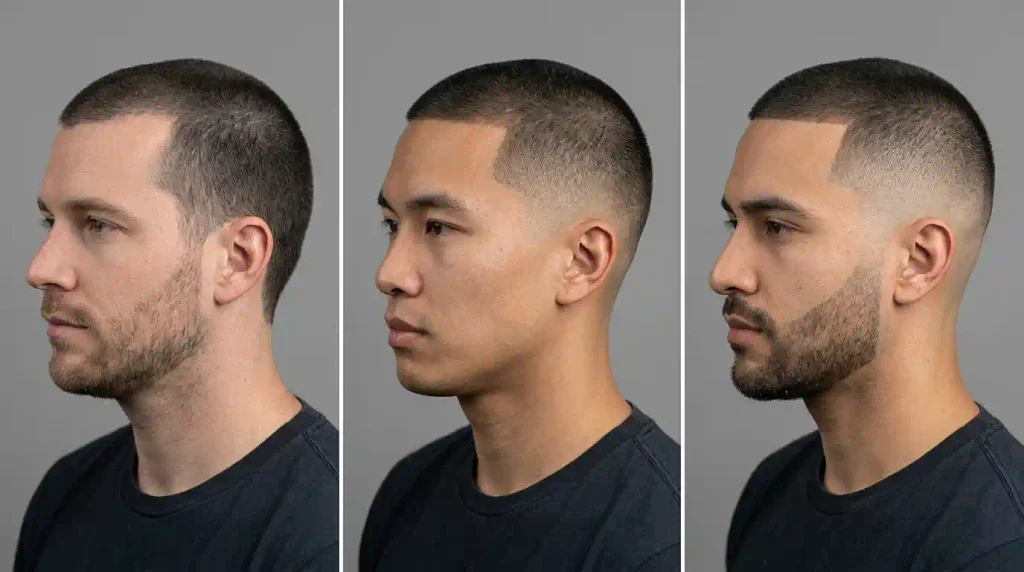
Styles by taper height
Taper height controls where the shorter section begins and how strongly it contrasts with the surrounding hair.
Low buzz taper
The low buzz taper keeps the shortest transition close to the lower temples, sideburns, and nape.
Most of the upper sides retain their original buzzed length, producing a subtle and balanced appearance.
This variation is useful for men who want clean edges without making the haircut look overly sharp.
A #2 or #3 top with a low taper is a popular practical combination.
It can suit professional environments, active lifestyles, and people who want a haircut that looks acceptable as it grows.
For straight hair, the low taper introduces definition without exposing excessive scalp.
For curly or coily hair, the localized transition can provide a clean outline while preserving the natural texture above.
The low buzz taper is also a reasonable first choice for anyone unsure about committing to a dramatic fade.
Mid buzz taper
A mid buzz taper raises the shorter transition around the middle of the temple region.
It creates a more noticeable difference between the shorter perimeter and the hair above.
The result is sharper than a low taper while generally retaining more upper side length than a conventional mid fade.
A #2 or #3 top often works well with this variation.
The mid taper can help reduce unwanted bulk around the sides, particularly for hair that grows outward near the ears.
However, the barber must maintain a smooth blend between the shorter section and the surrounding buzzed hair.
If the transition extends too far upward across the side panel, the result may resemble a mid fade.
This distinction matters when someone searches for a buzz cut taper haircut mid fade but actually wants a localized taper.
A mid buzz taper provides a useful balance between subtle grooming and visible barber detailing.
High buzz taper
A high buzz taper positions the shortened transition higher around the sides of the head.
This creates a stronger visual contrast and draws attention to the shape of the top.
It may suit men who want a bolder, more defined short haircut.
However, with very short buzz lengths, a high taper can be difficult to distinguish from a high fade.
A barber may need to retain some length around the upper side panels to preserve a tapered appearance.
High tapers also expose more of the head’s contours.
If you have prominent scalp irregularities, scars, or a head shape you would rather soften, consider a low or mid variation.
For men who prefer dramatic edge definition, a high buzz taper can work well when the transition remains controlled and symmetrical.
Styles by top length and clipper guard
The clipper guard determines how much hair remains after cutting.
In common U.S. clipper sizing, lower guard numbers leave shorter hair, while higher numbers preserve more length.
Before choosing a specific style, understand the approximate measurements.
| Clipper setting | Approximate length | Appearance |
| No guard, or often called #0 | Varies by blade and lever setting | Very close stubble |
| #0.5 | 1/16 inch (1.5 mm) | Extremely short |
| #1 | 1/8 inch (3 mm) | Very short buzz |
| #2 | 1/4 inch (6 mm) | Classic short buzz |
| #3 | 3/8 inch (10 mm) | Fuller buzz with visible texture |
| #4 | 1/2 inch (13 mm) | Longer buzz or short brush-cut appearance |
These are common nominal guard lengths. Actual results can vary by clipper brand, blade, attachment, cutting direction, and taper lever position.
A no-guard cut does not automatically mean bare skin. Some clippers leave a visible amount of stubble without an attachment.
#1 buzz taper
The #1 buzz taper leaves approximately 1/8 inch of hair on top.
This creates a very short haircut that closely follows the natural shape of the head.
Because the top is already short, the taper needs to be even shorter to create visible graduation.
Barbers may use a #0.5 attachment, an adjustable no-guard setting, or a carefully limited skin finish around the edges.
A #1 buzz taper is suitable for men who prefer a very close haircut and don’t mind visible scalp.
It may also appeal to people who want an almost maintenance-free morning routine.
However, the short length makes differences in hair density and scalp contours more noticeable.
If you’re unsure how your head shape looks with very little hair, consider starting with a #2 or #3 instead.
#2 buzz taper
The #2 buzz taper is one of the most versatile short buzz variations.
It leaves approximately 1/4 inch of hair on top, providing a compact appearance with slightly more coverage than a #1.
The hair remains short enough that most people won’t need significant styling products.
A low or mid taper can create visible definition around the sideburns and neckline while maintaining a balanced overall shape.
This length often works with straight, wavy, and dense hair.
Curly or coily hair may show a compact textured surface depending on its curl pattern and shrinkage.
For people trying a buzz taper for the first time, a #2 top can be a reasonable option if they are comfortable with a close haircut.
It provides a clear buzz cut appearance without reaching the extremely short finish of an induction-style cut.
#3 buzz taper
The #3 buzz taper leaves approximately 3/8 inch of hair on top.
Compared with a #1 or #2, this length offers greater coverage and more visible natural hair texture.
It is a useful choice for men who want a buzzed haircut but prefer to avoid an almost shaved appearance.
A low taper works especially well when the goal is a soft, conservative silhouette.
A mid taper adds stronger edge definition while keeping enough hair for the haircut to appear relatively full.
The #3 length can also make certain scalp contours less obvious than shorter guards, although coverage depends on hair density.
For coarse, curly, or wavy hair, the top may retain a slightly textured appearance.
People with fine hair should consider how the hair lies naturally, since a longer guard does not automatically guarantee greater visual fullness.
#4 buzz taper
The #4 buzz taper leaves approximately 1/2 inch of hair.
This length sits near the boundary between a longer buzz cut and a short brush or crew-style haircut.
It provides more coverage and may show the natural direction of hair growth.
A #4 top can work well with a low or mid taper, especially for men who want a neat haircut without taking the top extremely short.
With thick hair, the result may appear fuller and more textured.
With straight hair, the extra length can create a soft, brushed appearance.
A small amount of matte clay or texture cream may help control the hair, but daily product use isn’t always necessary.
The #4 buzz taper is a practical option when transitioning from a longer hairstyle to something shorter.
It allows you to experience a buzz-inspired cut before deciding whether to move down to a #2 or #1.
Longer buzz taper
A longer buzz taper usually uses a #5 guard or higher, sometimes with additional scissor detailing.
As the top becomes longer, the haircut can begin resembling a short crew cut or textured crop.
This variation is useful for men who want the clean sides of a buzz taper while preserving more flexibility on top.
Some prefer a slightly longer front, allowing the hair to be brushed forward, upward, or to one side.
For people with cowlicks or an uneven hairline, the extra length can provide more styling control.
A longer buzz taper also offers an easier transition for anyone who has never worn a very short haircut.
If you eventually want more volume, you can grow the top into a textured style or a Blowout Taper Haircut, which retains significantly more upper length.
Styles by taper and edge detail
Beyond taper height and top length, the finishing details determine how sharp or natural the haircut appears.
Buzz taper with a skin finish
A skin taper incorporates a very short or shaved finish at the lowest portion of the taper.
On a buzz cut, this creates noticeable contrast even when the top is only a #2 or #3.
The key is keeping the skin exposure localized.
If the barber shaves a large section of the side, the haircut may become a skin fade rather than a perimeter taper.
Skin finishes require careful technique and may not be ideal for people prone to irritation or ingrown hairs.
A short clipper finish can be a reasonable alternative.
Buzz taper with a natural hairline
A natural hairline preserves the original outline of the forehead and temples.
Instead of creating a sharp artificial border, the barber tidies stray hairs while respecting the natural growth pattern.
This approach can produce a softer appearance and may require fewer detailed line-up touch-ups.
It is particularly useful for men who prefer understated grooming or have an irregular hairline.
A natural hairline also avoids pushing the corners backward merely to create symmetry.
Buzz taper with a line-up or shape-up
A line-up, also known as a shape-up, defines the front hairline, temples, or sideburns.
The barber may use a precision trimmer to create a cleaner outline.
This works well with short buzz lengths because the shape of the hairline becomes visually prominent.
However, the line-up should respect the natural hairline.
Excessive edging can make a receding hairline more noticeable or create an outline that becomes awkward during grow-out.
A subtle shape-up is often easier to maintain than an extremely sharp, aggressively squared hairline.
Buzz taper with a blocked neckline
A blocked neckline uses a straight or squared-off finish at the back.
It can create a structured appearance, especially with a longer buzz taper.
However, a blocked neckline is not the same as a gradually tapered nape.
If the hair grows below the block, the outline may become noticeable relatively quickly.
A natural neckline or softly tapered finish usually grows out more gradually.
When requesting a blocked neckline, explain whether you want a visible edge or a soft transition above it.
Burst taper buzz cut
A burst taper buzz cut emphasizes a curved transition around the ear.
The shorter region follows the ear’s contour while more length remains above and behind it.
This variation can add shape to a short haircut without requiring a full fade across the back.
However, the term burst taper is sometimes used loosely for burst fades.
Use a side-profile reference photograph to show how far you want the shorter area to extend.
On a very short buzz, the curved design can be subtle, so the barber must carefully balance both sides.
Drop taper buzz cut
A drop taper buzz cut uses a transition that dips lower toward the back of the head.
This creates a curved profile that follows the skull’s natural contour.
The style may provide a more rounded appearance than a straight, horizontal transition.
A drop taper can be combined with different buzz guard lengths, but the effect is easier to recognize when the taper has sufficient contrast.
The barber should consider the crown and rear head shape before deciding how far the transition should drop.
Temple taper buzz cut
A temple taper buzz cut concentrates the shortest blending near the temples and sideburns.
The back may feature a separate, smaller neckline taper or retain a more natural outline.
This variation is useful if you want to clean the front sides without dramatically changing the overall haircut.
It works with straight, curly, and coily hair, especially when the goal is a clean but relatively natural appearance.
The phrase temp fade may also be used to describe a similar temple-focused technique.

Styles with added shape or detail
A buzz taper can also incorporate styling features that change the haircut’s overall character.
Military buzz taper
A military-style buzz taper emphasizes practicality, uniformity, and a neat silhouette.
It often uses a very short top and carefully maintained sides.
A #1 or #2 top can create the close-cropped appearance associated with military grooming.
However, actual military grooming requirements vary by service, unit, and current regulations.
An induction cut is typically much shorter and more uniform than a standard tapered buzz.
If you need a haircut for official military service, follow the applicable grooming policy rather than relying on a general style description.
Crew buzz and graduated buzz
A crew buzz combines a short upper haircut with some of the shaping associated with a crew cut.
The front may be slightly longer than the crown, creating a subtle graduated appearance.
This can help add structure to the front hairline without requiring a conventional longer hairstyle.
A graduated buzz may also use carefully selected clipper lengths to adjust the transition across the upper head.
These styles offer more visual shape than a completely uniform buzz.
They are useful when a single-length cut looks too flat or emphasizes an unwanted head contour.
Textured buzz taper
A textured buzz taper retains enough top length for the natural hair pattern to become visible.
This is especially effective with a #3, #4, or longer top.
Wavy or curly hair may show natural bends, while coarse straight hair can develop a slightly brushed texture.
A barber may use light point-cutting or controlled graduation when the top is long enough.
For styling, a small amount of matte clay, molding paste, or texture cream may help define the surface.
The product should complement the natural texture rather than create unnecessary stiffness.
Buzz taper with a beard blend
A buzz cut with a beard can create a strong, balanced appearance when the sideburns connect smoothly to the facial hair.
The barber gradually transitions from the shorter temple area into the beard.
A short beard may require only a subtle sideburn blend.
A fuller beard can benefit from more careful shaping so the haircut and facial hair appear connected.
This combination can also provide visual balance for different face shapes.
For example, beard fullness may add definition around the jaw, while the buzzed top keeps the overall appearance clean.
The beard blend should be maintained alongside the haircut to prevent an abrupt or disconnected transition.
Buzz taper with a hard part or hair design
A hard part is a shaved line used to create a deliberate separation.
Hair designs may include short geometric lines, curved details, or other patterns.
These features can make a buzz taper more expressive, although they work best when the hair is long enough to show contrast.
Very short buzz cuts may not provide enough visual difference for intricate designs.
A design line also requires regular maintenance as the hair grows.
Consider workplace requirements and personal preferences before adding permanent-looking shaved details to an otherwise simple haircut.
Faux hawk buzz taper
A faux hawk buzz taper retains slightly more length through the center of the head.
The surrounding upper sides are shorter, creating a subtle central ridge.
Unlike a traditional mohawk, the sides are not necessarily shaved.
A longer buzz guard or short scissor work may be needed to create enough distinction.
This style is more visually dramatic than a uniform buzz taper but can remain relatively easy to maintain.
A little matte product may help lift the center section.
Comb-over buzz
A comb-over buzz is a longer buzz-inspired haircut with enough top length to direct the hair sideways.
It is not usually achievable with a very short #1 or #2 guard.
A #4 or longer top may provide some directional movement, depending on hair texture.
The style can incorporate a low taper and a subtle side part.
It is particularly suitable for men who want the neatness of a buzz-inspired haircut but prefer a more polished professional appearance.
Celebrity buzz taper inspiration
Buzz cuts and short tapered hairstyles have appeared frequently in celebrity, sports, and entertainment grooming.
David Beckham has worn several closely cropped hairstyles over the years, demonstrating how a short haircut can look athletic and refined.
Zayn Malik has also experimented with very short buzzed styles, making his different hair lengths useful references for anyone considering a closer cut.
Michael B. Jordan is another recognizable example of short, clean-cut grooming, often combining closely cropped hair with carefully maintained facial hair.
Not every celebrity buzz cut is specifically a buzz taper. Some examples are uniform buzz cuts, while others incorporate more extensive fading.
Instead of copying a celebrity hairstyle by name, examine the actual photograph.
Pay attention to the top length, taper placement, hairline, beard connection, and amount of scalp exposure.
These details will help your barber recreate the elements that suit your own hair and facial features.
Choosing a Buzz Taper for Your Hair and Features
A buzz taper exposes more of the natural head shape than most medium or long hairstyles.
This makes hair density, texture, face shape, scalp contours, and hairline especially important considerations.
A haircut that looks balanced on one person may appear completely different on someone with another growth pattern or head shape.
How hair texture and density affect the result
Hair texture influences how a buzz taper appears even when two people use the same clipper guard.
Straight or fine hair
Straight hair tends to reveal the underlying shape of the haircut clearly.
With dense straight hair, a #2 or #3 buzz often creates an even-looking surface.
Fine hair may lie closer to the scalp, making very short lengths appear less full.
If you have fine hair and want more coverage, consider starting with a #3 or #4 guard.
Avoid assuming that a shorter cut will automatically make thin hair appear denser.
The result depends on the amount of hair present and the contrast between the hair and scalp.
A subtle low taper often works well when the goal is to preserve visual fullness.
Wavy hair
Wavy hair can create a soft textured appearance when enough length remains.
At very short lengths, the wave pattern may be less visible.
A #3 or #4 guard may reveal more natural movement than a #1.
Wavy hair can also grow in different directions around the crown.
The barber should use controlled clipper passes to achieve an even finish without creating unintended patches.
For a slightly longer style, a small amount of texture cream can help organize the top without requiring extensive styling.
Curly or coily hair
Curly and coily hair can create a naturally textured buzz taper.
The finished appearance depends on curl pattern, density, and shrinkage.
A #2 guard on tightly coiled hair may look different from the same guard on straight hair.
The barber should check the shape from several angles and avoid cutting aggressively through areas where the curl pattern changes.
A curly buzz cut with a temple taper can create strong visual definition.
A #3 or #4 top may preserve more visible curl texture, while a shorter guard creates a compact appearance.
If the hair is long enough, curl-enhancing cream can help maintain definition.
However, very short coily hair often requires little or no styling product beyond basic conditioning and scalp care.
Thick or thinning hair
Thick hair usually provides more consistent coverage across the scalp.
A buzz taper can reduce bulk while maintaining a clean and balanced shape.
However, thick hair may require several clipper passes in different directions to achieve an even length.
Thinning hair presents different considerations.
If density is noticeably reduced at the crown or front, a very short buzz may make the scalp more visible.
For some men, this creates a deliberate, uniform look that reduces the contrast between thinning and denser areas.
Others may prefer a slightly longer buzz to maintain coverage.
A buzz cut does not stop hair loss or stimulate new growth.
If thinning is sudden, patchy, or unexplained, medical evaluation is more useful than relying on a haircut to address the underlying problem.
Choosing a taper for your face shape
Face-shape categories provide helpful starting points, but they should not override personal preference.
The best haircut also depends on the head’s actual contours, forehead proportions, and facial hair.
Round face
Round faces often benefit from a haircut that creates a little vertical balance.
A #3 or #4 buzz with a mid taper can produce a structured appearance without excessive side width.
A subtle amount of additional length toward the front may also help.
Avoid assuming that an extremely high fade is necessary to make the face appear slimmer.
A balanced taper and neatly shaped beard can provide a similarly structured effect.
Oval face
Oval faces generally accommodate a broad range of short hairstyles.
Low, mid, and high buzz tapers can all work.
A #2 or #3 top is a practical starting point.
The main goal is to preserve natural proportion rather than exaggerating height or reducing the sides unnecessarily.
A low taper produces a softer appearance, while a mid taper creates more visible definition.
Square face
Square faces often feature a prominent jawline and stronger facial angles.
A buzz taper can complement these characteristics because it leaves the face relatively unobstructed.
A #1 or #2 buzz with a mid taper creates a compact, defined appearance.
A #3 or #4 provides a slightly softer effect.
If you want to reduce the emphasis on angular features, choose a natural hairline instead of an extremely sharp, squared shape-up.
Long or oblong face
Long faces may benefit from avoiding hairstyles that add unnecessary vertical emphasis.
A uniform #2 or #3 buzz with a low taper can maintain balanced proportions.
A very high taper combined with extra top length may visually lengthen the head.
Keeping the upper sides relatively full can create a softer silhouette.
If the forehead is especially prominent, a slightly longer front section may provide additional balance.
Diamond or heart-shaped face
Diamond-shaped faces are often wider around the cheekbones and narrower toward the forehead or jaw.
Heart-shaped faces commonly feature a wider forehead and narrower lower face.
A low or mid buzz taper can preserve some side fullness while keeping the perimeter neat.
A #3 or #4 top may provide a more balanced appearance than an extremely close cut.
Facial hair can also influence the result.
For men with a narrower jaw, a short, carefully shaped beard may help balance the overall facial silhouette.
How head shape, crown, scars, and scalp contours affect the cut
Head shape becomes much more visible when hair is cut extremely short.
Natural bumps, dips, asymmetry, and crown patterns can influence how a buzz taper looks.
This does not mean you need a perfectly symmetrical head to wear a buzz cut.
Most people have some variation in scalp contours.
However, a very short #1 or skin-level finish may reveal those features more clearly than a #3 or #4.
If you have scars, birthmarks, or raised areas, tell your barber before cutting.
The clipper should be handled carefully around sensitive or uneven skin.
Avoid running an exposed blade aggressively over raised moles, skin lesions, or scars.
The crown also requires attention because the hair may grow in several directions.
A barber may need to cut from different angles to achieve an even finish.
For significant contour differences, a slightly longer guard can help soften the overall appearance.
Buzz tapers for a receding hairline
A buzz taper can be an option for men with a receding hairline.
Keeping the top short may reduce the contrast between longer hair and thinning areas.
However, the effect varies according to the hairline pattern and overall density.
A #2 or #3 buzz may create a balanced look for some men, while others prefer an even shorter cut.
Avoid asking for an aggressive line-up that pushes the temples farther back.
This can create an unnatural outline and make recession more obvious.
A natural hairline often provides a softer, more realistic appearance.
If the recession is accompanied by significant crown thinning, consider how the haircut will look from above and behind, not only from the front.
Is a buzz taper right for work, school, or everyday life?
The buzz taper is generally compatible with many workplaces because it looks clean and controlled.
A low taper with a #2 or #3 top is especially versatile.
It usually requires little styling and can remain neat throughout a normal workday.
For people who exercise frequently, wear sports equipment, or prefer short grooming routines, a buzz taper is practical.
It also reduces the need for brushes, hair dryers, and strong styling products.
However, very sharp designs, shaved lines, or extreme contrast may not fit every workplace or school grooming policy.
If appearance regulations are strict, choose a conventional buzz length with a subtle taper and natural hairline.
Buzz tapers for boys and teens
A buzz taper haircut can work well for boys and teenagers because it is relatively easy to manage.
A #3 or #4 buzz with a low taper offers a neat appearance without exposing too much scalp.
For children who participate in sports, the short length may make washing and grooming simpler.
A mid taper can create a slightly more fashionable appearance while remaining practical.
Parents should consider school rules, the child’s hair texture, and personal preferences.
For younger children, avoid unnecessarily aggressive skin shaving or detailed edging that irritates sensitive skin.
A simple, comfortable haircut is usually preferable to a complicated design requiring frequent touch-ups.
Who may prefer a longer cut
A buzz taper is not the ideal haircut for everyone.
People who prefer concealing scalp scars, controlling a strong cowlick with longer hair, or covering certain areas of thinning may prefer a longer style.
Someone who enjoys changing their hairstyle daily may also find a very short buzz limiting.
If you frequently style a fringe, quiff, side part, or textured top, consider keeping additional length.
You can still maintain tapered temples and neckline without committing to a short buzz.
The broader range of Hairstyles with taper provides options that preserve more top length while keeping the perimeter clean.
How to Preview a Buzz Taper Before Committing
A buzz cut removes enough length that the result can feel dramatically different from a medium or long hairstyle.
Taking time to evaluate the style before cutting can help prevent disappointment.
Compare reference photos with your hair and head shape
Choose photographs of people with similar hair texture, density, and head shape.
A #2 buzz on thick, dark hair may appear fuller than the same guard on light, fine hair.
Likewise, a haircut photographed on a rounded head may look different on someone with a more pronounced crown.
Focus on the technical details rather than the attractiveness of the model or photograph.
Check whether the hairline is natural or lined up, whether the temples are tapered, and how much hair remains on the sides.
If possible, select a reference with similar hair color and scalp contrast.
This provides a more realistic expectation.
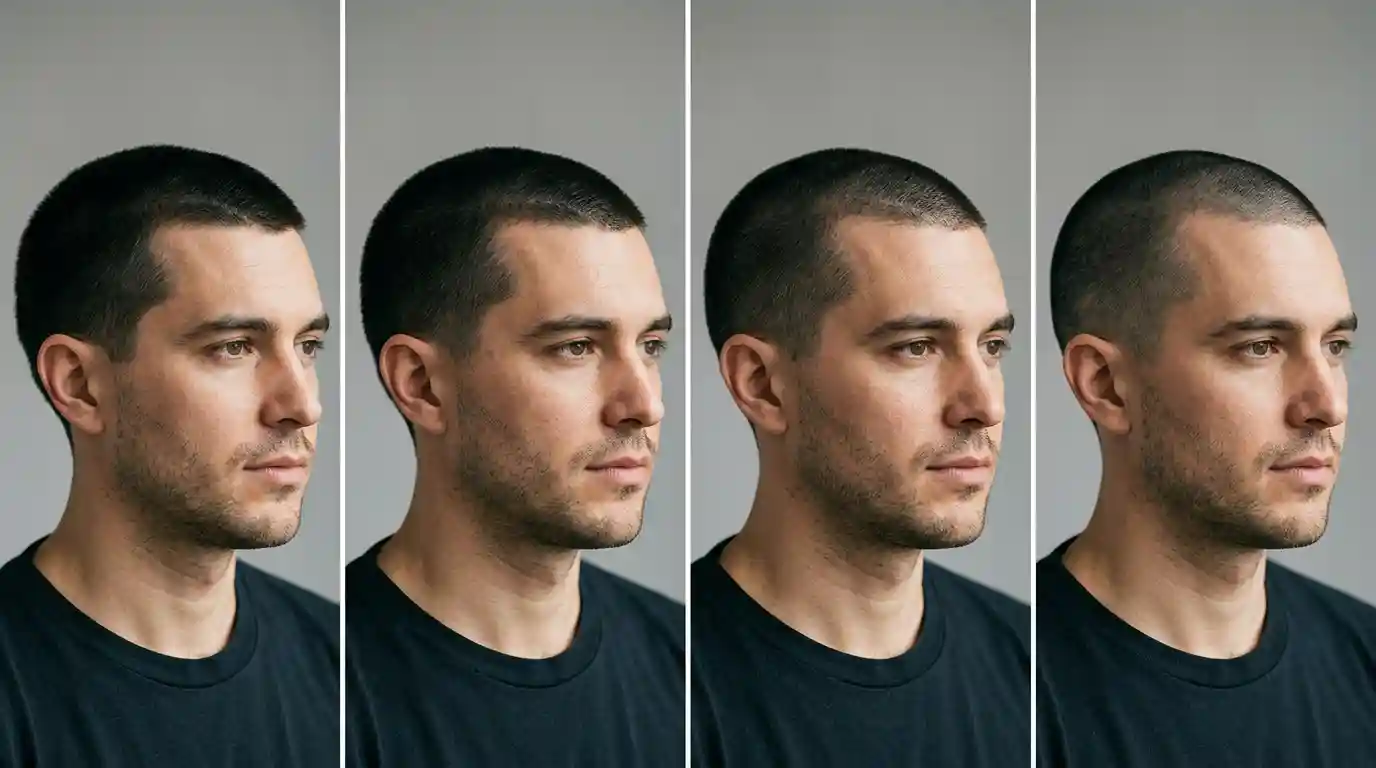
Check the front, side, and back views
A front-facing photograph does not reveal the complete haircut.
The side view shows the taper height and relationship between the top and side panels.
The rear view reveals the neckline, nape transition, and crown shape.
A haircut may look excellent from the front while having an unexpectedly high fade at the back.
Before visiting the barber, save at least one front view, one side view, and one back view.
Photographs of the same haircut are preferable to unrelated examples.
If only one view is available, explain which details you want preserved on the unseen sides.
Match the top guard, taper height, and neckline finish
Try to identify the top length before selecting the taper.
A #1 buzz with a skin taper produces a much closer overall appearance than a #4 buzz with a soft low taper.
The neckline also changes the final effect.
A natural taper grows out more softly, while a blocked neckline creates a stronger outline.
Write down your preferred combination before the appointment.
For example: “#3 on top, low taper, short but not skin, natural front hairline, tapered neckline.”
This is more useful than simply asking for a modern buzz cut.
Spot the difference between a taper and skin fade in photos
Look carefully at how much scalp is exposed.
If the shortest area covers most of the side and gradually blends upward, you’re likely looking at a fade.
If the shortest section remains localized around the sideburns and neckline, it is more likely a taper.
Lighting can make this difficult to judge, especially with very short or light-colored hair.
Ask your barber to explain the transition shown in the reference image.
If you want minimal scalp exposure, say so explicitly.
Consider going shorter in stages
If you currently have several inches of hair, jumping directly to a #1 buzz may feel like a major change.
A staged approach offers more control.
Start with a #4 or longer buzz and examine the shape.
You can then try a #3 or #2 if you prefer a shorter appearance.
The barber can remove more hair during the same appointment, but cannot restore length after cutting.
This approach is especially useful if you are uncertain about scalp visibility or head contours.
What to Tell Your Barber
A successful buzz taper starts with a clear consultation.
The most important details are the guard length on top, taper placement, shortest perimeter length, and hairline finish.
Details to specify: top length, taper height, and edge finish
Begin by telling the barber the exact top guard you want.
If you are unsure, ask to see how a #2 or #3 compares with the length of your current hair.
Next, specify the taper height.
Explain whether you want the transition kept low around the sideburns and nape, placed moderately higher, or made more pronounced.
Then discuss the shortest length.
You can request a short clipper finish without exposing bare skin.
Alternatively, you may prefer a skin taper around selected edges.
Finally, describe your preferred hairline and neckline.
A natural hairline looks different from a sharp line-up.
A blocked neckline creates a different grow-out pattern than a gradually tapered nape.
These details should be agreed upon before the barber begins cutting.
Barber scripts for subtle, balanced, and high-contrast styles
Subtle low buzz taper:
“I want a #3 buzz cut on top with a low taper around the temples and neckline. Keep the upper sides fairly full and don’t take the taper down to bare skin. Leave my front hairline natural.”
Balanced mid buzz taper:
“Give me a #2 buzz on top with a clean mid taper. I want visible blending around the temples and nape, but not a full mid fade across the sides. Keep the transition smooth.”
High-contrast buzz taper:
“I’d like a #2 buzz with a higher, sharper taper and a very short finish around the edges. Keep the shortest areas localized rather than extending the skin fade across the entire side.”
Curly buzz taper:
“Keep enough length on top to show my natural curl texture, around a #3 or #4 depending on how it looks. Give me a low temple taper and a clean neckline without taking too much off the upper sides.”
Buzz taper with beard:
“I want a #2 buzz, low taper, and a gradual blend from the sideburns into my beard. Keep the hairline natural and make sure the beard transition looks balanced.”
These examples provide a starting point, but your barber may recommend adjustments based on your hair density and head shape.
Choosing a reference photo
Choose a photograph that clearly shows the haircut’s technical features.
A dramatic celebrity portrait may be visually appealing but not show the neckline or taper transition.
Look for a sharp side-profile image with adequate lighting.
Try to avoid heavily edited photographs that obscure the natural hairline or scalp.
If you have several references, explain which feature you like in each one.
For example, you might prefer the top length from one photograph and the neckline from another.
Make sure these features can work together before cutting begins.
Questions to ask before the cut
A brief consultation can prevent misunderstandings.
Ask your barber whether the chosen guard will provide enough coverage for your hair density.
Confirm how high the taper will extend and whether the shortest point will reach skin.
Discuss whether the crown requires special attention.
If you’re concerned about your hairline, ask whether a natural finish would look better than a sharp line-up.
Finally, ask how the haircut should be maintained as it grows.
An experienced barber should be able to explain the expected result in practical terms.
How to Cut a Buzz Taper at Home
A buzz taper is possible to cut at home, but creating a smooth transition is more demanding than performing a single-length buzz cut.
The safest approach for beginners is to start longer, use conservative guard changes, and avoid attempting an aggressive skin taper.
Clippers, guards, trimmer, mirrors, and other tools
Prepare your equipment before starting.
You will need a reliable hair clipper, compatible attachment guards, a handheld mirror, a second mirror, and a comb or brush.
A precision trimmer may help clean the sideburns and neckline.
A smartphone camera can also be useful for checking the back of the head.
Use appropriate lighting so you can see uneven sections and blending lines.
Clean your clipper before use and maintain its blades according to the manufacturer’s instructions.
If the clipper has an adjustable taper lever, understand how it affects cutting length.
On many clippers, opening the lever creates a slightly longer cut, while closing it produces a shorter cut.
However, controls and blade distances vary by model.
Do not assume every manufacturer’s lever and attachment system behaves identically.
Step-by-step cutting and blending
The following example uses a #3 top with a conservative low taper.
It is intended as a beginner-friendly approach rather than a professional skin-fade tutorial.
Step 1: Wash and dry your hair.
Remove heavy products, oil, and buildup before cutting.
Allow the hair to dry fully if your clipper is designed for dry cutting.
Check the scalp for irritation, raised lesions, or sensitive areas.
Do not run the clipper aggressively over damaged skin.
Step 2: Choose the top guard.
Attach a #3 guard and confirm it is secured properly.
Start by cutting the top in smooth, overlapping passes.
For many hair types, cutting against the direction of growth helps produce an even finish.
However, curly or coily hair may require special attention to the way the hair sits.
Avoid applying excessive pressure.
Step 3: Cut the surrounding hair to the planned base length.
Use the selected guard around the sides and back, leaving enough length for the future taper.
If you’re unsure about the shape, begin with the same #3 guard before introducing a shorter length.
This prevents accidentally cutting a large section too short.
Step 4: Establish a low taper area.
Identify the small region around the sideburns and lower neckline that you want shortened.
Use a #2 guard conservatively in the area immediately above the intended shortest section.
Apply a gentle outward flicking motion as you approach the longer hair.
The goal is to avoid creating a hard horizontal line.
Step 5: Introduce the shortest length carefully.
If your plan includes a #1 finish, use it only in a small section near the lower sideburns or nape.
Avoid moving the shortest guard too high.
You can gradually extend the blend if necessary.
For beginners, retaining a little length at the bottom is easier to correct than attempting a bare-skin finish.
Step 6: Soften the transition.
Examine the areas between the different guard lengths.
Use an intermediate attachment or a suitable lever adjustment to soften visible lines.
Work in short, controlled strokes.
Avoid repeatedly cutting through the same area with a shorter guard, since that can create a new line or patch.
Step 7: Repeat the taper on the opposite side.
Use your mirrors to compare both temples.
Do not assume the same clipper movement will automatically produce symmetry because hair growth patterns may differ.
Check the height of the transition carefully.
Step 8: Blend the neckline.
Use the handheld mirror and second mirror to see the nape.
If visibility is poor, ask another person to help or leave the detailed neckline work for a professional barber.
Keep the transition low and avoid creating a strong line across the back.
Step 9: Clean the edges.
Use a precision trimmer carefully around the sideburns and visible stray hairs.
Preserve the natural hairline unless you intentionally want a defined line-up.
Do not press the trimmer into the skin.
Step 10: Inspect the finished haircut.
Check the front, both sides, crown, and back.
Use a smartphone photograph to inspect areas that are difficult to see directly.
Look for abrupt guard transitions, missed patches, and uneven taper heights.
Only make small corrections.
If the shape is becoming worse through repeated adjustments, stop and consult a barber rather than continuing to cut shorter.
Common DIY mistakes
One of the most common mistakes is starting with a guard that is too short.
Always begin longer than your final target if you’re uncertain.
Another mistake is taking the taper too high.
Once the shortest section moves upward, restoring a low taper may require waiting for the hair to grow.
Beginners also frequently create visible lines between different guard lengths.
These lines can result from abrupt movements or using guard sizes that are too far apart without sufficient blending.
Uneven pressure, dull blades, and poorly secured attachments can create additional problems.
Be especially cautious when working behind the ears and near the neckline.
These areas are difficult to see and may be more sensitive to aggressive trimming.
A simple one-length buzz with minor sideburn cleanup is often a better first home haircut than a complicated high taper.
How to Fix a Buzz Taper That Didn’t Turn Out Right
Not every buzz taper produces the expected result.
The good news is that some problems can be corrected through careful blending or minor adjustments.
Other mistakes require allowing the hair to grow before reshaping it.
What to do if the taper is too high or too short
If the taper was cut higher than requested, adding more clipper work won’t restore the missing hair.
The most practical solution may be to let the shorter region grow.
A barber may be able to soften the surrounding transition, but this can involve removing additional hair.
Avoid automatically converting the entire haircut into a higher fade if you don’t want that appearance.
If the top was cut too short, styling products cannot recreate missing length.
Allow the top to grow while maintaining the edges conservatively.
Hair commonly grows around half an inch per month on average, although individual rates vary.
Even a few weeks of growth may make a noticeable difference on a very short buzz.
How to handle an uneven blend or patchy top
An uneven blend may appear as a visible line between guard lengths.
A barber can sometimes soften the line using an intermediate guard or controlled clipper technique.
However, the ability to correct it depends on how much hair remains.
If one side is shorter than the other, matching the longer side to the shorter one may improve symmetry but create more contrast than originally intended.
For a patchy-looking top, first determine whether the problem is uneven cutting or natural hair density.
Uneven cutting can sometimes be corrected with additional clipper passes at the intended guard length.
Patchiness caused by thinning hair cannot be solved by repeatedly cutting the same area.
Avoid chasing an uneven appearance with progressively shorter guards.
What can be corrected at the next appointment
At your next barber appointment, explain the problem clearly.
If the taper was too high, ask for a lower placement as the hair grows.
If the neckline was blocked too sharply, request a softer natural taper.
If the sideburns were uneven, the barber may be able to reshape them once enough length returns.
If the top felt too short, request that the barber preserve it during the next visit.
Bring photographs of both the desired haircut and the result you received.
This helps identify the difference between the original request and the finished shape.
When to let the cut grow out before reshaping it
Some mistakes cannot be corrected immediately without making the haircut shorter.
Examples include an excessively high skin fade, a pushed-back hairline, or a top cut significantly below the intended guard length.
In these situations, patience is often the best option.
Allow the hair to grow until there is enough length for the desired transition.
Avoid repeatedly trimming the top while waiting for the sides to recover.
A temporary short buzz or crew-style shape may help the haircut look intentional during the growing period.
If the issue is skin irritation rather than appearance, allow the affected area to recover and seek medical guidance when appropriate before scheduling another close cut.
Maintenance and Grow-Out
A buzz taper requires little daily styling, but the clean perimeter gradually changes as hair grows.
The maintenance schedule depends on how sharp you want the taper to remain.
How often to refresh the cut and edges
Many men maintain a buzz taper every two to four weeks.
Those who prefer a skin-level finish or an extremely sharp line-up may schedule more frequent touch-ups.
A low taper with a natural hairline often looks acceptable for a longer period than a highly defined skin taper.
The top length also affects maintenance.
A #1 buzz can change noticeably after a few weeks because even a small amount of growth represents a large proportional increase.
A #4 buzz may gradually resemble a short textured crop.
If you prefer a very consistent appearance, schedule regular cuts based on how your hair grows rather than following a fixed rule.
What to expect after one, two, and three weeks
After one week: The shortest edges usually begin losing some sharpness, although the overall shape remains recognizable.
After two weeks: The taper becomes softer, sideburns may look less defined, and the hair around the ears or neckline may begin to appear fuller.
After three weeks: The difference between the original tapered areas and surrounding hair may become less noticeable. The top also looks longer, particularly with very short initial guards.
These are general expectations rather than exact timelines.
Hair growth rate, density, texture, and the original cutting length affect how quickly the appearance changes.
Someone with dense, dark hair may notice regrowth sooner than someone with lighter or finer hair.
Which details lose their shape first
The sideburns, neckline, and sharply defined hairline usually show early changes.
A line-up may lose its crisp edges as new hair grows around the perimeter.
Skin tapers develop visible stubble, reducing the original contrast.
A blocked neckline can become more noticeable as hair grows below the outline.
The top generally retains its basic buzz shape longer, although the texture and apparent density may change.
For curly hair, additional length may cause the curl pattern to become more apparent.
For straight hair, the top may begin lying in a more visible direction.
When to refresh the taper versus the top
You don’t always need a complete haircut to maintain a buzz taper.
If the top still has an acceptable length, a perimeter touch-up may be sufficient.
The barber can clean the temples, sideburns, and nape while leaving the buzzed top intact.
This is useful when you’re gradually growing from a #2 to a #3 or #4.
However, if the top becomes uneven or noticeably longer than intended, a full trim may provide a more balanced appearance.
For people maintaining a consistently short #1 buzz, trimming the entire head may be more practical.
The best approach depends on whether your priority is preserving a specific length or maintaining a sharp taper transition.
Scalp Care and Risks of a Very Short Cut
Very short haircuts expose more of the scalp and may involve closer contact between cutting tools and skin.
Proper scalp care is especially important when choosing a #1 buzz, skin taper, or other close-cropped variation.
Close shaving, irritation, razor bumps, and AKN
Close shaving can irritate the scalp and neckline, especially in people prone to ingrown hairs.
Razor bumps may develop when short hairs curve back into the skin or cause irritation during regrowth.
Another condition, acne keloidalis nuchae (AKN), can cause inflamed bumps and scarring around the back of the scalp and neck.
It is not simply ordinary acne and may become more serious without appropriate treatment.
The American Academy of Dermatology’s guidance on acne keloidalis nuchae advises avoiding close shaving at the back of the head and neck when it aggravates the condition.
If you regularly develop bumps after haircuts, consider keeping the neckline slightly longer.
Ask your barber to avoid unnecessary skin-level shaving and aggressive repeated passes.
Clean clippers and careful trimming are important for general hygiene, but equipment cleaning alone does not prevent every inflammatory scalp condition.
Persistent bumps, pain, pus, bleeding, or raised scars should be evaluated by a dermatologist.
Scalp exposure and sun protection
A buzz cut provides less protection from direct sunlight than longer, dense hair.
The shorter the guard, the more visible and exposed the scalp may become.
This is particularly important for people with thin hair, lighter hair color, or naturally sparse areas.
Use a broad-spectrum, water-resistant sunscreen with SPF 30 or higher on exposed scalp skin when spending time outdoors.
A suitable hat can provide additional protection.
Remember to protect the ears, forehead, and back of the neck.
Reapply sunscreen according to the product instructions, particularly after sweating or swimming.
A very short haircut may feel cooler and easier to manage, but it should not be treated as protection against ultraviolet radiation.
Scalp moisturizing and aftercare
After a haircut, gently remove loose hair clippings from the scalp and neckline.
If your skin feels dry, use a lightweight, fragrance-free moisturizer suitable for your scalp.
Avoid applying harsh or heavily fragranced products immediately after close shaving, particularly if the skin feels irritated.
Cleanse the scalp according to your hair type, oil production, activity level, and skin condition.
A buzz cut does not eliminate the need for shampoo or scalp hygiene.
If you have dandruff, eczema, psoriasis, or another scalp condition, continue the care plan recommended by your healthcare professional.
Avoid aggressively scratching irritated areas or attempting to remove bumps with sharp tools.
Proper aftercare helps keep a buzz taper comfortable between appointments.
Frequently Asked Questions
What is a buzz taper haircut?
A buzz taper is a short buzz cut combined with gradual length reduction around the temples, sideburns, and neckline.
What guard is best for a buzz taper?
A #2 or #3 guard is a practical starting point for many men, depending on their desired coverage.
Is a buzz taper the same as a buzz cut fade?
No. A buzz taper generally concentrates shorter blending around the perimeter, while a fade often extends across more of the sides.
Is a #2 buzz taper too short?
A #2 leaves approximately 1/4 inch of hair and creates a clearly short buzz without being completely shaved.
Is a low buzz taper better than a mid taper?
Neither is universally better; a low taper looks subtler, while a mid taper creates more visible contrast.
Can curly hair get a buzz taper?
Yes. Curly and coily hair can look excellent with a buzz taper when the guard length and blend account for natural texture.
Does a buzz taper work with a receding hairline?
Yes. A short, natural-looking buzz may create a balanced appearance, although results depend on hair density and the recession pattern.
Can you cut a buzz taper at home?
Yes, but blending requires practice; beginners should start with longer guards and a conservative low taper.
How often should you get a buzz taper?
Many people refresh the haircut every two to four weeks, depending on growth and preferred sharpness.
Does buzzing make hair grow back thicker?
No. Buzzing does not change hair thickness, growth rate, or follicle density; blunt-cut ends can temporarily feel coarser.
Is a buzz cut haram in Islam?
A uniform buzz cut is generally considered permissible, but scholarly opinions differ on tapers and fades involving partial shaving, known as qaza’, so consult a trusted qualified scholar for your specific style.
Can you get a buzz taper without a skin fade?
Yes. A buzz taper can finish with short visible hair rather than exposed skin.
What is the difference between a #1 and #3 buzz taper?
A #1 leaves approximately 1/8 inch of hair, while a #3 leaves approximately 3/8 inch and offers more coverage.
Is a buzz taper suitable for professional workplaces?
Yes. A low or mid buzz taper with a natural hairline is generally appropriate for many professional settings.
Which buzz taper lasts the longest?
A softer low taper with a natural neckline often has a less noticeable grow-out than a sharp skin taper.
Can a buzz taper include a beard?
Yes. A barber can blend the sideburns into a beard to create a coordinated appearance.
Conclusion
The buzz taper haircut is a practical choice for anyone who wants a sharp, modern hairstyle without spending much time on daily styling. Its versatility comes from the combination of top guard length, taper height, and edge detailing. A #3 or #4 buzz with a low taper offers a softer, more conservative appearance, while a #1 or #2 cut with stronger taper contrast creates a bolder look. Before choosing your haircut, consider your natural hair texture, head shape, scalp sensitivity, and preferred maintenance schedule. Bring clear reference photographs to your barber and explain exactly how short you want the top and perimeter. For more short haircut ideas, barber guides, and styling inspiration, explore Taper Haircut Hub and find a tapered style that matches your everyday needs.



7 Comments