

Fringe Taper Haircut for Men: Styles, Barber Guide, and Maintenance
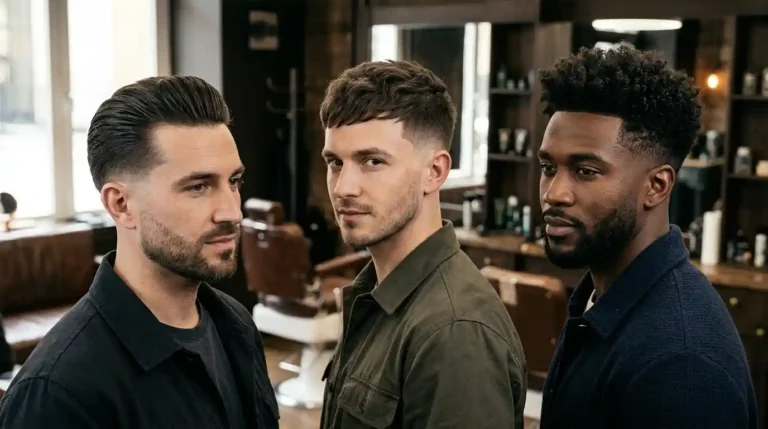
The fringe taper haircut combines hair that falls forward over the forehead with neatly tapered sides, creating a modern hairstyle that balances texture, movement, and clean edges. Unlike a traditional slick back or quiff, a fringe taper allows the front hair to become the main feature, whether it is short and blunt, long and layered, messy and textured, or naturally wavy and curly. The taper gradually shortens the hair around the temples, sideburns, and neckline while preserving the desired shape on top.
This versatile haircut works with straight, thick, fine, wavy, curly, and coily hair. A low taper with a textured fringe offers a relaxed everyday appearance, while a mid taper with an angular fringe creates stronger definition. The right fringe length can also change how your forehead, hairline, and facial proportions appear.
Whether you are considering your first taper haircut with fringe or want to update your existing hairstyle, this guide covers 29 fringe taper styles, face-shape recommendations, fringe lengths, barber instructions, styling products, maintenance schedules, and solutions to common fringe problems.
Table of Contents
- What Is a Fringe Taper Haircut?
- Fringe Taper Styles for Men
- How to Choose a Fringe Taper for Your Face Shape and Hair
- Fringe Length Guide: Where Should the Front End?
- How Cowlicks, Hairlines, and Growth Patterns Affect a Fringe Taper
- Fringe Taper vs. Similar Haircuts
- How to Ask Your Barber for a Fringe Taper
- How a Barber Cuts a Fringe Taper
- How to Style a Fringe Taper at Home
- How to Refresh a Fringe Taper Between Washes
- Fringe Taper for Men Who Wear Glasses
- Fringe Taper Maintenance and Grow-Out
- Fringe Taper Troubleshooting
- Fringe Taper Cost and Appointment Time
- Frequently Asked Questions
- Final Thoughts on the Fringe Taper Haircut
What Is a Fringe Taper Haircut?
A fringe taper haircut is a men’s hairstyle featuring hair that falls toward or across the forehead, combined with a gradual reduction in hair length around the sides and neckline.
The fringe, also called bangs, can be short, medium, or long. It may have a straight edge, irregular texture, loose curls, or a swept shape.
The taper creates a cleaner outline while allowing the barber to preserve more length in the upper sections of the haircut.
This combination is popular because the top and sides can be customized independently.
For example, a man may choose a long, wavy fringe with a subtle low taper, while another prefers a short, blunt fringe with a sharper mid taper.
Both can be described as fringe taper haircuts, even though their appearances are noticeably different.
The Fringe, Taper, and Fade: What Each Part Means
The fringe is the section of hair at the front of the head that falls toward the forehead.
Its shape determines whether the haircut looks soft, structured, casual, or dramatic.
A short fringe may end near the upper forehead, while a longer fringe can reach the eyebrows or extend farther when styled.
The taper refers to the gradual shortening of hair toward the perimeter.
A traditional taper commonly concentrates the shortest areas around the temples, sideburns, and nape.
A fade also transitions between hair lengths, but the shorter sections may extend farther around the sides and back.
A taper does not have to expose bare skin. The barber may leave visible stubble or slightly longer hair near the edges.
Understanding these terms helps you communicate the desired haircut more accurately.
How the Taper Shapes the Sides, Sideburns, and Neckline
The taper influences the overall balance of the hairstyle.
When the top contains a thick or long fringe, the sides need enough structure to support the silhouette.
A low taper keeps more hair around the upper sides, creating a soft transition into the fringe.
A mid taper removes additional weight around the temples, making the longer front more prominent.
A high taper creates greater contrast but can make the top appear more separated from the sides.
At the neckline, the barber gradually blends the hair near the nape.
This creates a cleaner finish without necessarily cutting the entire back extremely short.
The barber may also shape the sideburns to connect naturally with facial hair.
The result should look balanced from the front, sides, and back.
Taper vs. Fade: The Key Differences
Although the terms are frequently combined, a traditional taper and a full fade do not always produce the same silhouette.
| Feature | Fringe Taper | Fringe With a Full Fade |
| Top | Short or long fringe | Short or long fringe |
| Shortest areas | Usually near the perimeter | Can cover larger side sections |
| Upper-side length | Often retained | May be significantly shortened |
| Contrast | Subtle to moderate | Moderate to strong |
| Skin exposure | Optional | Common with skin-fade variations |
| Grow-out | Often softer | Short sections may become noticeable sooner |
| Overall appearance | Natural and balanced | Sharper and more contrasted |
A low taper fade may still be relatively subtle, while a high skin fade creates a much stronger visual difference.
The terminology varies between barbershops, so reference photographs are more reliable than haircut names alone.
Low, Mid, High, and Burst Taper Placements
Taper placement determines where the transition between lengths occurs.
Low taper: The shortest areas stay close to the sideburns and neckline. It preserves side fullness and works particularly well with longer or textured fringes.
Mid taper: The transition begins higher around the temples. It creates a balanced amount of contrast and can make the fringe appear more prominent.
High taper: The blend extends farther upward, reducing more side weight. This suits men wanting a sharper, more contemporary look.
Burst taper: A localized curved transition follows the area around the ear. It may leave additional length toward the back, making it suitable for mullet-inspired or longer fringe hairstyles.
Burst taper and burst fade are not universally standardized terms. Explain how far around the ear and toward the back you want the short section to extend.
For a first fringe taper, a low taper is often a practical starting point because it preserves more flexibility.
Fringe Taper Styles for Men
The fringe taper is not limited to one top length or fringe shape.
Some versions emphasize a sharp horizontal edge, while others depend on loose movement, soft layers, or natural curl definition.
The following 29 styles cover short crops, fluffy fringes, longer bangs, texture-specific cuts, and modern taper combinations.
Short and Crop Fringe Styles
Short fringe haircuts are useful when you want a recognizable front shape without managing long bangs.
They are generally easier to style and can work particularly well for school, professional settings, or active lifestyles.
1. Micro Crop and Mini Fringe Taper
The micro fringe taper features a very short front section that ends high on the forehead.
The top is usually compact, often around 0.75–1.5 inches, while the visible fringe may be considerably shorter.
A low taper keeps the sides neat without making the haircut excessively dramatic.
This style emphasizes the forehead, eyebrows, and overall head shape because it provides limited coverage.
The barber may create a straight micro fringe or soften the edge with point cutting.
Straight hair often produces the most defined line, while slightly wavy hair creates a less uniform finish.
For styling, guide the hair forward with your fingers and use a small amount of matte paste if necessary.
A micro fringe can also be adapted into a shorter kids’ fringe taper, provided the length and shape are comfortable and easy to maintain.
Men who prefer an even shorter overall silhouette may want to compare it with a Buzz Taper Haircut.
Best for: Straight or slightly wavy hair, short hairstyles, and minimal styling routines.
Barber request: “Keep the top short with a mini fringe high on my forehead, and use a subtle low taper around the sideburns and neckline.”
2. French Crop With a Low Taper
The French crop with a low taper features a short forward-directed top and a clearly recognizable fringe.
The fringe may be straight, soft, or lightly textured.
Unlike longer fringe hairstyles, the French crop generally maintains a compact silhouette with the hair following a forward direction.
The low taper cleans the temples and neckline while preserving more length around the upper sides.
A top length of approximately 1.5–3 inches works for many versions, although individual preferences vary.
The barber can use scissors to shape the fringe and create controlled texture.
A small amount of matte paste helps separate the top without making it stiff.
For a detailed comparison of fringe shapes and taper heights, explore our guide to french crop taper haircut men.
Best for: Straight, thick, slightly wavy, and medium-density hair.
Barber request: “Give me a French crop with a forward fringe, subtle texture, and a clean low taper.”
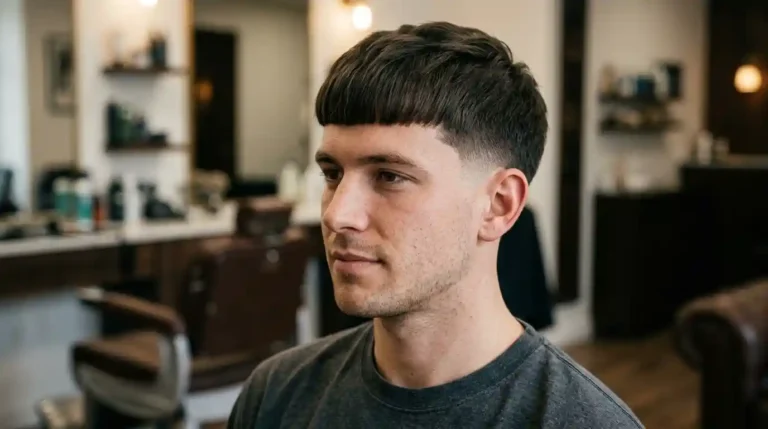
3. Blunt Fringe Taper
The blunt fringe taper has a relatively straight, clearly defined edge across the forehead.
This creates a sharp, geometric appearance.
The fringe can sit high on the forehead or extend lower, depending on the desired proportions.
A low taper produces a softer overall shape, while a mid fade can emphasize the contrast between the fringe and sides.
Thick straight hair often supports a defined blunt line because the strands can form a dense edge.
Fine hair may create a softer line because the fringe naturally separates into smaller sections.
The barber should consider your natural hairline before cutting.
A harsh fringe that is too short or uneven may become difficult to style.
For a more sharply defined front, the Edgar taper haircut offers a related geometric style, although not every blunt fringe is an Edgar cut.
Best for: Dense straight hair and men who prefer a structured haircut.
Barber request: “Keep a clean blunt fringe across my forehead with a low or mid taper, and make sure the front sits naturally.”
4. Caesar Fringe Taper
The Caesar fringe taper combines a short, forward-combed top with a compact fringe.
It resembles the French crop, although Caesar styles are often interpreted as having a shorter, more uniform top.
The fringe usually covers only a small portion of the forehead.
A low or mid taper creates a tidy outline without requiring a dramatic fade.
This is a practical choice for men who prefer short hair but want more shape than a uniform buzz cut.
The barber may cut the top with scissors or use a clipper-over-comb technique.
Styling is usually straightforward.
After washing, direct the hair forward while damp and let it settle naturally.
A small amount of light styling cream can provide additional control.
Best for: Short straight hair, compact hairstyles, and low-maintenance routines.
Barber request: “Give me a short Caesar-style fringe with an even top and a subtle taper around the edges.”
5. Jagged or Dense Forward Crop
A jagged forward crop emphasizes irregular fringe edges while keeping the top relatively short.
Unlike a blunt fringe, the front contains visible changes in length.
Some sections may extend slightly lower than others, creating a deliberately broken outline.
A dense forward crop retains substantial weight at the front, while the jagged texture provides movement.
This works particularly well for thick hair that might otherwise form a heavy, solid fringe.
The barber can use point cutting to soften selected sections.
However, removing too much weight can make the fringe appear thin.
A low or mid taper balances the textured front.
For styling, apply a small amount of matte clay and separate individual sections with your fingertips.
Avoid making every point identical.
Best for: Thick straight or slightly wavy hair and men who want a sharp but textured fringe.
Barber request: “Keep a dense forward crop with a jagged fringe, adding texture without thinning the front excessively.”
Textured and Relaxed Fringe Styles
Textured fringes use layers, natural bends, and strand separation to create a casual appearance.
They are ideal for men who prefer movement rather than a perfectly uniform haircut.
6. Classic Textured Fringe Taper
The classic textured fringe taper is one of the most versatile versions of this hairstyle.
The top is long enough to create natural separation, while the fringe falls forward in irregular sections.
A low taper keeps the sides clean and allows the top to remain the main feature.
The barber typically uses scissor-cut layers and selective point cutting to create texture.
The fringe often measures around 2–4 inches from its roots, although the finished position depends on forehead size and hair behavior.
For straight hair, texture may need to be created through cutting and styling.
For wavy hair, natural bends can provide much of the movement.
Apply a small amount of matte paste or styling cream and direct the fringe forward.
This haircut can be styled neatly for work or casually for everyday wear.
Best for: Straight, wavy, and medium-density hair.
Barber request: “Leave a textured fringe that falls naturally toward my forehead and blend the sides into a low taper.”
7. Messy or Disheveled Fringe Taper
The messy fringe taper uses deliberately irregular texture to produce a relaxed appearance.
Rather than keeping every strand aligned, the top contains separation and uneven movement.
The fringe may fall partly across the forehead or angle slightly toward one side.
A low taper works well because it keeps the perimeter neat while allowing the top to look casual.
The barber should introduce texture carefully.
Excessive thinning may create frizz or make fine hair appear sparse.
For styling, use a small amount of matte paste or lightweight texture spray.
Move selected sections forward and sideways with your fingers.
The goal is controlled messiness, not an unshaped haircut.
If you want more variations built around tousled texture, the messy taper haircut provides additional styling ideas.
Best for: Straight or wavy hair and men who prefer casual styling.
Barber request: “Give me a messy textured fringe with enough length to move naturally, and keep the taper low.”
8. Choppy and Point-Cut Fringe
A choppy fringe has visible variation in strand lengths, creating a more energetic hairstyle.
The barber may use point cutting to break up the ends and reduce a blunt appearance.
The result is a fringe with separated sections rather than one continuous line.
This works particularly well for men with thick or medium-density straight hair.
A mid taper can introduce additional definition around the temples.
However, the haircut does not need a high fade to appear modern.
The most important detail is retaining enough hair at the front for the texture to remain visible.
If the barber removes too much weight, the fringe may become wispy.
Use a small amount of matte clay to emphasize selected sections.
Avoid applying heavy products across the entire fringe.
Best for: Thick straight hair and men wanting visible choppy texture.
Barber request: “Point-cut the fringe for natural separation, keep enough weight in the front, and use a low or mid taper.”
9. Layered or Feathered Fringe
The layered fringe taper focuses on softer movement instead of dramatic choppy texture.
The barber creates gentle layers that allow the front sections to overlap naturally.
Feathered ends give the fringe a lighter, less rigid appearance.
This style is useful when the hair has some natural movement or when a blunt fringe feels too heavy.
A low taper complements the soft silhouette.
For medium-length versions, the front may fall near the middle of the forehead or eyebrows.
Straight hair can be styled with a vent brush and lightweight cream.
Wavy hair may need only finger shaping.
For fine hair, the layering should remain conservative so the fringe does not lose its fullness.
Best for: Straight or wavy hair and men wanting a soft, understated finish.
Barber request: “Keep a layered fringe with feathered ends and a natural low taper, without making the front too thin.”
10. Spiky or High-Volume Fringe
The spiky fringe taper combines forward hair movement with lifted sections.
Instead of lying flat on the forehead, some strands rise upward or diagonally.
This produces a textured silhouette with more volume.
A mid taper often works well because it balances the lifted top with cleaner sides.
The front usually needs enough length to separate into small textured sections.
The barber can use point cutting to encourage movement.
For styling, apply lightweight mousse or a suitable pre-styling product to damp hair.
Blow-dry the front upward and slightly forward.
Finish with a small amount of matte paste to define individual sections.
Avoid forming overly rigid spikes if you want a natural appearance.
For men who prefer a stronger lifted central shape, the fohawk taper haircut offers a more pronounced alternative.
Best for: Thick straight or slightly wavy hair and men wanting visible volume.
Barber request: “Keep a textured fringe with enough length for some upward movement, and blend it into a clean mid taper.”
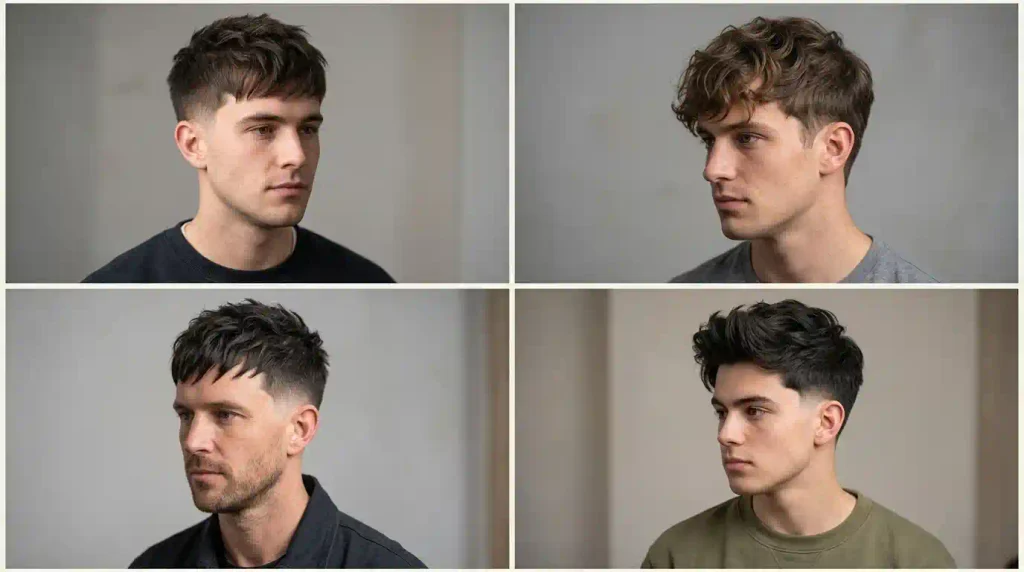
11. Fluffy Fringe Taper
The fluffy fringe taper features a soft, airy top with noticeable root volume.
The front may curve forward, rise slightly, or fall into loose sections across the forehead.
Unlike a rigid quiff, the fluffy fringe relies on natural-looking movement.
The barber should preserve enough length and weight for the hair to form a rounded silhouette.
Excessive thinning can make the top appear sparse rather than fluffy.
Straight and lightly wavy hair often work well with this style.
A low taper keeps the sides balanced, while a mid taper creates stronger contrast.
For styling, apply lightweight mousse or texture spray to damp hair.
Blow-dry the roots upward using a vent brush or your fingers.
Finish with a small amount of texture powder if additional lift is needed.
Best for: Straight, lightly wavy, and medium-density hair.
Barber request: “Leave enough length for a fluffy fringe with root volume, use soft layers, and keep a natural low taper.”
Swept and Longer Fringe Styles
Longer fringes offer additional styling possibilities, including side movement, curtain shapes, and eyebrow-level coverage.
These styles generally require more length and may need occasional blow-drying.
12. Side-Swept or Angular Fringe
The side-swept fringe taper directs the front hair diagonally across the forehead.
This creates an asymmetrical shape that can soften a blunt hairline or add movement to straight hair.
The fringe is usually longer on the side toward which it falls.
A low taper provides a natural outline, while a mid taper adds definition.
The barber may use scissor-cut layers to ensure the fringe moves smoothly without separating into awkward sections.
A small amount of styling cream helps control the direction.
For more volume, blow-dry the roots upward and guide the ends sideways.
This is a useful choice for men who prefer a fringe without covering the entire forehead.
Best for: Straight or wavy hair and men wanting a versatile hairstyle.
Barber request: “Keep a side-swept fringe that falls diagonally across my forehead, with a clean low taper.”
13. Asymmetrical Fringe Taper
The asymmetrical fringe deliberately uses different lengths across the front.
One side may sit above the eyebrow while the other extends farther down the forehead.
This creates a stronger visual statement than a regular side-swept fringe.
A mid taper often complements the sharper shape.
The barber should plan the fringe length according to the intended styling direction.
An asymmetrical fringe can be subtle, with only a small difference between sides, or dramatic, with a clearly uneven outline.
The haircut usually works best when enough length remains for the strands to fall naturally.
For styling, apply lightweight cream or paste and guide the fringe toward the longer side.
Avoid overloading the hair with product because this can make the longer sections clump together.
Best for: Medium-length straight or wavy hair and men wanting a distinctive fringe.
Barber request: “Create an intentionally asymmetrical fringe with one side longer, and keep the taper balanced around the temples.”
14. Curtain Fringe Taper
The curtain fringe taper features longer front hair separated near the center or slightly off-center.
Instead of falling straight across the forehead, the hair moves toward both temples.
The result frames the upper face and creates a softer silhouette.
A low taper is often suitable because it preserves enough side length to connect naturally with the curtain shape.
The front usually needs more length than a short crop.
The exact amount depends on whether the curtain ends near the eyebrows, cheekbones, or higher around the temples.
The barber should consider the natural part and growth direction.
A strong side part may make a perfectly centered curtain difficult to maintain.
Use a lightweight styling cream and blow-dry the front away from the center.
For a longer version with more movement through the sides and back, the Flow Taper Haircut offers a related silhouette.
Best for: Straight or wavy medium-length hair.
Barber request: “Keep a soft curtain fringe with a natural center part and a low taper that preserves side fullness.”
15. Long, Brow-Length, or Brushed-Forward Fringe
A long fringe taper places more emphasis on forehead coverage.
The front may reach the eyebrows or sit slightly above them when dry.
This version works well for men who want a softer, more relaxed appearance.
The hair can be styled straight forward, slightly sideways, or with natural waves.
A low taper preserves the balance between the longer front and the sides.
The main challenge is controlling weight.
If the fringe becomes too heavy, it may fall into the eyes or separate into thick sections.
The barber can adjust the layers while preserving the intended length.
For daily styling, use a lightweight cream and guide the fringe into position.
If you prefer a taper haircut with a fringe up to the eyebrow, ask the barber to check the final dry length before trimming the front.
Best for: Medium-length straight or wavy hair and men wanting greater forehead coverage.
Barber request: “Leave the fringe close to eyebrow length when dry, add soft movement, and maintain a clean low taper.”
16. Comb-Over Fringe Hybrid
The comb-over fringe hybrid combines the directional styling of a side part with a longer front section.
Instead of pushing the entire top backward, the barber leaves enough fringe to move diagonally across the forehead.
The result falls between a traditional side-part haircut and a relaxed fringe taper.
A low or mid taper gives the hairstyle structure.
This variation is particularly useful for men who want to switch between casual and professional styling.
For everyday wear, allow the front to fall naturally to one side.
For a more polished appearance, apply lightweight pomade or styling cream and establish a clearer part.
A Comb Over Taper Haircut generally emphasizes a neater side-directed top, while the hybrid retains a more visible fringe.
Best for: Straight or wavy hair and men wanting styling flexibility.
Barber request: “Keep a longer front that can sweep diagonally across my forehead, with a natural side part and a low taper.”
Fringe Tapers by Hair Texture and Density
Different hair textures require different fringe shapes, cutting techniques, and styling products.
A haircut that looks effortless on naturally wavy hair may need more styling on very straight hair.
17. Straight Hair Fringe Taper
Straight hair can create a defined fringe with a clean, consistent outline.
It is suitable for blunt, textured, side-swept, and curtain styles.
However, straight hair sometimes falls flat or forms a heavy block when the top lacks appropriate layering.
The barber should consider density before adding texture.
Thick straight hair may benefit from selective weight removal, while fine straight hair often needs more weight preserved.
A low taper creates a balanced appearance.
For a modern variation, a mid taper can emphasize the fringe without changing its direction.
Styling may require only a small amount of matte paste.
For additional lift, use a blow-dryer to direct the roots.
Best for: Straight hair with enough front length to form the desired fringe.
Barber request: “Shape a fringe that works with my straight hair, add suitable texture, and keep the sides neatly tapered.”
18. Wavy Hair Fringe Taper
A wavy fringe taper haircut uses natural bends to create movement across the forehead.
The fringe may form soft curves, irregular sections, or a lightly tousled shape.
A low taper works especially well because it preserves the natural fullness of the upper sides.
The barber should avoid cutting the fringe too short while wet.
Wavy hair can appear shorter after drying, depending on the strength of the wave pattern.
Soft layers help maintain movement without creating excessive bulk.
For styling, apply lightweight cream or mousse to damp hair.
Gently scrunch the waves and allow them to air-dry.
A diffuser can provide additional volume when necessary.
Avoid repeatedly brushing the fringe after drying because it can disrupt the wave pattern.
Best for: Naturally wavy hair and men wanting a relaxed, low-effort hairstyle.
Barber request: “Let my natural waves form the fringe, keep enough length for movement, and use a low taper around the edges.”
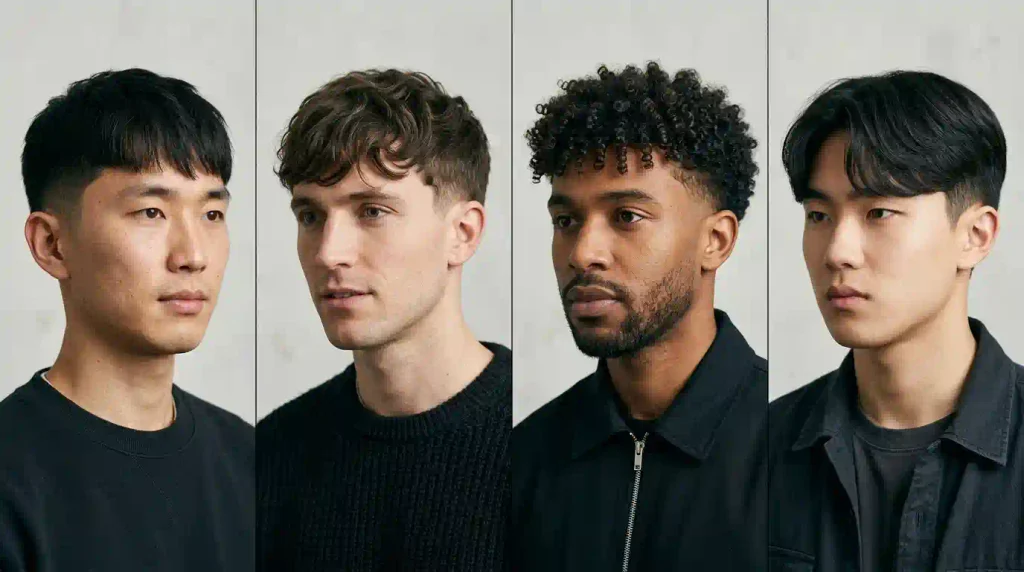
19. Curly and Coily Fringe Taper
A curly fringe taper combines natural curl definition with cleanly shortened temples and neckline.
The fringe is shaped by the curl pattern rather than forced into a straight horizontal line.
A low taper can preserve significant curl volume, while a mid taper creates additional contrast.
The barber must account for shrinkage.
A curl that looks long when stretched may sit considerably higher after drying.
For coily hair, the fringe may consist of shaped coils, twists, or longer textured sections across the front.
The exact style depends on natural texture and personal preference.
A barber experienced with curly or coily hair should assess the shape in its natural state.
Apply leave-in conditioner or curl cream to damp hair, then gently define the curls.
Air-dry or use a diffuser.
Avoid excessive thinning, which can disturb curl patterns or create unwanted frizz.
Best for: Loose curls, medium curls, tight curls, and coily textures.
Barber request: “Keep enough front length for my natural curls or coils to form a fringe, account for shrinkage, and taper the edges without removing too much volume.”
20. Asian-Inspired or Korean Fringe Taper
Korean-inspired fringe hairstyles often emphasize soft front sections, natural movement, and a relatively clean silhouette.
A popular variation includes a lightly curved fringe, sometimes with one section bending inward near the forehead.
Other versions use a curtain shape or a softly layered forward fringe.
These are styling approaches rather than haircuts limited to any ethnicity.
The hairstyle can be adapted to different hair types, although straight, dense hair often creates a clear front shape.
A low taper helps maintain a natural transition around the sideburns and neckline.
The barber should preserve enough length for the front to bend or separate naturally.
For hair that grows outward near the temples, careful scissor shaping may be needed.
Use lightweight styling cream and a round brush to create the desired bend while blow-drying.
Best for: Straight or slightly wavy hair and men wanting a soft, modern fringe.
Barber request: “Give me a softly layered Korean-inspired fringe with natural movement and a subtle low taper.”
21. Fringe Taper for Fine or Thin Hair
Fine hair can work well with a fringe taper, but the haircut requires careful weight management.
If the barber removes too much hair through thinning shears or deep point cutting, the fringe may become visibly sparse.
A short-to-medium fringe with conservative layering can create a fuller appearance.
A low taper may preserve more visual weight around the upper sides.
The fringe should be shaped according to the actual hair density rather than copied directly from a thick-haired reference photograph.
For styling, use lightweight mousse or a small amount of texture powder.
Heavy waxes, oils, and pomades can make fine hair clump and appear flatter.
A blow-dryer used at moderate heat can provide root lift.
A fringe may soften the appearance of thinning in some areas, but it does not increase hair density.
Best for: Fine straight hair and some mild thinning patterns.
Barber request: “Keep enough weight in the fringe for a fuller look, avoid excessive thinning, and create a soft low taper.”
22. Fringe Taper for Thick Hair
Thick hair can support a dense, textured fringe, but it may become heavy or bulky without appropriate shaping.
The barber should examine both the number of hairs and the thickness of individual strands.
Dense hair may need selected layers to improve movement.
However, aggressive thinning can create short internal strands that stick outward.
A textured or choppy fringe often works well because it breaks up a solid block of hair.
A mid taper can reduce visual width around the temples, while a low taper preserves a softer silhouette.
For styling, matte clay or paste can help control separation.
If the fringe naturally stands outward, gentle blow-drying may be more useful than adding large amounts of product.
Best for: Dense, thick, and coarse hair.
Barber request: “Keep a full textured fringe, remove unnecessary bulk carefully, and taper the sides without creating a harsh disconnection.”
Modern Fringe Taper Variations
Modern fringe tapers often combine longer front sections with more dramatic fades, unusual shapes, or additional styling details.
These versions are useful when you want a distinctive haircut rather than a traditional compact fringe.
23. Blowout Fringe Taper
The blowout fringe taper combines root volume with a forward-moving fringe.
The hair rises away from the scalp before bending forward or to the side.
This creates a fluffy appearance with more height than a standard textured fringe.
A low or mid taper provides a clean outline.
The barber should preserve enough front length for the hair to lift without becoming excessively heavy.
The crown also needs a balanced shape to support the volume.
For styling, apply lightweight mousse or volumizing spray to damp hair.
Blow-dry the roots upward using a vent brush, then guide the fringe forward.
Finish with a small amount of matte paste or texture powder.
For hairstyles that emphasize more upward and outward movement, explore the Blowout Taper Haircut.
Best for: Straight or slightly wavy hair that can hold root volume.
Barber request: “Leave enough length for a blowout-style fringe with soft volume, and use a low or mid taper.”
24. Disconnected Fringe Taper
The disconnected fringe taper creates a stronger difference between the longer top and shorter sides.
Instead of blending every section smoothly, the upper hair may appear to hang over the shorter side panel.
The fringe can be blunt, textured, or asymmetrical.
A higher taper or undercut-inspired side can emphasize the separation.
The barber should plan the disconnection carefully.
If the transition begins too high, the top may become difficult to manage or appear unintentionally isolated.
Straight, thick hair often displays this contrast clearly.
Wavy hair can soften the overall shape.
Styling usually involves directing the fringe forward while leaving the side contrast visible.
A matte product can create separation without excessive shine.
Best for: Men wanting a dramatic, high-contrast hairstyle.
Barber request: “Keep a longer fringe with a deliberate difference between the top and sides, and show me where the disconnection will begin.”
25. Drop Taper With Fringe
A drop taper with fringe features a transition that curves downward toward the back of the head.
This can create a more contoured silhouette compared with a straight horizontal fade.
The term drop taper is used inconsistently in barbershops, so clarify whether you want a localized taper or a broader drop fade.
A drop fade generally follows a curved line that descends behind the ears.
The fringe can be short, textured, or longer.
A wavy or choppy fringe often complements the curved side transition.
The barber should preserve enough length around the crown and back to avoid an uneven shape.
For styling, use a product appropriate to your natural texture.
Keep the front movement visible rather than flattening it completely.
Best for: Men wanting a curved side profile with a textured fringe.
Barber request: “Give me a textured fringe with a low drop-shaped transition behind the ears, while keeping the crown connected.”
26. Fringe Taper With a Hard Part or Carved Line
A hard part or carved line adds a precise detail to a fringe taper.
The line may appear near the temple, along a side part, or within the shorter tapered section.
This creates a more graphic appearance.
A single small line can complement a textured fringe without dominating the hairstyle.
The barber should consider the natural part and hair growth direction before placing the detail.
A hard part that conflicts with the natural growth pattern may be difficult to maintain.
Shaved lines also grow out relatively quickly.
If you prefer a subtle look, keep the design small and positioned within the taper.
For a more dramatic finish, the barber can combine a sharp fringe with a carefully placed carved detail.
Best for: Men wanting a personalized haircut with a defined accent.
Barber request: “Keep the fringe natural, add a clean taper, and create one subtle carved line near the temple.”
27. Fringe Taper With a Mullet or Wolf-Cut Shape
A fringe taper mullet combines a forward fringe with longer hair around the crown and nape.
The front may be short and choppy, while the back extends toward the neck.
A low taper or burst taper cleans the area around the ears without removing the longer rear section.
A wolf-cut-inspired version uses additional layers through the crown and sides.
This creates a more tousled, shaggy silhouette.
The barber should preserve a gradual connection between the fringe, crown, and longer back.
If the back is cut too short, the hairstyle may lose its mullet shape.
For styling, use lightweight cream or mousse and encourage natural movement.
A diffuser may help with wavy or curly versions.
Best for: Medium-length hair, natural waves, and men wanting a distinctive longer-back style.
Barber request: “Keep a choppy fringe and layered crown with extra length at the back, and add a low taper around the ears.”
28. Fringe Taper With a Beard Blend or Highlights
A fringe taper can be customized with facial-hair detailing or color.
For a beard blend, the barber gradually connects the sideburns to the upper beard.
This produces a smoother transition between the hairstyle and facial hair.
A low taper often works well with a short beard, while a mid taper can create more noticeable contrast.
Highlights offer a different form of personalization.
Subtle blonde, caramel, or lighter brown sections can make fringe layers appear more defined.
However, coloring does not change the underlying haircut structure.
Chemically lightened hair may also need additional conditioning and gentler heat styling.
A short textured fringe with a beard blend creates a polished look, while highlights can emphasize movement in longer fringes.
Best for: Men wanting a coordinated haircut and beard or more visible hair texture.
Barber request: “Keep a textured fringe with a low taper and blend the sideburns into my beard, or shape the fringe to show the highlighted layers.”
29. Professional or Low-Maintenance Fringe Taper
The professional fringe taper emphasizes a clean outline and controlled top.
The fringe is usually short or medium-length, with enough movement to avoid looking rigid.
A low taper provides a conservative silhouette.
The front may be styled forward, slightly sideways, or into a soft diagonal shape.
The barber should keep the sides balanced and avoid excessive disconnection.
For daily styling, use a small amount of lightweight cream or matte paste.
A short fringe generally requires less attention than a long eyebrow-level version.
This makes the hairstyle useful for work, school, and everyday activities.
Men who want a more compact top may also compare it with a Drake Taper Haircut, which offers a cleaner short-hair alternative.
Best for: Professional environments, short grooming routines, and understated styling.
Barber request: “Give me a neat, slightly textured fringe with a low taper and a natural neckline that’s easy to maintain.”
How to Choose a Fringe Taper for Your Face Shape and Hair
The most suitable fringe taper depends on several factors, including face shape, forehead proportions, hair density, natural texture, and styling preferences.
A reference photograph is useful, but it should not be copied without considering your individual hair.
Choose a Style for Your Face Shape
Different fringe shapes can change how the forehead and facial proportions appear.
| Face Shape | Recommended Fringe | Suggested Taper | Styling Goal |
| Oval | Textured, side-swept, or curtain fringe | Low or mid | Maintain natural balance |
| Round | Angular or lightly lifted fringe | Mid | Add some vertical structure |
| Square | Soft, layered, or textured fringe | Low or mid | Complement angular features |
| Long or oblong | Medium fringe with some side fullness | Low | Reduce excessive vertical emphasis |
| Heart-shaped | Soft or side-swept fringe | Low | Balance a wider forehead |
| Diamond-shaped | Layered or curtain fringe | Low | Add visual width near the upper face |
These are visual guidelines, not strict rules.
An oval face can accommodate many fringe variations.
For a round face, moderate height or a diagonal fringe can create the appearance of additional length.
A square face may benefit from softer texture that balances angular features.
For an oblong face, a brow-level fringe can reduce visible forehead height, while an extremely tall top may emphasize length.
Heart-shaped and diamond-shaped faces may benefit from preserving some fullness around the temples.
Ultimately, your preferred appearance matters more than following a fixed face-shape formula.
Consider Hair Texture, Density, and Growth Direction
Hair texture determines whether the fringe falls naturally, bends, curls, or stands outward.
Straight hair may form a clearly defined fringe, but it can also appear flat.
Wavy hair often creates natural movement.
Curly and coily hair require additional planning because of shrinkage.
Hair density determines how full the fringe appears.
Fine hair with low density may not support a very heavy, blunt fringe.
Thick hair may become bulky unless the barber redistributes some weight.
Natural growth direction is equally important.
If the front naturally grows forward, a fringe may be easy to maintain.
If it grows upward or sideways, you may need additional length or styling.
A successful haircut accounts for all these characteristics.
Match the Fringe Shape to Your Forehead and Hairline
Forehead height influences how much coverage the fringe provides.
A short micro fringe exposes most of the forehead.
A medium fringe covers more of the upper forehead.
A long brow-level fringe creates greater coverage and may soften the visual appearance of the hairline.
For a high forehead, a longer or angled fringe may create a balanced appearance.
For a shorter forehead, a micro or side-swept fringe can prevent the front from looking excessively heavy.
If you have a widow’s peak or uneven hairline, a textured fringe can sometimes make the front appear less rigid.
The barber should avoid forcing the hair into a shape that conflicts with its natural growth pattern.
Choose Between a Soft, Textured, or Blunt Finish
The fringe finish changes the haircut’s overall character.
A soft fringe uses gentle layers and a natural outline. It works well for relaxed hairstyles.
A textured fringe contains visible separation and movement. It suits men who want a casual, modern appearance.
A blunt fringe creates a clearly defined edge across the forehead. It produces a sharper, more structured result.
A choppy fringe introduces stronger variation in length, creating a more irregular appearance.
A feathered fringe emphasizes softness and movement through the ends.
For fine hair, preserve enough weight to avoid a sparse finish.
For thick hair, selected texture may improve movement.
For curls, the fringe should follow the natural curl pattern rather than being forced into a perfectly straight line.
Fringe Length Guide: Where Should the Front End?
Fringe length is one of the most important details to discuss with your barber.
A difference of even half an inch can change the amount of forehead coverage and how the hair behaves.
Micro, Short, Mid-Forehead, and Brow-Length Fringe
The following measurements are approximate and should be adjusted for forehead height, hair texture, and natural growth patterns.
| Fringe Type | Approximate Length | Typical Finished Position |
| Micro fringe | 0.5–1 inch | High on the forehead |
| Short fringe | 1–2 inches | Upper forehead |
| Mid-forehead fringe | 2–3 inches | Around the middle of the forehead |
| Brow-length fringe | 3–5 inches | Near the eyebrows |
| Long fringe | 4–6+ inches | Toward or below the eyebrows |
The length measurements refer broadly to the hair strands, not a guaranteed distance from the hairline.
A person with a taller forehead may need more strand length to reach the eyebrows.
Curly hair can also appear much shorter when dry.
Rather than relying only on a measurement, show the barber exactly where you want the fringe to end.
How Fringe Length Affects Forehead Coverage and Face Balance
A micro fringe leaves most of the forehead visible.
This creates a compact appearance and emphasizes the eyebrows.
A short fringe provides some coverage while keeping the front manageable.
A mid-forehead fringe is a versatile middle ground, offering visible bangs without necessarily reaching the eyes.
A brow-length fringe creates a softer appearance with greater forehead coverage.
Longer fringes also allow more styling options, including side sweeps and curtain shapes.
However, additional length can make the front feel heavier.
If you wear glasses or frequently work outdoors, a fringe that constantly reaches your eyes may be inconvenient.
Choose a length that complements your appearance while remaining practical.
How Much Length to Leave for Shrinkage and Styling
Curl shrinkage can significantly affect the finished length.
A fringe that reaches the eyebrows while wet may rise above the forehead when dry.
The amount of shrinkage varies widely between curl patterns.
For curly and coily hair, the barber should assess the natural dry shape before removing substantial length.
Straight hair generally changes less between stretched and dry states, but blow-drying can still alter how the fringe sits.
A lifted or fluffy fringe may appear shorter than the same hair when combed straight down.
If your goal is an eyebrow-level fringe, tell the barber whether you mean the styled appearance or the length when the hair is pulled straight.
That distinction can prevent an unexpectedly short result.
How Cowlicks, Hairlines, and Growth Patterns Affect a Fringe Taper
Natural hair growth patterns can strongly influence how a fringe behaves.
A hairstyle that appears easy in a photograph may require additional effort if the person’s hair grows in a different direction.
Working With a Front Cowlick or Uneven Growth Direction
A front cowlick can cause the fringe to rise, split, or move sideways.
This is not necessarily a haircutting mistake.
It reflects the natural direction of the hair follicles.
A barber may leave additional length so the hair has enough weight to fall forward.
In other cases, a side-swept or angular fringe may work better than a straight blunt fringe.
For styling, dampen the roots and direct the hair while blow-drying.
A vent brush or small round brush can help establish the desired direction.
Avoid repeatedly cutting the fringe shorter to make it lie flat.
Very short hair may actually stand up more noticeably when the natural growth direction is strong.
Adjusting the Fringe for a Widow’s Peak or Uneven Hairline
A widow’s peak creates a pointed or V-shaped area of hair growth at the center of the forehead.
The surrounding hairline may also be slightly uneven.
A textured or side-swept fringe can follow these natural variations.
A perfectly blunt fringe may require more careful shaping if the hair density differs across the front.
The barber should avoid unnecessarily cutting into the natural hairline to create an artificial shape.
Soft layering may help distribute the strands more evenly.
For a dramatic fringe, a carefully planned asymmetrical shape can incorporate the widow’s peak rather than trying to hide it completely.
Choosing a Fringe Taper for a Receding Hairline
A fringe can sometimes soften the appearance of a receding hairline by directing existing hair toward the forehead.
However, the result depends on where thinning occurs and how much density remains at the front.
A short textured fringe may work if the central front retains enough coverage.
A very long fringe on sparse hair may separate and reveal more scalp.
For some men, a compact crop with a soft fringe creates a more balanced appearance.
Avoid excessive thinning in the front.
The barber should preserve useful density and adapt the taper to the overall silhouette.
A fringe haircut changes how the hair is arranged but does not treat the underlying cause of hair loss.
Fringe Taper vs. Similar Haircuts
Fringe taper haircuts overlap with several popular men’s hairstyles.
The main differences usually involve the direction of the top, the fringe shape, and how extensively the sides are shortened.
Fringe Taper vs. French Crop
A French crop is a specific short hairstyle featuring a forward-directed top and recognizable fringe.
A fringe taper is a broader category that can include short, medium, long, swept, curly, or curtain fringes.
A French crop with a taper is therefore one possible fringe taper.
The key difference is flexibility.
The French crop usually maintains a relatively compact top, while a fringe taper can extend to longer, layered hairstyles.
Fringe Taper vs. Textured Crop
A textured crop emphasizes irregular layers and separation across the top.
It may or may not include a clearly defined fringe.
A fringe taper places more emphasis on the front hair falling toward the forehead.
A textured crop can become a fringe taper when the front is deliberately styled into bangs and the sides receive a tapered finish.
The two descriptions frequently overlap in modern barbershops.
Low Taper vs. Mid, High, or Burst Taper
| Taper Type | Main Characteristic | Visual Effect |
| Low taper | Short transition near sideburns and nape | Soft and natural |
| Mid taper | Transition rises around the temples | Balanced contrast |
| High taper | Shorter areas extend higher | More dramatic silhouette |
| Burst taper | Curved transition around the ear | Rounded side detail |
The correct choice depends on how much upper-side fullness you want to preserve.
For longer fringes, a low taper often provides a softer balance.
For short textured fringes, a mid taper can create stronger definition.
High tapers and burst tapers are suitable when a more distinctive shape is desired.
Taper vs. Skin Fade
A traditional taper can leave visible hair around the shortest areas.
A skin fade reduces the hair to bare or nearly bare skin.
The skin fade may extend across a much larger portion of the sides and back.
This creates stronger contrast and usually requires more frequent cleanup to preserve the original sharpness.
For a fringe taper, a localized skin taper is also possible.
Explain whether you want skin exposure only near the edges or across the broader sides.
Fringe Taper vs. Blowout Taper
A fringe taper typically emphasizes hair falling toward or across the forehead.
A blowout taper emphasizes root lift, outward movement, and volume.
Some hairstyles combine both features.
A blowout fringe may rise upward before bending toward the forehead.
However, a classic blowout with all the hair pushed high and backward may not have a recognizable fringe.
Similarly, a Taper Haircut Crew Cut Low Fade creates a shorter, more structured silhouette with less emphasis on bangs.
Choose the haircut according to the desired direction of the front hair rather than the taper alone.
How to Ask Your Barber for a Fringe Taper
Clear instructions are essential because the phrase fringe taper can describe many different hairstyles.
The barber needs to know the fringe shape, front length, taper height, and amount of top texture.
Describe the Taper Height and Neckline
Start by choosing a low, mid, or high taper.
For a soft, natural appearance, request a low taper that stays close to the sideburns and nape.
For stronger contrast, ask for a mid taper.
If you want a skin taper, explain that the shortest area should approach bare skin.
Also describe the neckline.
A natural tapered neckline gradually blends into the surrounding hair.
A blocked neckline creates a more defined horizontal outline.
A rounded neckline follows a curved shape.
For a relaxed fringe hairstyle, a natural taper often grows out more softly.
Specify the Fringe Length, Shape, and Texture
Tell the barber exactly where you want the front to end.
For example:
“I want the fringe to sit just above my eyebrows when dry.”
Then explain the shape.
You may want a blunt line, a choppy edge, a soft textured fringe, or an angular side sweep.
Also describe the volume.
A flat French crop fringe behaves differently from a fluffy, lifted fringe.
If you want a natural finish, ask the barber to preserve enough length and weight for movement.
If you have fine hair, explain that you do not want aggressive thinning.
If you have thick hair, ask for controlled weight removal rather than excessive shortening.
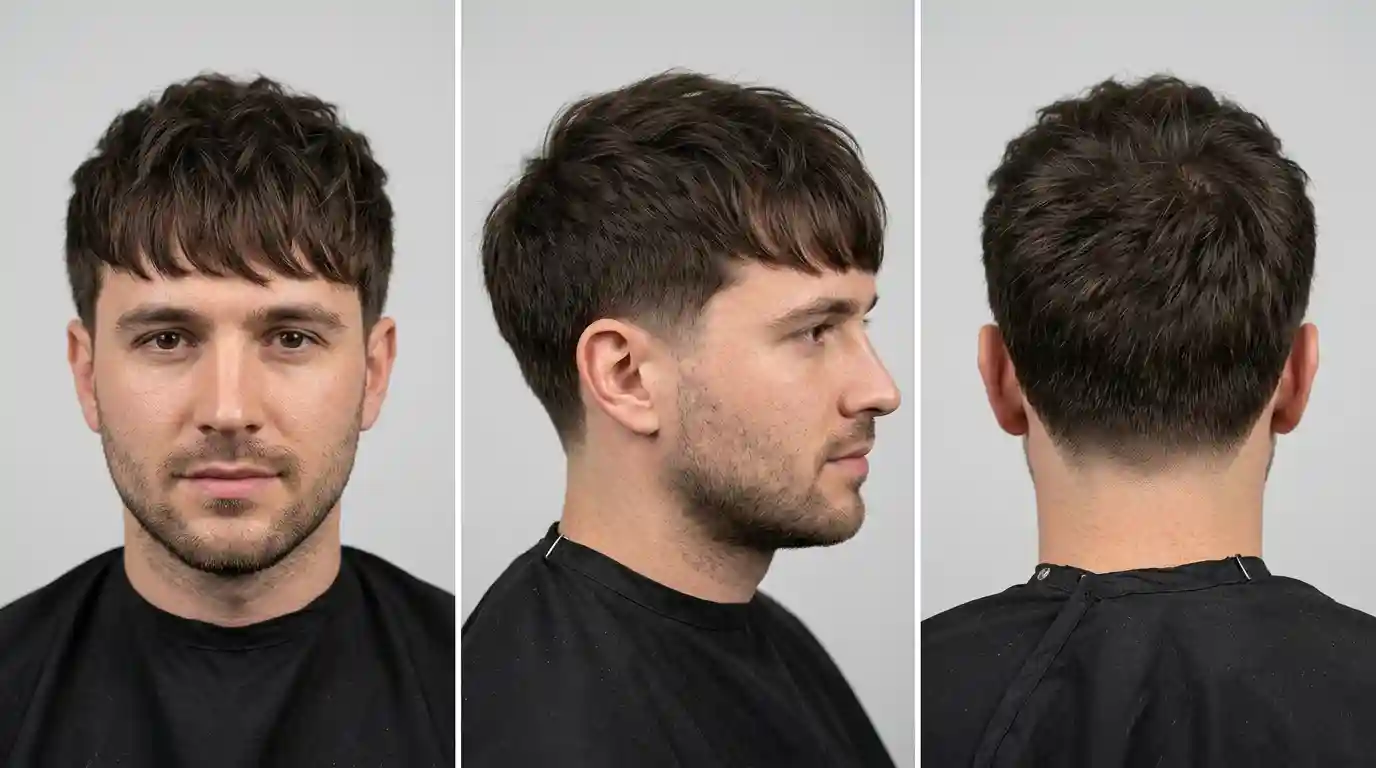
Share Reference Photos From the Front, Side, and Back
A front photograph shows the fringe length and shape.
A side photograph shows taper height, side fullness, and how the front connects to the top.
A back photograph reveals the neckline and crown transition.
Try to choose photographs featuring hair similar to your own.
A dense, straight fringe may not behave the same way on fine or curly hair.
If the photographs show different styles, explain which feature you want from each.
For example, you may prefer the fringe from one image and the low taper from another.
Barber Add-Ons and Details to Confirm
Before cutting, confirm the following details:
- Whether the fringe will be blunt, textured, layered, or swept.
- The approximate dry fringe length.
- The taper height and shortest clipper length.
- Whether the sides should remain connected to the top.
- Whether you want a skin finish or visible hair at the edges.
- Whether the neckline should be natural or sharply lined.
- Whether a beard blend, hard part, or carved line is included.
- Whether the barber will style the finished haircut in your preferred direction.
A useful barber script is:
“I want a fringe taper haircut with a textured front that sits just above my eyebrows when dry. Keep enough length on top for natural movement, but avoid removing too much weight. Give me a low taper around the temples, sideburns, and neckline, with the upper sides connected to the top. Please check my cowlicks and show me the intended fringe length before cutting.”
This description provides the barber with more useful information than the haircut name alone.
How a Barber Cuts a Fringe Taper
A professional fringe taper is built by establishing the longer top shape, creating the taper, and refining the fringe.
The sequence can vary according to the barber’s preferred cutting method.
Tools and Equipment Used
A barber may use scissors, clippers, clipper guards, a trimmer, combs, and styling tools.
| Tool | Main Purpose |
| Scissors | Establish top and fringe length |
| Clippers | Shorten and blend the sides |
| Clipper guards | Control approximate cutting length |
| Trimmer | Refine sideburns and neckline |
| Fine-tooth comb | Control straight sections |
| Wide-tooth comb | Manage thicker or textured hair |
| Texturizing shears | Remove selected bulk |
| Razor | Create texture on suitable hair types |
| Blow-dryer | Establish direction and volume |
| Round or vent brush | Shape the front while drying |
Point cutting can soften a blunt fringe.
Layering can distribute weight through the top.
Razor cutting and thinning shears should be used selectively, especially on fragile, curly, or fine hair.
Cutting Sequence for the Sides, Back, and Fringe
The barber first examines hair density, growth direction, head shape, and natural parting.
The top may then be sectioned away from the sides.
Next, the barber establishes the basic length through the crown and upper sections.
The fringe is shaped according to the requested position and finish.
For curly hair, the barber should account for shrinkage before removing substantial length.
The taper is created using progressively adjusted clipper lengths.
The shortest area is blended toward the longer upper sides.
The barber checks the neckline and sideburns for balance.
Finally, the top is refined with selective texture and styled in its intended direction.
The finished haircut should be checked when dry because wet hair may conceal cowlicks, uneven fringe movement, and excessive bulk.
How to Style a Fringe Taper at Home
A fringe taper can be easy to style when the haircut follows the natural direction and texture of your hair.
The best routine depends on whether you want a neat fringe, loose waves, fluffy volume, or deliberate separation.
Step-by-Step Styling Routine
Step 1: Start with slightly damp hair.
You do not need to shampoo every morning.
If the hair already feels clean, lightly mist it with water to reset the fringe.
Step 2: Choose the right product.
Fine hair often benefits from lightweight mousse or texture spray.
Thick straight hair may need matte paste or clay.
Wavy and curly hair may respond better to styling cream or curl cream.
Step 3: Apply a small amount evenly.
Spread the product across your fingers before working it through the top.
Avoid placing all the product directly onto the fringe.
Step 4: Direct the fringe.
For a straight fringe, guide the hair forward.
For an angular fringe, move it diagonally.
For a curtain fringe, establish the natural part.
For curly hair, gently shape the curls without pulling them straight.
Step 5: Blow-dry if necessary.
Use low or medium heat and appropriate heat protection.
A vent brush can help create direction, while a round brush can provide lift and a curved shape.
Step 6: Finish with your fingers.
Separate selected strands for texture.
Avoid repeatedly combing the fringe until it becomes flat or overly uniform.
The goal is to maintain the shape without sacrificing natural movement.
Styling Straight, Wavy, and Curly Fringe
Straight hair often benefits from controlled blow-drying and a small amount of matte paste.
If the fringe falls flat, direct the roots slightly upward before brushing the ends forward.
Wavy hair may only need lightweight cream and gentle scrunching.
Allow the natural bends to form instead of repeatedly brushing the hair straight.
Curly hair benefits from curl cream or leave-in conditioner when needed.
Apply product to damp hair and allow curls to air-dry or use a diffuser.
For coily textures, shape the front according to the natural curl or twist pattern.
The objective is not to make every hair texture look identical.
A well-styled fringe should complement the hair’s natural structure.
Products for Texture, Volume, and Hold
| Styling Product | Best For | Result |
| Matte clay | Thick, short textured fringes | Definition and stronger hold |
| Matte paste | Straight or textured fringes | Flexible separation |
| Styling cream | Soft and wavy fringes | Natural movement |
| Mousse | Fine or flat hair | Root volume |
| Sea salt spray | Suitable straight or wavy hair | Tousled texture |
| Texturizing powder | Fine hair needing lift | Dry volume |
| Curl cream | Curly and coily hair | Curl definition |
| Pomade | Neat side-swept fringes | Controlled finish |
| Lightweight gel | More structured fringes | Additional hold |
Use the smallest effective amount.
Too much clay or wax can make the fringe separate into heavy sections.
Excessive sea salt spray may dry out some hair types.
Texture powder can create buildup if repeatedly applied without cleansing.
For fine hair, avoid heavy products near the roots.
For dry or curly hair, prioritize moisture and gentle styling.
Styling With or Without a Blow-Dryer
A blow-dryer can help change the direction of a fringe, especially when the hair has a strong cowlick.
It also helps produce fluffy volume.
However, many fringe tapers can be styled without heat.
For a no-heat routine, apply a suitable lightweight product to damp hair and guide it into position.
Allow the fringe to air-dry.
Straight hair with a natural forward growth pattern may settle easily.
Wavy and curly hair can often maintain its natural movement through air-drying.
Use heat only when needed, and avoid holding the dryer too close to the hair.
Excessive heat can contribute to dryness and breakage over time.
How to Refresh a Fringe Taper Between Washes
The fringe is one of the most visible areas of the haircut.
Because it rests near the forehead, it can also become affected by skin oil, sweat, humidity, and styling product buildup.
A quick refresh can restore the shape without requiring a full shampoo every time.
Resetting the Fringe With Water and a Blow-Dryer
Lightly dampen the fringe using a spray bottle.
Focus particularly on the roots if the hair has developed an unwanted part or flattened overnight.
Use your fingers or a brush to guide the hair into its preferred direction.
If necessary, blow-dry on low or medium heat while controlling the roots.
For a forward fringe, direct the hair toward the forehead.
For a side-swept fringe, establish the diagonal movement.
For a curtain fringe, reset the part and gently direct the sections outward.
Allow the hair to cool before making final adjustments.
This helps the fringe retain the new direction.
Refreshing Texture Without Adding Too Much Product
If the fringe feels heavy, avoid automatically adding another layer of clay or paste.
Product buildup can make the hair greasy, stiff, or difficult to separate.
First, loosen the existing style with clean fingers or a small amount of water.
If additional texture is needed, use a minimal quantity of product.
A lightweight texturizing spray may be suitable for some straight or wavy hair types.
For curly hair, a little water and suitable curl cream may help refresh definition.
If the hair already contains substantial buildup, washing may be more effective than applying more products.
Keeping the Fringe in Place Under Hats or in Humid Weather
Hats can flatten the roots and push the fringe into an unwanted direction.
When removing a hat, gently lift the roots with your fingers.
If the shape does not return, use a little water to reset it.
Humidity may cause some hair types to frizz, curl, or lose their styling direction.
For humid conditions, choose a flexible product that provides appropriate control without making the hair stiff.
Avoid overusing heavy products in an attempt to force naturally curly or wavy hair into a completely straight shape.
A fringe that works with your natural texture is usually easier to maintain in changing weather.
Fringe Taper for Men Who Wear Glasses
A fringe taper can work well with glasses, but the front length and shape should complement the frames.
The main consideration is preventing the hair from constantly falling onto the lenses.
Choosing a Fringe Length That Clears the Frames
A short or mid-forehead fringe generally provides more clearance above the glasses.
A brow-length fringe may overlap the top of the frames, especially when the hair falls forward.
If you prefer longer bangs, a side-swept or curtain fringe can move more hair away from the center of the face.
Show your barber how the glasses sit on your nose.
A fringe that looks ideal without glasses may behave differently once the frames are worn.
Ask the barber to check the finished fringe while you are wearing them.
Balancing the Fringe With Your Glasses
Thicker frames can create a strong horizontal line across the face.
A soft, textured fringe may complement them by introducing natural movement.
Thin frames often pair well with a neat or lightly layered fringe.
An angular fringe can create diagonal movement that contrasts with rectangular frames.
A curtain fringe may leave more of the upper face visible.
There is no universal rule that one frame shape requires a particular fringe.
Choose a combination that feels comfortable and keeps the lenses clear during everyday activities.
Fringe Taper Maintenance and Grow-Out
A fringe taper requires attention to two separate areas: the shorter perimeter and the longer front.
These areas do not necessarily need trimming at the same frequency.
How Often to Trim the Taper and Fringe
A taper cleanup approximately every 2–4 weeks is a useful starting point for many men.
A low taper may grow out gradually.
A skin taper or sharper fade can become noticeably less defined sooner.
Fringe maintenance depends on length and shape.
A micro fringe or blunt fringe may need more frequent shaping to preserve its intended position.
A soft, textured fringe often grows out more naturally.
For many styles, checking the fringe approximately every 3–6 weeks can be practical.
If you are growing the front longer, explain that goal to your barber before trimming.
What to Expect as the Haircut Grows Out
As the hair grows, the fringe may fall lower on the forehead.
A short crop may develop into a textured medium fringe.
A side-swept fringe may become easier to style as additional length develops.
The sides also gain fullness, reducing the contrast created by the taper.
A low taper often transitions into a softer shape.
A high skin fade may show more visible regrowth.
If you want to grow the haircut longer, maintain the neckline and sideburns while preserving the front length.
Occasional shaping can prevent the fringe from becoming heavy without resetting the entire grow-out process.
How to Keep the Neckline and Fringe Looking Neat
Regular cleaning and gentle styling help maintain the haircut between appointments.
Wash according to your scalp’s oil production and styling product buildup.
Apply shampoo primarily to the scalp and use conditioner suited to your hair type.
Avoid aggressive towel rubbing and unnecessary high heat.
The American Academy of Dermatology’s healthy hair tips recommend choosing care routines for your hair type, handling wet hair gently, conditioning appropriately, and limiting excessive heat exposure.
For the neckline, avoid cutting too high when attempting a home cleanup.
A small amount of stray growth is usually better than an accidentally uneven taper.
For the fringe, lightly reset the direction with water when necessary.
If the front needs significant reshaping, visit your barber rather than repeatedly trimming small sections without a clear guide.
Fringe Taper Troubleshooting
Even a well-cut fringe taper may develop styling problems because of growth patterns, hair density, humidity, or changing length.
Understanding the cause helps determine whether you need a different product, a styling adjustment, or a professional haircut correction.
What to Do When the Fringe Splits or Falls Flat
A splitting fringe may be caused by a front cowlick, natural part, uneven density, or excessive product.
Start by dampening the roots.
Use a brush or your fingers to direct the hair against the unwanted split, then guide it into the desired position.
For fine hair, lightweight mousse may help add lift.
For thicker hair, a small amount of styling cream can improve control.
If the fringe repeatedly separates in the same location, the natural growth pattern may be responsible.
A side-swept or textured fringe may work better than forcing a perfectly blunt line.
If the fringe falls flat, avoid heavy waxes or oils near the roots.
How to Manage a Fringe That Sticks Up or Will Not Lie Forward
A fringe that sticks upward often reflects the hair’s natural growth direction.
Cutting it shorter can sometimes make the problem more noticeable.
Additional length may help the strands settle.
A barber can also adjust the layering and front weight.
For daily styling, dampen the hair and use a blow-dryer to direct the roots forward.
A small amount of flexible product may provide additional control.
If the hair strongly resists lying forward, consider a side-swept or lifted fringe instead.
Working with the natural pattern usually creates a more manageable hairstyle.
How to Fix a Fringe That Feels Too Heavy or Reaches Your Eyes
A heavy fringe can interfere with vision and feel uncomfortable during daily activities.
The barber may need to remove selected weight or shorten the front slightly.
However, aggressive thinning is not always the best solution.
For fine hair, it can create visible gaps.
For thick hair, controlled internal layering may help distribute the weight.
You can also temporarily style the fringe sideways or into a curtain shape.
If the front constantly reaches your eyes, ask the barber to check the dry length rather than trimming only while wet.
When to Restyle It and When to Ask Your Barber for a Correction
Restyling may be sufficient when the problem involves flat roots, product buildup, or an unwanted part.
A quick water refresh and directional blow-drying can often solve these issues.
A barber correction may be necessary when the fringe is visibly uneven, the taper rises higher than intended, or the top and sides do not connect properly.
If too much length has already been removed, immediate cutting usually cannot restore the original shape.
In that situation, a gradual grow-out plan may be more appropriate.
Explain what you dislike about the current haircut and show the intended result.
Clear communication helps prevent the same issue during the next appointment.
Fringe Taper Cost and Appointment Time
The cost of a fringe taper haircut varies according to location, barber experience, service complexity, and the amount of scissor work required.
In the United States, a standard men’s haircut with a taper may cost approximately 25–75, while more elaborate salon services or detailed restyling can cost more.
A basic taper cleanup is often less expensive than a complete haircut.
The following figures are broad planning estimates rather than guaranteed prices.
| Service | Illustrative US Price Range | Approximate Appointment Time |
| Basic fringe and taper cleanup | 15–35 | 15–25 minutes |
| Standard fringe taper haircut | 25–60 | 25–45 minutes |
| Detailed textured or layered fringe taper | 40–85 | 35–60 minutes |
| Premium long-fringe restyling | 60–120+ | 45–75 minutes |
| Fringe taper with beard detailing | Varies by shop | Additional time may apply |
Prices and service times can be significantly different in major cities, premium salons, and specialized barbershops.
A curly or coily fringe may require more consultation and careful shaping.
A long curtain fringe may also involve more scissor work than a short crop.
Before booking, confirm whether the service includes a consultation, shampoo, styling, and beard detailing.
If you only want a taper cleanup while preserving the fringe, tell the barber that in advance.
Frequently Asked Questions
Does a fringe taper work with curly or fine hair?
Yes, curly hair can form a naturally defined fringe, while fine hair often benefits from a shorter, softly textured fringe with minimal thinning.
Is a fringe taper suitable for school or professional settings?
Yes, a neat low taper with a short or controlled fringe can create a practical appearance for school and many professional environments.
Can I wear a fringe taper with a beard?
Yes, the taper can be blended into the sideburns and beard to create a smoother transition between the haircut and facial hair.
How often should I get a fringe taper trimmed?
A taper cleanup every 2–4 weeks and fringe shaping approximately every 3–6 weeks are practical starting points, depending on growth and style.
Can I style a fringe taper without heat?
Yes, many fringe tapers can be styled with damp hair, finger shaping, and a lightweight product or no product at all.
Final Thoughts on the Fringe Taper Haircut
The fringe taper haircut offers a versatile combination of forehead-framing hair and clean, gradually shortened sides. From short French crops and blunt fringes to textured, wavy, fluffy, curtain, and brow-length styles, the best version depends on your hair type, facial proportions, growth patterns, and daily routine.
For a natural, easy-to-maintain appearance, start with a low taper and soft textured fringe. If you prefer stronger contrast, consider a mid taper or a more defined fade. Always show your barber reference photos, specify your desired fringe length when dry, and choose products that complement your natural hair.
For more haircut ideas, styling tutorials, and barber guidance, explore Taper Haircut Hub and browse our collection of Hairstyles with taper to discover a style that fits your appearance and lifestyle.




3 Comments