
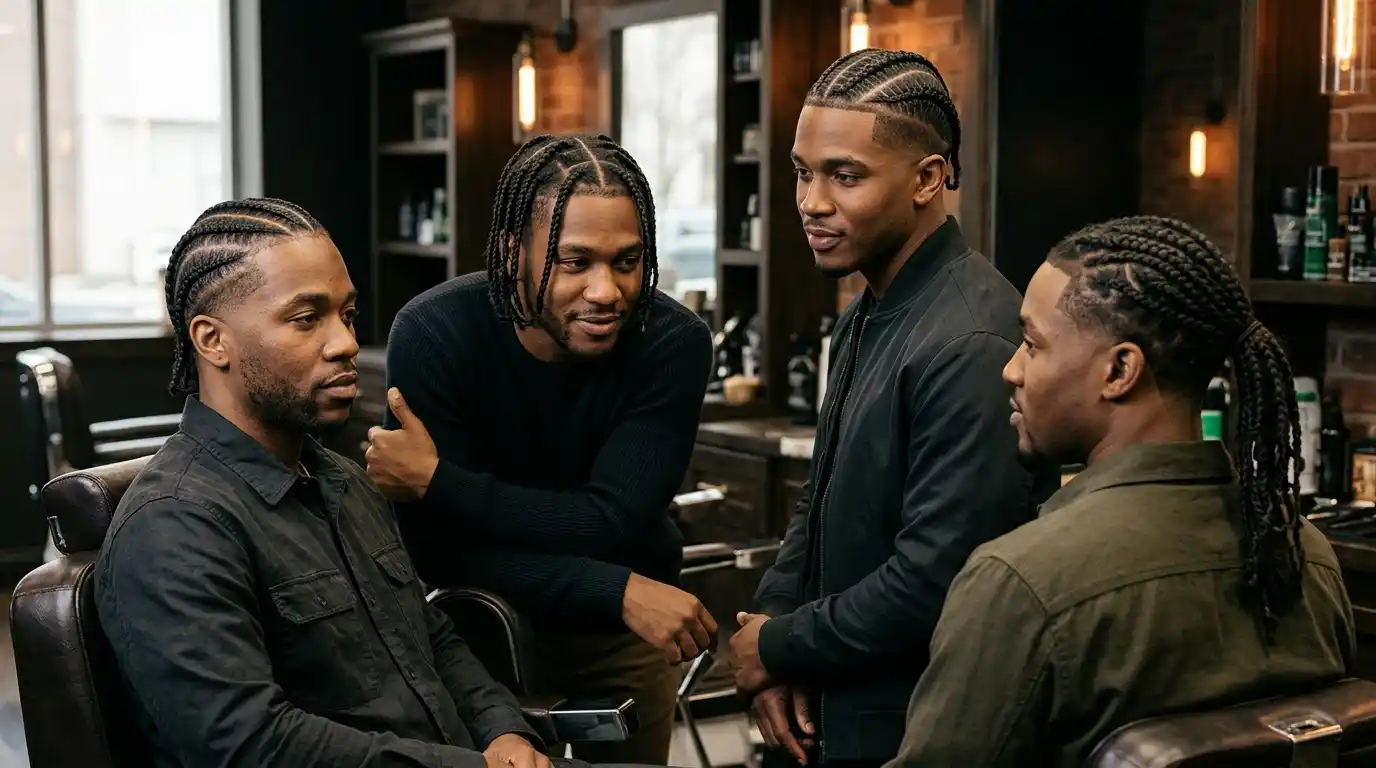
Taper Haircut Braids: Best Styles, Fades & Barber Guide
Taper haircut braids combine the clean, gradually blended sides of a taper fade with the texture, structure, and versatility of braided hairstyles. Whether you prefer classic cornrows, box braids, stitch braids, two-strand twists, or long braided ponytails, a well-placed taper can create a sharp, balanced appearance without removing the hair needed for your preferred braid pattern. Low tapers offer subtle temple and neckline blending, mid tapers provide more contrast, and high tapers create a bolder silhouette.
However, choosing a taper haircut with braids involves more than selecting a style from a photograph. Hair length, braid thickness, scalp condition, parting direction, hairline shape, and the order of your barber and braiding appointments all influence the finished result. Cutting too much hair before braiding can limit your options, while excessive braid tension can damage the hairline.
This comprehensive guide explores over 100 braided taper combinations and related variations, from simple straight-back cornrows to creative geometric designs. You’ll discover how to choose the right fade, prepare for your appointment, maintain your braids, protect your scalp, understand U.S. costs, and communicate clearly with your barber and professional braider.
Table of Contents
- Taper Haircut Braids: Quick Overview
- Understanding Taper Fades, Undercuts, and Braided Haircuts
- Best Taper Haircut Braids Styles and Variations for Men
- Taper Haircut Braids Pictures and Photo Gallery
- Taper Haircut Braids for Different Hair Lengths
- Best Taper Haircut Braids for Different Hair Types and Textures
- Choosing the Right Taper Haircut Braids for Your Face Shape, Head Shape, and Hairline
- Taper Haircut Braids for Different Ages and Lifestyles
- How to Prepare for a Taper Haircut and Braiding Appointment
- How to Ask Your Barber for Taper Haircut Braids
- How to Style Taper Haircut Braids for Men
- Best Hair Products for Taper Fade Braids
- Taper Haircut Braids Maintenance and Daily Hair Care
- Braids, Hairline Health, and Common Risks
- Common Taper Haircut Braids Mistakes and How to Avoid Them
- Taper Haircut Braids Cost and Maintenance Budget
- Taper Haircut Braids Trends and Popular Styles for 2026
- Taper Haircut Braids FAQs
- Final Thoughts on Taper Haircut Braids
1. Taper Haircut Braids: Quick Overview
1.1 What Is a Taper Haircut With Braids?
A taper haircut with braids is a hairstyle that combines braided hair with gradually shortened sections around the temples, sideburns, neckline, or sides of the head.
The braided portion can feature cornrows, box braids, individual plaits, or intricate geometric patterns. The taper creates a neat perimeter while the braids provide texture and visual interest.
Unlike an undercut, which may sharply separate longer hair from short sides, a traditional taper generally uses gradual blending. This allows the haircut to retain a natural silhouette.
The amount of hair that remains available for braiding depends on where the taper begins. A low taper preserves more of the head’s perimeter, making it particularly useful for full-head cornrows and box braids.
1.2 What Is a Taper Fade With Braids?
A taper fade with braids is a variation in which the hair becomes progressively shorter around selected areas while the braided top remains longer.
Professional barbers use clippers, guards, and blending techniques to create a gradual transition. The shortest sections may retain visible hair or be reduced close to skin level.
The braids can remain stationary against the scalp, as with cornrows, or hang freely, as with box braids.
This combination creates a defined appearance without requiring the entire head to be closely shaved.
1.3 What Is a Low Taper Fade With Braids?
A low taper fade with braids keeps the shortest transition near the sideburns, temples, and lower neckline.
Most of the upper side hair remains available for the braid pattern.
This makes the low taper especially suitable for cornrows, stitch braids, and other styles that need enough hair around the sides and crown.
It also provides a more understated appearance than a high fade.
For men getting their first braided taper, a low taper is often the most flexible starting point because the barber can increase the height at a future appointment.
1.4 Why Are Taper Haircuts With Braids Popular Among Men?
Braided tapers combine two complementary grooming features: structured braiding and clean barber detailing.
The braids create a distinctive top pattern, while the taper controls side bulk and sharpens the overall silhouette.
This style also offers considerable flexibility. A simple two-cornrow taper can look understated, while geometric stitch braids with a fade create a much more expressive appearance.
Some styles require frequent rebraiding, but others can be maintained for several weeks when installed comfortably and cared for correctly.
At Taper Haircut Hub, different haircut combinations are explored according to their styling requirements, hair types, and practical maintenance needs.
1.5 Braids vs. Plaits vs. Twists vs. Locs
These terms are often used together, but they do not all describe the same hair structure.
Braids are created by interweaving sections of hair, commonly using three strands. Plaits is another word frequently used for braids.
Twists generally involve wrapping two sections of hair around each other, rather than weaving three sections.
Locs are formed by allowing or encouraging sections of hair to lock together over time. They can be styled into braided patterns, but locs themselves are not the same as conventional braids.
All four styles can be combined with taper fades, although the installation, maintenance, and removal processes differ.
1.6 How Do Braids and a Taper Fade Work Together?
The braids occupy a planned section of the head, while the taper shapes the remaining perimeter.
For example, straight-back cornrows may extend from the forehead toward the crown, with a low taper around the temples and nape.
Box braids can hang over the faded sides, creating contrast between freely moving hair and the shorter perimeter.
A successful combination depends on correctly dividing the head into braided and tapered areas.
That division should be decided before excessive hair is removed.
1.7 Benefits and Drawbacks of Taper Haircut Braids
| Benefits | Potential drawbacks |
| Clean, defined sides | Requires coordination between barber and braider |
| Many braid patterns available | Some patterns need considerable hair length |
| Suitable for different natural textures | Tight braiding can stress the hairline |
| Can be worn casually or professionally | Braids and fades have different maintenance schedules |
| Works with long and short braided sections | Detailed designs may be expensive |
| Can preserve much of the natural hair | Excessive fading can remove braid anchors |
| Supports creative accessories and colors | Extensions can add weight and tension |
The best results come from choosing a suitable braid pattern, keeping the installation comfortable, and preserving healthy hair around the temples.
1.8 Who Should Consider Braids With a Taper?
A braided taper is worth considering if you want clean edges while retaining enough hair for braiding.
It can work with curly, coily, wavy, and some straight hair textures, depending on length and the braiding technique.
Men who regularly wear cornrows, box braids, or twists may appreciate the clean appearance of a low temple taper.
However, anyone with fragile edges, active scalp irritation, or significant hairline thinning should avoid styles that place additional tension on those areas.
Explore other hairstyles with taper if you want a similar silhouette without installing braids.
1.9 Taper Haircut Braids at a Glance
Compare Braided Tapers by Fade Height, Braid Type, Hair Length, and Maintenance
| Hairstyle | Taper placement | Common braid type | Suggested natural hair length | Typical maintenance |
| Low taper cornrows | Low | Straight-back cornrows | Around 3–4+ inches | Braids often 2–4 weeks |
| Mid taper stitch braids | Mid | Stitch braids | Around 3–5+ inches | Braids often 2–4 weeks |
| High taper box braids | High | Individual box braids | Varies; often 3–4+ inches for secure attachment | Often 4–6 weeks |
| Temple taper with twists | Temples | Two-strand twists | Around 3–4+ inches | Varies by texture |
| Low taper braided bun | Low | Long braids | Usually longer hair or extensions | Varies |
| Skin taper braids | Low or mid | Cornrows or box braids | Enough hair above the taper | Fade often 1–2 weeks |
| Long braids with nape taper | Nape | Long individual braids | Often 6+ inches or extensions | Varies |
These are practical starting ranges, not universal rules. Hair texture, braid size, grip, scalp condition, and professional technique determine what is achievable.
Best Braided Taper Styles for Classic, Modern, and Creative Looks
For a classic appearance, choose straight-back cornrows with a low taper.
For a contemporary look, stitch braids with controlled parting and a mid taper create more visible definition.
For creative styling, geometric cornrows, colored extensions, or braided ponytails can be combined with a carefully placed taper.
Quick Picks for Short, Long, Curly, Coily, and Low-Maintenance Hairstyles
Short coily hair may support compact cornrows or small plaits when enough length is available.
Long hair works well with box braids, braided buns, and ponytails.
For low-maintenance grooming, simple medium-sized cornrows with a conservative low taper are often easier to manage than intricate microbraids or elaborate geometric designs.
2. Understanding Taper Fades, Undercuts, and Braided Haircuts
2.1 Taper Haircut vs. Fade Haircut With Braids
A traditional taper gradually shortens hair near the perimeter, often preserving most upper side coverage.
A full fade may extend farther across the side panels and rear of the head.
With braids, this distinction matters because the location of the shortest section determines how much hair remains for the braid pattern.
A low taper is generally better suited to preserving a larger braided area.
2.2 Low Taper Fade vs. Low Fade With Braids
A low taper fade usually focuses on the sideburns and lower neckline.
A conventional low fade may continue around more of the head’s lower perimeter.
Although barbers sometimes use the terms interchangeably, they can produce different results.
Show reference photographs and identify the exact sections you want shortened.
2.3 Low vs. Mid vs. High Taper Fade With Braids
A low taper fade braids style preserves more hair around the perimeter.
A mid taper creates stronger contrast through the sides.
A high taper removes additional side coverage and may reduce the area available for cornrows or other scalp-based braids.
| Taper height | Visual result | Best consideration |
| Low | Subtle, natural | Preserves braid area |
| Mid | Balanced contrast | Requires careful braid placement |
| High | Bold, sharp | May reduce usable side hair |
| Temple-only | Localized detail | Maintains most of the braided head |
| Skin-level | Very close finish | Requires careful hairline and scalp assessment |
2.4 Taper Fade vs. Skin or Bald Fade With Braids
A skin or bald fade reaches bare or nearly bare skin at its shortest section.
A taper can stop at a longer guard length.
For braided styles, a skin taper creates strong contrast, but it may require more frequent barber touch-ups.
Clients prone to razor bumps or scalp irritation may prefer a slightly longer finishing guard.
2.5 Taper Fade vs. Undercut With Braids
A taper creates gradual blending.
An undercut creates a more abrupt separation between longer braided sections and short sides.
An undercut may suit long braids or a braided top knot, but it can remove more hair than a traditional low taper.
If you expect to switch between full-head braids and loose hairstyles, preserving additional side length may provide greater flexibility.
2.6 Temple Taper Fade With Braids
A temple taper focuses on the hair around the temples and sideburns.
It is particularly useful with cornrows that extend along the upper sides.
The barber can create clean edges while leaving the main braid structure intact.
2.7 Burst Fade With Braids
A burst fade follows a curved shape around the ear.
It can complement braided mohawks and hairstyles that preserve length behind the ear.
Some burst fades remove more side coverage than a traditional taper, so discuss the braid pattern before cutting.
2.8 Drop Fade With Braids
A drop fade curves downward toward the rear of the head.
It produces a rounded side silhouette that can work with freestyle cornrows and longer braided tops.
The drop placement should complement the crown and nape.
2.9 How Fade Height Changes the Appearance of Braids
Fade height affects the balance between visible scalp, braided volume, and head shape.
Higher fades emphasize the braided top by reducing side bulk.
Lower fades produce a more natural appearance and leave a larger area available for braiding.
2.10 Natural Hairline vs. Sharp Line Up With Braids
A natural hairline follows the existing shape of the forehead and temples.
A line up uses careful trimming to create more defined edges.
Both can look attractive, but repeatedly pushing an uneven or receding hairline backward may unnecessarily reduce coverage.
A clean line up should respect the natural hairline rather than attempt to manufacture an unrealistic one.
2.11 How the Taper Connects With the Braided Top
The boundary between the taper and braids should be planned before installation.
For cornrows, the braider needs sufficient hair for secure starting points and continuous rows.
For box braids, enough hair must remain around the planned parting squares or triangles.
The barber should not remove hair simply because it appears to be outside the main braid pattern.
2.12 Taper Fade and Braid Placement Blueprint
Understanding the Braided Top and Tapered Perimeter
Think of the head as two connected areas: a braided zone and a tapered zone.
The braided zone includes the hair needed for the chosen pattern. The tapered zone includes the perimeter hair intended for gradual shortening.
The dividing line is not necessarily straight.
It may follow the natural temples, curve around the ears, or descend toward the nape.
Where Should the Taper Fade Start Below the Braids?
For a conservative low taper, the shortest sections remain near the lower temples and neckline.
A mid or high taper may extend farther upward.
The fade should begin below the hair required for the braid pattern, not inside it.
How Much Hair Should Remain Around the Temples?
The amount depends on whether the braids begin close to the temples.
If cornrows require hair near the front corners, removing too much can make the first rows difficult to secure.
Preserve the natural hairline and let the braider identify any essential anchor sections.
How to Preserve Enough Hair for Cornrow Anchors
Cornrow anchors are the beginning sections where the braider establishes control over the strands.
These sections need sufficient length and density for comfortable grip.
The barber should avoid shaving into them, especially before the braid parting has been marked.
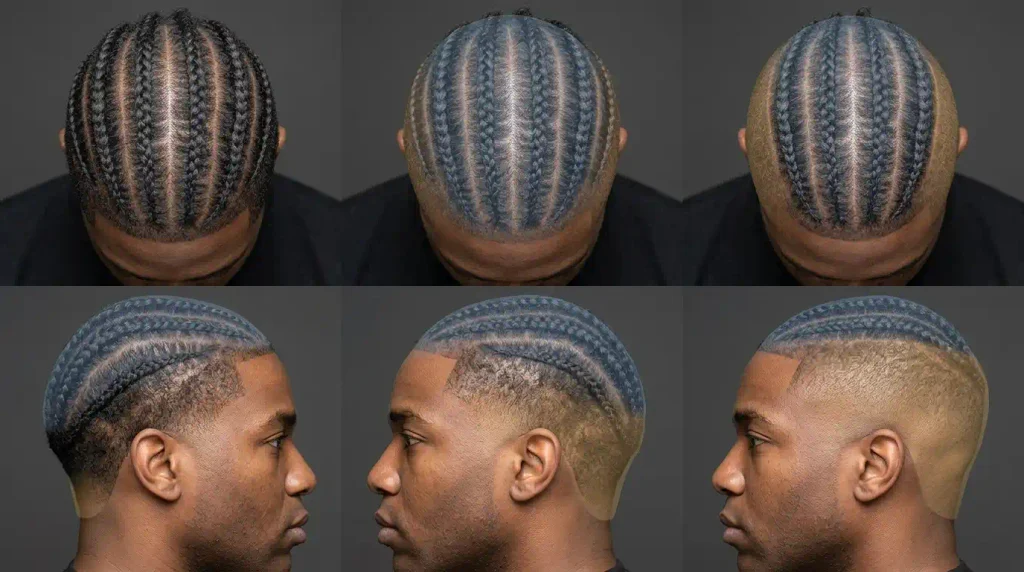
Low Taper Fade With Braids Placement Diagram
A low-taper diagram should show the braided area covering most of the top and upper sides.
The short transition is concentrated at the sideburns and nape.
This demonstrates why low tapers are useful for preserving hair.
Mid Taper Fade With Braids Placement Diagram
A mid-taper diagram should show the transition extending into the middle sides.
The braided area becomes somewhat narrower.
The barber and braider must ensure the remaining hair supports the chosen pattern.
High Taper Fade With Braids Placement Diagram
A high-taper diagram should show shorter sides extending toward the upper side panels.
This creates strong contrast but leaves less hair available for side-based braids.
How Braid Parting Direction Affects Fade Placement
Straight-back cornrows, sideways cornrows, and geometric braids require different hair distributions.
The taper should accommodate the direction of the rows.
A pattern that travels toward the ear may need more side hair than one concentrated on the top.
How Hairline Shape Changes Braid and Taper Placement
Uneven temples, a naturally high forehead, and thinning edges can influence where braids should begin.
A professional should adjust the parting pattern rather than pulling fragile hair into a uniform design.
Taper Fade Braids Cutting and Parting Layout Chart
| Braid pattern | Preferred starting taper | Main area to preserve |
| Straight-back cornrows | Low or temple taper | Front hairline and full row path |
| Stitch braids | Low or carefully planned mid taper | Defined parting tracks |
| Box braids | Low taper | Individual parting sections |
| Two large braids | Low taper | Front and side anchor hair |
| Braided mohawk | Burst or high fade | Central braid strip |
| Long braided bun | Low or nape taper | Hair needed for secure gathering |
| Sideways cornrows | Temple taper | Side row direction |
2.13 Which Taper Fade Works Best With Braids?
For most men who want flexibility, a low taper is the safest starting point for preserving the braid layout.
A temple taper works well when only localized cleanup is needed.
Mid and high fades can be attractive, but they require more careful planning to avoid removing essential braid sections.
3. Best Taper Haircut Braids Styles and Variations for Men
The following styles range from traditional cornrows to more experimental braid-and-fade combinations.
Not every variation requires extensions, and some are related hairstyles rather than conventional three-strand braids.
Choose the style according to your hair length, density, natural texture, maintenance preferences, and scalp comfort.
3.1 Classic Cornrow Braids With Taper Fade
Straight-Back Cornrows With Low Taper Fade
Straight-back cornrows run from the front of the head toward the back in parallel rows.
A low taper cleans the sideburns and neckline while preserving most of the braided area.
This is one of the most versatile choices for men who want a neat braided hairstyle with minimal decorative detail.
Two Cornrow Braids With Taper Fade
Two large cornrows create a symmetrical appearance with a central part.
The taper emphasizes the clean side profile without distracting from the braids.
This style generally requires sufficient hair length for the braider to maintain a secure, comfortable grip.
Four Cornrows With Taper Fade
Four cornrows provide more definition than a two-braid style.
The rows can be evenly spaced or slightly curved to complement the head shape.
A low taper preserves the hair needed around the side sections.
Six Cornrows With Taper Fade
Six cornrows create a more detailed pattern.
They can work particularly well with medium-length coily hair.
The braider should distribute the hair evenly so no single row creates excessive tension.
Large Cornrows With Low Fade
Large cornrows use wider hair sections, producing a bold and recognizable pattern.
A low fade creates contrast around the perimeter.
Larger rows may be quicker to install than numerous small braids, although the result depends on length and design complexity.
Thin Cornrows With Tapered Sides
Thin cornrows create a detailed appearance with smaller parting sections.
The taper adds sharpness around the temples.
Fine rows should not be braided tightly merely to preserve their shape, especially near fragile edges.
Cornrows With High Taper Fade
A high taper removes more side coverage and emphasizes the braided top.
This works best when the row pattern is planned around the reduced braided area.
Cornrow Cap With Tapered Finish
A cornrow cap uses closely arranged rows across much of the top.
A low perimeter taper creates a clean boundary without interrupting the overall braid pattern.
Sideways Cornrows With Taper Fade
Sideways cornrows travel diagonally or across the head.
The fade placement must accommodate their direction.
A temple taper often works better than an aggressive full-side fade.
Cornrows on the Sides With Loose Top
This combination uses braided side sections with loose curls or textured hair above.
The lower perimeter can be tapered for additional definition.
It provides an alternative for men who want braiding without securing the entire top.
Cornrows With a Natural Hairline
A natural hairline preserves the original forehead and temple contours.
It creates a softer finish and avoids unnecessary hairline reshaping.
Cornrows With a Sharp Line Up
A line up adds more defined edges around the forehead and temples.
The barber should avoid cutting into braid anchors or thinning the natural hairline.
3.2 Box Braids and Individual Plaits With Taper Fade
Classic Box Braids With Low Taper Fade
Box braids use individual sections arranged in a grid-like pattern.
A low taper creates clean edges while allowing the braids to hang naturally.
This is a practical option for men who want independent braids rather than scalp-attached cornrows.
Knotless Box Braids With Taper
Knotless box braids commonly use a gradual feed-in method rather than beginning with a bulky knot.
They can create a smoother appearance at the roots.
However, they still require appropriate tension control and suitable extension weight.
Short Box Braids With Taper Fade
Short box braids form compact individual sections.
They work well with a low taper and can provide a neat everyday hairstyle.
The natural hair must be long enough for secure, comfortable installation.
Jumbo Box Braids With Taper
Jumbo box braids use larger sections and create a bold appearance.
The barber should preserve enough hair for each parting area.
Heavy extensions should be avoided when the natural hair or scalp cannot comfortably support them.
Micro Box Braids With Taper
Microbraids use very small sections and produce a highly detailed appearance.
They can require substantial installation and removal time.
Because of the small sections, careful tension management is especially important.
Small Individual Braids With Low Taper
Small plaits create detailed texture while the low taper maintains clean sides.
They can be styled forward, backward, or gathered loosely.
Twisted Box Braids With Defined Parts
Twist-style sections can be arranged using the same square or triangular parting layout as box braids.
Although twists are constructed differently from traditional braids, they can create a similar organized appearance.
Triangle-Part Box Braids With Taper
Triangle parts create geometric scalp patterns.
The taper should be positioned outside the parting areas so the design remains complete.
Single Plait With Side Taper
A single long plait can run along the center or toward the rear.
A subtle side taper keeps the surrounding hair neat.
Polished Plaits With Precision Fade
This style emphasizes clean parting, consistent braid thickness, and carefully blended sides.
It is particularly suitable for men who want an organized appearance for work or formal occasions.
3.3 Stitch Braids and Feed-In Braids With Taper Fade
Stitch Braids With Low Taper Fade
Stitch braids feature distinct parting lines and a structured cornrow pattern.
A low taper keeps the temples clean while preserving the braid tracks.
Freestyle Stitch Braids With Drop Fade
Freestyle stitch braids use changing directions and decorative parting.
A drop fade can create a curved side silhouette.
The pattern should be planned before cutting.
Two Feed-In Braids With Taper
Feed-in braids gradually incorporate additional hair into the braid.
This can create a smoother starting section.
A low taper maintains a natural balance.
Feed-In Cornrows With Tapered Sides
Feed-in cornrows can produce longer or fuller-looking rows using extensions.
The taper should avoid removing hair needed for the attachment points.
Straight-Back Feed-In Braids With Low Fade
This style maintains a traditional straight-back direction while adding extension hair when needed.
A low fade refines the perimeter.
Stitch Braids With Sharp Parting Lines
Precision parting creates the distinctive stitch-braid appearance.
The braider should maintain clean lines without excessive pulling.
Feed-In Braids With Natural Temple Taper
A natural temple taper softens the side profile.
It works well for men who want structured feed-in braids without a harsh skin fade.
3.4 Geometric and Creative Braided Taper Haircuts
Zigzag Braids With Low Taper Fade
Zigzag braids follow angled parting lines rather than straight rows.
The low taper keeps the perimeter clean while the braid pattern provides the visual emphasis.
Criss-Cross Braids With Taper Fade
Criss-cross braids create intersecting patterns across the scalp.
They require careful sectioning to maintain balanced symmetry.
Snake Braids With Taper
Snake braids use curved lines that move across the head.
A low taper preserves space for the pattern.
Geometric Star Cornrows With Taper
Star-shaped cornrows use multiple parting directions that create a recognizable geometric design.
They are better suited to experienced braiders.
Curved Swirl Cornrows With Taper
Swirl patterns create circular or spiral movement.
The barber should avoid cutting into the perimeter of the design.
Geometric Maze Cornrows With Taper
Maze patterns use interconnected parting lines.
They require detailed planning and may take longer to install than simple straight-back rows.
Curved Wave Cornrows With Taper
Wave-shaped cornrows produce flowing lines across the scalp.
A subtle taper complements the movement without overpowering the design.
Radiating Spiderweb Cornrows With Taper
Spiderweb patterns feature rows extending outward from a central or selected point.
The braided area should remain large enough to complete the intended design.
Spider Braids With Fade
Spider braids use radiating or intersecting sections that resemble spiderweb elements.
A low fade provides a clean boundary.
Braided Top With Side Swirl and Taper
A side swirl changes the direction of the braids near the temples.
The taper must follow the planned pattern rather than removing its outer sections.
Asymmetrical Braids With Sharp Taper
Asymmetrical braids use intentionally unequal directions or section sizes.
The taper provides a controlled contrast to the creative top.
Freestyle Cornrow Designs With Fade
Freestyle cornrows allow the braider to combine curves, angles, and geometric sections.
A low or mid taper can refine the perimeter.
Crown Design Braids With Tapered Sides
Crown designs concentrate a pattern around the upper or central head.
A taper can emphasize the design while preserving hair near the crown.
3.5 Short Braids and Braided Top Taper Haircuts
Short Braids With Low Taper Fade
Short braids create a compact hairstyle with clean edges.
They are suitable when the natural hair has enough length for secure installation.
Braided Top With Skin Fade
This style preserves braids on the top while shaving selected side sections close to skin level.
It creates stronger contrast than a traditional low taper.
High Top Braids With Taper Fade
High top braids concentrate length and texture above shorter sides.
The high top taper haircut offers related inspiration for maintaining height and upper volume.
Tight Braids With Buzzed Sides
Closely arranged braids can be combined with very short sides.
The phrase tight braids should describe the compact appearance, not painful tension at the roots.
If you prefer an unbraided short hairstyle, the Buzz Taper Haircut is a lower-maintenance alternative.
Braided Top With Faded Sides
The braided top remains the main feature while the sides are gradually shortened.
The fade height determines the amount of contrast.
Half-Head Braids With Taper
Half-head braids cover only selected sections.
The remaining hair may be left natural, faded, or styled separately.
Faded Braided Top With Defined Parts
Clean parting lines highlight the structure of the braided top.
The fade creates a contrasting lower section.
Subtle Taper Fade With Minimalist Braids
Minimalist braids use simple rows or individual plaits without decorative designs.
This is a good option for men who want understated styling.
3.6 Long Braids With Taper Fade
Long Braids With Tapered Sides
Long braids can fall past the ears while the sides remain neatly blended.
The taper creates a clean silhouette without restricting the movement of the braids.
Shoulder-Length Braids With Taper
Shoulder-length braids provide additional styling flexibility.
They can be worn loose or gathered gently, provided the added weight does not stress the hairline.
Full-Head Long Braids With Taper
This style preserves long braids across most of the head.
A low taper cleans the perimeter while retaining maximum braid coverage.
Half-Head Long Braids With Fade
Long braids occupy only the top or one side of the head.
The faded sections create stronger contrast.
Long Braids With Undercut Taper
An undercut removes more side hair while preserving long braids above.
This can create a bold, disconnected appearance.
Side-Faded Long Braids
Long braids hang over shorter faded side panels.
A low fade offers a subtle result, while a high fade increases contrast.
Neck-Length Braids With Taper
Neck-length braids provide a balance between shorter plaits and shoulder-length styles.
They can be worn naturally or gathered loosely.
Long Braids With Shaved Sides
This variation creates an aggressive contrast between long braids and shaved sides.
It requires more commitment than a classic taper because the shorter sections take time to grow back.
3.7 Braided Buns, Ponytails, and Top Knots With Taper
Braided Man Bun With Taper Fade
Long braids are gathered into a bun, usually near the crown.
The taper cleans the temples and neckline.
Avoid tying the bun so tightly that it pulls on the front hairline.
Braided Top Knot With Low Taper
A top knot gathers the braids higher on the head.
A low taper preserves more side coverage than a high undercut.
Samurai Top Knot With Braids
This variation uses a compact knot and a structured silhouette.
The sides may be tapered or faded depending on the desired contrast.
Braided Ponytail With Taper Fade
A braided ponytail gathers the braids into a single group.
For a related hairstyle without full braiding, see the taper haircut ponytail.
Box Braids Ponytail With Fade
Individual box braids are gathered into a loose ponytail.
The taper creates clean edges around the temples.
Half-Up Braids With Taper
Some braids are tied back while others remain loose.
This provides styling flexibility without gathering all the hair.
Braids in a Half Bun
A half bun collects the upper braids while the lower sections remain free.
It is a practical option for medium-length braids.
Small Braided Ponytail on Top
Shorter braids may be gathered into a compact ponytail when enough length is available.
Avoid forcing short braids into a tight elastic.
Long Braided Undercut With Top Knot
This style combines long braids, a defined top knot, and shorter disconnected sides.
It is visually bold but requires careful maintenance around the shaved perimeter.
3.8 Twists and Locs With Taper Fade
Twists and locs are related textured hairstyles, but they are not identical to traditional braids.
They are included because they can create similar silhouettes when paired with taper fades.
Two-Strand Twists With Low Taper Fade
Two sections of hair are twisted together to create defined strands.
A low taper cleans the lower perimeter.
Flat Twists With Taper and Hair Designs
Flat twists are formed close to the scalp and can follow curved or straight patterns.
A taper provides a clean boundary.
Twisted Braids With Symmetrical Parts
Twist-style sections can be arranged in symmetrical rows.
The result resembles a carefully organized braided top.
Senegalese Twists With Taper Fade
Senegalese twists generally use smooth rope-like twists, often with extensions.
They can be paired with a low taper for a defined perimeter.
Sponge-Twist Curls With Low Taper
A twisting sponge helps create small textured sections in suitable short coily hair.
A low taper complements the style without requiring full braiding.
Starter Locs With Low Taper Fade
Starter locs are newly developing loc sections.
The taper should avoid cutting into their bases.
Mature Locs With Taper and Undercut Blend
Mature locs can be combined with a low taper or more pronounced undercut.
The cutting area should be established carefully to preserve loc density.
Braided Locs With Taper Fade
Existing locs can sometimes be braided together into larger sections.
The taper maintains clean edges while the locs create additional texture.
Faux Locs With Tapered Sides
Faux locs use added hair to create a loc-like appearance.
Choose appropriate extension weight to reduce tension.
Freeform Twists With Dynamic Taper
Freeform twists emphasize natural texture and irregular separation.
A subtle taper provides shape without making the top overly structured.
3.9 Bold and Statement Braided Taper Haircuts
Braided Mohawk With Taper Fade
Braids are concentrated through the center of the head while the sides are shortened.
A burst fade can complement the mohawk silhouette.
For a related unbraided alternative, explore the fohawk taper haircut.
Viking Braids With Shaved Sides
Viking-inspired braids generally emphasize longer central or rear braids with shorter sides.
The style is adaptable, and there is no single standardized cutting pattern.
Rat Tail Braid With Taper Fade
A narrow braid is retained at the back while the surrounding hair is shortened.
It creates a distinctive rear silhouette.
Omarion-Inspired Braids With Fade
This celebrity-inspired label generally refers to neatly arranged cornrows or individual braids combined with clean sides.
Use a reference photograph because the name can describe different appearances.
Pop Smoke Braids With Taper Fade
Pop Smoke-style braids are commonly associated with prominent cornrow sections directed across the head.
A low taper can keep the perimeter neat while preserving the characteristic pattern.
French Braids With Tapered Sides
French braids gradually incorporate hair into the braid as it progresses.
A taper can sharpen the side profile.
Dutch Braids With Taper Fade
Dutch braids use an underhand braiding technique that creates a raised appearance.
They can be paired with a low taper.
Fishtail Braids With Taper
A fishtail braid creates a distinctive woven pattern.
This style generally benefits from longer hair.
Braided Crown With Taper Fade
Braids follow a circular or crown-like arrangement.
The taper defines the lower perimeter.
Inverted Disconnected Braids With Taper
This variation uses dramatic separation between braided sections and short sides.
It is best suited to men comfortable with a bold haircut.
3.10 Taper Fade Braids With Hair Designs and Line Ups
Braided Top With Sharp Line Up
A sharp line up defines the forehead and temple edges.
The braid roots should remain protected from unnecessary trimming.
Braids With Shaved Line Designs
Shaved lines add decorative elements to the fade.
They grow out relatively quickly and may need frequent cleanup.
Braids With Geometric Side Patterns
Geometric designs can be created in the shortened side hair.
These patterns require sufficient space outside the braided area.
Braided Top With Designed Sides
The upper section contains braids while the sides display shaved designs.
This creates a strong contrast.
Taper Fade Braids With Hair Tattoos
Hair tattoos are decorative patterns shaved into shorter hair.
They do not involve permanent tattooing.
Braids With a Precision Temple Line Up
A temple line up emphasizes clean corners around the front sides.
Avoid repeatedly moving the natural hairline backward.
Braids With a Hard Part and Taper
A hard part uses a shaved line to emphasize separation between hair sections.
It should not interrupt essential braid anchors.
Braided Fade With Intertwined Hair Patterns
Intertwined designs combine braid direction with decorative shaved patterns.
Professional planning is important.
X-Shaped Fade Design With Braids
An X-shaped design adds a geometric accent to the fade.
It works best where enough short hair remains outside the braid layout.
3.11 Colored and Highlighted Braids With Taper Fade
Blonde Box Braids With Taper Fade
Blonde box braids create a bright contrast against darker natural roots or tapered sides.
For additional color-placement inspiration, the taper haircut blonde guide explains how light hair changes fade visibility.
Dyed Braids With Fine Taper Fade
Dyed braids can feature subtle highlights or full color.
Chemical processing should be approached carefully, especially on already fragile hair.
Black and Blue Braids With Fade
Blue highlights or extensions create contrast against natural black hair.
A low taper keeps the perimeter clean.
Two-Tone Braids With Taper Fade
Two-tone braids combine contrasting colors within the same hairstyle.
The colors can be alternated across sections or incorporated into individual braids.
Highlighted Braids With Taper
Selected lighter strands emphasize braid texture and movement.
Dyed Spider Braids With Fade
Colored spider braids combine geometric parting and creative pigmentation.
The fade adds another layer of contrast.
Frosted Braids With Low Taper
Frosted braids feature lightened tips or sections.
A low taper preserves the braided top while refining the edges.
Braids With Colored Tips and Tapered Sides
Colored tips introduce visual interest without changing the entire hair color.
Hair extensions can sometimes provide a non-bleaching alternative for color experimentation.
3.12 Braids With Beads, Cuffs, and Hair Accessories
Box Braids With Beads and Taper
Beads add decorative elements to individual braids.
Choose lightweight accessories that do not pull excessively on the roots.
Cornrows With Decorative Hair Jewelry
Small decorative pieces can be attached to selected rows.
Avoid placing heavy accessories near fragile edges.
Braids With Hair Cuffs and Taper Fade
Hair cuffs create metallic accents along the braids.
They should fit comfortably without damaging the strands.
Braids With Metal Hoops
Metal hoops can be added to selected braid sections.
Use smooth accessories to reduce snagging.
Long Braids With Bead Accents
Long braids provide additional space for decorative beads.
Distribute the accessories rather than concentrating excessive weight in one area.
How to Choose Accessories for Taper Fade Braids
Select accessories according to braid thickness and length.
Prioritize comfort, manageable weight, and easy removal.
3.13 Taper Fade Braids With Beards and Facial Hair
Low Taper Fade Braids With Full Beard
A full beard can balance the clean sides and structured braided top.
The barber can gradually connect the sideburns to the beard.
Braids With Connected Beard Fade
A beard fade softens the transition from sideburns to facial hair.
It creates a coordinated appearance.
Braided Top With Goatee
A goatee provides a lighter facial-hair option.
The taper keeps the upper silhouette neat.
Taper Fade Braids With Mustache and Goatee
This combination pairs a structured braided top with defined facial hair.
The beard should complement the face shape without overwhelming the hairstyle.
How to Blend Sideburns Into a Beard With Braids
Ask your barber to match the sideburn transition with the intended beard density.
A natural blend works well for understated grooming.
3.14 Best Taper Haircut Braids Comparison Table
Compare Braid Styles by Length, Pattern, Fade Type, and Maintenance
| Braided hairstyle | Hair length requirement | Pattern | Suggested fade | Styling effort |
| Straight-back cornrows | Short to medium, sufficient grip | Parallel rows | Low taper | Low |
| Stitch braids | Medium or suitable extensions | Defined stitch parts | Low or mid | Low after installation |
| Box braids | Medium or extensions | Individual sections | Low taper | Low to moderate |
| Zigzag braids | Enough length for stable rows | Angular | Low taper | Low after installation |
| Braided man bun | Long hair or extensions | Gathered braids | Low taper | Moderate |
| Braided mohawk | Suitable central hair length | Center strip | Burst or high fade | Moderate |
| Two-strand twists | Short to medium | Rope-like twists | Temple taper | Low to moderate |
| Microbraids | Sufficient strong hair | Very small sections | Low taper | High installation effort |
Best Picks for Classic, Professional, Creative, and Bold Braided Haircuts
For classic styling, straight-back cornrows with a low taper are a dependable choice.
For professional grooming, medium-sized braids with neat parts and natural edges create an organized appearance.
For creative styling, geometric stitch braids or colored box braids offer greater individuality.
For a bold silhouette, consider a braided mohawk, high taper, or disconnected braided top.
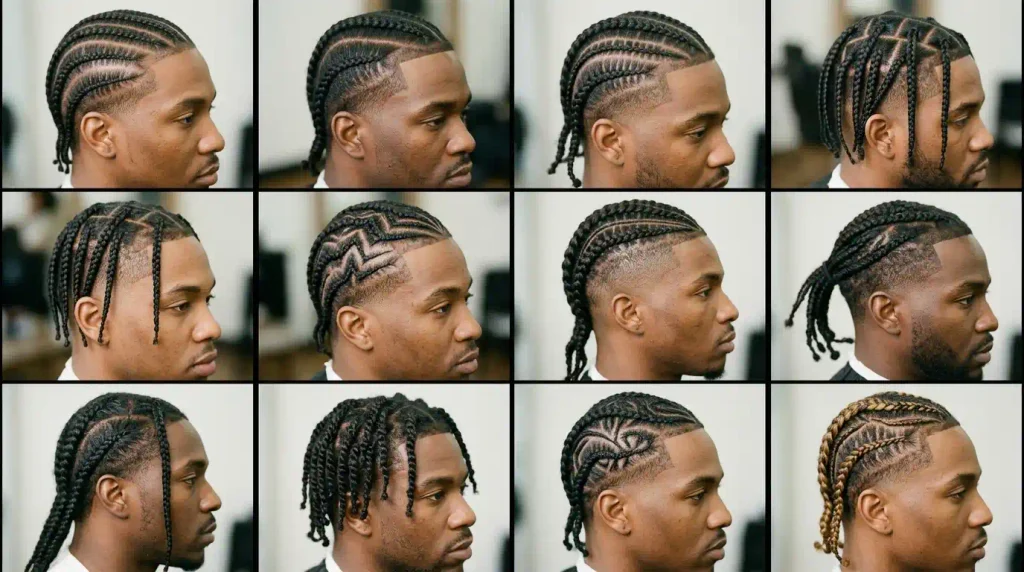
4. Taper Haircut Braids Pictures and Photo Gallery
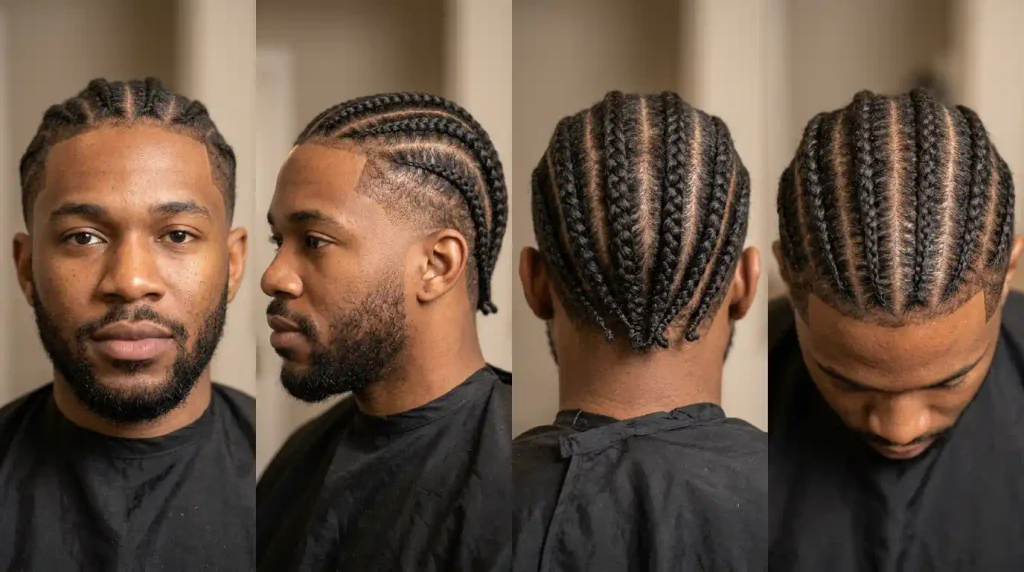
A useful braided taper photo gallery should show the front, sides, back, and top of the hairstyle.
One attractive front-facing photograph may not reveal the fade height, braid parting, or neckline design.
For meaningful comparisons, use consistent lighting and realistic hair textures.
4.1 Low Taper Fade Braids Pictures From Every Angle
Low Taper Fade Braids Front View
The front view shows the hairline, braid starting points, and facial framing.
A low taper may appear subtle because much of the fading occurs around the sideburns.
Low Taper Fade Braids Left and Right Side Views
Side photographs reveal the temple transition and the relationship between the braids and faded areas.
Both sides should be shown because the braid pattern may not be perfectly symmetrical.
Low Taper Fade Braids Back View
The back view shows how the taper connects to the nape and lower braid ends.
This angle is important for evaluating neckline shape.
Low Taper Fade Braids Top View
The top view reveals the number of braids, parting width, symmetry, and direction.
It is especially useful for cornrows and geometric designs.
4.2 Mid Taper Fade Braids Pictures From Every Angle
Mid Taper Fade Braids Front View
A mid taper creates stronger side contrast and may emphasize the braided top.
Mid Taper Fade Braids Side View
The side view should show how high the shorter transition extends.
Look for smooth blending and a clear boundary outside the braid anchors.
Mid Taper Fade Braids Back View
The rear reveals how the middle fade connects to the neckline.
Mid Taper Fade Braids Top View
A top view helps identify whether the fade has reduced the available braid area.
4.3 High Taper Fade Braids Pictures From Every Angle
High Taper Fade Braids Front View
A high taper creates a narrower braided silhouette by removing more upper side hair.
High Taper Fade Braids Side View
The side profile should clearly show the stronger contrast.
High Taper Fade Braids Back View
The rear photograph reveals the connection between the high sides, crown, and nape.
High Taper Fade Braids Top View
This angle shows how much hair remains for the braid pattern.
4.4 Cornrows With Taper Fade Photo Examples
Straight-Back Cornrows With Low Taper Pictures
Use front, top, side, and rear photographs to show how the rows travel from the forehead toward the crown.
Two vs. Four vs. Six Cornrows Photo Comparison
Photograph the same person with comparable hair length and taper placement.
This helps isolate the visual difference caused by braid count.
Stitch Cornrows With Taper Fade Pictures
Show close-up top views of the stitch parting and side views of the taper.
Zigzag and Freestyle Cornrows With Taper Pictures
Include overhead photographs because geometric patterns are difficult to evaluate from the front alone.
4.5 Box Braids With Taper Fade Photo Examples
Short Box Braids With Low Taper Pictures
Show the braid length, individual parts, and temple taper.
Long Box Braids With Taper Pictures
Use photographs showing how the braids hang over the faded sides.
Knotless Box Braids With Taper Pictures
Include close-ups of the braid roots and parting.
Jumbo vs. Small Box Braids Photo Comparison
Use side-by-side images showing different braid thicknesses without confusing the comparison through unrelated haircut changes.
4.6 Stitch Braids and Feed-In Braids Photo Examples
Straight-Back Stitch Braids Pictures
Show the precise stitch pattern from overhead and three-quarter views.
Feed-In Braids With Taper Side Views
Use side photographs that reveal both the extension transition and the fade.
Geometric Stitch Braid Parting Examples
Overhead images are most useful for identifying geometric symmetry.
4.7 Braided Taper Haircut Back View and Neckline Examples
Natural vs. Tapered Neckline
A natural neckline follows the existing hair growth pattern.
A tapered neckline gradually shortens the lower nape.
Rounded vs. Squared Neckline
Rounded and squared finishes create more deliberate rear outlines.
V-Shaped Neckline With Braids
A V-shaped neckline creates a pointed design beneath the braided crown.
How the Taper Connects to the Braided Crown
The transition should preserve the hair needed for the final braid sections.
Low vs. High Neckline Taper Placement
A low nape taper preserves more rear coverage, while a higher transition creates greater contrast.
4.8 Low vs. Mid vs. High Taper Fade Braids Side-by-Side Comparison
The clearest comparison uses the same braid pattern, model, hair density, and camera angle.
Only the taper height should change.
This helps readers choose the amount of side coverage they want.
4.9 Taper Fade Braids Before and After Pictures
Unbraided Hair vs. Fresh Braided Taper
Show the original natural texture and the finished braid layout.
Overgrown Sides vs. Fresh Taper Fade
Photograph the same braided style before and after a perimeter touch-up.
Natural Hair Braids vs. Extension Braids
Use comparable parting patterns to show how extensions change length and volume.
Unstyled vs. Professionally Finished Braided Taper
A finished style may include controlled flyaways and refined edges.
The comparison should not exaggerate hairline sharpness.
Fresh Braids vs. Grown-Out Braids
Show realistic changes in root regrowth and braid definition.
4.10 How to Choose Realistic Braided Taper Reference Photos
Choose photographs showing hair similar to yours in texture, length, and density.
Check whether extensions are being used.
Avoid unrealistic images that show impossible scalp parting, excessive hair density, or braids that appear to originate from shaved skin.
5. Taper Haircut Braids for Different Hair Lengths
Hair length is one of the most important factors in choosing a braided taper.
The ability to install a particular braid depends on the shortest section of hair required for that pattern, not merely the longest strand on the head.
5.1 How Long Does Hair Need to Be for Braids With a Taper?
Some experienced braiders can work with approximately two to three inches of tightly curled or coily hair.
However, many braid styles are easier to install and maintain with three to five inches or more.
Straight or slippery hair may need additional length for secure braiding.
Extensions do not eliminate the need for sufficient healthy natural hair at the attachment points.
5.2 Minimum Hair Length for Cornrows
Cornrows can sometimes be installed on relatively short textured hair.
Around three to four inches is a practical starting point for many clients, although the minimum varies.
Tighter curl patterns may provide better grip than very straight hair.
5.3 Minimum Hair Length for Box Braids
Individual box braids generally benefit from enough length for secure sections.
Many braiders prefer at least three to four inches of natural hair for shorter box braids or extension-assisted installation.
The actual minimum depends on the braid size, texture, and extension method.
5.4 How Hair Length Affects Braid Size and Grip
Short hair offers less material for the braider to control.
Small sections may be difficult to secure without excessive tension.
Longer hair generally allows more flexibility in braid thickness, pattern, and direction.
5.5 Braids With 2–3 Inches of Hair
Short Cornrows
Short cornrows may be possible when the natural texture provides sufficient grip.
The braider should avoid pulling aggressively to compensate for limited length.
Small Braided Sections
Small plaits may be possible on suitable short textured hair.
However, a very fine section should not be forced into a tight braid.
Limitations of Very Short Hair
Very short hair may not support long hanging braids, complex designs, or certain extension methods.
Waiting for additional growth can provide a better result.
5.6 Braids With 4–5 Inches of Hair
Medium-Length Cornrows
Four to five inches can support several cornrow patterns, depending on texture.
Straight-back and curved rows become easier to construct.
Short Box Braids
Short box braids can create a compact individual-plait appearance.
The braider should choose parting sizes that suit density.
Two-Braid Hairstyles
Two larger braids can be practical when enough hair is available from the front to the back.
5.7 Braids With 6 Inches or More of Hair
Long Box Braids
Longer natural hair offers more flexibility for individual box braids.
Extensions may still be used for additional length.
Braided Ponytails and Buns
Long braids can be gathered into ponytails or buns.
Keep the gathered style loose enough to avoid unnecessary tension.
Long Decorative Braid Patterns
Longer hair can support more complex geometric and flowing patterns.
5.8 Why the Shortest Hair Section Matters More Than the Longest
If the crown is six inches long but the temples are only one inch long, a braid design extending into the temples may not be achievable.
The shortest required section determines whether the pattern can be completed securely.
5.9 How Braid Thickness Affects Minimum Hair Length
Larger braids generally require more hair per section.
Very small braids may need precise control and adequate density.
Hair thickness, texture, and strength all influence the appropriate braid size.
5.10 Short vs. Medium vs. Long Braids With Taper Comparison Chart
| Natural hair length | Potential options | Main limitation |
| Under 2 inches | Limited, texture-dependent | Often insufficient grip |
| 2–3 inches | Some short cornrows or plaits | Secure installation may be difficult |
| 4–5 inches | Cornrows, short box braids, twists | Complex long styles may need extensions |
| 6–8 inches | More cornrows and individual braids | Some long styles still need extensions |
| Over 8 inches | Long braids, buns, ponytails | Weight and maintenance become important |
5.11 Taper Fade Braids With Natural Hair vs. Extensions
Can You Get Taper Fade Braids Without Extensions?
Yes. Natural hair can be braided when sufficient length and density are available.
Extensions are optional for many cornrow and individual-plait styles.
How Hair Extensions Change Braid Length and Appearance
Extensions can increase length, fullness, or color variety.
They also add weight and may alter the way the braids hang.
Feed-In Braids vs. Natural-Hair Cornrows
Natural-hair cornrows use the client’s existing strands.
Feed-in braids gradually incorporate additional hair.
The correct choice depends on the desired length, appearance, and hair condition.
Knotless vs. Traditional Box Braids With a Taper
Knotless braids use a gradual attachment method.
Traditional box braids may begin with a more pronounced attachment at the root.
Neither method should cause pain or excessive pulling.
Choosing Extension Length and Weight
Longer and thicker extensions generally add more weight.
Choose an amount that the natural hair can support comfortably.
How Extensions Affect Hairline Tension
Heavy extensions can place extra stress on the roots, particularly around the temples.
Keep fragile edges out of heavily weighted braids.
Minimum Natural Hair Length Needed for Extensions
There is no universal minimum for all extension methods.
A qualified braider must assess the shortest sections, texture, density, and scalp condition.
Natural Hair vs. Extension Braids Cost and Maintenance Comparison
| Feature | Natural hair braids | Extension braids |
| Added weight | None | Depends on extension length |
| Additional hair cost | No | Often yes |
| Length flexibility | Limited by natural hair | Greater |
| Installation time | Often shorter | Often longer |
| Hairline stress | Depends on tension | Can increase with added weight |
| Removal | Usually simpler | May require more time |
5.12 How to Choose the Right Number and Thickness of Braids With a Taper
Two vs. Four vs. Six vs. Eight Cornrows With a Taper
Two cornrows create broad sections.
Four rows offer a balanced appearance, while six or eight rows create more detailed parting.
The best number depends on head size, hair density, and desired braid thickness.
Small Braids vs. Medium Braids vs. Jumbo Braids
Small braids produce more individual sections.
Medium braids balance detail and styling convenience.
Jumbo braids create a bold appearance with fewer sections.
How Hair Density Affects Braid Count
Thick hair can support a variety of braid counts.
Fine or sparse hair may be better suited to fewer, appropriately sized sections.
How Head Size Affects Parting Width
A larger head may allow wider or more numerous parting sections.
The braider should adjust the layout rather than use one fixed pattern for every client.
Straight Parts vs. Triangle Parts vs. Freestyle Parting
Straight parts create a traditional organized appearance.
Triangle parts add geometric interest, while freestyle parting allows more creative designs.
How Braid Size Affects Installation Time
More numerous small braids typically require more sectioning and installation work.
Complex geometric patterns also increase appointment time.
How Braid Thickness Affects Longevity and Maintenance
Braid thickness can influence frizz, tension, and how the style changes during wear.
There is no guarantee that smaller braids always last longer or are healthier.
Braid Count and Parting Pattern Comparison Chart
| Braid count | Appearance | Typical planning consideration |
| 2 | Broad, simple rows | Requires sufficient length |
| 4 | Balanced symmetry | Clear central and side parts |
| 6 | Detailed classic pattern | Moderate sectioning |
| 8 | More intricate rows | Density and tension management |
| 10+ | Fine detailed pattern | More installation time |
6. Best Taper Haircut Braids for Different Hair Types and Textures
6.1 Taper Fade Braids for Curly Hair
Curly hair can provide natural grip and volume for braids.
Cornrows, box braids, and twists may all work when the hair has enough length.
6.2 Taper Fade Braids for Coily Hair
Coily hair is commonly styled into cornrows, twists, and box braids.
A low taper preserves much of the natural perimeter.
6.3 Taper Fade Braids for Type 4 Hair
Type 4 hair often has a tightly coiled pattern.
Gentle detangling, appropriate moisture, and comfortable braiding tension are important.
6.4 Braids With Taper for 3C to 4A Hair Textures
These curl patterns can support several braided styles.
The braider should consider shrinkage and the hair’s actual stretched length.
6.5 Taper Haircut Braids for Straight Hair
Straight hair can be braided, although it may require additional length and securing techniques.
The braider should avoid creating excessive tightness simply to maintain grip.
6.6 Braids With Taper for Thick Hair
Thick hair offers flexibility in braid size.
However, the braider should distribute the sections evenly to prevent unnecessary bulk.
6.7 Braids With Taper for Fine or Thin Hair
Fine hair may need larger parting sections and lighter styling.
Microbraids and heavy extensions may be unsuitable when they place stress on fragile roots.
6.8 Braids With Taper for Short Natural Hair
Short natural hair may support compact cornrows when enough length is available.
A low taper helps preserve the remaining braid area.
6.9 Braids With Taper for Black Men
Cornrows, box braids, twists, and locs are widely used in textured-hair grooming.
The ideal choice depends on individual hair characteristics, not racial identity alone.
6.10 Braids With Taper for White Men
Men with straight or wavy hair can also wear braids.
Longer hair and suitable grip may be necessary for certain patterns.
The braider should choose techniques that avoid unnecessary scalp tension.
6.11 How Natural Hair Texture Affects Braid Hold and Appearance
Curl pattern, strand thickness, and hair length influence how securely a braid remains in place.
Very slippery hair may loosen more quickly.
6.12 Best Braided Taper Styles by Hair Type Comparison Table
| Hair texture | Practical braid options | Taper suggestion |
| Straight | French braids, longer cornrows | Low |
| Wavy | Two braids, individual plaits | Low or temple |
| Curly | Cornrows, box braids | Low or mid |
| Coily | Cornrows, stitch braids, twists | Low |
| Thick | Multiple braid sizes | Low or mid |
| Fine | Fewer, appropriately sized braids | Natural low taper |
| Chemically fragile | Lightweight, low-tension styles | Gentle perimeter shaping |
7. Choosing the Right Taper Haircut Braids for Your Face Shape, Head Shape, and Hairline
7.1 Best Taper Fade Braids for an Oval Face
Oval faces can accommodate many braid patterns.
Straight-back cornrows and box braids with a low taper are versatile starting points.
7.2 Best Taper Fade Braids for a Round Face
Braids directed backward or upward may create a more elongated silhouette.
A mid taper can reduce side bulk.
7.3 Best Taper Fade Braids for a Square Face
Defined jawlines can complement structured cornrows and balanced tapers.
A natural line up may provide a softer finish.
7.4 Best Taper Fade Braids for a Heart-Shaped Face
A wider forehead may benefit from balanced braid placement.
Avoid styles that pull tightly at the front corners.
7.5 Best Taper Fade Braids for an Oblong Face
Longer faces may benefit from moderate side fullness and restrained top height.
A low taper helps preserve balance.
7.6 Best Taper Fade Braids for a Diamond Face
A low taper with controlled side coverage can complement prominent cheekbones.
7.7 Cornrows With a Softer Front Line for a Large Forehead
A natural hairline avoids emphasizing unnecessary angularity.
The braider should not pull fragile front sections tightly to create an artificial shape.
7.8 How Braid Direction and Fade Height Affect Facial Proportions
Backward braid direction may visually lengthen the head.
Higher fades can narrow the side silhouette.
Choose the combination according to personal preference rather than rigid face-shape rules.
7.9 Face Shape and Braided Taper Style Selection Table
| Face shape | Suggested braid style | Taper approach |
| Oval | Cornrows or box braids | Low or mid |
| Round | Straight-back cornrows | Low or mid |
| Square | Structured box braids | Classic low |
| Heart | Medium cornrows | Low |
| Oblong | Side-directed braids | Low |
| Diamond | Balanced individual braids | Low |
7.10 How Head Shape and Hairline Affect Taper Fade Braids
Best Braided Taper for a Flat Back of the Head
Preserve appropriate length near the rear crown.
A low nape taper can help maintain a balanced rear silhouette.
Braids With Taper for a Prominent Occipital Bone
A prominent rear bone may change how the taper appears.
The barber should adjust the transition accordingly.
Braids With Taper for a Receding Hairline
Avoid starting tight rows directly on fragile or thinning areas.
A softer parting layout may be more comfortable.
Braided Taper Haircuts for Uneven Temple Hairlines
Natural temple asymmetry is common.
The braider should adapt the layout rather than pull hair into forced symmetry.
How Crown Whorls Affect Braid Parting
Crown whorls influence hair growth direction.
The braider may adjust the parting to follow the natural pattern.
How to Choose a Taper Without Exposing Thin Edges
Keep the taper low and preserve natural coverage.
Avoid aggressive line ups around fragile temples.
How Braid Direction Changes the Appearance of Head Shape
Curved or diagonal braids can change the perceived width or length of the upper head.
Braid Direction and Head Shape Comparison Chart
| Head characteristic | Useful approach |
| Flat rear | Preserve crown coverage |
| Prominent occipital bone | Soft rear blending |
| Receding temples | Low-tension starting points |
| Uneven hairline | Natural parting |
| Wide crown | Balanced braid count |
| Strong crown whorl | Adjust row direction |
8. Taper Haircut Braids for Different Ages and Lifestyles
8.1 Professional Taper Fade Braids for Work
Neat medium-sized cornrows or box braids with a low taper can create a polished appearance.
Workplace grooming rules vary, so consider the setting without assuming braided hairstyles are inherently unprofessional.
8.2 Low-Maintenance Braids With Taper for Everyday Wear
Simple cornrows and medium-sized braids generally require less daily styling than elaborate designs.
However, they still need regular scalp cleansing and maintenance.
8.3 Braided Taper Haircuts for Teenagers
Low taper cornrows and shorter box braids can be practical for teenagers.
Comfort, scalp health, and school rules should guide the selection.
8.4 Taper Fade Braids for Boys
Children’s braided hairstyles should prioritize gentle installation and easy maintenance.
Avoid tight rows, heavy extensions, and unnecessary hairline tension.
8.5 Braids With Taper for Formal Occasions
Neatly gathered braids or symmetrical cornrows can complement formal clothing.
A clean taper creates a polished perimeter.
8.6 How to Choose a Braid Pattern Based on Your Routine
Consider exercise, headwear, grooming time, and how frequently you can visit a braider.
A simple design may be more practical than an elaborate pattern.
8.7 Taper Fade Braids for Sports and Active Lifestyles
Best Braided Taper Styles for Athletes
Short or medium braids that remain secure without excessive pulling may be practical.
Avoid heavy accessories during physical activity.
How to Manage Sweat With Cornrows and Box Braids
Clean the scalp as needed after heavy sweating.
Do not allow sweat and product buildup to accumulate indefinitely.
Braids With Taper for Gym Workouts
A loose gathering method can keep longer braids out of the face.
Avoid tight elastics that pull repeatedly at the roots.
Wearing Helmets With Long Braids
Braids should not interfere with the helmet’s correct fit.
Rearrange or choose a different hairstyle if the helmet creates uncomfortable pressure.
How Swimming Affects Braided Hairstyles
Swimming can introduce chlorine, salt, and moisture into the braids.
Rinse the hair afterward and allow it to dry thoroughly.
How to Clean and Fully Dry Braids After Swimming
Gently cleanse the scalp and braids with an appropriate product.
Rinse thoroughly and avoid leaving thick braids damp for extended periods.
How to Prevent Frizz During Physical Activity
Use lightweight styling products sparingly and protect the hair from unnecessary friction.
Best Low-Maintenance Braided Styles for Active Men
Medium-sized cornrows or compact individual braids can offer a manageable balance between styling and comfort.
8.8 Which Braided Taper Haircut Is Right for You?
Choose a low taper with simple cornrows for a natural, versatile appearance.
Select stitch braids or geometric patterns if you prefer more visual detail.
For long hair, box braids and braided ponytails provide additional styling flexibility.
9. How to Prepare for a Taper Haircut and Braiding Appointment
9.1 What to Decide Before Getting Braids With a Taper
Choose the braid type, desired taper height, approximate braid count, and whether extensions will be used.
Also decide whether you want a natural hairline or defined line up.
9.2 How to Choose Between Cornrows, Box Braids, and Twists
Cornrows remain attached to the scalp.
Box braids form individual hanging sections.
Twists create rope-like sections using a different construction technique.
Your choice depends on hair length, desired appearance, and maintenance.
9.3 How to Choose the Right Braid Size
Braid size should complement hair density and natural strand strength.
Avoid selecting extremely small braids solely because they appear more detailed.
9.4 Understanding Braid Parting Patterns
Common parting patterns include straight rows, squares, triangles, zigzags, and freestyle designs.
The chosen pattern determines how much hair must remain in each area.
9.5 How to Prepare Your Hair Before Braiding
Remove excessive product buildup and gently detangle.
Follow your braider’s instructions about washing and drying.
9.6 Washing, Conditioning, and Detangling Before the Appointment
Clean, conditioned, detangled hair is generally easier to section.
Avoid aggressive brushing that causes breakage.
9.7 How to Prepare Your Scalp and Hairline
Inspect the scalp for irritation, sores, or tenderness.
Avoid braiding over painful or inflamed areas.
9.8 What Reference Photos Should You Bring?
Bring top, side, front, and rear photographs.
Choose examples showing hair similar to your own texture and length.
9.9 What to Discuss With Your Braider Before Installation
Discuss braid size, tension, extension weight, parting direction, and the planned taper boundary.
Confirm that the design can be installed comfortably.
10. How to Ask Your Barber for Taper Haircut Braids
10.1 How to Explain a Low Taper Fade With Braids
Ask your barber to keep the shortest transition near the temples and neckline.
Explain that the upper hair must remain available for braiding.
10.2 How to Request a Mid or High Taper With Braids
Show the desired fade height and explain where the braided area should end.
Confirm that enough hair remains for the planned pattern.
10.3 How to Ask for a Temple Taper With Cornrows
Request localized blending around the temple and sideburns.
Avoid unnecessary cutting into the upper side hair.
10.4 How to Explain the Braided Top and Fade Placement
Use photographs or a marked parting plan.
Clearly identify the sections that must remain untouched.
10.5 How to Request a Natural Hairline or Sharp Line Up
Tell the barber whether you prefer natural edges or a more defined finish.
Ask them not to push the hairline backward.
10.6 How to Communicate Braid Size, Direction, and Parting
Specify the number of braids, their direction, and whether the parts should be straight, curved, or geometric.
10.7 How to Ask for a Taper Without a Skin Fade
Request a low taper using a longer finishing guard.
This preserves visible hair coverage.
10.8 Should You Get the Taper Fade Before or After Braiding?
There is no universal correct order.
The best sequence depends on the braid pattern, taper placement, and whether the same professional performs both services.
Getting a Taper Fade Before Installing Braids
A fade may be performed first when the braid area has already been clearly planned.
However, the barber must avoid removing hair needed for the braid pattern.
Getting Braids Before the Taper Fade
Braiding first can make the boundary between the braided zone and fade area easier to identify.
The barber can then refine the perimeter without guessing where the braids will begin.
Which Order Works Best for Cornrows?
For many cornrow designs, planning the parting before cutting is essential.
Braiding first or marking the braid area before the taper can help protect the row anchors.
Which Order Works Best for Box Braids?
Box braids require carefully planned individual sections.
The braid layout should be established before any aggressive side cutting.
How to Avoid Cutting Hair Needed for the Braid Pattern
Have the braider identify the planned boundary.
Ask the barber to keep the clippers outside that area.
How Barbers and Braiders Should Coordinate the Hairline
Both professionals should agree on which hair belongs to the braids and which sections can be tapered.
This is particularly important near the temples.
Step-by-Step Barber and Braiding Appointment Workflow
A practical workflow is to assess hair length and scalp condition, select the braid pattern, establish the braided zone, complete braiding and tapering in the agreed sequence, and finish with a final perimeter check.
10.9 Example Barber Request Scripts for Different Braid Styles
Low taper cornrows: “I want six straight-back cornrows with a subtle low taper around the temples and neckline. Please leave enough hair for the full braid pattern and keep the hairline natural.”
Box braids: “I want medium-sized box braids with a low taper. Please coordinate the parting with the braider before removing any side hair.”
Mid taper stitch braids: “I want four stitch braids with a mid taper and clean temple blending, but don’t cut into the braid anchors.”
10.10 Common Communication Mistakes During Consultation
Do not request only a guard number without explaining fade placement.
Avoid assuming the barber and braider interpret a reference photograph identically.
10.11 Why Your Taper Fade Braids May Look Different From the Reference Photo
Natural Hair Density vs. Extension-Assisted Braids
A photograph may show added extension hair that creates more fullness than natural hair alone.
How Hair Length Changes the Finished Braid Pattern
Shorter hair limits the length and complexity of certain braids.
How Head Shape Affects Braid Direction
Natural head contours change how rows appear from different angles.
How Lighting and Styling Affect Fade Visibility
Professional lighting can exaggerate clean lines and contrast.
Unrealistic or AI-Generated Braided Haircut References
Some images show impossible braid origins, unrealistic density, or perfectly symmetrical hairlines.
Treat them as inspiration rather than guaranteed results.
What to Ask Your Barber and Braider Before Copying a Photo
Ask whether your hair has sufficient length, density, and strength for the style.
How to Set Realistic Expectations for Taper Fade Braids
Focus on a comfortable, achievable pattern and balanced fade rather than exact replication of every detail.
10.12 What to Check Before Leaving the Barber or Braiding Appointment
Inspect the hairline, braid tension, parting symmetry, and neckline.
The braids should feel secure without persistent pain or pulling.
11. How to Style Taper Haircut Braids for Men
11.1 Essential Tools and Products for Braided Hairstyles
Useful items include a wide-tooth comb, rat-tail comb, lightweight conditioner, satin bonnet or durag, and suitable scalp-cleansing products.
11.2 How to Style Cornrows With a Taper
Cornrows generally retain their installed pattern.
Daily styling focuses on keeping the hair neat and protecting the edges.
11.3 How to Style Box Braids With a Taper Fade
Box braids can hang naturally or be gathered loosely.
Avoid repeated tight pulling at the roots.
11.4 How to Style Long Braids Into a Man Bun
Gather the braids into a loose bun.
Use a soft fastening method and avoid excessive tension.
11.5 How to Create a Braided Ponytail With Tapered Sides
Collect the braids gently toward the desired position.
The ponytail should not pull on fragile temples.
11.6 How to Style Half-Up Braids
Gather the upper braids while leaving the lower sections loose.
This offers a flexible appearance without securing all the hair.
11.7 How to Style Braids With Curls
Some braided styles leave selected curls loose.
Use a suitable curl cream to maintain definition.
11.8 How to Combine Braids With a Fade and Hair Accessories
Add lightweight beads or cuffs to selected sections.
Avoid heavy accessories near the roots.
11.9 How to Keep Braided Styles Looking Neat Without Excessive Tension
Use gentle styling products and nighttime protection.
Do not tighten existing braids repeatedly to conceal regrowth.
11.10 Quick Everyday Styling Routine for Taper Fade Braids
Check the scalp, lightly manage flyaways, and position the braids comfortably.
A simple braided taper often requires little daily reshaping.
12. Best Hair Products for Taper Fade Braids
12.1 Recommended Products for Cornrows and Box Braids
Use gentle cleansing products, lightweight conditioning, and minimal finishing products.
12.2 Best Products for Coily and Curly Braided Hair
Moisturizing leave-in products may help reduce dryness.
Choose products that suit the natural hair texture.
12.3 Braid Mousse and Styling Foam
Braid mousse can help control flyaways and provide a neat finish.
Apply sparingly.
12.4 Leave-In Conditioner and Moisturizing Products
A lightweight leave-in conditioner can help maintain softness.
Avoid excessive buildup near the roots.
12.5 Scalp Care Products for Braided Hairstyles
Choose products appropriate for your scalp condition.
Persistent itching, irritation, or scaling may require professional assessment.
12.6 Edge Control and Hairline Styling Products
Edge control can smooth short hair around the perimeter.
Avoid using it to pull fragile edges into a tighter shape.
12.7 Products for Frizz and Flyaways
Lightweight styling foam or cream can help manage surface frizz.
12.8 Hair Accessories for Braids With Taper
Beads, cuffs, and soft hair ties can add variety.
Choose accessories that do not create excessive weight.
12.9 How to Avoid Excessive Product Buildup
Use small product quantities and cleanse the scalp regularly.
12.10 Braided Hair Product Comparison Table
| Product | Main purpose | Key consideration |
| Gentle shampoo | Scalp cleansing | Rinse thoroughly |
| Leave-in conditioner | Moisture and manageability | Avoid heavy buildup |
| Braid mousse | Surface smoothing | Use sparingly |
| Styling cream | Frizz control | Match hair texture |
| Lightweight oil | Lubrication and shine | Does not replace water-based moisture |
| Edge control | Hairline styling | Avoid pulling the edges |
| Satin bonnet or durag | Friction reduction | Wear comfortably |
| Soft hair ties | Gathering braids | Avoid excessive tension |
13. Taper Haircut Braids Maintenance and Daily Hair Care
13.1 How Long Do Braids With a Taper Fade Last?
Cornrows are often worn for approximately two to four weeks.
Box braids may remain wearable for four to six weeks or sometimes longer, depending on hair condition, installation, and maintenance.
No hairstyle should be kept in place simply because the braids still look neat if the scalp is irritated or the roots are under stress.
13.2 How Often Should You Refresh the Taper Fade?
Many men refresh the taper every one to three weeks, depending on how sharp they want the fade to remain.
13.3 How Often Should You Redo Cornrows or Box Braids?
Cornrows generally require more frequent reinstallation than many box-braid styles.
The appropriate interval depends on tension, regrowth, hygiene, and scalp comfort.
13.4 Daily Hair Care Routine for Taper Fade Braids
Check the scalp for irritation.
Keep the braids comfortable and avoid unnecessary pulling.
13.5 How to Wash Braids Without Ruining the Style
Use a suitable gentle shampoo and focus on cleansing the scalp.
Rinse thoroughly and dry the braids completely.
13.6 How to Keep the Scalp Clean While Wearing Braids
Clean the scalp according to oiliness, sweat, and product use.
Avoid leaving heavy buildup around the roots.
13.7 How to Moisturize Natural Hair Under Braids
Use lightweight conditioning products appropriate for your texture.
Avoid saturating the scalp with heavy oils.
13.8 How to Protect Braids While Sleeping
A satin bonnet, durag, or satin pillowcase can reduce friction.
The covering should not pull tightly on the hairline.
13.9 How to Reduce Frizz and Loose Braid Ends
Use gentle nighttime protection and avoid excessive handling.
Some frizz is normal as hair grows.
13.10 Taper Fade Braids Growth Timeline: Day 1 to Week 6
Fresh Taper Fade Braids: Day 1
The braids are newly installed and the taper is sharply blended.
The scalp should not feel painfully tight.
Taper Fade Braids After 1 Week
Minor hair growth may soften the fade.
The braid pattern generally remains recognizable.
Taper Fade Braids After 2 Weeks
The sides may require cleanup.
Cornrows may begin showing root growth or additional frizz.
Taper Fade Braids After 3–4 Weeks
Some cornrow styles may need reinstallation.
Box braids may remain wearable if the scalp and roots are healthy.
Taper Fade Braids After 5–6 Weeks
Longer-wear styles may show noticeable root regrowth.
Assess whether removal or rebraiding is appropriate rather than relying only on appearance.
Braid Root Growth vs. Taper Fade Grow-Out
Braid root growth affects how the sections sit.
Fade grow-out changes the side silhouette.
They progress at different rates.
When to Refresh the Fade Without Rebraiding
A fade can sometimes be refreshed while the braids remain installed, provided the barber protects their roots.
When to Remove or Redo the Braids
Remove or redo the braids when there is uncomfortable tension, excessive tangling, significant buildup, or the style is no longer suitable.
Fresh vs. Grown-Out Taper Fade Braids Photo Comparison
Photograph the same person under consistent lighting at regular intervals.
This illustrates realistic changes in root growth and taper definition.
13.11 How to Refresh a Taper Fade Without Damaging Existing Braids
Which Areas Can Be Safely Trimmed Between Braiding Appointments?
Only the hair outside the braid anchors should be trimmed.
The barber must clearly identify the boundary.
How to Protect Braid Roots During a Fade Touch-Up
Keep the braids away from the cutting area without pulling tightly.
How to Maintain the Temples Without Cutting Braid Anchors
Use precise trimming around the natural temple perimeter.
Avoid cutting into hair that belongs to the first braid sections.
Should You Refresh the Line Up While Wearing Cornrows?
A modest line-up cleanup may be possible.
Do not repeatedly push the hairline backward to make the fade look sharper.
When to Avoid Trimming Around Tight Braids
Avoid further cutting or shaving around painful, inflamed, or irritated roots.
At-Home Edge Cleanup vs. Professional Barber Touch-Up
Minor grooming may be manageable at home, but complex fade work is safer with an experienced barber.
13.12 How to Remove Braids and Transition to Another Taper Haircut
When Is It Time to Take Down Cornrows or Box Braids?
Remove braids when maintenance becomes difficult, roots are heavily tangled, or tension causes discomfort.
How to Remove Braids Without Excessive Pulling
Undo the braids carefully rather than pulling them apart aggressively.
How to Detangle Hair After Removing Braids
Work gently in manageable sections.
Use suitable conditioner or detangling products.
Normal Shed Hair vs. Signs of Breakage
Naturally shed hair can accumulate while braids are installed.
Short snapped strands, painful roots, and visible thinning may indicate damage.
How to Care for the Scalp After Braid Removal
Cleanse gently and assess the scalp before installing another tight style.
Transitioning From Braided Taper to Curly Top Taper
Remove the braids and allow the natural curls to settle.
The barber can then refine the taper.
For a more voluminous alternative, consider the Blowout Taper Haircut.
Transitioning From Braids to Twists or Locs
Choose the next style based on hair condition and desired long-term maintenance.
When to Take a Break From Tight Braided Styles
Take a break when there is persistent soreness, thinning, breakage, or scalp irritation.
13.13 Taper Fade and Braid Maintenance Schedule
Haircut Touch-Up Frequency vs. Braid Reinstallation Frequency
A taper may need refreshing before the braids need removal.
The two schedules should be managed separately.
Maintenance Differences Between Cornrows and Box Braids
Cornrows often show visible root growth earlier.
Box braids may remain wearable longer, although that does not justify leaving them installed beyond a healthy period.
How to Plan Barber and Braider Appointments Together
Coordinate appointments so the barber knows which braid sections must remain untouched.
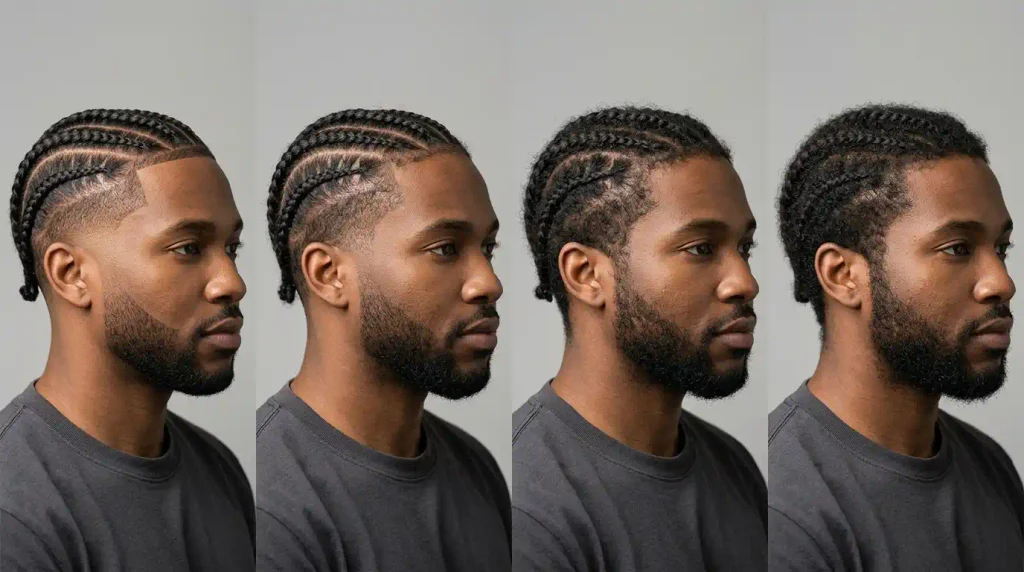
14. Braids, Hairline Health, and Common Risks
14.1 Can Tight Braids Damage Your Hair?
Yes. Repeated pulling from tight braids can damage hair and contribute to traction alopecia.
The American Academy of Dermatology recommends loosening tight braids, reducing repeated tension, and paying attention to early hairline changes.
14.2 Understanding Braiding Tension
Braiding tension is the pulling force placed on the hair during installation and wear.
A secure braid should not require persistent pain.
14.3 How Tight Braids Affect the Hairline and Edges
The temples and forehead edges can be vulnerable to repeated pulling.
Excessive tension may contribute to breakage and thinning.
14.4 How to Reduce Hairline Stress From Cornrows
Use comfortable tension, preserve fragile edges, and avoid very tight starting sections.
14.5 Risks of Repeated Tight Braiding
Repeated pulling can contribute to progressive hair damage.
Advanced traction-related hair loss may become permanent.
14.6 How to Recognize Excessive Scalp Tension
Pain, stinging, scalp bumps, crusting, or raised skin around the braid roots are warning signs.
A painful hairstyle should be loosened or removed.
14.7 Protecting the Temples Around a Taper Fade
Avoid cutting into thin edges or braiding fragile temple hair aggressively.
14.8 When a Braided Taper May Not Be the Best Choice
A braided taper may be unsuitable when there is active scalp inflammation, severe tension-related hair loss, or insufficient healthy hair for the chosen pattern.
14.9 When to Consult a Professional Hairstylist
An experienced braider can evaluate hair length, tension, and installation suitability.
Persistent hair loss, scalp pain, or inflammation should be assessed by a dermatologist.
14.10 How to Maintain Healthy Natural Hair Between Braided Styles
Allow the hair and scalp time to recover when needed.
Use gentle cleansing, appropriate conditioning, and low-tension styling.
15. Common Taper Haircut Braids Mistakes and How to Avoid Them
15.1 Choosing a Braid Style Without Enough Hair Length
Select a pattern your shortest required hair sections can support.
15.2 Taking the Taper Fade Too High
A high fade may remove hair needed for the braids.
Plan the pattern first.
15.3 Cutting Too Much Hair Before Braiding
Do not let the barber shorten the sides before the braided area has been established.
15.4 Choosing the Wrong Braid Size
Select braid thickness based on density, length, and hair strength.
15.5 Uneven Braid Parting and Poor Symmetry
Use realistic reference photographs and discuss the layout before installation.
15.6 Excessive Braiding Tension
Painful braids should be loosened or removed.
15.7 Ignoring the Natural Hairline
Preserve fragile edges and avoid excessive line-up reshaping.
15.8 Neglecting Scalp Hygiene
Clean the scalp according to its needs and product use.
15.9 Using Too Much Styling Product
Heavy buildup can make braids difficult to clean and maintain.
15.10 Leaving Braids Installed for Too Long
Do not keep braids installed beyond a safe and comfortable period simply to avoid reinstallation costs.
15.11 Confusing a Taper Fade With a Full Fade
Show reference photographs to clarify how much side hair should remain.
15.12 How to Correct an Uneven Taper With Braids
Ask a professional barber to assess the problem.
Avoid aggressive home clipping that may cut into braid anchors.
16. Taper Haircut Braids Cost and Maintenance Budget
16.1 How Much Do Taper Haircut Braids Cost?
In the United States, the total cost depends on both the barbering and braiding services.
A simple haircut or fade may cost approximately 30–70 at many shops, while the braiding service adds a separate charge.
A complete braided taper can therefore cost considerably more than an ordinary haircut.
16.2 How Much Do Cornrows With a Taper Cost?
Basic cornrow services may cost around 60–180, depending on complexity, region, and service provider.
Adding a taper may increase the total if the fade is charged separately.
16.3 How Much Do Box Braids With a Taper Cost?
Medium box braids commonly involve more installation time.
U.S. salon prices can fall around 150–300 for medium box braids, with smaller or longer styles costing more.
A separate taper haircut may increase the total.
16.4 How Braid Size and Length Affect the Price
Smaller braids require more sections and often more time.
Longer extension-assisted braids may increase both installation time and material cost.
16.5 Barbershop vs. Professional Braiding Service Costs
Some professionals offer both services.
Others require separate appointments with a barber and braider.
Always confirm whether the haircut, washing, extension hair, and styling are included.
16.6 What Affects Braiding Installation Time?
Braid count, hair length, texture, parting complexity, and extension use influence installation time.
Simple cornrows may be completed relatively quickly.
Intricate microbraids or long knotless braids can require several hours.
16.7 How Much Does It Cost to Maintain Braids and a Taper Each Month?
Monthly expenses depend on how frequently the taper is refreshed and whether the braids need reinstallation.
If the fade is refreshed twice at $40 per visit, barbering alone costs $80 that month.
The braiding cost is additional.
16.8 Taper Fade and Braiding Cost Comparison Table
| Service | Illustrative U.S. price range |
| Men’s taper or fade haircut | 30–70 |
| Simple cornrows | 60–180 |
| Medium box braids | 150–300 |
| Small box braids | 200–400+ |
| Knotless braids | 150–300+ |
| Detailed geometric braids | Varies by complexity |
| Braid removal service | Often 50–100 |
| Hair extensions | Additional cost when required |
These ranges are planning estimates, not guaranteed quotes. Prices vary by city, provider, length, hair type, and included services.
16.9 How to Choose a Barber and Braider for Your Hair Type
Review examples of previous work.
Choose professionals experienced with your texture, preferred braid pattern, and taper placement.
Comfort and hairline safety should matter as much as price.
17. Taper Haircut Braids Trends and Popular Styles for 2026
17.1 Which Taper Fade Braid Styles Are Popular in 2026?
Cornrows, stitch braids, box braids, and braided tops with low tapers remain prominent in contemporary men’s hairstyle coverage.
However, there is no universally verified nationwide ranking that identifies one braid-and-taper combination as the most requested style.
17.2 Classic Cornrows vs. Modern Braided Taper Styles
Classic cornrows prioritize straightforward rows and natural styling.
Modern variations introduce geometric parts, creative directions, and more pronounced fades.
17.3 Stitch Braids and Precision Parting Patterns
Stitch braids create highly defined sections.
They work well with low and carefully planned mid tapers.
17.4 Creative Geometric Braid Designs
Zigzag, curved, and freestyle patterns add individuality.
Their complexity often increases installation time.
17.5 Short Braids With Clean Low Tapers
Short braids with low tapers offer a compact appearance.
For men who prefer a short unbraided haircut instead, the Taper Haircut Crew Cut Low Fade is a practical comparison.
17.6 Long Braids With Faded Sides
Long box braids and braided ponytails create movement above clean sides.
A low taper preserves flexibility, while an undercut creates stronger contrast.
For an unbraided long-hair alternative, the Flow Taper Haircut offers a different way to maintain length.
17.7 Braided Man Buns and Ponytails
These styles combine long braids with gathered top styling.
Avoid tightly pulling the braids toward the crown.
17.8 Colored Braids and Decorative Accessories
Highlights, colored extensions, beads, and cuffs provide additional customization.
The accessories should remain lightweight.
17.9 Professional and Low-Maintenance Braided Styles
Neat cornrows, medium box braids, and simple low tapers provide structured appearances without elaborate daily styling.
17.10 How to Choose a Modern Braided Taper That Fits Your Style
Start with your hair length and texture.
Choose a suitable braid pattern, determine the taper placement, and plan the maintenance schedule.
A fashionable style is only worthwhile if it can be installed comfortably and maintained without unnecessary hairline stress.
For a wider comparison of men’s taper combinations, explore the taper haircut 2026 guide.
Men who prefer a nonbraided textured fringe may also like the Edgar taper haircut, while the mullet taper haircut offers a longer rear silhouette.
18. Taper Haircut Braids FAQs
18.1 What Is a Taper Haircut With Braids?
A taper haircut with braids combines braided hair with gradually shortened temples, sides, or neckline.
18.2 Can You Get Braids With a Low Taper Fade?
Yes. A low taper preserves much of the hair needed for cornrows, box braids, and other braided styles.
18.3 What Is the Difference Between a Taper and a Fade With Braids?
A taper usually concentrates on perimeter blending, while a full fade may shorten a larger area of the sides and back.
18.4 How Long Does Your Hair Need to Be for Taper Fade Braids?
Many braids are easier to install with around three to four inches or more, although some textured hair can be braided shorter.
18.5 Can You Get Braids With 2 Inches of Hair?
Sometimes, especially with suitable tightly curled hair and an experienced braider, but two inches may not support every style.
18.6 Can Short Hair Be Braided With a Taper?
Yes, provided there is enough healthy hair for secure, comfortable braiding.
18.7 Are Box Braids or Cornrows Better With a Taper?
Cornrows create scalp-attached patterns, while box braids provide more freely hanging individual sections.
18.8 Do Taper Fade Braids Work With Straight Hair?
Yes, although straight hair may require additional length and appropriate securing techniques.
18.9 Are Taper Fade Braids Suitable for Curly Hair?
Yes. Curly hair can support cornrows, box braids, and twists when enough length is available.
18.10 How Long Do Braids With a Taper Last?
Cornrows often last around two to four weeks, while box braids may remain wearable for four to six weeks or longer depending on scalp health.
18.11 Can You Wash Your Hair With Braids?
Yes. Cleanse the scalp gently, rinse thoroughly, and dry the braids completely.
18.12 How Often Should You Refresh a Braided Taper?
Many men refresh the taper every one to three weeks, depending on hair growth and preferred sharpness.
18.13 Can Tight Braids Damage Your Hairline?
Yes. Repeated tight braiding can contribute to breakage and traction alopecia.
18.14 Do Braids With a Taper Work With a Beard?
Yes. A barber can blend the sideburns into a beard for a coordinated appearance.
18.15 What Is the Best Taper Fade for Cornrows?
A low taper is a versatile choice because it preserves more hair for the cornrow pattern.
18.16 How Much Do Braids With a Taper Cost?
The total varies widely, but it generally includes the braiding service plus any separately charged fade.
18.17 Are Braids With a Taper Suitable for Work or School?
Yes, although workplace and school grooming policies differ.
18.18 Which Taper Haircut Braids Require the Least Maintenance?
Simple medium-sized cornrows with a natural low taper are often easier to maintain than intricate small-braid designs.
19. Final Thoughts on Taper Haircut Braids
Taper haircut braids offer one of the most adaptable combinations in men’s grooming, blending clean barbering with the texture and individuality of cornrows, box braids, stitch braids, twists, and long braided styles. Whether you prefer a subtle low taper or a sharper mid fade, the key is preserving enough hair for the braid pattern while maintaining a comfortable, balanced appearance.
A successful braided taper depends on more than the finished photograph. Hair length, braid size, natural texture, scalp health, and barber-and-braider coordination all matter.
Before your next appointment, choose realistic reference photos, discuss your preferred braid layout, and confirm where the taper should begin.
Use the style comparisons, maintenance advice, and barber instructions in this guide to select a braided taper that suits your personal style without compromising hairline comfort or long-term hair health.


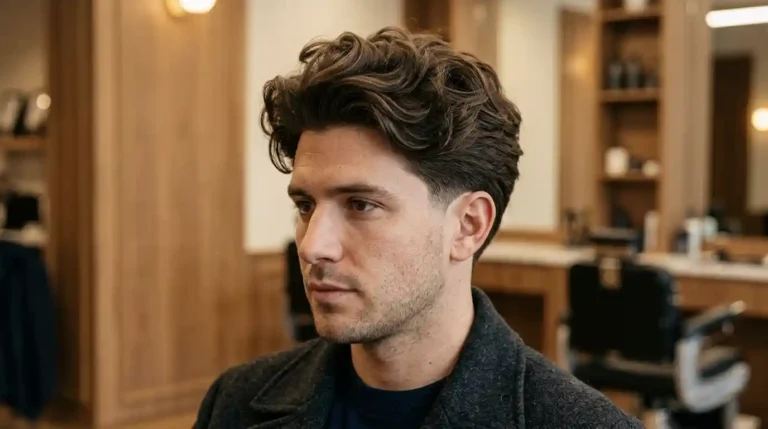

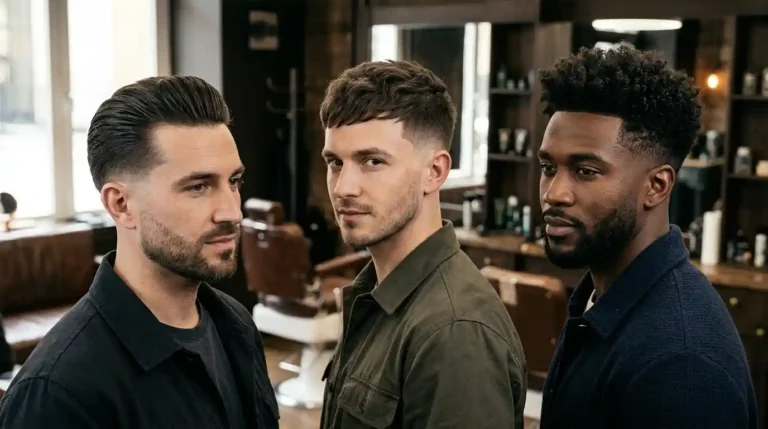
One Comment