
Soft Taper Haircut: Styles, Differences, and Barber Guide
The soft taper haircut is a timeless men’s hairstyle that combines natural blending, subtle graduation, and clean edges without the dramatic contrast of a skin fade. Unlike a tight taper or high fade that removes significant length around the sides, a soft taper preserves more hair near the temples, sideburns, and neckline, creating a balanced appearance that grows out naturally. It’s an excellent choice for men who prefer a professional, low-maintenance haircut with enough flexibility for a classic side part, textured crop, quiff, brushed-back style, or longer flowing hair. Whether you have straight, wavy, curly, coily, fine, or thick hair, the cut can be adjusted to complement your natural texture and face shape. However, the term “soft taper” is not standardized, so explaining your preferred taper height, side coverage, and neckline to your barber is essential. In this guide, you’ll discover how a soft taper differs from traditional tapers and fades, explore popular style combinations, learn which variations work for different hair types, and get practical barber instructions, styling techniques, and maintenance advice.
Table of Contents
- What Is a Soft Taper Haircut?
- Soft Taper vs. Other Haircuts
- Taper Height, Length, and Shape
- Soft Taper Styles and Pairings
- Who Is a Soft Taper Best For?
- How Barbers Create a Soft Taper
- How to Ask Your Barber for a Soft Taper
- Growing Out a Fade Into a Soft Taper
- Styling and Maintaining a Soft Taper
- Frequently Asked Questions
- Final Thoughts
What Is a Soft Taper Haircut?
A soft taper haircut is a men’s hairstyle that gradually reduces hair length toward the sides, temples, sideburns, and neckline while maintaining a natural-looking transition between longer and shorter sections.
The defining characteristic is subtle blending rather than extreme contrast.
Instead of cutting the lower sides extremely close to the scalp, a barber usually preserves enough length for the hair to remain visible throughout the transition.
This creates a clean taper haircut that looks neat without appearing overly sharp, heavily faded, or disconnected.
A soft taper can be combined with short, medium, or long hair on top.
It can support a professional side part, relaxed textured fringe, naturally curly top, or longer brushed-back style.
Because the shape is adaptable, it is suitable for men who prefer classic proportions and understated grooming.
How a Soft Taper Shapes the Sides, Temples, and Neckline
The taper starts with the longer hair around the upper sides and gradually becomes shorter toward the perimeter of the haircut.
The perimeter refers to the visible lower boundaries of the hairstyle, including the areas around the ears, sideburns, and neckline.
In a soft taper, the barber generally avoids creating a harsh division between the upper sides and the shorter hair near these edges.
For example, hair above the ear may retain enough length to lie naturally against the head.
Moving downward toward the sideburn, the barber gradually shortens the hair.
The same principle applies to the back of the head, where the longer crown and lower sides connect smoothly into the nape.
This graduated transition creates a softer silhouette than a closely shaved skin fade.
The final appearance depends on the head shape, hair density, and amount of side coverage the barber preserves.
Why a Soft Taper Keeps More Hair at the Perimeter
A soft taper usually retains more visible hair near the lower edges than a very tight fade.
This matters because the shortest areas strongly influence the haircut’s overall appearance.
When the sideburns and neckline are shaved down to bare skin, the contrast between the upper hair and lower edges becomes more obvious.
When a little more length remains, the transition appears gentler.
Preserving side weight also helps support longer hairstyles.
For example, a medium-length side part may look disconnected if the sides are cut extremely short.
A soft taper maintains enough hair to connect the longer top into the lower sections naturally.
This can be especially useful for thick hair, naturally wavy hair, and hairstyles that require flowing movement.
However, retaining more hair does not mean leaving the entire haircut bulky.
A skilled barber can remove unnecessary weight while preserving the soft graduation.
Why “Soft Taper” Can Mean Different Things to Different Barbers
The term “soft taper” is descriptive rather than a universally standardized technical haircut name.
One barber may interpret it as a traditional low taper with longer sides.
Another may create a scissor-cut taper with minimal clipper use.
A third may use a close low taper fade but soften the upper blending.
These variations can produce noticeably different results.
That is why simply asking for a soft taper may not be enough.
To communicate clearly, explain whether you want visible hair around the lower edges, how high the taper should begin, and whether you prefer scissors or clippers.
You should also specify how much length you want on top.
A good reference photograph helps communicate these details more effectively than the haircut name alone.
The Classic Taper’s History and Lasting Appeal
Tapered haircuts have been part of traditional men’s barbering for generations.
Before modern high-contrast fades became widely popular, many men’s hairstyles relied on natural side graduation and neatly shaped necklines.
Traditional short-back-and-sides cuts, conservative side parts, and gentleman’s hairstyles frequently used these principles.
During the twentieth century, tapered cuts appeared in professional grooming, military-influenced styles, and everyday men’s fashion.
The softer side proportions also remained relevant as hairstyle trends changed.
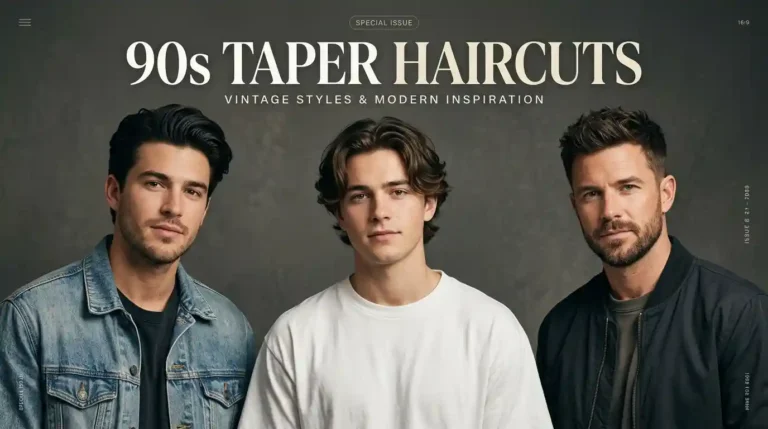
For example, the taper haircut 90s aesthetic often emphasized fuller sides, natural movement, and relaxed styling.
Today, the soft taper offers a similar balance between traditional barbering and modern flexibility.
Its lasting appeal comes from the ability to look polished without requiring an extremely sharp fade.
Soft Taper vs. Other Haircuts
Understanding the difference between a soft taper, regular taper, taper fade, and skin fade is essential before choosing a haircut.
These styles share similar cutting principles, but they differ in side length, transition height, and scalp exposure.
Soft Taper vs. Skin Fade
The most noticeable difference is the amount of hair remaining at the shortest point.
A soft taper usually preserves visible hair around the sideburns and neckline.
A skin fade transitions down to bare skin.
This creates a stronger visual contrast, especially when the fade extends higher along the sides.
| Feature | Soft Taper | Skin Fade |
| Scalp exposure | Usually little or none | Exposed at the shortest point |
| Side coverage | Greater | Reduced within the faded section |
| Transition | Gentle and natural | Closer and more defined |
| Overall appearance | Understated and classic | Sharp and contemporary |
| Grow-out | Usually softer | Close-cut areas become noticeable as they grow |
| Best for | Natural movement and subtle grooming | High-contrast styling preferences |
A skin fade is not inherently better or worse.
It simply creates a different appearance.
If you want the sides to remain soft and connected to the top, a traditional taper is often more suitable.
Taper vs. Taper Fade
A taper gradually reduces hair length.
A taper fade generally uses closer blending around selected areas, often the sideburns and neckline.
However, barbers do not always use these terms consistently.
Some use “low taper” and “low taper fade” interchangeably.
Others distinguish them based on how closely the lowest hair is cut.
A soft taper usually emphasizes natural graduation with limited scalp exposure.
A taper fade can have a sharper finish, although a carefully blended low fade may still look subtle.
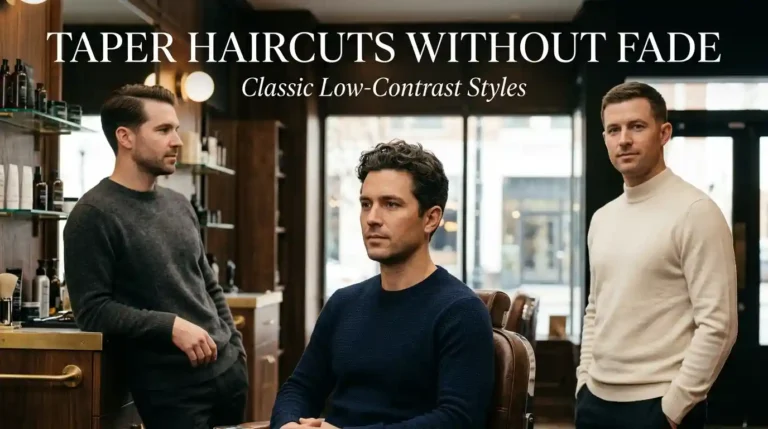
If your priority is keeping visible hair around the edges, a taper haircut without fade may be the clearest reference.
The most useful instruction is to describe the shortest length you want, not simply the name of the cut.
Soft Taper vs. Classic or Regular Taper
A soft taper and a classic taper are closely related.
Both generally feature graduated sides, a controlled neckline, and a naturally connected top.
The difference is often one of emphasis rather than a completely different haircut structure.
A classic taper haircut focuses on traditional proportions and smooth blending.
A soft taper emphasizes a particularly gentle transition with minimal contrast.
A regular taper is a broader term that can describe many standard tapered haircuts.
A standard taper haircut may be performed with scissors, clippers, or both.
The main characteristics depend on the client’s preferences and the barber’s interpretation.
| Haircut | Main Emphasis |
| Soft taper | Gentle blending and natural-looking edges |
| Classic taper | Traditional proportions and balanced graduation |
| Regular taper | General short-to-long transition |
| Low taper | Shortening concentrated near lower edges |
| Tight taper | Closer cutting with reduced length |
| Skin taper fade | Very close graduation reaching exposed skin |
A soft taper is an excellent choice when you want the neatness of a regular taper without the sharper contrast of a close fade.
Scissor Taper vs. Clipper Taper
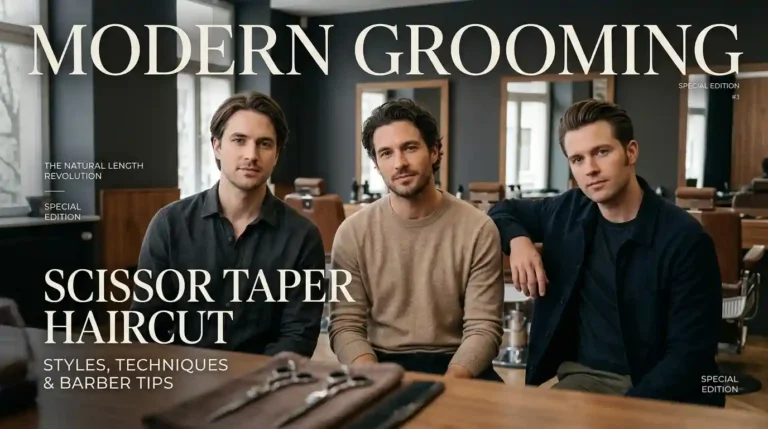
A scissor taper describes the cutting method rather than one fixed hairstyle.
The barber uses scissors and a comb to gradually shorten the sides and back.
This is often done through a technique called scissor-over-comb.
A clipper taper uses electric clippers, guard attachments, and sometimes clipper-over-comb techniques.
Both methods can create smooth, natural results.
Scissors offer flexible control over longer lengths and can be particularly useful for preserving side weight.
Clippers allow precise control of short lengths and are often efficient when working near the lower edges.
A scissor taper haircut is worth considering if you prefer a fuller, more traditional finish.
However, many barbers combine scissors and clippers to achieve the desired result.
The final shape matters more than which tool is used exclusively.

Taper Height, Length, and Shape
The taper’s height and length determine how subtle or noticeable the finished haircut appears.
Two people can request the same top style and receive very different results depending on the side graduation.
Low, Mid, and High Tapers
A low soft taper concentrates the shortest transition close to the sideburns and neckline.
Most of the upper sides remain relatively full.
This creates one of the most understated variations.
A mid soft taper starts the noticeable graduation farther up the sides.
It removes more bulk while maintaining a connected appearance.
A high taper extends the shorter transition even farther upward.
This creates a stronger contrast and may be less consistent with the traditional soft taper aesthetic.
| Taper Height | Side Fullness | Appearance | Suitable Pairings |
| Low | Greatest | Subtle and traditional | Side part, flow, longer top |
| Mid | Moderate | Balanced and neat | Textured crop, quiff |
| High | Least | More defined and modern | Brush-up, short textured top |
For the most natural appearance, a low or moderate taper is usually the best starting point.
Short, Standard, and Long Tapers
The word “taper” describes a change in length rather than a fixed measurement.
A short taper may begin with relatively short upper sides and gradually reduce the length toward the lower edges.
A standard taper generally retains enough hair for a smooth, visible graduation.
A long taper keeps additional side length, allowing the hair to flow naturally into longer top sections.
The actual measurements depend on texture, density, and haircut shape.
For example, a long scissor taper may preserve enough hair around the ears to move naturally.
A short taper might keep the upper sides compact while still avoiding exposed scalp.
If you want a “small taper haircut,” explain whether you mean a narrow area of tapering or a very short overall haircut.
These are different requests.
Tapering the Temples and Sideburns
The temples are located near the front sides of the head, above and around the sideburn area.
A temple taper gradually reduces length in this region.
A soft temple taper should maintain a natural connection between the upper sides and lower hairline.
The sideburns can be shortened while preserving their natural shape.
If you have a beard, the barber may create a gentle beard blend that connects the sideburns into the facial hair.
For a clean-shaven look, the sideburns can be shaped to complement the ears and face.
Avoid pushing the temple hairline backward simply to create a sharper outline.
A soft taper generally looks best when it respects the natural hairline.
Tapering the Neckline
The neckline is an important part of the haircut because it affects the back-view appearance and grow-out.
A soft neckline taper gradually reduces length toward the nape.
The transition should connect smoothly into the lower back of the head.
Unlike a sharply blocked neckline, it does not depend on a strong artificial line.
This creates a natural finish that often remains presentable as the hair grows.
For people with longer hair on top, a subtle neckline taper can make the overall hairstyle appear neater without shortening the visible upper sections.
Natural, Rounded, and Blocked Necklines
There are three common neckline finishes.
Natural tapered neckline: Follows the natural hairline with gradual shortening.
Rounded neckline: Creates a curved outline along the lower back of the head.
Blocked neckline: Produces a relatively straight or squared lower edge.
For a traditional soft taper, the natural tapered neckline is often the best match.
A rounded neckline can also work when it suits the person’s natural neck shape.
A blocked neckline may look sharp immediately after cutting but become more obvious during regrowth.
Ask your barber to consider your natural nape growth pattern before choosing the final shape.
What Stays Long and What Gets Tapered
One of the most common misunderstandings is assuming a soft taper means keeping every section long.
In reality, the haircut still involves controlled length reduction.
The top remains long enough to support the chosen hairstyle.
The upper sides are shaped to connect naturally with the top.
The hair becomes shorter near the sideburns, temples, and neckline.
However, the transition is generally compact and gentle.
The result is not an unshaped haircut.
It is a deliberately graduated cut with softer edges.
For example, a medium-length side part may retain approximately three inches on top, moderate fullness along the sides, and shorter hair near the lower perimeter.
The exact measurements can be adjusted according to hair texture and styling preference.
Soft Taper Styles and Pairings
A soft taper can be combined with many popular hairstyles because it changes the perimeter without requiring one specific top shape.
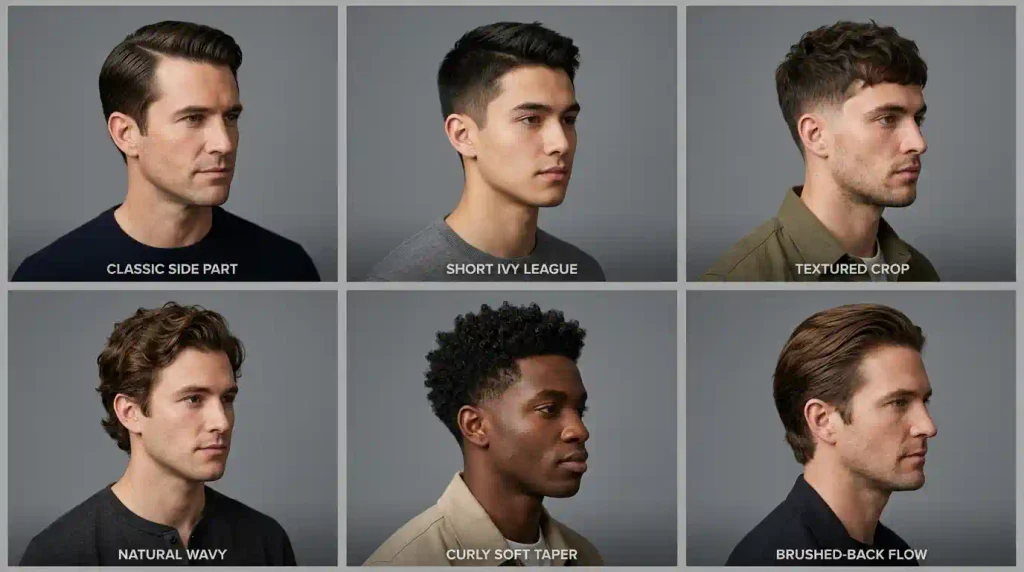
Classic and Business Taper
The classic soft taper is one of the most versatile professional hairstyles.
It features a short-to-medium top, gradually shortened sides, and a natural neckline.
The top can be worn with a side part or lightly brushed backward.
A business taper haircut uses similar proportions while emphasizing a neat, office-ready appearance.
Best for: Formal settings, professional grooming, and low-maintenance styling.
Barber request: Keep enough top length for a natural part and taper the sides gently without exposing skin.
Side Part and Comb-Over
A soft taper with a side part creates a traditional gentleman’s hairstyle.
The longer top follows the natural parting direction, while the sides remain smoothly connected.
A comb-over uses a similar foundation but places greater emphasis on sweeping the hair across the top.
Both styles work well with moderate side fullness.
A lightweight pomade or styling cream can create a controlled finish.
Best for: Straight or wavy hair with medium density.
Styling tip: Follow your natural part rather than forcing a sharply shaved line.
Crew Cut and Ivy League
A crew cut usually features short hair on top with slightly greater length at the front.
An Ivy League leaves enough length to create a small side part.
Both can be paired with a soft taper.
This creates a practical haircut with less contrast than a high skin fade.
A short Ivy League is especially suitable for people who want a traditional shape without extensive styling.
Best for: Short hair preferences, busy routines, and classic grooming.
Barber request: Keep a compact top with a smooth low taper and neatly graduated sideburns.
Scissor Cut with a Beard
A scissor-cut soft taper preserves natural side length while allowing the barber to connect the haircut into a beard.
The upper sideburns remain relatively full.
The hair gradually becomes shorter toward the facial hair, or the beard is adjusted to create a balanced transition.
This can produce a refined look without highly defined shaved lines.
Best for: Men with short or medium beards who prefer natural grooming.
Styling tip: Maintain a consistent overall shape between the haircut and facial hair.
Textured Crop and Fringe
A textured crop uses carefully shaped layers to create movement on top.
The fringe may be directed forward or slightly to one side.
A soft taper around the temples and neckline keeps the haircut neat without creating a disconnected appearance.
The barber can use point cutting to soften the ends and remove selected areas of bulk.
Best for: Straight, wavy, and medium-to-thick hair.
Styling tip: Apply a small amount of matte paste and use your fingers to create separation.
Quiff, Pompadour, and Brushed-Back Styles
A quiff creates controlled height near the front of the head.
A pompadour uses more rounded volume, while a brushed-back style directs the hair away from the forehead.
A soft taper can help balance these longer top sections.
Instead of creating a dramatic contrast between the top and sides, the haircut preserves enough side length to support a natural silhouette.
Best for: Straight or wavy hair with sufficient density.
Barber request: Keep additional front length for styling and blend the upper sides naturally into the top.
Undercut with a Taper
A traditional undercut features a noticeable separation between longer top hair and shorter sides.
This is different from a fully connected soft taper.
However, a barber can introduce a soft lower taper beneath a longer top to reduce harshness around the edges.
The result becomes a hybrid hairstyle.
If you want a completely natural transition, ask for a connected taper rather than a disconnected undercut.
Best for: People who want a modern appearance with some softer details.
Wavy, Curly, and Long-Top Styles
A soft taper works particularly well with natural waves and curls.
The barber can preserve sufficient length on top for the texture to form naturally.
A low perimeter taper keeps the edges neat without removing the fullness that supports the hairstyle.
For curly and coily hair, the barber should account for shrinkage.
Cutting the hair too short while stretched may create an unexpectedly compact shape after it dries.
Best for: Wavy, curly, and coily hair.
Styling tip: Use moisture-supporting products and avoid excessive thinning that disrupts the natural curl pattern.
Flow, Man Bun, and Other Longer Styles
Longer hairstyles can also incorporate a soft taper.
A flow haircut features medium-to-long hair that naturally moves backward or away from the face.
A man bun gathers longer hair, typically at the back or top of the head.
A subtle lower taper may clean the neckline and sideburns while preserving most of the length.
This creates a neater perimeter without changing the overall longer hairstyle.
Avoid making the taper too high if you want the longer hair to maintain full coverage.
Also avoid pulling the hair tightly into a bun every day, as persistent tension can contribute to hair damage.
Best for: Medium-to-long hair and relaxed styling preferences.
Who Is a Soft Taper Best For?
A soft taper is particularly useful for men who want a clean haircut without removing too much length around the sides.
However, the ideal variation depends on face shape, hair texture, density, and daily styling preferences.
Choosing a Taper for Your Face Shape
Different taper heights and top shapes can influence the proportions of the face.
| Face Shape | Suggested Soft Taper | Main Consideration |
| Oval | Classic low taper or side part | Most balanced shapes can work |
| Round | Soft taper with modest quiff | Some top height may create visual length |
| Square | Natural side part or textured taper | Soft movement can balance angular features |
| Diamond | Low taper with moderate temple fullness | Balances prominent cheekbones |
| Heart-shaped | Side-swept soft taper | Maintains gentle side volume |
| Oblong or long | Low taper with fuller sides | Avoids excessive vertical emphasis |
These recommendations are guidelines rather than strict rules.
Someone with a round face can still wear a longer flowing style.
Someone with a square face may prefer a short crop.
A skilled barber can adjust the top shape, side weight, and fringe to create the desired appearance.
Choosing a Taper for Your Hair Texture and Density
Hair texture and density strongly influence how a soft taper behaves after cutting.
Fine hair may require careful weight preservation.
Thick hair may need controlled bulk removal.
Wavy, curly, and coily hair require attention to natural movement and shrinkage.
The goal is to create a hairstyle that looks balanced without forcing the hair into an unnatural shape.
Fine or Straight Hair
Fine hair often benefits from a compact top and carefully preserved side coverage.
An extremely close fade may expose more of the scalp than desired.
A soft taper can help maintain a fuller visual outline.
For straight hair, a natural side part, Ivy League, or short textured crop may be practical.
Avoid excessive thinning or heavy pomade if it makes fine strands separate.
Recommended style: Low soft taper with a short-to-medium top.
Styling product: Lightweight styling cream or mousse.
Dense or Thick Hair
Thick hair can support medium-length side parts, quiffs, and brushed-back styles.
However, excess weight around the upper sides may cause the hair to expand outward.
A barber can manage this through scissor-over-comb or controlled layering.
The objective is to reduce bulk without creating a hollow or disconnected appearance.
Recommended style: Low-to-mid soft taper with carefully shaped upper sides.
Styling product: Matte paste, styling cream, or suitable pomade.
Wavy, Curly, or Coily Hair
Wavy hair naturally creates movement and often looks excellent with a soft taper.
Curly hair benefits from sufficient top length to maintain curl formation.
Coily hair can be shaped into a neatly graduated silhouette while preserving its natural texture.
Shrinkage should be considered before cutting.
A barber who understands natural curl patterns can adjust the taper to avoid removing too much side coverage.
Recommended style: Low soft taper with a natural textured top.
Styling product: Curl cream, lightweight leave-in conditioner, or suitable styling product for the hair type.
Matching the Taper to Your Routine and Workplace
A soft taper can suit formal, business-casual, and relaxed environments.
For professional settings, a natural side part or short classic taper provides an understated appearance.
For creative workplaces, a textured crop or longer soft taper may feel more appropriate.
For students and people with busy schedules, a short Ivy League or crew cut combination can require minimal styling.
The best haircut is one that remains manageable during a normal day.
If you prefer traditional elegance, an old money taper haircut is another useful reference because it emphasizes soft graduation, natural movement, and controlled volume.
When a Soft Taper May Not Be the Right Choice
A soft taper may not match your preferences if you want extremely short sides, strong contrast, or a highly defined skin fade.
It may also be less suitable if your goal is an intentionally disconnected undercut.
For example, someone who likes exposed scalp around the temples may prefer a tight taper fade.
Someone who wants the hair uniformly short may be happier with a buzz cut.
A military taper haircut can provide inspiration for a more compact, disciplined silhouette.
However, a soft taper remains a flexible option for people who prefer natural-looking side transitions.
How Barbers Create a Soft Taper
A barber creates a soft taper by gradually reducing hair length while preserving enough hair for a smooth connection between sections.
The exact technique depends on hair texture, desired length, and the barber’s experience.
Scissor-Over-Comb Technique
Scissor-over-comb is a traditional method for controlling graduation.
The barber lifts sections of hair using a comb and cuts the hair extending beyond it.
The comb’s angle and position determine how much length remains.
As the barber moves toward the lower sides, the remaining hair can gradually become shorter.
This technique is useful for preserving fullness and avoiding abrupt transitions.
It is often used when creating a soft, natural finish.
Scissor and Clipper Blending
Many soft tapers combine scissors and clippers.
Scissors may shape the top and upper sides.
Clippers may refine the lower sideburns or neckline.
The barber can then blend the sections together to create a consistent graduation.
Clipper-over-comb may also be used for areas requiring precise bulk removal.
A combined approach can produce a soft taper without requiring a scissors-only haircut.
The finished shape is more important than the number of tools used.
Choosing Clipper Guards and Taper Length
Clipper guard numbers indicate approximate cutting lengths.
Common examples include:
| Guard | Approximate Length |
| #1 | 3 mm / 1/8 inch |
| #2 | 6 mm / 1/4 inch |
| #3 | 10 mm / 3/8 inch |
| #4 | 13 mm / 1/2 inch |
| #5 | 16 mm / 5/8 inch |
| #6 | 19 mm / 3/4 inch |
These are nominal measurements, and results vary depending on the clipper, guard system, blade, and lever position.
There is no universal guard number for a soft taper.
For a longer, subtle result, a barber may use scissors or longer guards across the upper sides and shorten the lower edges gradually.
The shortest guard should be selected based on your desired scalp exposure and overall haircut shape.
Preserving Natural Side Weight
Side weight refers to the amount of hair retained around the upper sides of the head.
This is an important feature of a soft taper.
Removing too much side weight can make the haircut look hollow, disconnected, or excessively faded.
For thick hair, some bulk may need to be removed so the sides lie naturally.
For fine hair, retaining additional weight can help maintain a fuller appearance.
The barber should consider the head shape, crown, and growth direction when determining how much to remove.
Crosschecking the Blend and Neckline
After shaping the haircut, the barber should examine the sides and back from multiple angles.
Crosschecking helps identify uneven graduation, heavy lines, or areas that were cut differently.
The neckline should be assessed separately.
A soft taper generally benefits from a natural transition rather than an overly sharp lower boundary.
The barber may make small finishing adjustments after drying the hair because dry hair can reveal movement and bulk that were less visible during cutting.
How to Ask Your Barber for a Soft Taper
The most important part of a successful appointment is explaining your desired silhouette.
The phrase “soft taper” communicates an aesthetic, but the barber still needs practical cutting instructions.
Specify the Taper Height, Perimeter, and Side Coverage
Begin by explaining whether you want a low, mid, or high taper.
For the softest traditional appearance, a low taper is usually a good starting point.
Next, describe how much hair you want around the ears and temples.
For example:
“Keep enough hair above the ears so the sides look naturally full.”
Then explain whether you want the lower neckline closely cut or softly graduated.
These details are more precise than requesting a “light taper haircut” without further explanation.
Explain Whether You Want Scissors, Clippers, or Both
If you prefer a scissors-dominant cut, mention that clearly.
You might want scissors because you prefer longer side coverage or a softer finish.
However, clippers can also create natural results when used appropriately.
A practical instruction is:
“Please use scissors for the longer blending, and only use clippers where necessary for a clean lower edge.”
If you want to avoid clippers entirely, explain that before the haircut begins.
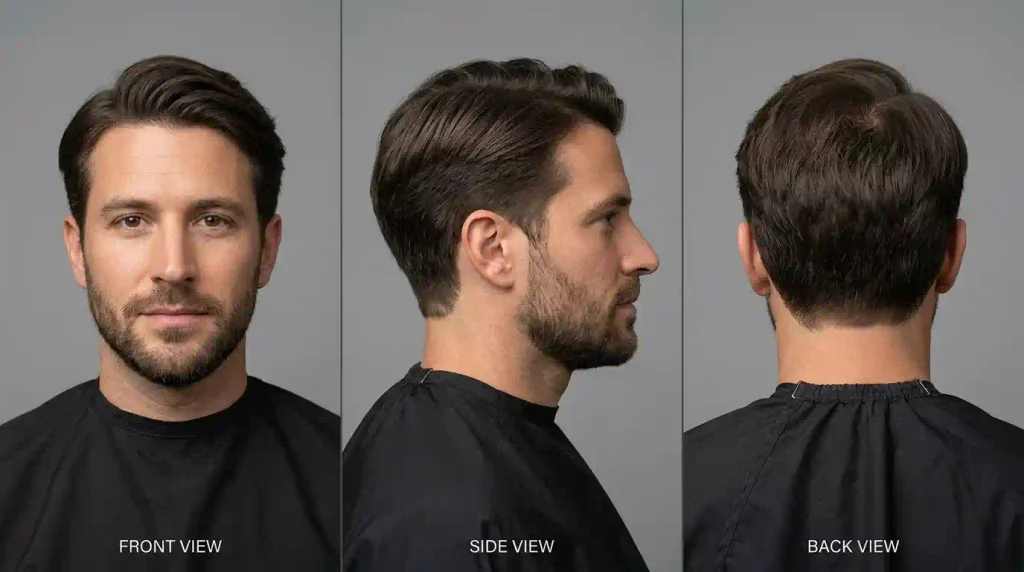
Bring Front, Side, and Back Reference Photos
Reference photos are especially useful because the term “soft” is subjective.
Bring photographs showing the desired top shape, side graduation, and neckline.
The front view reveals fringe direction and volume.
The side view shows taper height and side coverage.
The back view shows the nape and crown connection.
Choose images with hair texture similar to yours whenever possible.
If you like different details from multiple photos, explain exactly which elements you want combined.
Share Your Hair Texture and Daily Styling Routine
Tell the barber how your hair behaves naturally.
Mention cowlicks, crown whorls, uneven growth, thinning areas, or sections that expand outward.
If you have curly or coily hair, explain how much visible length you want after shrinkage.
Also describe your morning routine.
If you only spend a few minutes styling, the barber may recommend a shorter top.
If you enjoy using a blow-dryer, a longer side part or quiff may be practical.
Soft Taper Consultation Script
Use this description at your next barbershop appointment:
“I want a soft taper haircut with a natural, gradual blend. Please keep the taper low around my sideburns and neckline, and leave some fullness above my ears. I don’t want a skin fade or an overly tight transition. Keep enough length on top for a natural side part or textured finish. I’d prefer a soft, connected shape that grows out neatly, with a natural tapered neckline.”
For a shorter haircut, request an Ivy League or short textured top.
For a longer style, ask the barber to preserve layers and taper only the lower perimeter.
Saveable Barber Reference Card
| Haircut Detail | Recommended Soft Taper |
| Taper height | Low |
| Upper-side fullness | Moderate |
| Scalp exposure | Minimal or none |
| Top length | Approximately 2–4 inches for a medium style |
| Side blending | Gradual and natural |
| Main cutting method | Scissors and clippers as needed |
| Temple area | Softly graduated |
| Sideburns | Natural and neatly shaped |
| Neckline | Soft tapered finish |
| Overall appearance | Clean, subtle, and connected |
| Avoid | High skin fade, disconnected transition, aggressive line-up |
| Styling | Natural side part or lightweight texture |
Growing Out a Fade Into a Soft Taper
If you currently have a skin fade or very tight taper, you may need to grow out the sides before achieving a softer silhouette.
The process depends on how much hair was removed and how long you want the sides to become.
What to Ask for at the First Appointment
At the first appointment, explain that your goal is to preserve side length rather than continue the close fade.
Ask your barber to clean the neckline and refine any uneven sections without taking the sides unnecessarily short.
If the upper sides have enough length, the barber may be able to soften the transition immediately.
However, a high skin fade cannot be converted into a full traditional taper in one appointment if the necessary hair has not grown.
Avoid cutting the top excessively short simply to match the faded sides unless you genuinely want a shorter hairstyle.
What to Expect While the Sides Regain Length
Hair commonly grows around half an inch per month on average, although individual growth rates vary.
During the grow-out period, the sides may look uneven or bulky in certain areas.
This does not necessarily mean the haircut needs a new fade.
A barber can manage the shape with light scissor trimming while allowing the shorter sections to grow.
You may need several weeks or longer before the sides develop enough coverage for a full soft taper.
The timeline depends on the original fade height and your preferred final length.
When to Book a Follow-Up Trim
A follow-up appointment after several weeks can help maintain the overall shape.
Ask the barber to evaluate whether the previously faded areas have gained enough length to blend naturally.
The appointment may focus on removing excess bulk rather than cutting the entire side area shorter.
Once the desired side coverage is established, the barber can create the final low or standard soft taper.
The goal is a gradual transition toward a fuller silhouette.
Styling and Maintaining a Soft Taper
A soft taper can be relatively easy to maintain because its natural graduation often grows out more gently than a closely shaved fade.
However, daily care and occasional trimming are still important.
A Simple Styling Routine
Start with clean or slightly damp hair.
Use a comb or your fingers to arrange the top in its natural direction.
For a short soft taper, minimal styling may be necessary.
For a medium-length side part, apply a small amount of grooming cream.
For a textured haircut, use a lightweight paste and separate the hair gently.
If you want additional volume, use a blow-dryer on low or medium heat.
Avoid prolonged high-temperature styling.
The American Academy of Dermatology’s healthy hair-care guidance recommends selecting products for your hair type and limiting excessive heat to reduce avoidable hair damage.
The key is maintaining natural movement rather than creating an excessively rigid shape.
Products for Texture, Hold, and Natural Finish
| Product | Main Benefit | Suitable Hairstyle |
| Grooming cream | Soft control and movement | Classic taper, side part |
| Styling paste | Flexible hold and separation | Textured crop |
| Matte clay | Stronger texture with minimal shine | Short quiff |
| Pomade | Controlled shape with varying shine | Comb-over, brushed-back |
| Sea salt spray | Airy texture on suitable hair types | Wavy top, casual flow |
| Lightweight mousse | Root lift and volume | Fine hair, quiff |
| Curl cream | Moisture and curl definition | Curly soft taper |
| Clarifying shampoo | Removes accumulated product buildup when needed | Product-heavy styling routines |
Use clarifying shampoo only as appropriate for your hair and scalp, since overuse may leave some hair types feeling dry.
Fine hair may need lighter products to avoid flattening the roots.
Thick hair may require additional control.
Curly and coily hair may benefit from conditioning products that preserve moisture.
Choose based on your natural texture rather than following one universal product recommendation.
Edge Cleanup vs. a Full Haircut
An edge cleanup focuses on the lower perimeter.
This may include tidying the sideburns, hair around the ears, and neckline.
A full haircut involves reshaping the top and adjusting the sides to restore the intended proportions.
For example, a soft taper with a medium-length top may only need a neckline cleanup after a few weeks.
After additional growth, the upper sides and top may require more substantial trimming.
Avoid turning every cleanup appointment into a tighter fade if your goal is to maintain natural side fullness.
How Often to Maintain the Temples, Sideburns, and Neckline
Maintenance frequency depends on hair growth and how defined you want the haircut to remain.
| Soft Taper Style | Approximate Full Trim Interval |
| Short soft taper | 3–5 weeks |
| Low soft taper with side part | 4–6 weeks |
| Medium-length textured taper | 4–7 weeks |
| Scissor-cut soft taper | 5–7 weeks |
| Long-top soft taper | 5–8 weeks |
| Flow hairstyle with tapered neckline | 6–10 weeks |
These are general estimates.
Some people prefer small perimeter cleanups every two to four weeks while maintaining longer intervals between full haircuts.
If you enjoy a slightly grown-out appearance, you may need fewer touchups.
Keeping the Taper Neat as It Grows Out
A natural grow-out is one of the strongest advantages of a soft taper.
Because the original length difference is relatively subtle, the haircut often retains a balanced appearance as the hair gets longer.
However, side bulk may develop around the ears.
The neckline may also become less defined.
To maintain the shape, follow the natural styling direction and use appropriate products.
Avoid excessive thinning or aggressive at-home blending.
If the sides become difficult to manage, a barber can remove selected bulk without creating a close fade.
Regular, moderate maintenance generally works better than repeatedly cutting the perimeter extremely short.
Frequently Asked Questions
Does a Soft Taper Expose the Scalp?
Usually not, because a soft taper generally preserves visible hair around the lower sides and neckline.
Is a Soft Taper the Same as a Scissor Taper?
Not necessarily; a soft taper describes the subtle finished appearance, while a scissor taper describes the cutting technique.
Can a Soft Taper Work with Curly or Wavy Hair?
Yes, a soft taper can preserve natural waves and curls while keeping the temples, sideburns, and neckline neatly graduated.
How Long Does a Soft Taper Last?
Most soft tapers remain presentable for approximately three to six weeks, although hair growth speed, top length, and styling preferences vary.
Should I Ask for a Soft Taper or a Low Taper Fade?
Ask for a soft taper if you want more natural side coverage, or a low taper fade if you prefer a closer, more defined lower transition.
Can I Grow Out a Skin Fade Into a Soft Taper?
Yes, but the shorter sides need time to regrow before a barber can create fuller, naturally graduated proportions.
Final Thoughts
The soft taper haircut is an excellent choice for men who want natural blending, subtle side graduation, and a clean appearance without the dramatic contrast of a skin fade. Whether you prefer a traditional side part, textured crop, short Ivy League, brushed-back style, or longer flowing hair, a soft taper can be adapted to your face shape, hair texture, and daily routine.
For the most understated result, choose a low taper, preserve moderate side coverage, and request a natural neckline. Clear reference photos and specific barber instructions will help you achieve the right finish.
Our top recommendation is a soft low taper with a medium-length, naturally styled top, offering a balance of versatility, comfort, and easy maintenance.
Explore more haircut inspiration at Taper Haircut Hub and browse our Classic & Traditional Tapers collection before your next barber appointment.


2 Comments