
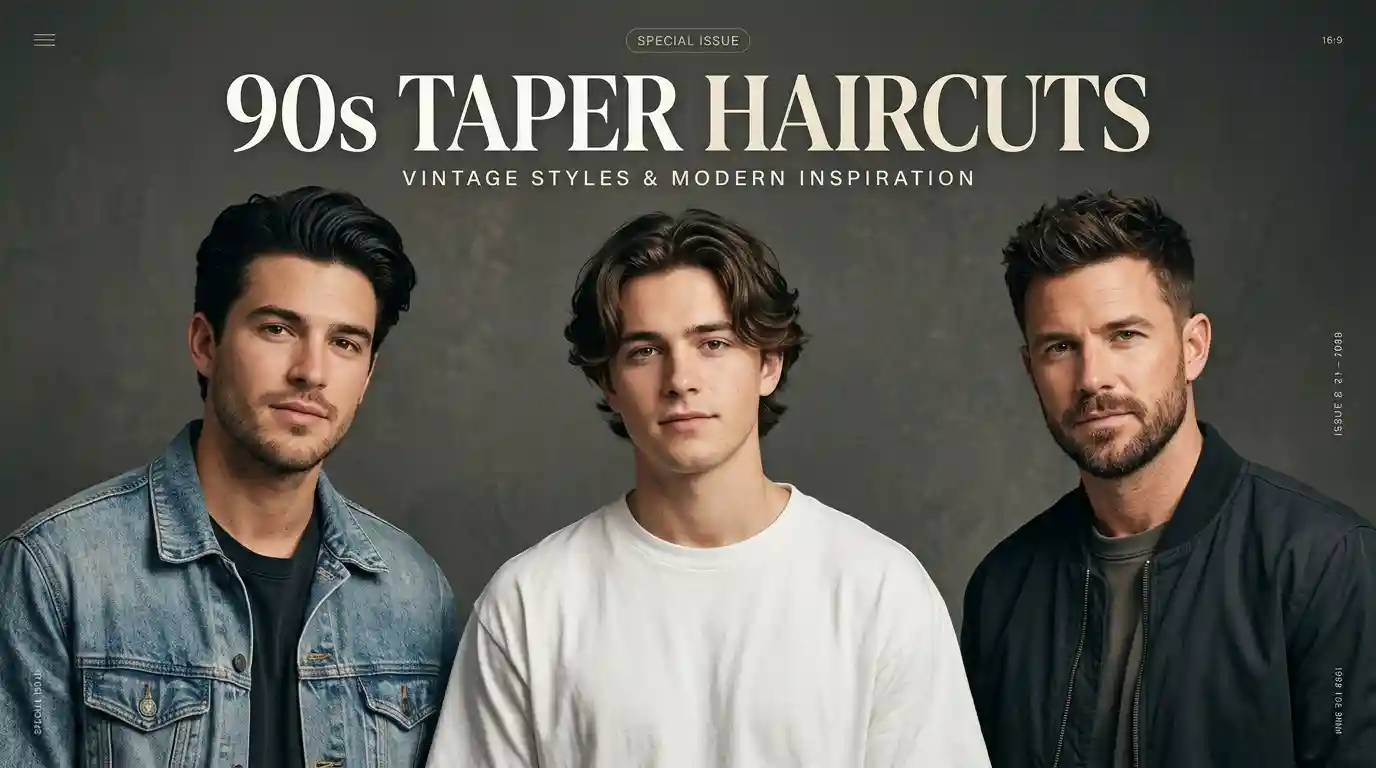
90s Taper Haircut: Styles, Barber Guide, and Styling Tips
The taper haircut 90s trend is bringing back one of the most recognizable eras of men’s hairstyling, combining vintage charm with clean, modern barbering. From Johnny Depp’s relaxed, grown-out hair and Leonardo DiCaprio-inspired curtains to sharp low tapers, high-top fades, spiky hair, and textured cuts, the 1990s offered styles for almost every personality. Unlike today’s ultra-sharp skin fades, many classic 90s taper haircuts featured natural transitions, fuller sides, longer tops, and effortless movement. The decade also borrowed inspiration from the structured 80s taper haircut while introducing softer layers, center parts, and grunge-inspired finishes. Today, barbers are updating these looks with cleaner necklines, controlled texture, and carefully blended sides. Whether you want an authentic vintage haircut or a contemporary taper fade haircut 90s combination, understanding the original shape is essential. This guide explores 18 popular hairstyles, their defining features, the best options for different face shapes and hair textures, exactly what to ask your barber, and practical styling and maintenance tips.
Table of Contents
- What Is a 90s Taper Haircut?
- Popular 90s Taper Haircut Styles
- 90s Taper Haircut Photo Gallery
- How to Choose a 90s Taper for Your Face Shape and Hair Type
- What to Ask Your Barber For
- How a Barber Cuts a 90s Low Taper
- How to Style and Maintain a 90s Taper
- Frequently Asked Questions
- Final Thoughts
What Is a 90s Taper Haircut?
A 90s taper haircut is a men’s hairstyle inspired by the grooming trends of the 1990s, typically featuring gradually shortened hair around the sideburns and neckline while preserving more length and natural shape through the sides and top.
However, the term does not describe one historically standardized haircut.
During the 1990s, men wore everything from conservative classic tapers to curtains, high-top fades, Caesar cuts, and long grunge hairstyles. Some of these featured tapered edges, while others originally had little or no taper.
Today’s term “90s taper” often describes a vintage silhouette combined with contemporary tapering techniques.
The Classic 90s Shape and Finish
The classic 90s-inspired taper generally emphasizes a natural appearance rather than an aggressively shaved finish.
Its defining characteristics often include:
- Fuller hair around the upper sides of the head.
- Gradual shortening near the sideburns and neckline.
- Medium-length or longer hair on top.
- Natural-looking transitions between hair lengths.
- Soft movement rather than excessively sharp styling.
- A subtle, rounded, or squared neckline depending on the cut.
The top could be styled into a side part, a relaxed fringe, a middle part, or brushed-back volume.
Compared with many contemporary barbering styles, the overall silhouette usually appears softer and less tightly faded.
What Makes a Taper Look True to the 1990s?
An authentic-looking 90s taper depends heavily on proportion.
Modern haircuts frequently emphasize extremely short sides, high contrast, and precision-cut hairlines. Many classic 1990s styles instead maintained greater fullness above the ears and around the temples.
The hair also tended to have a more natural finish.
Rather than relying entirely on heavy matte styling products, men often used gel, mousse, pomade, or simple blow-drying to create a recognizable shape.
The 1990s were influenced by earlier grooming traditions, including the 50s taper haircut, which featured neatly controlled sides, side parts, and groomed volume.
The 80s added stronger shapes, high-top silhouettes, mullets, and exaggerated volume. During the 90s, those influences evolved alongside softer curtains, grunge layers, Caesar cuts, and shorter textured looks.
For a convincing retro result, preserve enough length and weight that the haircut does not resemble a modern skin fade with a vintage label.
How a Low Taper Differs from a Taper Fade, Temple Fade, and Skin Fade
These terms are often confused, but they describe different cutting approaches.
| Haircut | Main Characteristic | Overall Appearance |
| Classic taper | Hair gradually shortens around the edges | Natural and traditional |
| Low taper | Shortening stays concentrated near the lowest edges | Subtle and balanced |
| Taper fade | Very close blending around the sideburns and neckline | Cleaner and more defined |
| Temple fade | Fading concentrates around the temples | Sharp detail near the front sides |
| Skin fade | Hair transitions down to bare skin | High contrast and modern |
A low taper is particularly suitable for recreating the softer 1990s appearance.
A skin fade can work as a modern reinterpretation, but its exposed scalp may move the finished look away from a strictly vintage silhouette.
How the Style Has Been Updated for Today
Modern barbers retain familiar 90s shapes while refining the details.
A contemporary version may include a cleaner taper blend, more intentional texturizing, a sharper neckline, or a slightly shorter fringe.
For instance, a classic 90s curtain haircut often had relatively full sides. A modern variation may retain the same center-parted top while introducing a low taper around the ears.
Similarly, a textured crop can borrow the forward fringe of a 90s Caesar cut while adding softer layers and a more refined transition.
The best result respects the original hairstyle while adapting it to the wearer’s hair type, face shape, and daily routine.
Popular 90s Taper Haircut Styles
The 1990s produced several influential men’s hairstyles. Some were true tapered cuts, while others can be paired with a taper for a modern interpretation.
Here are 18 options worth considering.
90s Low Taper
The 90s low taper is one of the simplest ways to create a retro-inspired haircut without drastically changing your appearance.
It keeps the sides relatively full while shortening the hair around the lower sideburns and neckline.
The top can remain two to four inches long, depending on your preferred shape and hair texture.
Unlike an aggressive low skin fade, the traditional version maintains a softer transition with less exposed scalp.
Best for: Straight, wavy, or curly hair; people wanting a neat everyday haircut.
Barber request: Keep natural fullness above the ears, taper only the lower edges, and avoid taking the blend too high.
Johnny Depp’s Grown-Out Classic Taper
Johnny Depp’s relaxed 1990s hairstyles are often remembered for their soft layers, natural movement, and slightly messy finish.
His longer styles were not always technically tapered haircuts, but they provide useful inspiration for a grown-out classic taper.
To recreate this appearance, maintain medium-length hair on top and around the sides, with subtle shaping toward the ears and neckline.
The finished cut should look natural rather than sharply sculpted.
A small amount of styling cream can help control flyaways while preserving movement.
Best for: Medium-density or thick straight and wavy hair.
Barber request: Preserve length around the crown and fringe, use soft layers, and keep the lower edges naturally tapered.
Textured Taper Cut
The textured taper cut blends vintage proportions with a modern, relaxed finish.
The barber creates movement through the top using point cutting or other appropriate texturizing techniques.
The sides remain shorter but retain enough weight to avoid an overly dramatic contrast.
This hairstyle works particularly well when the hair has a natural wave or moderate density.
For styling, use a small amount of matte clay or texture spray.
Best for: Thick, medium-density, or naturally wavy hair.
Barber request: Create natural texture on top, keep the sides softly tapered, and avoid excessive thinning.
Taper Fade with Volume
A taper fade with volume combines the structured finish of modern barbering with the fuller tops associated with several 1990s hairstyles.
The hair around the sideburns and neckline is blended shorter, while the top stays long enough for a quiff or loose brushed-back shape.
The key is preserving height and movement.
Blow-drying the hair upward can create volume without requiring a stiff, heavily gelled finish.
Best for: Straight or wavy hair with enough density to hold volume.
Barber request: Keep approximately three to five inches on top, depending on your hair, and add a low taper fade without removing too much side bulk.
Tapered Curtains and Center-Part Flow
The curtain haircut is one of the decade’s most recognizable men’s styles.
It features a center part or slightly off-center part, with longer sections falling toward either side of the face.
A modern tapered version cleans up the sideburns and neckline while preserving the flowing fringe.
The top generally needs enough length to separate naturally.
Light layers help prevent the hair from forming two heavy, flat panels.
Best for: Straight, wavy, and medium-density hair.
Barber request: Keep the fringe long enough to part and frame the face, maintain natural movement, and use only a subtle taper at the edges.
Natural 90s Side Part
The natural side part is a conservative option that remained common throughout the 1990s.
It builds on older classic taper traditions, including styles associated with the 1950s.
Rather than creating a sharply shaved hard part, the barber follows the hair’s natural direction.
The top is combed neatly to one side, while the sides are shortened gradually.
A light pomade or styling cream can provide control without making the hair look stiff.
Best for: Professional settings and anyone wanting a timeless haircut.
Barber request: Create a natural side part, maintain moderate fullness, and finish with a traditional tapered neckline.
Spiky Hair with Tapered Sides
Spiky hairstyles became particularly recognizable during the later 1990s and continued into the early 2000s.
The hair on top is cut short enough to stand upward using styling gel, wax, or a light-hold product.
A taper around the sides creates a cleaner silhouette.
For a more wearable modern result, use separated textured pieces instead of forming rigid spikes.
Best for: Straight hair or hair that naturally holds short, upright shapes.
Barber request: Keep enough length for short textured spikes, reduce excess bulk on the sides, and blend the edges neatly.
Short Caesar Cut with a Taper
The Caesar cut became a recognizable men’s hairstyle during the 1990s.
Its defining feature is a short fringe worn forward across the forehead.
The top is typically fairly even in length, with modest texture.
A traditional Caesar does not require a fade, but a low taper can create a cleaner contemporary appearance.
The short forward fringe makes the cut relatively easy to style.
Best for: Straight or slightly wavy hair and people who prefer short hairstyles.
Barber request: Cut a short, forward-facing fringe with a consistent top shape and a subtle taper at the sides and neckline.
Frosted Tips with a Tapered Cut
Frosted tips became particularly associated with late-1990s and early-2000s men’s fashion.
This hairstyle features lighter-colored ends contrasting with darker roots.
The top is often textured or styled into short spikes.
A tapered haircut helps maintain a neat shape beneath the highlighted sections.
For a modern interpretation, choose softer highlights rather than extremely high-contrast bleaching.
Best for: People who enjoy expressive hairstyles and do not mind color maintenance.
Barber request: Create a short textured taper that supports highlighted tips; consult a professional colorist for the lightening process.
Tram Lines with a Taper
Tram lines are narrow shaved designs added to a haircut.
They can take the form of one or two parallel lines or more elaborate patterns.
Hair designs appeared in different barbershop traditions, including styles associated with hip-hop culture.
A modern taper with tram lines can reference that creative energy.
The design is usually placed near the temple or along the side of the head.
Best for: Short hairstyles with sufficient contrast to make the design visible.
Barber request: Keep a low taper and add one or two narrow, clean lines near the temple without extending them into the longer top.
Bowl Cut with a Modern Fade
The bowl cut was another recognizable hairstyle during the 1990s.
Its traditional version featured a rounded outline and relatively consistent length around the head.
A modern variation replaces some of the bulk beneath that shape with a low fade or taper.
This creates an intentional contrast between the rounded top and shorter sides.
It is a contemporary hybrid, not an exact reproduction of every original 90s bowl cut.
Best for: Straight hair that naturally falls forward.
Barber request: Maintain a rounded fringe and bowl-shaped top while introducing a controlled taper beneath the longer perimeter.
Flat Top and High-Top Fade
Flat tops and high-top fades were important styles in Black barbering culture during the late 1980s and early 1990s.
The high-top fade features substantial height on top, often shaped into a flat or geometric silhouette, with significantly shorter sides.
The style became especially visible through hip-hop artists, performers, and television personalities.
A traditional high-top fade is not the same haircut as a subtle low taper.
However, a barber can create a version with less dramatic side contrast while preserving the elevated top.
Best for: Coily and tightly curled hair with enough density to maintain the desired shape.
Barber request: Preserve the desired height, carefully shape the top, and choose the side transition according to your preferred level of contrast.
Heartthrob Hair and Dreamy Volume
The 1990s heartthrob hairstyle emphasized soft layers, brushed-back volume, and an effortless finish.
Actors such as Leonardo DiCaprio and Brad Pitt helped popularize variations of longer, flowing men’s hair.
The cut typically keeps significant length through the front and crown.
A subtle taper can clean the neckline without removing the flowing shape.
To style it, use a lightweight mousse and blow-dry the hair backward or away from the face.
Best for: Medium-length straight or wavy hair.
Barber request: Maintain soft layers, preserve movement around the fringe, and avoid aggressively thinning or fading the sides.
Grunge Layers and Textured Shag
The grunge movement popularized deliberately relaxed, sometimes unkempt-looking hair.
Longer layers, natural waves, and rough texture were common elements.
Many authentic grunge hairstyles were not tapered at all.
A modern interpretation can use a subtle neckline taper while preserving the shaggy top and sides.
The goal is natural movement rather than precise, symmetrical styling.
Best for: Medium-length or longer wavy hair.
Barber request: Create soft, uneven-looking layers with natural texture and maintain enough length around the ears and back.
90s Mullet with Modern Layers
The mullet remained visible in the early 1990s as a continuation of an important 1980s trend.
Its defining feature is shorter hair at the front and sides with longer hair at the back.
A modern taper mullet introduces cleaner transitions around the temples and ears while preserving the longer rear section.
Layering can make the hairstyle feel lighter and more contemporary.
Best for: Straight, wavy, or curly hair with sufficient length at the back.
Barber request: Keep the back noticeably longer, add textured layers, and taper the temple area without losing the mullet silhouette.
Slicked-Back Hair and Pompadour
Slicked-back hairstyles and pompadours have roots extending well before the 1990s, but they remained part of men’s grooming during the decade.
The slick-back pushes the top hair away from the forehead.
The pompadour adds more lift and rounded volume near the front.
Both styles can work with a classic taper.
Pomade provides shine and control, while blow-drying creates height.
Best for: Straight or wavy hair with enough top length to style backward.
Barber request: Leave extra length at the front, blend the sides gradually, and maintain a classic silhouette rather than a disconnected undercut.
Buzz Cut with a Line-Up
The buzz cut is a closely cropped hairstyle that became a familiar minimalist option during the 1990s.
A line-up creates a carefully defined outline around the forehead and temples.
Combining a buzz cut with a tapered neckline produces a particularly clean appearance.
The haircut requires little daily styling, but sharp outlines may need frequent attention.
Best for: People who prefer very short hair and minimal styling.
Barber request: Choose a clipper length suited to your head shape, add a subtle taper, and keep the line-up natural without pushing the hairline backward.
Long Layered and Punk-Inspired Styles
Long layered hair and punk-inspired cuts represent the more experimental side of 1990s men’s grooming.
Styles ranged from loose shoulder-length layers to textured, intentionally uneven shapes.
Some featured shaved sides or dramatic contrast, while others relied on longer natural movement.
Adding a low taper to one of these cuts is usually a modern adaptation.
The barber should preserve the overall length and distinctive shape rather than turning the haircut into a conventional short fade.
Best for: People who prefer expressive, less traditional hairstyles.
Barber request: Retain the chosen layered or alternative silhouette, add controlled texture, and taper only the areas that need cleanup.

90s Taper Haircut Photo Gallery
A good reference photo should show more than the top of the hairstyle.
The front, sides, and back reveal different haircut details, helping your barber understand the complete shape.
When collecting 90s taper haircut pictures, try to find multiple views of the same style rather than combining unrelated reference cuts.
Front View: Part, Fringe, and Top Shape
The front view shows the overall silhouette, facial framing, fringe length, and hair parting.
For a curtain haircut, look closely at where the center part begins and how the front sections fall.
For a Caesar cut, focus on the fringe position and length.
For a quiff or pompadour, examine the height and direction of the front hair.
A front-view photo is especially useful when discussing volume and face shape.
Side View: Taper Height and Side Length
The side view reveals whether the haircut has a traditional taper, low taper fade, temple fade, or a more aggressive skin fade.
Look at the transition around the sideburns and ears.
A true 90s-inspired classic taper usually retains more hair above the ears than an ultra-short modern fade.
The side view also shows whether the upper sides blend naturally into the top or form a disconnected shape.
Back View: Taper Blend and Neckline
The back view is essential for communicating neckline preferences.
A tapered neckline gradually shortens toward the lower hairline.
A blocked neckline has a more defined edge, while a rounded neckline follows a curved outline.
The back also reveals how the top and crown blend into the lower sections.
A good barber should tailor the neckline to your natural growth pattern rather than forcing one shape on every client.

How to Choose a 90s Taper for Your Face Shape and Hair Type
Choosing the right vintage-inspired haircut is about balancing the hairstyle’s proportions with your natural features.
Face shape provides a useful starting point, but hair texture, growth patterns, and personal preference are equally important.
Choosing a Style for Round, Oval, Square, Heart-Shaped, or Oblong Faces
Different face shapes may benefit from different amounts of volume and side fullness.
| Face Shape | Suggested 90s-Inspired Style | Styling Consideration |
| Round | Low taper with a quiff or moderate top volume | Add some height without excessive side bulk |
| Oval | Classic taper, curtains, Caesar, or side part | Experiment with different proportions |
| Square | Textured taper or soft layered curtains | Use softer movement to balance angular features |
| Heart-shaped | Grown-out taper or medium-length side part | Keep some fullness around the lower sides |
| Oblong | Curtain haircut or fuller classic taper | Avoid excessive height with extremely short sides |
These are visual suggestions, not rigid rules.
A haircut can work across several face shapes when the barber adjusts the fringe, top length, and side proportions.
Taper Styles for Straight, Wavy, Curly, and Coily Hair
Straight hair: Works well with curtains, Caesar cuts, side parts, and short textured tapers. Lightweight products may help create volume.
Wavy hair: Suits grown-out tapers, textured shags, natural side parts, and flowing curtains. A styling cream can help maintain definition without stiffness.
Curly hair: Can create a fuller 90s silhouette with a subtle taper around the ears and neckline. Maintaining curl length helps preserve natural shape.
Coily hair: Is well suited to shaped flat tops, high-top fades, and precision tapers. The cutting technique should respect natural shrinkage, density, and curl patterns.
A skilled barber should adapt the haircut to how your hair naturally grows rather than expecting every texture to behave like straight hair.
Choosing for Fine, Medium-Density, or Thick Hair
Hair density determines how much fullness a haircut can naturally maintain.
Fine or low-density hair often benefits from strategic layering and modest top volume. Excessive thinning may make the hair appear flatter.
Medium-density hair is versatile and can support most classic taper styles.
Thick or dense hair may require controlled bulk removal through scissor work and carefully placed texturizing.
The key is maintaining enough structure to support the intended 90s shape.
Choosing a Taper for a Receding Hairline or Thinning Temples
A receding hairline does not automatically rule out a vintage-inspired taper.
A short Caesar, natural side part, or gently textured top can reduce the emphasis on thinning temples.
Very tight skin fades may expose more of the side hairline, which some people prefer and others want to avoid.
Avoid relying on a long, thin fringe to conceal a receding hairline if it produces an unnatural appearance.
Instead, work with your barber to choose a proportional shape that complements your existing density.
If thinning is new, sudden, or progressing, a dermatologist can help evaluate the cause.
Low-Maintenance Cuts Versus Styles That Need Daily Styling
Some 90s-inspired haircuts require only a quick comb-through, while others need regular blow-drying and product.
| Hairstyle | Daily Styling Effort |
| Buzz cut with taper | Very low |
| Short Caesar taper | Low |
| Classic low taper | Low to moderate |
| Textured taper | Moderate |
| Natural side part | Moderate |
| Curtains | Moderate |
| Pompadour | Moderate to high |
| High-top fade | Varies; regular shaping is important |
| Frosted spiky taper | High, including color maintenance |
If you want minimal daily effort, a short Caesar or classic low taper may be more practical than a long curtain haircut.
What to Ask Your Barber For
Explaining the exact shape is more useful than simply asking for a “90s haircut.”
The term can mean different things to different barbers.
A Ready-to-Use 90s Taper Barber Script
You can use this description at your next appointment:
“I want a classic 90s-inspired taper with a natural, fuller shape. Please keep some length and weight on the sides, with a gradual low taper around the sideburns and neckline. I don’t want a high skin fade or an overly sharp disconnected look. Keep the top long enough for a natural side part or loose volume, and blend everything smoothly so it grows out well.”
For curtains, replace the side-part instruction with a request for a longer center-parted fringe.
For a shorter look, ask for a Caesar-style fringe or textured crop.
Describe the Taper Height, Top Length, and Side Bulk
Tell your barber whether you want a low, medium, or high transition.
A classic 90s taper generally works best when the shorter area remains relatively low.
Next, discuss the top length.
Curtains require substantially more length than a Caesar cut or buzz cut.
Finally, explain how much side bulk you want retained.
Removing too much hair above the ears can change the entire appearance.
Explain How You Want the Fringe, Part, and Neckline Shaped
The fringe is one of the most recognizable features of many 90s styles.
Decide whether you prefer a forward fringe, middle part, side part, or brushed-back front.
Then discuss the neckline.
A natural tapered neckline provides a softer finish, while a sharper edge creates more definition.
If your hair has strong cowlicks, ask the barber how those growth patterns will affect the result.
How to Choose Reference Photos That Show the Details You Want
Bring two or three useful reference images to the appointment.
Ideally, choose photos that show:
- The desired top length and fringe.
- The taper height and side shape.
- The neckline and rear blending.
- A hair texture similar to yours.
Avoid relying exclusively on a photograph that shows only the face or front of the haircut.
For additional comparisons, explore the haircut guides at Taper Haircut Hub before choosing a final reference.
How a Barber Cuts a 90s Low Taper
A professional barber adapts the cutting process to the client’s hair texture, density, head shape, and desired finish.
A classic 90s low taper usually combines scissor work with controlled clipper blending.
Tools Used for the Cut
Depending on the haircut, the barber may use:
- Professional hair clippers and clipper guards.
- A detail trimmer for edges.
- Cutting and texturizing scissors.
- A comb and sectioning clips.
- A blow dryer and styling brush.
- A foil shaver when a very close finish is specifically requested.
A foil shaver is not necessary for every classic taper, particularly when the goal is a softer vintage appearance.
Section the Hair and Remove Bulk from the Back and Sides
The barber first assesses the natural growth direction and desired silhouette.
A horseshoe-shaped parting may be used to separate the top from the sides and back.
The stylist can then control the longer sections while adjusting side length.
Clipper-over-comb and scissor-over-comb techniques help remove excessive bulk without creating an abrupt transition.
Preserving enough hair above the ears is important for a classic 90s look.
Blend the Taper and Refine the Edges
The taper is created by gradually reducing hair length near the sideburns and neckline.
The barber uses different clipper settings, guards, or comb techniques to blend the transition.
The shorter section should remain proportional to the desired style.
A trimmer may refine the edges, but an extremely sharp hairline is optional rather than essential.
Cut and Texture the Top
The top is shaped according to the selected hairstyle.
Club cutting, or blunt cutting, can establish a solid baseline.
Point cutting can soften ends and create movement.
Slide cutting may be useful for removing weight and connecting longer layers when the hair type and technique are appropriate.
Texturizing should be controlled, especially on fine hair or curls that may respond poorly to excessive weight removal.
Shape the Neckline and Dry the Hair
The barber finishes the neckline and checks how the haircut looks from several angles.
Blow-drying can reveal uneven bulk or areas that need refinement.
A cold-air setting may help settle the finished shape after warm-air styling.
Before leaving, ask the barber to demonstrate the direction of styling and recommend a suitable product.
How to Style and Maintain a 90s Taper
The styling routine should support the shape of the haircut rather than overpower it.
A vintage-inspired taper often looks best when the hair retains natural movement.
Style a Short Taper, Grown-Out Taper, or Curtain Top
For a short taper, begin with clean or slightly damp hair. Apply a small amount of styling cream or matte clay and work the hair into its natural direction.
For a grown-out taper, use lightweight styling cream to control frizz while preserving loose movement.
For curtains, create a natural center part while the hair is damp. Use a small amount of mousse or lightweight styling product, then gently blow-dry the front away from the face.
Avoid forcing the part into a position that conflicts strongly with your natural growth pattern.
Use Pomade for a Classic High-Shine Finish
Pomade works well with traditional side parts, slicked-back cuts, and pompadours.
For a vintage finish, apply a small quantity evenly through the hair and comb it into the desired shape.
Start with less product than you think you need.
Too much pomade can make fine hair appear greasy or weigh down the top.
Choose the hold and shine level according to your hair type and preferred finish.
Use Matte Clay or Texture Spray for a Modern Finish
Matte clay can create controlled texture with minimal shine.
Texturizing spray adds separation and movement, while sea salt spray may enhance a naturally tousled appearance on suitable hair types.
Hair wax can provide flexible hold for short textured styles.
Styling gel creates stronger definition but may feel stiff if overapplied.
For longer or naturally curly hair, a lighter styling cream is often preferable to heavy wax.
How the Taper Changes as It Grows Out
A classic taper usually grows out more softly than a very short skin fade because the difference between hair lengths is less dramatic.
During the first couple of weeks, the sideburns and neckline may begin losing their sharp definition.
After several weeks, the sides may appear fuller and the top may require reshaping.
A grown-out taper can still look intentional when the original cut has balanced proportions.
If you prefer the relaxed 90s appearance, you may enjoy a slightly longer grow-out period.
When to Book a Cleanup Based on Your Chosen Taper
Different styles require different maintenance schedules.
| Haircut Style | Approximate Cleanup Interval |
| Very short taper fade | 2–3 weeks |
| Classic low taper | 3–5 weeks |
| Short Caesar taper | 3–5 weeks |
| Textured medium taper | 4–6 weeks |
| Grown-out classic taper | 5–8 weeks |
| Medium-length curtains | 6–10 weeks |
| High-top fade | 2–4 weeks for shape maintenance |
These ranges are general estimates. Hair growth speed, desired sharpness, and personal preference determine the best schedule.
For more traditional haircut ideas, explore Classic & Traditional Tapers, which can help you compare softer vintage finishes with more structured cuts.
Common Styling Mistakes to Avoid
A few common mistakes can prevent a 90s taper from looking natural.
Cutting the sides too short: Removing too much bulk may turn a classic taper into a modern disconnected fade.
Using excessive product: Heavy gel or wax can flatten movement and make longer hair appear stiff.
Ignoring natural hair texture: Straight, wavy, curly, and coily hair require different cutting and styling approaches.
Over-texturizing: Removing too much weight can create gaps or make fine hair appear thinner.
Using excessive blow-dryer heat: High temperatures may cause unnecessary dryness and damage.
Choosing the wrong reference photo: A single front-facing image may not communicate the taper height or neckline shape.
For healthier heat styling, follow the recommendations in the American Academy of Dermatology’s hair-styling guidance, including limiting excessive heat exposure and avoiding unnecessary mechanical damage.

Frequently Asked Questions
Which 90s Taper Style Is Easiest to Maintain?
A classic low taper or short Caesar taper is among the easiest options because both require minimal daily styling.
Can a 90s Taper Work with Thin Hair?
Yes, a soft classic taper with controlled layering and moderate top volume can complement fine or thinning hair.
How Can You Keep a Middle-Part Style from Looking Flat?
Use a lightweight mousse, blow-dry the roots gently away from the face, and finish with minimal styling product.
Final Thoughts
The 90s taper haircut combines vintage character with the versatility of modern men’s grooming. Whether you prefer a subtle low taper, Johnny Depp-inspired grown-out layers, classic curtains, a textured Caesar, or a bold high-top fade, the key is understanding the shape and proportions that define your chosen style.
For an authentic 1990s appearance, preserve natural volume, avoid unnecessarily aggressive fading, and select a finish that suits your hair texture. Modern barbering techniques can improve the blend without removing the hairstyle’s retro identity.
Our top recommendations are the 90s low taper, tapered curtains, natural side part, textured taper, and grown-out classic taper.
Save your favorite reference photos, show your barber the front, sides, and neckline you want, and experiment with styling techniques until you find your ideal vintage-inspired look.

2 Comments