Scissor Taper Haircut: Styles, Barber Tips, and Styling Guide
The scissor taper haircut is a timeless men’s hairstyle that creates smoothly graduated sides, natural hair movement, and a softer finish than many closely clipped cuts. Instead of relying entirely on electric clippers and fixed guard lengths, a barber uses scissors and a comb to carefully control the transition from longer hair on top to shorter hair around the sideburns and neckline. This technique is especially popular for classic gentleman’s haircuts, professional side parts, textured crops, medium-length layers, and naturally wavy or curly hairstyles. But is a scissor taper better than a clipper taper, and how does it differ from a scissor fade? The answer depends on your desired length, hair texture, and the amount of contrast you want. Scissors can create both subtle tapers and closer graduated cuts, while clippers can also produce natural-looking results in skilled hands. In this guide, you’ll discover popular scissor taper styles, compare different cutting techniques, learn which variations suit your face shape and hair type, and get practical barber instructions, styling tips, and maintenance advice.
Table of Contents
- What Is a Scissor Taper Haircut?
- Scissor Taper Styles to Consider
- How to Choose a Scissor Taper
- Scissor Taper Length and Shape Guide
- How Barbers Create a Scissor Taper
- How to Ask Your Barber for a Scissor Taper
- Common Scissor Taper Request Mistakes
- Styling and Maintaining a Scissor Taper
- Frequently Asked Questions
- Final Thoughts
What Is a Scissor Taper Haircut?
A scissor taper haircut is a hairstyle in which the hair gradually becomes shorter toward the sides, sideburns, and neckline, with scissors used for much or all of the cutting and blending.
The technique is commonly associated with traditional barbering and men’s scissor cuts that preserve natural fullness.
Unlike a haircut defined by a particular top style, such as a crew cut or pompadour, a scissor taper describes how the hair is graduated.
The top may be short, medium, or long. It can be styled into a side part, textured fringe, quiff, slick back, or naturally flowing shape.
A scissor taper typically works well when the desired result includes visible side coverage and a gradual transition without an obvious disconnected line.
However, using scissors does not automatically guarantee a particular length, texture, or level of contrast.
Those details depend on how the barber positions the comb, cuts the hair, and shapes the overall silhouette.
How a Scissor Taper Creates a Soft, Gradual Blend
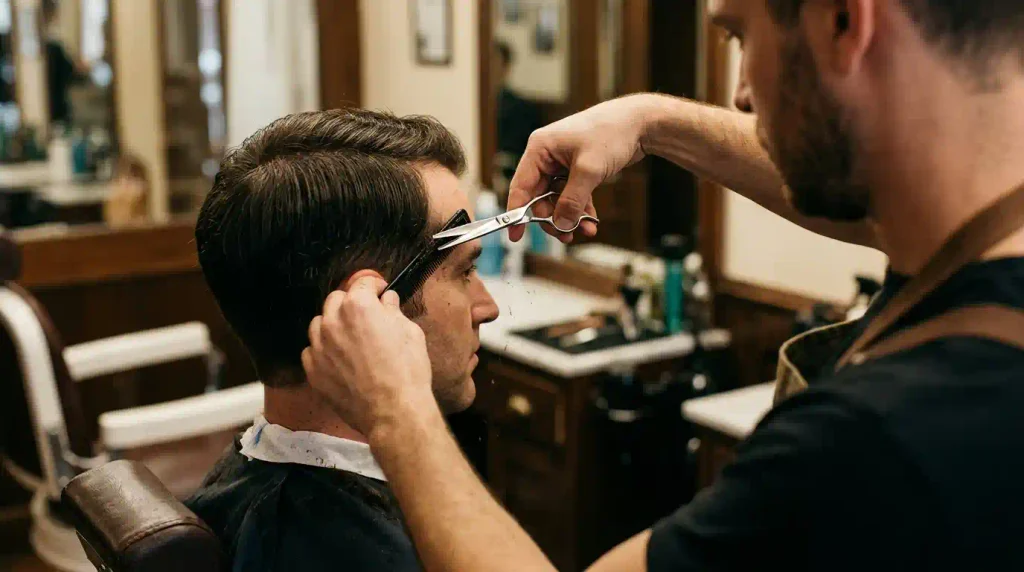
The most recognizable scissor taper technique is scissor-over-comb.
During this process, the barber uses a comb to lift sections of hair away from the scalp.
Scissors then remove the hair extending beyond the comb.
By gradually changing the comb’s angle and distance from the head, the barber controls how much length remains.
For example, the hair near the upper sides may remain relatively long.
As the barber moves toward the lower sideburns and nape, the remaining length gradually decreases.
This creates graduation without necessarily relying on clipper guards.
Scissor-over-comb is particularly useful for connecting longer side sections to the top while preserving natural movement.
The finished result can appear softer and fuller than a very close clipper fade.
However, the difference comes from the combination of cutting technique, chosen length, and blending—not simply from which tool touches the hair.
Scissor Taper vs. Scissor Fade
A scissor taper and scissor fade are closely related, but they generally describe different visual goals.
A traditional scissor taper maintains more hair near the lower sides and neckline.
A scissor fade aims for a closer, more noticeable transition, potentially reaching very short lengths.
The term “scissor fade” does not have one universally standardized definition.
Some barbers use it to describe a tightly graduated cut performed primarily with scissors.
Others use scissors to refine the upper blending of a fade initially established with clippers.
| Feature | Scissor Taper | Scissor Fade |
| Main objective | Natural graduation | Closer length transition |
| Side coverage | Usually greater | May be reduced |
| Scalp exposure | Generally limited | Depends on the desired fade |
| Typical appearance | Soft and traditional | More defined |
| Common top pairing | Side part, flow, textured layers | Short crop, quiff, modern styles |
| Main techniques | Scissor-over-comb and layering | Close scissor blending, sometimes combined with clippers |
A scissor fade does not necessarily reach bare skin.
A true skin fade usually benefits from clippers, trimmers, or a foil shaver to achieve the closest finish.
If you want a natural cut without exposed scalp, explain that preference directly.
Scissor Taper vs. Clipper Taper and Clipper Fade
The main difference between a scissor taper and clipper taper is the cutting method.
Clippers generally cut hair to a controlled length using a blade and optional guards.
Scissors allow the barber to adjust length continuously through hand positioning, sectioning, and comb elevation.
Neither tool is automatically superior.
| Feature | Scissor Taper | Clipper Taper | Clipper Fade |
| Primary tool | Scissors | Clippers | Clippers and sometimes trimmers |
| Length control | Comb angle and scissor positioning | Guards, lever, and comb | Multiple close cutting settings |
| Natural fullness | Commonly preserved | Depends on guard lengths | Often reduced near the fade |
| Texture options | Excellent for layering and shaping | Precise, even cutting | Strong close-blend control |
| Cutting speed | Often more time-intensive | Often efficient | Depends on fade complexity |
| Common appearance | Traditional and natural | Neat and controlled | Close and defined |
Clippers can create soft transitions when the barber chooses appropriate lengths.
Likewise, scissors can create sharp, precise cuts.
The most important distinction is the intended shape, not an assumption that one technique always looks better.
Scissors-Only Cuts vs. Cuts That Combine Scissors and Clippers
A scissors-only haircut uses scissors for the primary shaping and tapering.
The barber may rely on scissor-over-comb, finger-guided cutting, layering, and carefully controlled graduation.
A combined haircut uses scissors where longer shaping is needed and clippers where shorter cutting is more practical.
For example, a barber might use scissors to preserve fullness around the upper sides, then introduce clippers for a cleaner lower neckline.
This does not prevent the haircut from having a natural scissor-cut appearance.
Some clients request scissors only because they dislike very short sides, clipper vibration, or sharply defined fades.
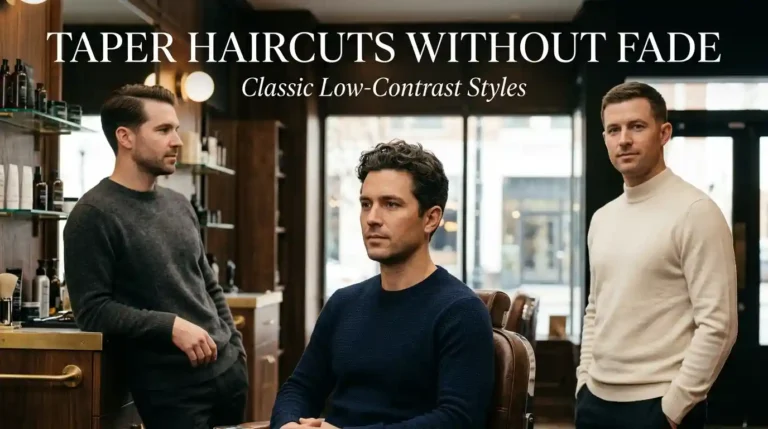
If your goal is primarily to preserve visible hair rather than avoid the tools themselves, a taper haircut without fade may be the more useful description.
Tell your barber whether your preference concerns the cutting equipment, finished length, or both.
Scissor Taper Styles to Consider
A scissor taper is highly adaptable because the technique can support many different haircut shapes.
Some variations look traditional and formal, while others emphasize texture, movement, or longer hair.
The following styles offer inspiration for different preferences and hair types.
Classic Scissor Taper
The classic scissor taper features naturally graduated sides, a neatly shaped neckline, and a top that remains long enough for easy styling.
The barber uses scissor-over-comb to control side length and connect the upper sections.
The result usually has less contrast than a closely clipped skin fade.
The top can be worn with a natural part, brushed backward, or left slightly textured.
Best for: Straight, wavy, and medium-density hair.
Suggested top length: Approximately 2–4 inches.
Barber request: “Keep the sides naturally graduated using scissors, preserve some fullness above the ears, and taper the neckline softly.”
This haircut shares the traditional proportions of a classic taper haircut.
Low, Medium, and High Taper
A scissor taper can be positioned low, medium, or high depending on how much side length you want to preserve.
Low scissor taper: Keeps the shorter graduation near the lower sideburns and neckline while retaining fuller upper sides.
Medium scissor taper: Begins reducing hair length farther up the sides, offering a balance between fullness and definition.
High scissor taper: Removes more side bulk and creates a stronger distinction between the top and lower sections.
A low taper is often the most traditional-looking option.
A higher scissor taper can work well for people with thick hair who want to reduce excess side volume.
Best for: Anyone wanting to customize the silhouette without relying entirely on clipper fading.
Soft Side Part and Business Scissor Taper
The side-part scissor taper combines a classic haircut shape with smooth, naturally graduated sides.
The barber preserves enough top length to create a comfortable parting.
Unlike a shaved hard part, the hair follows its natural direction.
This style can be finished with a light pomade for formal occasions or a styling cream for everyday wear.
A business taper haircut is a related option for men who prefer a polished professional silhouette.
Best for: Formal workplaces, interviews, business-casual settings, and traditional grooming.
Barber request: “Leave enough top length for a natural side part, keep moderate side fullness, and create a soft scissor taper.”
Ivy League and Crew Cut with a Scissor Taper
The Ivy League is a longer variation of the crew cut that allows a small side part.
A tapered crew cut generally keeps the hair short with slightly greater length toward the front.
Both can be combined with scissor-over-comb shaping around the sides.
This preserves a traditional outline without requiring an aggressive fade.
Because these styles are relatively short, they often need little daily styling.
Best for: Men who prefer simple grooming and manageable top length.
Barber request: “Create an Ivy League or short crew cut with gradual scissor blending around the sides and neckline.”
Side-Swept Fringe and Classic Taper
A side-swept fringe allows the front hair to move naturally across the forehead.
The sides remain softly tapered, creating a balanced outline.
The fringe can be short and controlled or slightly longer for a relaxed appearance.
This variation is useful for people who dislike sharply defined parts.
A small amount of styling cream can help maintain direction without making the hair stiff.
Best for: Straight or wavy hair with enough length at the front.
Barber request: “Keep a natural side-swept fringe and blend the sides with scissors while preserving movement.”
Caesar and Short Scissor Crop
The Caesar cut features a short, forward-directed fringe and a compact top.
A short scissor crop may use similar proportions with additional texture.
Scissor tapering can soften the transition between the upper sides and top.
This creates an alternative to a heavily faded crop.
For a traditional result, avoid an exaggerated disconnected fringe or unnecessarily exposed scalp.
Best for: Straight, slightly wavy, or shorter textured hair.
Barber request: “Keep a short forward fringe, shape the top naturally, and use scissor graduation instead of a high fade.”
Textured Crop and Messy Scissor Quiff
A textured crop uses layers and carefully shaped ends to create visible movement.
A messy quiff keeps additional length at the front, allowing the hair to lift upward.
Both hairstyles benefit from controlled scissor cutting.
Point cutting can help soften the ends and create separation.
However, excessive thinning may weaken the shape, particularly on fine hair.
Best for: Medium-density and thick straight or wavy hair.
Styling: Use matte clay or lightweight styling paste.
Barber request: “Create controlled texture on top with a soft scissor taper, keeping enough length for natural movement.”
Brush-Up, Side-Pushed Quiff, and Pompadour
The brush-up directs the top hair upward.
A side-pushed quiff adds direction toward one side while retaining some front height.
A pompadour creates greater rounded volume near the forehead.
These styles generally need extra length at the front and careful blending around the crown.
Scissor tapering can preserve enough upper-side fullness to balance the elevated top.
Best for: Straight or wavy hair with enough density to hold volume.
Barber request: “Leave additional length at the front for styling and use smooth scissor graduation around the sides.”
For a more traditional finish, keep the quiff moderate rather than creating extreme height.
Medium-Length Layered Cut and Bro Flow
Medium-length layered hairstyles are particularly suitable for scissor cutting.
The barber can remove excess bulk while preserving movement through the sides and crown.
A bro flow usually features medium-to-long hair that naturally moves backward or away from the face.
A subtle lower scissor taper can clean up the edges without removing the flowing shape.
Best for: Wavy, straight, or medium-to-thick hair.
Barber request: “Keep the flowing medium-length shape, add soft layers, and taper only the lower sides and neckline.”
This is a good choice when you want a longer hairstyle that still feels controlled.
Wavy Scissor Shag and Curly Rounded Layers
A scissor shag uses varied layers to create a loose, textured silhouette.
For wavy hair, the layers can emphasize natural movement.
For curly hair, rounded shaping helps distribute volume and maintain the curl pattern.
The barber should account for natural shrinkage, particularly when cutting curly or coily hair.
Removing too much length may cause the finished hair to appear significantly shorter once dry.
Best for: Wavy and curly hair with natural movement.
Barber request: “Preserve my natural wave or curl pattern, use balanced layers, and create a subtle scissor taper near the lower edges.”
Long, Messy Scissor Cut
A long scissor cut keeps substantial length through the top, sides, and back.
The taper may be limited to the lower neckline and sideburns.
Careful layering helps prevent excessive bulk while preserving a relaxed silhouette.
This approach can be particularly attractive for people who want a vintage-inspired hairstyle.
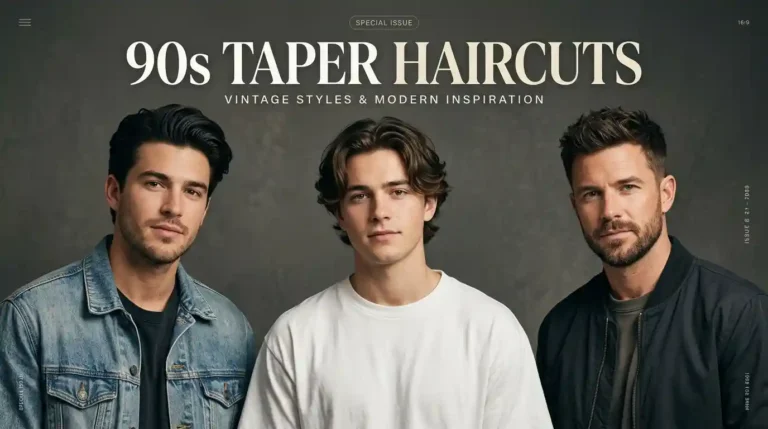
A taper haircut 90s offers related inspiration through longer layers, relaxed curtains, and natural movement.
Best for: Medium-to-long straight or wavy hair.
Barber request: “Preserve the length and natural flow, soften the layers, and lightly taper the neckline without making the sides too short.”
Undercut with a Longer Top
An undercut features a more obvious difference between the longer top and shorter sides.
This is not the same as a traditional scissor taper.
However, scissors may be used to shape the longer top and soften selected transition areas.
A deliberately disconnected undercut retains a visible separation, while a connected scissor taper blends the sections gradually.
Best for: People who prefer a modern, high-contrast silhouette.
Barber request: Explain whether you want a truly disconnected undercut or a connected taper with fuller upper sides.
Scissor Taper with Textured, Spiky, or Two-Tone Styling
Scissor tapers can also support more expressive styling.
A short textured top may be shaped into natural spikes using matte paste.
A longer top can be separated into textured sections.
Two-tone styling introduces contrasting hair colors or highlights while keeping the haircut’s graduated structure.
Hair coloring is separate from the cutting technique, so a scissor taper can be worn with natural or dyed hair.
Best for: Men wanting a modern or creative appearance.
Barber request: “Keep the scissor taper natural through the sides and shape the top to support my preferred textured styling.”

How to Choose a Scissor Taper
The best scissor taper should complement your natural hair characteristics and fit your preferred styling routine.
Choosing a haircut based only on a photograph can produce disappointing results if the reference model has different hair density, growth patterns, or texture.
Choose a Taper Height and Side Length
Start by deciding how much hair you want to retain around the temples and ears.
A low taper keeps the upper sides fuller.
A medium taper reduces additional bulk.
A high taper creates a more noticeable transition.
Next, determine whether you want the lower edges cut very short or simply tidied.
These details influence the final appearance more than whether scissors are used exclusively.
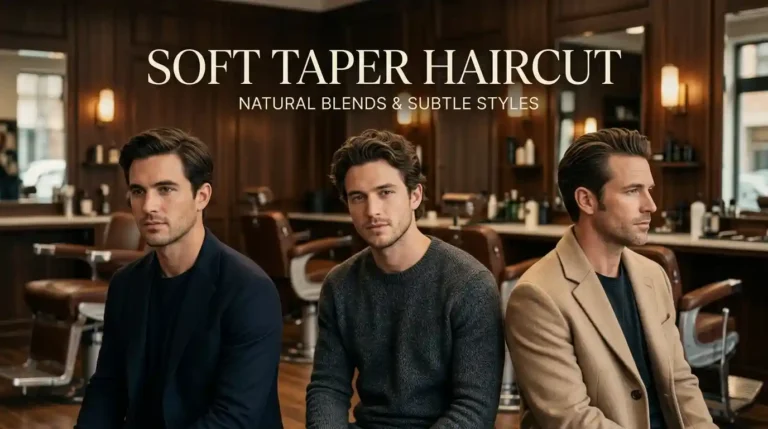
If you prefer a gentle, natural transition, a soft taper haircut is another useful reference.
Choose a Style for Your Face Shape
Face shape can help guide the amount of top volume and side fullness.
| Face Shape | Suggested Scissor Taper | Styling Consideration |
| Oval face | Classic taper, side part, textured top | Many proportions can work |
| Round face | Medium taper with modest quiff | Some top height may create visual length |
| Square face | Soft side part or layered taper | Natural movement can balance angular features |
| Long or oblong face | Low taper with fuller sides | Avoid excessive vertical volume if seeking balance |
| Heart-shaped face | Side-swept taper | Moderate side fullness may balance the forehead |
| Diamond face | Low taper with textured top | Preserve some volume near the temples |
These suggestions are not strict rules.
A skilled barber can modify the haircut to accommodate your preferred appearance.
Choose a Style for Straight, Wavy, Curly, Fine, or Thick Hair
Straight hair: Works well with clean side parts, Ivy League cuts, brush-ups, and scissor crops.
Wavy hair: Benefits from natural scissor layers that preserve movement.
Curly hair: Requires careful shaping and attention to shrinkage.
Fine hair: Often looks best when the barber preserves enough weight rather than using excessive thinning.
Thick hair: May benefit from controlled bulk removal through scissor-over-comb and strategic layering.
Coarse hair: Often needs careful shaping to manage stiffness or outward growth.
Hair density also matters.
Someone with fine but dense hair may require a different approach from someone with coarse but sparse hair.
Match the Top Length to Your Styling Routine
The longer the top, the more styling flexibility you generally have.
However, longer hair may also require additional time.
| Top Length | Suitable Styles | Approximate Styling Time |
| 1–2 inches | Short crop, crew cut | 1–3 minutes |
| 2–3 inches | Ivy League, short side part | 2–5 minutes |
| 3–4 inches | Classic taper, textured quiff | 3–6 minutes |
| 4–6 inches | Pompadour, brushed-back top | 5–10 minutes |
| Over 6 inches | Layered flow, long scissor cut | Depends on texture and finish |
These are illustrative ranges rather than fixed requirements.
Choose a length you can manage comfortably on an ordinary morning.
Consider Your Hairline, Cowlicks, and Natural Growth Pattern
A cowlick can cause certain sections to stand upright.
Cutting a strong cowlick too short may make it harder to control.
Crown whorls can also influence how the hair separates near the back of the head.
Scissor cutting allows the barber to preserve extra length where necessary.
For a receding hairline, a short textured taper or natural side part may create a balanced appearance.
Avoid asking the barber to push the temples backward unnecessarily.
A natural hairline often complements the softer finish of a scissor taper.
Scissor Taper Length and Shape Guide
A scissor taper can look different depending on taper height, side coverage, and neckline shape.
Understanding these details makes it easier to communicate with your barber.
What a Low, Medium, or High Taper Looks Like
A low scissor taper gradually shortens the hair near the lower sideburns and neckline.
A medium taper extends the graduation farther up the sides.
A high taper removes more upper-side bulk and creates stronger contrast.
The exact transition is not determined by one universal measurement.
Barbers may interpret low, medium, and high slightly differently.
Reference photos are therefore particularly useful.
How Much Side Coverage to Keep
Side coverage refers to how much visible hair remains around the ears, temples, and upper sides.
For a traditional gentleman’s taper, moderate fullness is usually appropriate.
For a short scissor crop, the sides may be cut closer.
If your hair naturally expands outward, the barber can remove bulk while still preserving a connected shape.
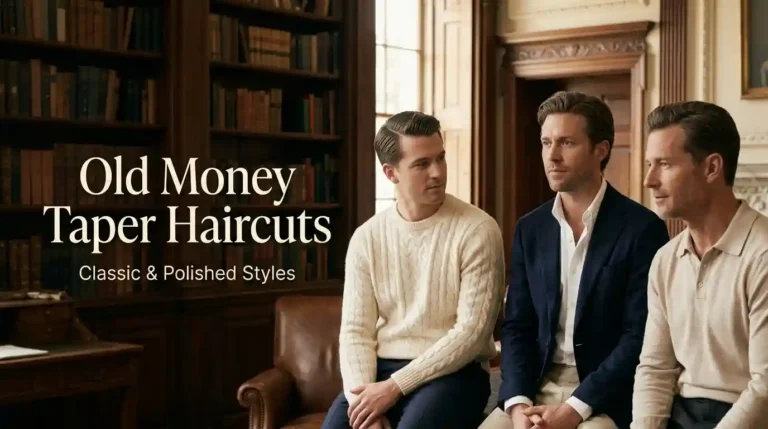
For a more refined appearance with fuller sides, an old money taper haircut provides useful inspiration.
What Changes When the Taper Exposes the Scalp
A scissor taper does not automatically involve exposed scalp.
When the hair becomes extremely short, the scalp may become more visible.
This increases contrast between the longer and shorter sections.
For a true skin-close effect, barbers often combine scissors with clippers or other finishing tools.
If you want to avoid a fade, request visible hair throughout the lower sides and neckline.
If you prefer a sharp finish, explain how close you want the shortest section.
Compare the Front, Sides, and Neckline
The front view shows the fringe, parting, and top volume.
The side view reveals taper height and how smoothly the hair connects above the ears.
The back view shows the neckline and crown transition.
For a soft scissor taper, look for natural graduation rather than visible steps or disconnected sections.
A well-balanced haircut should maintain a consistent shape from every angle.

How Barbers Create a Scissor Taper
A professional scissor taper requires careful control of length, graduation, and the connection between different sections.
The barber should consider the natural growth pattern before cutting.
Scissor-Over-Comb Technique
Scissor-over-comb is a foundational barbering technique.
The barber holds a comb against or near the head to lift hair at a controlled angle.
Scissors remove the hair that extends beyond the comb.
As the comb moves along the head, its position determines how much length remains.
This allows the barber to create a continuous transition from longer hair to shorter sections.
The technique is useful around the upper sides, lower back, and areas where different lengths need to connect smoothly.
However, scissor-over-comb requires skill and consistent control.
Uneven comb angles or irregular cutting can create visible steps in the finished haircut.
Point Cutting and Blunt Cutting
Point cutting involves cutting into the hair ends at an angle.
It can soften the perimeter and create controlled texture.
Blunt cutting, sometimes called club cutting, removes hair along a more direct line.
It is useful for establishing a strong shape or consistent baseline.
A barber may combine both methods.
For example, blunt cutting can establish top length, while point cutting softens selected sections.
Neither technique should be applied excessively.
Fine hair may become sparse if too much weight is removed.
Layering and Texturizing Shears
Layering creates variation in hair length to control volume and movement.
It is particularly useful for medium-length styles, wavy hair, and longer scissor cuts.
Texturizing or thinning shears can reduce selected areas of density.
However, these tools must be used carefully.
Excessive thinning may create frizz, gaps, or weak-looking ends, especially on fine or naturally curly hair.
A skilled barber chooses the technique according to texture, density, and desired shape.
Blending the Sides, Neckline, and Sideburns
The sides should connect naturally with the top.
A scissor taper usually becomes shorter toward the sideburns and nape.
The barber checks for unwanted heavy lines and uneven transitions.
Around the ears, small controlled cuts help maintain the desired shape.
The neckline may be softly tapered, rounded, or blocked.
For a traditional scissor taper, a natural tapered neckline usually provides a balanced appearance.
When a Barber May Combine Scissors and Clippers
Many barbers combine scissors and clippers rather than using one tool exclusively.
Scissors may establish the longer shape and soften the upper transition.
Clippers may refine shorter sections around the neckline or sideburns.
A trimmer may be used to remove stray hairs near the ears.
This combination can produce a natural-looking haircut with precise lower-edge detailing.
If you specifically want a scissors-only haircut, explain that during the consultation.
Otherwise, focus on the finished appearance rather than requiring a particular tool.
How to Ask Your Barber for a Scissor Taper
A successful haircut begins with explaining the desired result.
The phrase “scissor taper” may communicate the cutting technique, but it does not fully describe the top length, side fullness, or neckline.
Specify the Taper Height, Side Length, and Top Length
Start by telling the barber whether you want a low, medium, or high taper.
Then explain how much length should remain above the ears.
For a traditional appearance, request natural fullness through the upper sides.
Next, choose the top length.
Approximately 2–4 inches works for many classic side parts and textured scissor styles, although the right measurement depends on your hair.
If you want a longer flowing haircut, explain that the top and upper sides should remain connected.
Describe the Neckline and How Much Hair to Leave Around the Ears
The neckline affects how the haircut looks from behind.
A natural tapered neckline generally creates a soft finish.
A blocked neckline produces a more defined lower edge.
A rounded neckline follows a curved shape.
For a traditional scissor taper, explain that you want the hair around the ears and neckline shortened gradually without an aggressive shaved outline.
The barber should also consider your natural hairline and growth direction.
Explain Whether You Want Scissors Only or Some Clipper Work
A scissors-only taper and a combined scissor-and-clipper taper can produce similar overall shapes.
If you prefer scissors only, say so clearly.
You might have a preference because you want a softer-looking cut or dislike clipper vibration.
If you are comfortable with limited clipper detailing, explain that too.
For example:
“Please use scissors for the main sides and blending, but a trimmer is fine for cleaning stray neckline hairs.”
This helps the barber understand your expectations before beginning.
Bring Front, Side, and Back Reference Photos
Reference images are particularly helpful for scissor tapers.
The front view reveals the parting and top shape.
The side view shows how much fullness remains above the ears.
The back view demonstrates neckline graduation.
Choose photographs featuring a similar hair texture when possible.
If you want to combine details from multiple images, explain which specific elements you like.
Mention Your Hair’s Growth Pattern and Daily Styling Routine
Tell your barber about any cowlicks, uneven growth, thinning areas, or sections that are difficult to manage.
Also explain how much time you want to spend styling.
If you prefer a quick morning routine, a short classic scissor taper may be more appropriate than a long pompadour.
If you enjoy styling, additional top length offers greater flexibility.
A successful haircut should look good not only in the barber’s chair but also when you style it yourself.
Barber Request Template for a Scissor Taper
Use this script during your appointment:
“I want a scissor taper haircut with a natural, graduated finish. Please keep the taper low around the sideburns and neckline, with enough fullness above the ears to connect smoothly into the top. I’d like approximately three inches on top for a natural side part or textured finish. I don’t want a high skin fade or disconnected undercut. Use scissor-over-comb for the main blending, and keep the neckline softly tapered.”
For a shorter style, request an Ivy League or short scissor crop.
For a longer style, ask for layered movement and a minimal lower neckline taper.
Common Scissor Taper Request Mistakes
Miscommunication can produce a haircut that looks very different from the intended style.
Knowing what to avoid can save time and unnecessary corrections.
Asking for a Taper When You Mean a Fade
A taper and fade are related cutting concepts, but the amount of contrast may differ.
If you want the lower hair cut extremely close, explain that you prefer a tighter fade.
If you want visible side coverage, request a softer natural taper.
Do not assume that asking for scissors automatically excludes a close fade.
The barber still needs to know the desired shortest length.
Using Vague Directions Such as “Taper the Sides”
“Taper the sides” does not explain how high the taper should begin.
One barber may create a low traditional taper.
Another may produce a more noticeable mid taper.
Specify the taper height and whether you want the upper sides full or closely cut.
Reference photos can make this much clearer.
Forgetting to Specify the Neckline or Side Coverage
A haircut may look excellent from the front but differ from your expectations around the back.
Always discuss the neckline.
Also explain whether you want visible hair covering the upper sides or a tighter transition around the ears.
These details determine whether the final style looks traditional or contemporary.
What to Say If the Cut Looks Too Short or Too Sharp
If the haircut looks too short, avoid asking the barber to cut everything even shorter without considering the overall shape.
You can say:
“The sides look closer than I expected. Can we keep the remaining length and soften the transition?”
If a blending line is visible, request refinement.
If the hair has already been removed, the barber cannot immediately restore it.
In some cases, allowing a short grow-out period is better than making further major changes.
Styling and Maintaining a Scissor Taper
A scissor taper generally supports a flexible styling routine.
The amount of daily effort depends more on top length and texture than on the cutting technique itself.
Everyday Styling Routine
Begin with clean or slightly damp hair.
Use a comb or your fingers to arrange the top according to its natural direction.
For a short taper, a small amount of matte paste may be enough.
For a medium-length side part, apply lightweight styling cream and comb the hair gently into place.
For a longer brushed-back style, use a blow-dryer on controlled heat and direct the hair backward.
Avoid using excessive heat or pulling the hair tightly.
According to the American Academy of Dermatology’s healthy hair-care guidance, limiting excessive heat and choosing products suited to your hair type can help reduce avoidable damage.
Choosing Products for Texture, Hold, and Shine
Different styling products provide different results.
| Product | Main Benefit | Suitable Scissor Taper Style |
| Matte paste | Flexible textured hold | Short taper, messy crop |
| Matte clay | Stronger texture with low shine | Textured quiff |
| Pomade | Control and optional shine | Side part, comb-over |
| Styling cream | Natural movement | Wavy taper, layered cut |
| Hair wax | Flexible shape and separation | Short-to-medium cuts |
| Sea salt spray | Airy texture on suitable hair | Wavy shag, textured flow |
| Hairspray | Additional finishing hold | Quiff, pompadour |
| Lightweight mousse | Root lift and volume | Fine hair, longer styles |
Fine hair generally benefits from lighter products.
Thick hair may require greater hold or weight control.
Curly and coily hair may benefit from moisture-supporting products that preserve the natural pattern.
Use a small amount first and add more only when needed.
How Often to Get a Trim
Scissor tapers can grow out naturally when the original blending is balanced.
However, every haircut eventually needs reshaping.
| Scissor Taper Style | Suggested Trim Interval |
| Short scissor taper | 3–5 weeks |
| Classic side-part taper | 4–6 weeks |
| Ivy League scissor taper | 3–5 weeks |
| Medium-length textured taper | 4–7 weeks |
| Long layered scissor taper | 6–9 weeks |
| Bro flow with soft neckline taper | 6–10 weeks |
These are approximate maintenance ranges.
Hair growth speed, top length, and personal preference influence the ideal schedule.
What to Expect as the Taper Grows Out
During the first couple of weeks, the haircut generally maintains its original shape.
After several weeks, the sides may appear fuller and the neckline less defined.
A scissor taper with moderate side length often grows out more softly than a very close skin fade.
However, the technique alone does not determine how well the haircut grows.
A closely cut scissor fade may need frequent cleanup, while a longer scissor taper may remain balanced for several weeks.
At home, focus on appropriate washing, conditioning, and styling.
Avoid attempting major scissor corrections around the back of your head.
If the neckline becomes untidy before the rest of the haircut needs reshaping, ask your barber about a simple cleanup.
For more traditional men’s hairstyles and related taper variations, explore Classic & Traditional Tapers.
Frequently Asked Questions
Is a Scissor Taper the Same as a Scissor Fade?
No, a scissor taper generally preserves more natural side length, while a scissor fade aims for a closer graduated transition.
Can a Barber Do a Taper Entirely with Scissors?
Yes, a skilled barber can create a complete taper using scissor-over-comb and other scissor-cutting techniques.
Can a Barber Use Clippers for Part of a Scissor Taper?
Yes, scissors and clippers can be combined to create natural graduation with precise detailing around the lower edges.
Is a Scissor Taper Suitable for Short Hair?
Yes, short crops, Ivy League cuts, and crew cuts can all incorporate scissor tapering when enough length is available for the intended technique.
How Do I Maintain a Scissor Taper at Home?
Wash and condition according to your hair type, use lightweight styling products, and schedule regular barber cleanups without attempting major corrections yourself.
How Often Should I Get a Scissor Taper Trimmed?
Most scissor tapers benefit from a trim approximately every three to eight weeks, depending on haircut length, growth speed, and styling preferences.
Final Thoughts
The scissor taper haircut is an excellent choice for men who prefer natural blending, controlled side length, and versatile styling. Unlike a haircut relying entirely on fixed clipper settings, scissor tapering allows the barber to adjust graduation carefully while preserving texture and movement. From classic side parts and professional tapers to textured crops, wavy layers, and longer flowing styles, the technique can support many different looks.
For a traditional appearance, choose a low scissor taper with moderate side fullness and a softly shaped neckline. If you want a more contemporary result, consider a textured top or closer scissor blend.
Our top recommendation is a classic low scissor taper with a medium-length natural side part, combining timeless proportions with manageable maintenance.
Explore more men’s haircut guides at Taper Haircut Hub, save your favorite reference photos, and explain the desired side length, top shape, and cutting method to your barber.