
Military Taper Haircut: Styles, Regulations, Barber Tips, and Maintenance
The military taper haircut is a clean, practical, and disciplined hairstyle inspired by traditional military grooming. Known for its gradually shortened sides, controlled top length, and neatly finished neckline, this haircut combines a sharp appearance with easy everyday maintenance. Popular variations include the classic regulation cut, low military taper, high and tight, crew cut, buzz cut, and military taper fade. Whether you’re preparing for basic training, serving in the U.S. Armed Forces, or simply want a short, low-maintenance hairstyle, understanding the differences between these cuts can help you choose the right look. However, military grooming standards are not identical across the Army, Marine Corps, Navy, Air Force, and Coast Guard, and a haircut that looks military-inspired is not automatically regulation-compliant. This guide explains the major styles, compares branch-specific grooming requirements, covers taper heights and clipper guard sizes, and provides practical barber instructions. You’ll also learn how to maintain your haircut, avoid common mistakes, and choose a military-inspired taper that complements your face shape, hair texture, and lifestyle.
Table of Contents
- What Is a Military Taper Haircut?
- Military Grooming Standards by Branch
- Military Taper Haircut Styles
- Low, Mid, and High Tapers Compared
- Choosing a Military Taper for Your Hair and Face
- How to Ask Your Barber for a Military Taper
- How Barbers Create a Military Taper
- Can You Cut a Military Taper at Home?
- Styling and Maintaining a Military Taper
- Military Tapers for Civilians
- Military Taper Haircut FAQs
- Final Thoughts
What Is a Military Taper Haircut?
A military taper haircut is a short, neatly graduated hairstyle in which the hair becomes progressively shorter toward the sides and back while maintaining a controlled length on top.
The style is associated with military grooming traditions that emphasize neatness, uniformity, practicality, and compatibility with military headgear.
Unlike a single standardized haircut, the term military taper describes a group of related styles.
A traditional regulation cut may retain enough hair for a short side part, while a high and tight keeps most of the sides extremely short.
A military taper may also be combined with a buzz cut, crew cut, or short textured top.
The defining characteristics are a clean outline, controlled hair bulk, and a deliberate transition between longer and shorter sections.
Key Features of a Military Taper
Most military-inspired taper haircuts share several recognizable features.
- Short, controlled top: Hair remains manageable and generally requires little daily styling.
- Graduated sides: Hair transitions from longer upper sections to shorter lower sections.
- Neat neckline: The nape is trimmed and shaped to create a clean finish.
- Well-maintained sideburns: Sideburn length and shape are controlled.
- Balanced silhouette: The haircut follows the head’s natural shape.
- Practical styling: The hairstyle is designed to remain manageable during daily activities.
- Headgear compatibility: For service members, the haircut must meet applicable rules for helmets, caps, and other equipment.
A traditional military taper does not necessarily require shaving the sides completely to the skin.
The amount of visible scalp depends on the particular haircut and the applicable grooming regulations.
Military Taper vs. Military Taper Fade
A military taper and military taper fade both involve gradually reducing hair length, but they may produce different levels of contrast.
A traditional military taper often preserves some visible hair along the lower sides.
A military taper fade uses closer blending and may transition to extremely short stubble or exposed skin.
| Feature | Military Taper | Military Taper Fade |
| Side length | Short and graduated | Usually shorter near the edges |
| Scalp visibility | Often limited | May expose some scalp |
| Contrast | Subtle to moderate | Moderate to strong |
| Overall appearance | Traditional and disciplined | Sharper and contemporary |
| Daily styling | Usually minimal | Usually minimal |
| Cleanup needs | Depends on length | Close fades often lose definition sooner |
Both styles can create a neat appearance.
However, military regulation compliance depends on the specific branch and current standards, not simply whether the haircut is called a taper or fade.
Military Taper vs. a Civilian Taper or Fade
The main difference between military and civilian taper haircuts is the purpose and restrictions behind the styling.
A civilian haircut can be tailored entirely to individual preference, workplace expectations, and personal style.
A service member must also consider official grooming requirements.
For example, a civilian might choose a high fade with a long pompadour, dramatic hard part, or disconnected top.
Those details may not be permitted under the grooming rules of a particular military branch.
A traditional classic taper haircut often retains fuller sides and more styling flexibility.
A military taper usually emphasizes shorter, more controlled proportions.
Nevertheless, the two hairstyles overlap, and civilians can wear military-inspired cuts without following service-specific requirements.
How the Regulation Cut Relates to the Military Taper
A regulation cut refers to a hairstyle intended to meet applicable military grooming requirements.
It is not one universal clipper-guard combination.
Different branches define acceptable hair length, bulk, tapering, sideburns, and styling details differently.
A regulation-style cut commonly features a short top, graduated sides, and neat neckline.
However, a haircut cannot be declared compliant merely because a barber describes it as a regulation cut.
The service member must confirm the current policy for their branch, training environment, and assignment.
Why Military Tapers Are Practical and Popular
Military tapers remain popular because they offer a convenient balance between appearance and maintenance.
Shorter hair is generally easier to wash, dry, and style.
The tapered shape also reduces excess bulk around the ears and neckline.
For civilians, the hairstyle can provide a structured appearance without requiring elaborate products or a lengthy morning routine.
A short military-inspired taper may work well for students, athletes, professionals, and men who prefer practical grooming.
Its versatility makes it suitable for different face shapes and hair textures when the cutting technique is adjusted appropriately.
Military Grooming Standards by Branch
Military grooming rules are an important consideration for active-duty personnel, reservists, recruits, and individuals preparing for service.
Important: The following overview concerns commonly applicable U.S. male haircut standards and guidance reviewed through October 2026. Branch regulations are separate, and current directives, amendments, accommodations, training requirements, and command instructions can change how a rule applies.
A haircut described here as military-inspired should not automatically be considered regulation-compliant.
Army Haircut Standards
The U.S. Army’s grooming requirements are associated with Army Regulation 670-1 and supplementary directives.
The Army emphasizes neat, professional haircuts with a tapered appearance.
Under the Army’s September 2025 grooming clarification, male hair standards include a maximum styled bulk of two inches on top and one inch at the sides, with tapering or fading beginning at zero or one-quarter inch around the sideburns and ears.
Hair should present a neat appearance and must not interfere with proper headgear use.
The Army also places restrictions on inappropriate designs and other hairstyle details.
For someone searching for a taper haircut army style, a short graduated cut with controlled bulk is a useful starting point.
However, exact compliance must be checked against the latest Army directive and any relevant command guidance.
Marine Corps Haircut Standards
The U.S. Marine Corps is particularly associated with close-cut hairstyles such as the high and tight.
Marine Corps grooming requirements are governed by MCO 1020.34H and applicable updates.
The published male grooming standards describe hair no longer than three inches when fully extended on top, with bulk not exceeding approximately two inches.
The Marine Corps also emphasizes even graduation from zero length at the lower hairline.
Its official haircut guidance explains that a zero fade must extend from the nape upward to at least the top of the ear opening before fully blending into longer hair.
A fade that changes from zero to maximum length too abruptly can fall outside those guidelines.
Individuals searching for a taper haircut USMC should therefore avoid assuming that a very small temple-only fade is automatically acceptable.
Conservative styling, appropriate top length, and correct graduation are important.
Navy Haircut Standards
The U.S. Navy publishes grooming requirements through its Navy Uniform Regulations.
For male personnel, the standards generally specify a tapered appearance around the sides and back.
The published grooming rules include a maximum hair length of four inches and a maximum bulk of two inches.
Hair must remain clear of the ears and collar and must not interfere with military headgear.
The Navy also defines graduation requirements near the lower hairline and regulates sideburns and shaved parts.
A short regulation-style taper, crew cut, or appropriately blended high and tight may suit these expectations.
However, authorized haircut examples and precise grooming measurements should always be checked in the current Navy Uniform Regulations.
Air Force Haircut Standards
The U.S. Air Force uses Department of the Air Force Instruction 36-2903, together with applicable guidance memoranda, for dress and appearance standards.
Published male grooming requirements include a tapered appearance along the sides and back, with hair bulk limited to two and a half inches.
The instruction also specifies a maximum length of one-quarter inch at the natural termination point.
Air Force guidance issued in 2025 clarified that male hair must not touch the ears.
A further Department of the Air Force guidance memorandum was issued on February 19, 2026, incorporating earlier appearance-related changes.
For an Air Force-inspired haircut, a classic short taper, low fade, or neatly shaped crew cut can provide a useful visual reference.
Actual compliance still depends on the current consolidated instructions and applicable guidance.
Coast Guard Haircut Standards
The U.S. Coast Guard maintains its own grooming requirements through its Uniform Regulations, including COMDTINST M1020.6K and subsequent guidance.
The published male haircut standards describe a tapered transition above the ears and around the neck.
The manual specifies maximum hair bulk of one and a half inches and individual hair length of four inches.
Hair must not touch the ears or collar, extend below the eyebrows, or interfere with properly worn headgear.
The Coast Guard’s regulations also address neckline shape, sideburns, and overall grooming appearance.
A traditional short military taper can provide an appropriate starting style, but current instructions must be checked before relying on a particular haircut for inspection or duty.
Where to Check Current Official Grooming Rules
Always use current official military publications instead of relying only on barber photos, social media discussions, or old grooming charts.
For the Army, consult the official Army Uniforms and Appearance Standards resource, which provides access to grooming policies, regulations, and updates.
For other branches, look for their official publications:
- Army: AR 670-1 and applicable Army directives.
- Marine Corps: MCO 1020.34H, Marine Corps Uniform Board guidance, and applicable MARADMINs.
- Navy: Navy Uniform Regulations, particularly Chapter 2.
- Air Force: DAFI 36-2903 and relevant Department of the Air Force guidance memoranda.
- Coast Guard: COMDTINST M1020.6 series and applicable ALCOAST or personnel guidance.
The correct source is the currently effective regulation, together with any amendments or exceptions that apply to your situation.
How to Verify When a Regulation Was Last Updated
A regulation’s original publication date does not necessarily indicate that every provision remains unchanged.
Before using a grooming rule, check the publication date, effective date, revision number, and associated guidance memoranda.
Look for references to superseded instructions or interim policy changes.
For example, an older version of an appearance instruction may remain online even after new guidance has changed certain requirements.
If you are preparing for basic training or a military inspection, confirm the current rules with your recruiter, instructor, or chain of command.
Hair Length, Bulk, Neckline, Sideburn, and Headgear Requirements
Military grooming standards often distinguish between hair length and hair bulk.
Hair length measures the length of individual strands.
Hair bulk describes how far the styled hair projects away from the scalp.
This distinction matters because curly or coily hair may have substantial stretched length while appearing shorter in its natural state.
Regulations may also address the following:
- Whether hair touches the ears or collar.
- How the neckline must taper.
- How sideburns are shaped and where they end.
- Whether the hair interferes with helmets or other headgear.
- Whether shaved parts or design lines are permitted.
- Whether hair creates excessive height or an irregular silhouette.
Do not apply one branch’s measurements to another branch.
Styles or Details That May Not Meet Regulations
Certain modern haircut details may conflict with military grooming rules.
Depending on the service, potential concerns include exaggerated disconnected undercuts, unauthorized hair designs, extreme asymmetry, excessive bulk, long fringes, or incorrectly positioned shaved parts.
A dramatic pompadour might look sharp as a civilian hairstyle but fail a service’s bulk or headgear requirements.
Similarly, a beard blend may be unsuitable for a service member who is required to remain clean-shaven and does not have an approved accommodation.
Compliance depends on the overall haircut and applicable policy.
What to Do If You Are Unsure Whether a Style Is Allowed
If you’re uncertain, do not assume that a military-style haircut is automatically authorized.
Show your barber a reference image and explain your branch’s requirements.
If you are already serving, ask your supervisor or appropriate command representative about the current standard.
If you are preparing for basic training, follow the instructions provided by your recruiter or training organization.
Choosing a conservative haircut can reduce uncertainty, but it does not replace checking official policy.
Military Taper Haircut Styles
Military-inspired haircuts range from traditional regulation cuts to extremely short fades and crew cuts.
Some of the following styles are commonly associated with military grooming, while others are civilian adaptations.
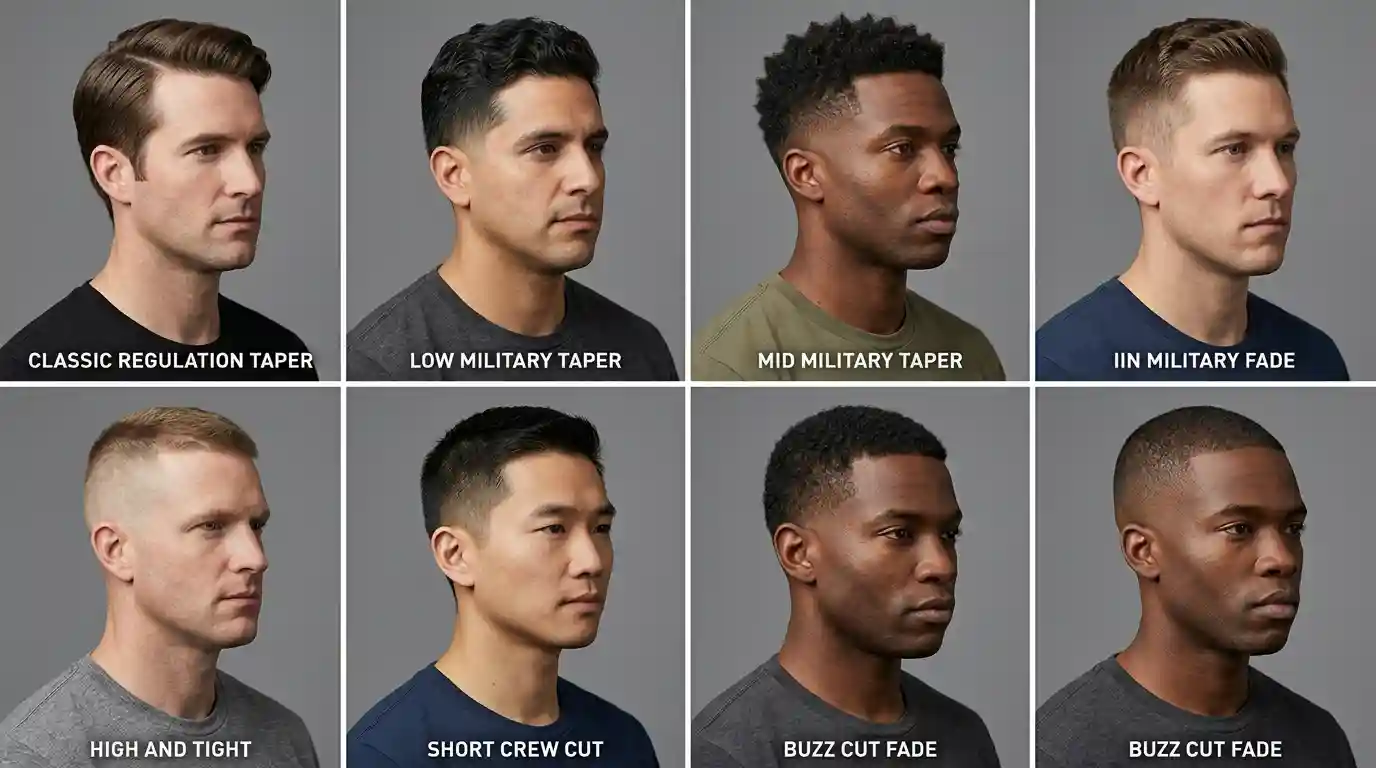
Classic Regulation Cut
The classic regulation cut features a short, neatly groomed top with smoothly tapered sides and back.
It may allow enough length for a small natural side part.
The overall silhouette follows the head without creating an aggressive disconnected effect.
Best for: Traditional military-inspired grooming and neat everyday wear.
Barber request: Keep a short, controlled top with even graduation around the sides and neckline.
Low Military Taper
A low military taper concentrates the shorter transition near the ears and nape.
The upper sides retain more fullness than a mid or high taper.
It is a useful civilian option for someone who wants military-inspired neatness without an extreme fade.
However, a very short low transition may not satisfy every branch’s specific graduation requirements.
Best for: Civilians seeking a conservative short haircut.
Barber request: Keep the taper low, with a smooth connection to the top and a clean neckline.
Mid Military Taper
A mid military taper begins the noticeable transition higher along the sides.
It removes additional bulk around the ears while preserving enough top length for simple styling.
The result appears cleaner and more defined than a low taper.
Best for: Thick hair and men who prefer a balanced short haircut.
Barber request: Create a medium-height graduated taper with a controlled top and natural blending.
High Military Taper
A high military taper removes more side bulk, with the transition extending farther toward the upper sides.
This creates stronger contrast between the top and sides.
It can be particularly effective with short crew cuts and brush-up styles.
Best for: Short hairstyles and men who prefer a more defined silhouette.
Barber request: Taper the sides higher while maintaining a smooth connection to the top.
Military Taper Fade
A military taper fade combines short, graduated sides with very close blending around selected areas.
It can range from subtle to highly defined.
Some versions expose skin near the sideburns or neckline.
For civilians, the fade height can be adjusted entirely according to preference.
For service members, exact fade placement and graduation must meet applicable branch rules.
Best for: Sharp military-inspired grooming with a contemporary finish.
High and Tight
The high and tight is one of the most recognizable military-associated hairstyles.
It typically features very short sides and back, with a compact section of longer hair on top.
The transition is positioned relatively high on the head.
Its popularity comes from practical short length and minimal styling requirements.
However, the exact shape and blending must still meet the relevant military service’s grooming standards.
Best for: Men who prefer a very short, structured haircut.
Barber request: Keep the top compact and the sides very short, with appropriate blending for the desired version.
Recon Cut
The recon cut is a colloquial name often used for an extremely close variation of the high and tight.
It commonly features shaved or nearly shaved sides with a small, short top section.
It creates a particularly strong contrast.
Because the term is not a universal regulatory haircut classification, a recon-style cut should not be assumed compliant with every branch.
Extremely disconnected versions may raise concerns under rules requiring continuous graduation.
Best for: Civilians who want an aggressive, minimal military-inspired appearance.
Buzz Cut and Buzz Cut Fade
A buzz cut uses clippers to produce a relatively even, short length across the head.
A buzz cut fade adds a shorter transition along the sides and back.
A uniform buzz cut is particularly easy to maintain daily.
The faded version creates additional definition but usually requires more frequent cleanup to preserve its sharp appearance.
Best for: Low-maintenance grooming and men who prefer very short hair.
Barber request: Choose a comfortable clipper length for the top and decide whether you want the sides uniform or gradually shorter.
Crew Cut
The crew cut is a traditional short hairstyle with slightly more length toward the front.
The top becomes shorter near the crown, creating a compact, balanced shape.
Graduated sides give it a clean military-inspired appearance.
This cut is useful for men who want some styling flexibility without longer hair.
Best for: Straight, wavy, or short textured hair.
Barber request: Leave slightly more length at the front, shorten toward the crown, and blend the sides neatly.
Burr Cut and Butch Cut
Both burr and butch cuts are short clipper hairstyles.
A burr cut is extremely short and usually cut close to the scalp.
A butch cut generally retains slightly more length while maintaining a uniform, compact appearance.
Exact guard terminology varies between barbers.
These cuts require little or no styling product.
However, very short hair can expose more of the scalp to sunlight.
Best for: Men prioritizing minimal daily grooming.
Flat Top
A flat top is a structured haircut in which the top is shaped into a relatively level surface.
It can be combined with short tapered or faded sides.
The hairstyle requires precise cutting to maintain its geometric silhouette.
It works particularly well when hair density and texture can support the intended height and shape.
Best for: Men who prefer a defined, traditional barbering style.
Textured and Brush-Up Variations
A textured military taper maintains short, controlled sides while introducing moderate movement on top.
A brush-up directs the front hair slightly upward.
These variations can look more contemporary than a strict regulation-style cut.
For actual military use, excessive height, spiking, or directional styling may be restricted.
For civilian wear, a little matte clay can create an easy, controlled finish.
Side Part, Slicked-Back, and Side-Swept Variations
A short military-style side part maintains neatness while providing a more traditional appearance.
A slicked-back version uses slightly longer top hair directed backward.
A side-swept cut allows the front to move naturally to one side.
These styles can work well for civilians wanting a military-inspired professional haircut.
For service members, the top length, bulk, parting details, and headgear compatibility must be checked.
Hard Part, Combover, and Beard-Blend Variations
A hard part is a narrow shaved line used to define the hair’s parting.
Some branches permit specific forms of shaved parts, but the permitted width, position, and shape differ.
A combover uses longer hair swept across the top and can be adapted to a short taper.
A beard blend gradually connects the sideburns into facial hair.
For civilians, this can create a cohesive appearance.
For active-duty service members, beard blending is relevant only when facial hair is permitted under applicable grooming requirements or an approved accommodation.
Low, Mid, and High Tapers Compared
Choosing taper height changes how the haircut looks from the side and how much hair remains around the temples.
Where Each Taper Begins
A low taper concentrates the shortest transition around the sideburns and neckline.
A mid taper extends the graduation farther upward.
A high taper reduces length across a larger area of the sides.
These terms describe the visual position of the taper rather than guaranteed military compliance.
How Much Scalp Each Option Shows
Taper height and scalp exposure are separate considerations.
A high taper does not always require exposed skin.
Similarly, a low taper fade may reach skin at the lowest point.
| Style | Taper Position | Typical Visual Contrast | Daily Styling |
| Low military taper | Lower sideburns and nape | Subtle | Low |
| Mid military taper | Middle portion of sides | Moderate | Low |
| High military taper | Upper sides | More noticeable | Very low |
| Military skin fade | Depends on chosen fade height | High contrast near skin | Very low |
Close fades may require more frequent barber visits to preserve the appearance.
Front, Side, and Back View Comparison
The front view shows the top length, fringe, and overall proportions.
The side view reveals where the taper begins and how smoothly it blends upward.
The back view shows the neckline, nape, and connection into the crown.
For military-inspired styles, the side and back views are especially useful because they reveal whether the transition is gradual or disconnected.
Choosing a Taper Height for Your Preferred Look
If you want a traditional civilian haircut, a low or mid taper may provide enough structure without excessive contrast.
If you prefer a very short style, a high taper or high and tight may be more appealing.
For actual military service, start with the required graduation and bulk limits rather than selecting a taper height solely from a photograph.

Choosing a Military Taper for Your Hair and Face
A military-inspired taper should complement your natural proportions and hair characteristics.
The same clipper guard may create different results depending on hair density, curl pattern, and head shape.
Matching the Cut to Your Face Shape
| Face Shape | Suggested Military-Inspired Style | Main Consideration |
| Round | Crew cut with moderate top height | Adds visual length |
| Oval | Classic regulation taper or crew cut | Balanced proportions |
| Square | Short classic taper or high and tight | Complements angular features |
| Diamond | Low taper with some temple fullness | Balances prominent cheekbones |
| Heart-shaped | Low taper with controlled side length | Softens the upper-face emphasis |
| Oblong | Short crop with modest height | Avoids excessive vertical volume |
These are styling suggestions rather than strict rules.
A skilled barber can adapt nearly any short hairstyle to different facial proportions.
Choosing a Taper for Straight, Wavy, Curly, or Coily Hair
Straight hair: Works well with crew cuts, regulation-style tapers, and short side parts.
Wavy hair: Benefits from controlled top length that allows natural movement without excessive bulk.
Curly hair: Requires careful consideration of shrinkage and the visible dry length.
Coily hair: Can support short natural tops, flat tops, close tapers, and precisely shaped outlines.
For curly and coily hair, the barber should understand how the hair contracts after cutting.
A natural texture can remain neat without being straightened.
Adapting the Cut for Cowlicks and Uneven Growth
Cowlicks and crown whorls may cause short hair to stand upright.
Cutting these areas too closely can make them more noticeable.
A barber may preserve slightly more length or adjust the blending direction.
Uneven hair growth around the neckline should also be considered before selecting an extremely sharp outline.
Options for Thinning Hair or a Receding Hairline
Short military-inspired styles can work well with thinning hair.
A crew cut, short crop, or buzz cut may create a balanced appearance without requiring complicated styling.
A receding hairline does not automatically require shaving the entire head.
Choose a top length that works naturally with the remaining hair density.
If hair loss is sudden or unusual, consider a medical evaluation.
Matching the Cut to Your Lifestyle and Upkeep Preferences
A buzz cut or burr cut usually requires the least daily effort.
A short regulation-style taper provides more styling flexibility.
A high-and-tight haircut has minimal daily styling needs but may require frequent trims to maintain its crisp shape.
Choose according to how often you can visit a barber and whether you prefer a softer grow-out or sharply defined edges.
How to Ask Your Barber for a Military Taper
Clear barber instructions are more useful than relying on one haircut name.
Explain whether the result is for civilian wear or must comply with official military standards.
Specify the Taper Height, Guard Size, and Top Length
Start with the preferred taper height.
Then explain how short you want the sides and how much length you want preserved on top.
Clipper guard numbers provide useful reference points.
| Clipper Guard | Approximate Length |
| #0.5 | 1.5 mm / 1/16 inch |
| #1 | 3 mm / 1/8 inch |
| #2 | 6 mm / 1/4 inch |
| #3 | 10 mm / 3/8 inch |
| #4 | 13 mm / 1/2 inch |
| #5 | 16 mm / 5/8 inch |
| #6 | 19 mm / 3/4 inch |
Actual cutting length varies with the clipper, blade, guard system, and taper-lever position.
Guard numbers are cutting references, not official military regulations.
Explain Whether You Need to Meet Military Standards
Tell your barber which service branch you belong to and whether you have specific training or command requirements.
For example:
“I need a short, regulation-compliant haircut for my branch. Please follow these current grooming measurements and keep the graduation consistent.”
Bring the applicable instructions rather than expecting the barber to know every service’s latest rules.
Ask for a Civilian Military-Inspired Version
If you are not serving, you can choose the general military appearance without regulatory limitations.
You might say:
“I want a military-inspired taper with short graduated sides, a clean neckline, and enough length on top for easy styling.”
For a softer result, consider a soft taper haircut that maintains more natural fullness around the sides.
Barber Scripts for Different Styles and Hair Types
Classic regulation-inspired taper
“Keep the top short and neat, taper the sides gradually, and shape the neckline naturally.”
High and tight
“I want a high and tight with very short sides, a compact top, and smooth blending rather than an accidental hard line.”
Military crew cut
“Leave slightly more length at the front, keep the crown short, and create a clean graduated transition on the sides.”
Curly military-inspired taper
“Keep enough length for my curls to hold their shape, account for shrinkage, and taper the sides without pushing back my natural hairline.”
Low-maintenance civilian taper
“Give me a short military-inspired haircut with a low taper, minimal styling requirements, and a neckline that grows out naturally.”
Use Reference Photos to Communicate the Desired Result
Bring photographs showing the front, side, and back.
The front reveals top length.
The side shows taper height.
The back reveals neckline blending.
Choose examples with similar hair texture whenever possible.
Reference photographs should communicate visual preferences, while actual military compliance must be determined from current rules.
How Barbers Create a Military Taper
A professional barber uses controlled cutting and blending techniques to produce an even shape.
The cutting process depends on the chosen style and hair type.
Setting Guidelines and Selecting Clipper Guards
The barber begins by assessing the natural hairline, crown, density, and desired length.
A guideline helps establish where the shorter taper begins.
Clippers and guards are selected according to the intended transition.
The barber may use the taper lever to adjust cutting length between guard settings.
The goal is to avoid an obvious unintended fade line.
Blending the Sides and Back
The barber gradually connects shorter hair at the lower sides with longer sections above.
Clipper-over-comb and carefully adjusted guard settings may be used.
A military-inspired high taper requires a different blending area from a low regular taper.
The barber should maintain balance on both sides and check the shape from multiple angles.
Shaping the Neckline, Sideburns, and Edges
The neckline may be naturally tapered or shaped according to the requested style.
A trimmer can refine edges and remove stray hair.
Sideburns should be shaped consistently with the overall haircut.
For service members, these details must follow the applicable branch’s regulations.
Creating a Hard Part or Beard Blend
A hard part is created using a trimmer to define a narrow parting line.
A beard blend gradually connects the haircut to facial hair.
Both are optional details and are more relevant to civilian military-inspired styling unless specifically authorized under service regulations.
Can You Cut a Military Taper at Home?
A very short haircut can be maintained at home, but creating a smooth taper requires practice.
An even buzz cut is generally easier than a graduated fade.
Clippers, Guards, and Other Tools
Useful tools include hair clippers, compatible guards, a comb, a handheld mirror, and a trimmer.
A second mirror is helpful for viewing the back of the head.
Keep tools clean and follow the manufacturer’s instructions.
Basic Tapering and Blending Steps
For a simple civilian-inspired haircut, begin with a longer guard rather than immediately choosing the shortest setting.
Cut the main sections evenly, then gradually work toward the shorter lower edges.
Use small, controlled movements and check both sides frequently.
Do not attempt an extremely close fade on your first try.
The neckline and back are particularly easy to cut unevenly when visibility is limited.
For official military compliance, professional cutting is preferable unless you are experienced and understand the applicable standards.
Common DIY Mistakes
Common problems include taking the taper too high, creating uneven sides, leaving visible blending lines, and cutting the neckline asymmetrically.
Using an unfamiliar guard or opening and closing the clipper lever inconsistently can also affect the result.
If the haircut becomes uneven, avoid repeatedly shortening the entire head in an attempt to correct it.
A barber may be able to refine the shape while preserving some length.
Styling and Maintaining a Military Taper
Military-inspired tapers are usually straightforward to maintain, but shorter cuts often require regular cleanup.
Daily Washing, Brushing, and Styling
Wash your hair according to your scalp condition and activity level.
Short hairstyles may require little more than gentle brushing or combing.
If you wear a crew cut or side-parted regulation-style cut, use a small amount of styling product when needed.
Avoid unnecessary product buildup.
Choosing Light-Hold Styling Products
For a natural finish, use lightweight styling cream.
Matte pomade or hair clay may help control a short textured top.
Light-hold paste can provide subtle direction without stiffness.
Heavy gels and excessive shine are generally unnecessary for very short military-inspired styles.
Service members should also ensure styling products do not produce a prohibited or exaggerated appearance.
How Often to Get a Trim
Maintenance intervals depend on the haircut’s length and how sharp you want it to remain.
| Haircut | Approximate Trim Interval |
| Burr or very short buzz cut | 1–3 weeks |
| High and tight | 2–3 weeks |
| Military taper fade | 2–3 weeks |
| Short crew cut | 2–4 weeks |
| Classic regulation-style taper | 2–4 weeks |
| Softer civilian military taper | 3–5 weeks |
These intervals are general grooming estimates, not official military haircut schedules.
For service members, trim frequency should be based on maintaining compliance.
Touch-Ups Between Barber Visits
A quick cleanup may involve tidying around the ears and neckline.
However, avoid reshaping the taper too aggressively.
A small error around the temples may change the entire haircut.
If possible, ask your barber about short maintenance appointments between full cuts.
How the Taper Changes as It Grows Out
A close military taper fade can lose its sharp contrast as hair grows.
A softer military taper usually develops fuller sides more gradually.
After several weeks, the neckline and sideburns may require attention.
Very short top lengths can also lose their intended proportions quickly.
The exact grow-out period depends on individual growth speed and the original haircut.
Fixing a Taper That Is Too High, Too Short, or Uneven
If the taper is too high, removed hair must grow back.
A barber may improve the overall balance, but restoring the original length is not immediately possible.
If the sides are uneven, careful blending may help.
Avoid cutting the entire haircut shorter without considering whether the correction is necessary.
Scalp Care After a Very Close Cut
Very short hair exposes more scalp to sunlight.
Use appropriate sun protection when outdoors, including a suitable hat or sunscreen on exposed skin.
If clipping causes irritation, avoid repeatedly shaving the same area too closely.
Clean clipper equipment and appropriate grooming practices help reduce avoidable skin irritation.
Persistent bumps, inflammation, or painful ingrown hairs deserve professional evaluation.
Maintaining the Cut While Deployed or Traveling
Short, practical haircuts can be convenient when regular barber access is limited.
A uniform buzz cut may be easier to maintain than a complicated fade.
For deployment or extended travel, consider choosing a shape that grows out predictably.
Service members must continue following applicable grooming requirements, including any operational or local instructions.
Military Tapers for Civilians
You do not need to be in the military to wear a military-inspired taper.
The clean silhouette works well for people who want minimal styling and a neatly groomed appearance.
Adapting a Regulation Style for Everyday Wear
Civilians can adjust top length, taper height, and styling finish according to preference.
A short taper with a natural side part works well in many professional settings.
A textured military-inspired crop can create a more relaxed appearance.
If you prefer a polished office-ready look, a business taper haircut provides a useful alternative with additional top-length flexibility.
For a traditional appearance, browse Classic & Traditional Tapers to compare other understated styles.
Making the Cut Softer or More Textured
A military-inspired taper does not have to be extremely short.
You can preserve additional length around the temples and upper sides.
A taper haircut without fade offers a softer silhouette with less scalp exposure.
For a relaxed vintage interpretation, the taper haircut 90s emphasizes natural movement and fuller sides.
If you prefer refined grooming with traditional proportions, the old money taper haircut offers another elegant option.
A scissor taper haircut can also help preserve natural side length and texture.
These options are civilian styling alternatives rather than universal military regulation cuts.
Military Taper Haircut Cost and Appointment Expectations
Military-inspired taper haircuts vary in cost depending on location, barbershop type, complexity, and additional services.
In the United States, civilian barbershop prices may broadly range from approximately $20 to $60 or more for a standard short haircut.
Highly detailed fades or premium services may cost more.
Prices at military installation barbershops can differ from civilian shop rates.
A straightforward buzz cut is usually faster than a detailed taper fade requiring multiple blending stages.
Before booking, ask whether the quoted price includes a neckline cleanup, wash, or styling.
For more haircut inspiration and practical barber guides, visit Taper Haircut Hub.
Military Taper Haircut FAQs
What Is the Difference Between a Military Taper and a Regular Taper?
A military taper generally emphasizes shorter, more controlled styling, while a regular taper may retain additional length and greater styling flexibility.
Are Fades Allowed in the Military?
Certain fades are permitted under various branch policies, but the graduation, length, and styling must meet the applicable current regulations.
Can You Get a Skin Fade or Temple Fade?
Yes, civilians can choose either, but service members must verify whether the specific fade shape satisfies their branch’s requirements.
What Guard Number Should You Ask For?
There is no universal military taper guard number; ask your barber to choose guards based on the required length, graduation, and desired finished shape.
How Often Should You Get a Military Taper Trimmed?
Many short military-inspired tapers benefit from trimming every two to four weeks, while service members must maintain compliance regardless of the interval.
Is a Military Taper Suitable for Civilian Workplaces?
Yes, a neatly maintained military taper is a versatile hairstyle that can complement formal, business-casual, and everyday clothing.
Final Thoughts
The military taper haircut combines clean graduation, practical styling, and a disciplined appearance, making it a popular option for service members and civilians alike. From the classic regulation-style taper and crew cut to the high and tight, buzz cut, and modern military taper fade, each variation offers a different balance of length, contrast, and upkeep.
If you are serving or preparing for military training, always verify the current grooming standards for your specific branch before choosing a haircut. A military-inspired style is not necessarily regulation-compliant.
For civilians, a short low or mid taper can provide a polished appearance without requiring extensive daily styling.
Choose your preferred style, save clear front, side, and back reference photos, and discuss the taper height, guard lengths, and neckline with your barber before your next appointment.



One Comment