
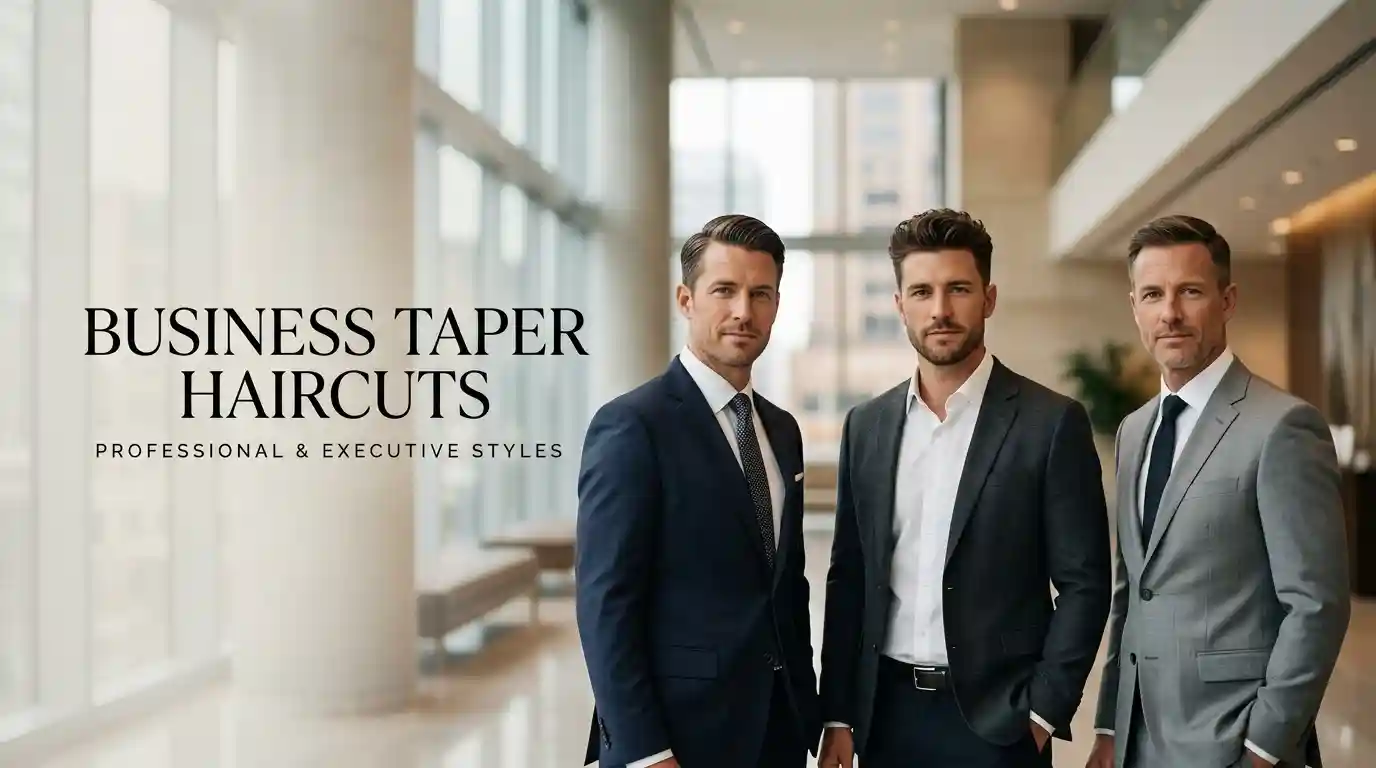
Business Taper Haircut: Styles, Barber Tips, and Maintenance
The business taper haircut is one of the most versatile men’s hairstyles for creating a polished, confident, and professional appearance without sacrificing personal style. Whether you work in a corporate office, attend regular client meetings, or prefer a timeless gentleman’s haircut, this classic style combines neatly graduated sides, a clean neckline, and enough length on top for natural movement. Unlike dramatic skin fades or disconnected undercuts, a traditional business taper maintains balanced proportions and a subtle transition from longer to shorter hair. Popular variations include the classic professional taper, executive taper, Ivy League, side part, comb-over, slicked-back taper, and modern textured crop. Each offers a different balance of formality, styling flexibility, and maintenance. The right choice depends on your workplace expectations, face shape, hair texture, and daily routine. In this complete guide, you’ll discover nine professional taper haircut styles, learn how to select the best option for your features, understand exactly what to tell your barber, and explore practical styling techniques and maintenance schedules for keeping your haircut sharp throughout the workweek.
Table of Contents
- What Is a Business Taper Haircut?
- Business Taper Haircut Styles
- Choosing a Business Taper for Your Workplace
- Choosing a Taper for Your Face Shape, Hair Type, and Hairline
- What to Tell Your Barber
- Business Taper Examples From Every Angle
- How to Style a Business Taper Haircut
- How to Maintain a Business Taper
- Frequently Asked Questions
- Final Thoughts
What Is a Business Taper Haircut?
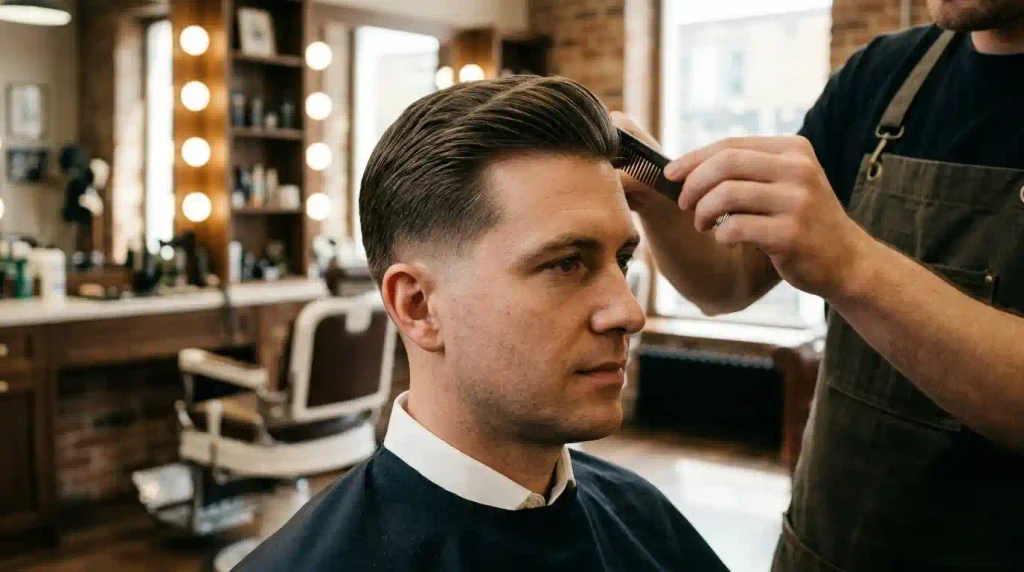
A business taper haircut is a neat, professional men’s haircut that gradually reduces hair length along the sides and back while leaving enough hair on top for controlled styling.
The term describes a professional appearance rather than one universally standardized haircut. Different barbers may interpret it as a traditional businessman’s cut, regular taper, executive taper, or neatly blended side-part hairstyle.
What connects these variations is their balanced silhouette.
The top usually maintains enough length for a side part, comb-over, brushed-back shape, or subtle texture. The sides become progressively shorter toward the sideburns and nape without necessarily exposing the scalp.
The result is an adaptable professional haircut that can look formal with a combed finish or more relaxed with natural texture.
Unlike high-contrast hairstyles designed to attract attention to the sides, a business taper places emphasis on overall proportion, clean grooming, and a controlled outline.
For a conservative workplace, the traditional version generally offers the most understated appearance. In a business-casual or creative environment, a slightly shorter low taper or textured top may provide additional flexibility.
Key Features of the Classic Business Taper
A classic business taper has several recognizable characteristics.
Gradually shortened sides: Hair becomes progressively shorter toward the lower sides and neckline rather than ending in a harsh, disconnected transition.
Longer hair on top: The top remains long enough to comb, part, or style into a neat shape. Depending on the haircut, this may range from approximately 1.5 to 4 inches.
Balanced side volume: Enough hair is retained above the temples and ears to create a natural, proportional silhouette.
Clean neckline: The hair around the nape is shaped neatly, typically with a natural taper rather than an exaggerated shaved outline.
Controlled sideburns: Sideburn length is adjusted to complement the face shape, hairstyle, and any facial hair.
Versatile styling: The haircut can be worn with a classic side part, lightly textured finish, or brushed-back top.
Professional appearance: The overall cut is tidy and deliberate without requiring excessive shine, extreme contrast, or a rigid hairstyle.
These features make the business taper suitable for a broad range of personal styles and professional settings.
Men who prefer an especially traditional finish may also appreciate a classic taper haircut, which emphasizes natural blending and timeless proportions.
How the Taper Works Around the Sides, Sideburns, and Neckline
The taper is created by progressively reducing hair length as the cut approaches the lower edges of the head.
The hair near the upper sides is usually left longer so it blends naturally into the top.
Moving downward toward the ears, temples, and sideburns, the hair becomes shorter.
At the back, the taper follows the natural shape of the head toward the nape.
This gradual transition is sometimes called graduation or taper blending.
A barber may use scissors, clipper-over-comb techniques, or hair clippers with different guard lengths.
For a classic business appearance, the taper generally remains controlled and does not extend excessively high into the upper sides.
The neckline may be softly tapered, rounded, or more clearly defined depending on personal preference.
A natural tapered neckline is particularly useful for someone who wants the haircut to grow out without immediately developing a sharp line of regrowth.
Classic Taper vs. Taper Fade vs. Skin Fade
Understanding the difference between these cutting styles helps prevent confusion during a barbershop appointment.
| Feature | Classic Business Taper | Taper Fade | Skin Fade |
| Side length | Generally retains more visible length | Very short near selected edges | Blends down to bare skin |
| Transition | Gradual and subtle | Closer and more defined | Stronger contrast |
| Scalp exposure | Usually little or none | May expose skin at the lowest edges | Exposes skin in faded areas |
| Typical finish | Traditional and understated | Clean and contemporary | Sharp and high contrast |
| Grow-out appearance | Usually soft and natural | Gradually loses definition | Contrast changes more noticeably |
| Workplace suitability | Particularly versatile | Depends on height and workplace | Depends on the setting and personal preference |
A low taper fade can still look appropriate in many professional environments, particularly when the top remains neatly styled.
However, if you want a traditional businessman’s cut, avoid assuming that a taper and skin fade mean the same thing.
Explain how much scalp exposure you want, how high the shorter section should extend, and whether the overall appearance should be soft or sharply defined.
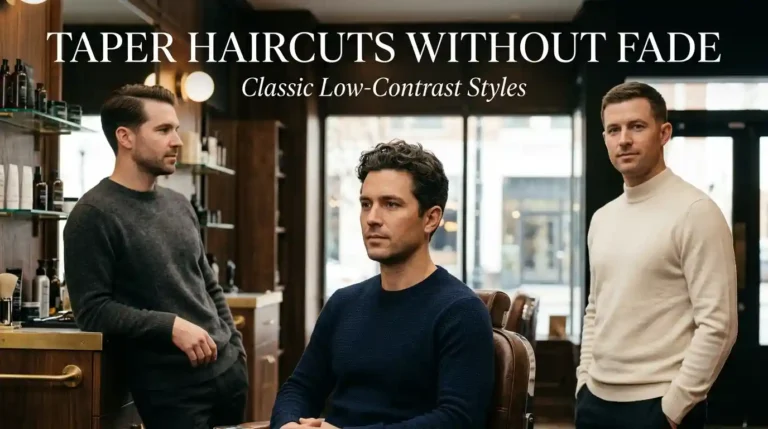
A taper haircut without fade is worth considering if you prefer longer, naturally graduated sides.
Business Taper Haircut Styles
The ideal business taper combines practicality with a shape that complements your hair and daily routine.
Some variations lean toward a conservative gentleman’s appearance, while others offer additional texture or volume.
Here are nine professional styles to consider.
Classic Professional Taper
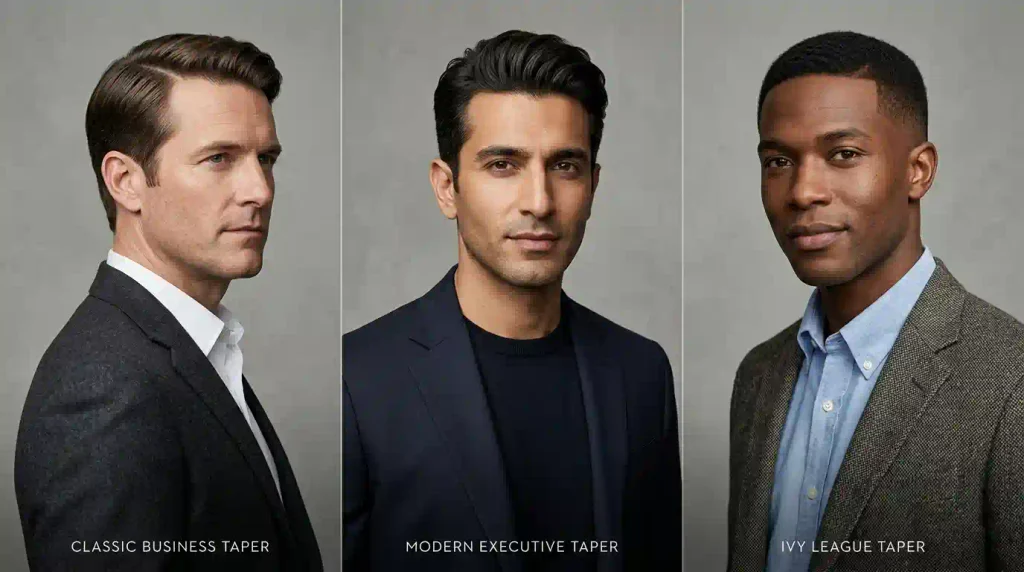
The classic professional taper is one of the most timeless choices for men who want a neat haircut without dramatic styling.
It features gradually shortened sides, a softly tapered neckline, and a medium-short top that can be combed naturally.
The upper sides usually retain enough fullness to prevent the cut from looking overly close to the scalp.
A traditional side part or gentle brushed-back finish completes the appearance.
This hairstyle works well for men who regularly wear suits, business shirts, or smart-casual clothing.
It also transitions comfortably between a formal office and everyday activities.
Recommended top length: Approximately 2–3 inches, adjusted to hair texture and preferred styling.
Best suited for: Straight or wavy hair, conservative dress codes, and men seeking a versatile everyday haircut.
Styling product: Lightweight pomade or styling cream.
Maintenance level: Low to moderate.
What to ask your barber: “I want a traditional business taper with natural graduation on the sides, enough length to part the top, and a softly tapered neckline.”
The main advantage is its longevity as a style. It does not depend on an extreme trend, so it can remain appropriate across different professions and age groups.
Modern Executive Taper
The modern executive taper updates the traditional businessman’s haircut with sharper detailing and controlled volume.
It generally keeps a polished top while introducing a slightly closer taper around the sideburns and neckline.
Compared with the classic version, the modern executive haircut may have more obvious texture or a cleaner low-taper transition.
The top can be swept backward, parted, or styled into a restrained quiff.
The result is professional without appearing excessively formal.
Some barbers also use the term executive contour for related side-parted hairstyles, although the exact terminology and shape can vary.
Recommended top length: Approximately 2.5–4 inches.
Best suited for: Corporate professionals, managers, executives, and men who want a contemporary polished look.
Styling product: Medium-hold pomade or matte styling cream.
Maintenance level: Moderate.
What to ask your barber: “Give me a modern executive taper with a clean low transition, controlled volume on top, and a natural professional finish.”
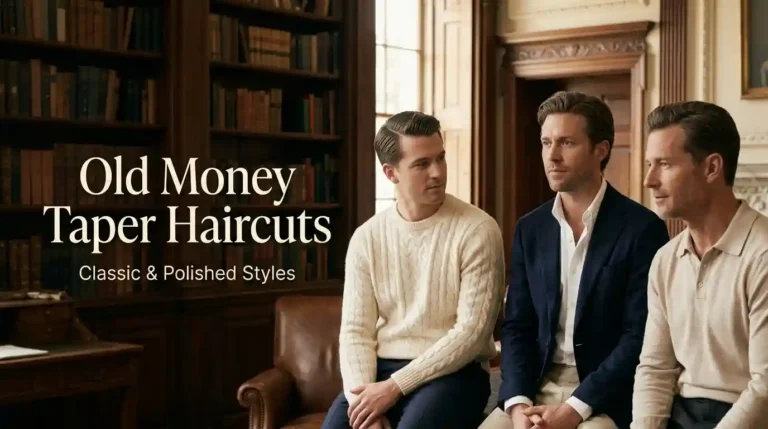
For a more traditional interpretation, the old money taper haircut offers similar understated sophistication, often with softer side graduation and classic styling.
Side-Part Taper
The side-part taper is one of the most recognizable professional men’s hairstyles.
Its defining feature is a clear but natural hair parting on one side of the head.
The longer hair is combed across the top, while the sides gradually shorten toward the ears and neckline.
Unlike a hard-part haircut, the classic version does not require a shaved line.
This makes it more subtle and easier to adjust as the hair grows.
A side part can create a balanced silhouette for many face shapes and hair densities.
It can also be styled with different finishes.
A small amount of high-shine pomade produces a more formal gentleman’s appearance. A low-shine styling cream gives the same haircut a softer business-casual character.
Recommended top length: Approximately 2–4 inches.
Best suited for: Straight and wavy hair, medium-density hair, formal offices, and traditional grooming preferences.
Styling product: Pomade, grooming cream, or lightweight hair wax.
Maintenance level: Low to moderate.
What to ask your barber: “Keep enough length for a natural side part, blend the sides gradually, and avoid shaving a hard part.”
The side-part taper is particularly useful for men who want one haircut that can be styled conservatively during the week and more casually on weekends.
Ivy League Taper
The Ivy League haircut is a refined variation of the crew cut.
It keeps the hair relatively short while preserving enough length near the front to create a small side part or combed-over shape.
When combined with tapered sides, it creates a clean, structured appearance.
The Ivy League is often associated with traditional American collegiate grooming, but it remains a practical professional hairstyle.
Because the top is shorter than a conventional business side part, daily styling is usually quick.
The front typically remains slightly longer than the crown, helping the hair form a controlled natural sweep.
Recommended top length: Approximately 1.5–2.5 inches near the front, with shorter hair toward the crown.
Best suited for: Men who want a polished short haircut with limited styling requirements.
Styling product: Light pomade, matte paste, or styling cream.
Maintenance level: Low.
What to ask your barber: “I want an Ivy League with a slightly longer front, neatly tapered sides, and enough length to create a small natural side part.”
This is an excellent option for early meetings, frequent travel, or anyone who prefers a haircut that looks organized without a lengthy morning routine.
Textured Taper and Textured Crop
A textured taper combines neatly graduated sides with movement and separation on top.
Instead of combing the hair into a completely smooth shape, the top is cut to create controlled texture.
The hairstyle can range from a lightly textured professional taper to a shorter textured crop.
A textured crop often directs the front hair forward and may include a short fringe.
The French crop is a related style with a recognizable forward fringe and shorter sides.
For professional settings, the most versatile version usually keeps the fringe tidy and avoids excessive contrast.
Recommended top length: Approximately 1.5–3 inches.
Best suited for: Straight, wavy, thick, or medium-density hair; business-casual and creative workplaces.
Styling product: Matte clay, texture spray, or lightweight hair wax.
Maintenance level: Low to moderate.
What to ask your barber: “Keep a clean low taper on the sides and use controlled point cutting to create natural texture on top without making the fringe too heavy.”
The textured taper is particularly useful for men who dislike shiny products or perfectly combed hairstyles.
It can look relaxed while still maintaining a deliberate and groomed shape.
Tapered Crew Cut
The tapered crew cut is a short, practical hairstyle with a neat silhouette.
The top is generally longer near the front and gradually becomes shorter toward the crown.
The sides and back are clipped or cut close, with a subtle taper around the lower edges.
This hairstyle requires very little daily styling and is suitable for men who prioritize convenience.
A crew cut can look conservative without requiring a prominent side part.
It is also a practical choice for active lifestyles or frequent travel.
Recommended top length: Commonly around 0.5–1.5 inches, depending on the variation.
Best suited for: Men wanting a short, low-maintenance hairstyle.
Styling product: Optional matte paste or lightweight wax.
Maintenance level: Very low for daily styling, although frequent trims may be needed.
What to ask your barber: “I want a traditional crew cut with a little extra length at the front, smoothly tapered sides, and a natural neckline.”
The tapered crew cut shares some characteristics with a military taper haircut, although military grooming standards and specific cuts vary.
For a formal workplace, keeping some natural fullness on the sides can make the result appear less severe than a very short high fade.
Comb-Over Taper
The comb-over taper features longer hair swept across the top from a natural parting.
It is similar to the side-part taper, but the styling places greater emphasis on the direction and volume of the combed hair.
A modern comb-over can be worn with a subtle low taper rather than a disconnected undercut or aggressive fade.
The front can be raised slightly to introduce controlled height.
This style is versatile because the amount of volume can be adjusted depending on the occasion.
For a conservative office, keep the top smooth and moderately controlled.
For business-casual settings, add a little texture and natural movement.
Recommended top length: Approximately 2.5–4 inches.
Best suited for: Straight, wavy, and medium-density hair.
Styling product: Medium-hold pomade, hair wax, or styling cream.
Maintenance level: Moderate.
What to ask your barber: “Leave enough length on top to comb naturally to one side, keep the sides graduated, and blend the crown smoothly.”
A comb-over taper is not necessarily a hairstyle intended to conceal hair loss. It can simply describe the direction of the top hair.
For thinning hair, however, the amount of length and coverage should be adjusted carefully to avoid emphasizing sparse areas.
Slicked-Back Taper
The slicked-back taper creates a polished appearance by directing the top hair backward.
Unlike an undercut, a classic slicked-back taper maintains a gradual transition between the top and sides.
The hairstyle can be worn with a glossy finish or a more restrained natural sheen.
For professional environments, controlled volume usually looks more balanced than an extremely flat or heavily saturated slick-back.
The top needs sufficient length to lie backward comfortably.
A barber may reduce excessive bulk near the crown to help the hair follow its natural direction.
Recommended top length: Approximately 3–5 inches.
Best suited for: Medium to thick straight or wavy hair, formal events, and men who enjoy structured styling.
Styling product: Pomade, styling cream, or medium-hold gel.
Maintenance level: Moderate.
What to ask your barber: “Keep the top long enough to brush backward, taper the sides smoothly, and avoid a disconnected undercut.”
This hairstyle works particularly well with formal clothing, but it can be softened for everyday wear by using less product and allowing natural movement.
Taper with a Quiff or Pompadour
A quiff or pompadour adds height and personality to the classic business taper.
The quiff generally lifts the front hair upward and slightly backward.
A pompadour creates a more pronounced rounded volume at the front, with the hair styled away from the forehead.
Both styles can be combined with graduated sides.
For professional settings, a restrained quiff is usually easier to manage than an exaggerated pompadour.
The haircut should maintain enough side fullness to balance the elevated front.
Recommended top length: Approximately 3–5 inches, sometimes longer for a pronounced pompadour.
Best suited for: Straight or wavy hair with sufficient density to hold volume.
Styling product: Mousse, pomade, matte clay, or a suitable finishing spray.
Maintenance level: Moderate to high.
What to ask your barber: “Keep extra length at the front for controlled volume, maintain a classic taper on the sides, and blend the crown naturally.”
If you want a sophisticated haircut that can transition from the boardroom to an evening event, a low-volume quiff offers a practical compromise.
Quick Comparison: Which Business Taper Is Right for You?
| Style | Formal Appearance | Styling Time | Main Advantage |
| Classic professional taper | Very traditional | 2–5 minutes | Timeless versatility |
| Modern executive taper | Polished and contemporary | 3–7 minutes | Controlled modern volume |
| Side-part taper | Traditional | 3–5 minutes | Easy styling flexibility |
| Ivy League taper | Understated and neat | 1–3 minutes | Minimal daily effort |
| Textured taper | Relaxed professional | 2–5 minutes | Natural movement |
| Tapered crew cut | Clean and simple | 0–2 minutes | Lowest styling demands |
| Comb-over taper | Polished | 3–7 minutes | Directional volume |
| Slicked-back taper | Refined and structured | 4–8 minutes | Smooth formal finish |
| Quiff or pompadour taper | More expressive | 5–10 minutes | Height and visual impact |
Styling times are estimates and vary with hair length, texture, and experience.
Choosing a Business Taper for Your Workplace
The best professional haircut should work with your environment and personal preferences rather than follow an inflexible definition of what professional hair must look like.
Workplace expectations differ between industries, employers, locations, and individual organizations.
A hairstyle that feels conservative in one workplace may be considered ordinary in another.
Conservative Styles for Formal Workplaces
Some workplaces maintain more traditional expectations around grooming and dress.
These may include certain corporate offices, financial institutions, legal environments, or client-facing positions.
However, standards vary within these industries, and there is no universal rule requiring one hairstyle.
For an understated appearance, consider the classic professional taper, Ivy League, or natural side-part taper.
These styles maintain a relatively balanced outline without relying on dramatic contrast.
Useful features include:
- A moderate top length that stays away from the eyes.
- Smoothly graduated sides.
- A neat neckline and sideburns.
- Natural or controlled hair parting.
- Styling products that do not leave excessive buildup.
A traditional taper is also practical when a workplace requires consistently neat grooming.
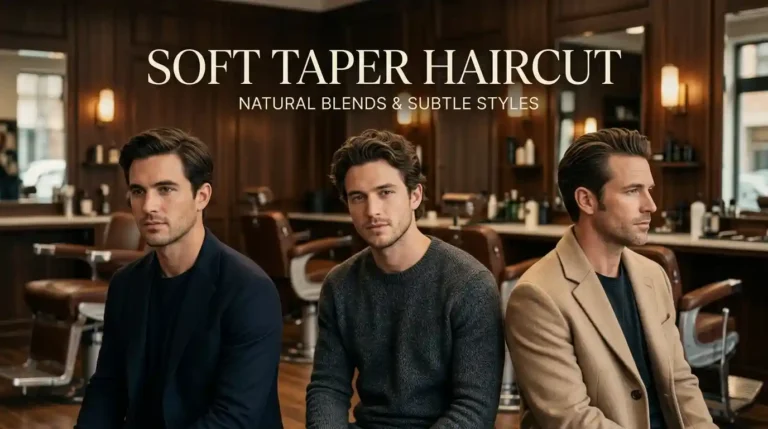
For people who appreciate a softer outline rather than tightly clipped sides, a soft taper haircut offers another restrained option.
The goal is not to eliminate individuality but to choose a haircut that feels comfortable and appropriate for your role.
Business-Casual Styles for Flexible Dress Codes
Business-casual environments often allow more freedom with hair length, texture, and styling.
A modern executive taper, textured crop, or lightly styled comb-over can work particularly well.
These cuts preserve a neat silhouette while introducing a relaxed finish.
For example, a medium-length textured taper can be styled with matte clay for a regular workday.
The same haircut can be smoothed into a more defined side part before a presentation.
A business-casual hairstyle does not need to look rigid.
Natural waves, curls, and texture can all be incorporated into a professional haircut.
For many men, a low taper with moderately long hair on top offers the best combination of comfort and styling flexibility.
Modern Options for Creative Workplaces
Creative workplaces may encourage expressive hairstyles and personal styling choices.
Designers, media professionals, developers, and people in other flexible environments may prefer a more textured or contemporary taper.
Possible options include a low taper fade with a quiff, textured crop, relaxed slick-back, or longer executive taper.
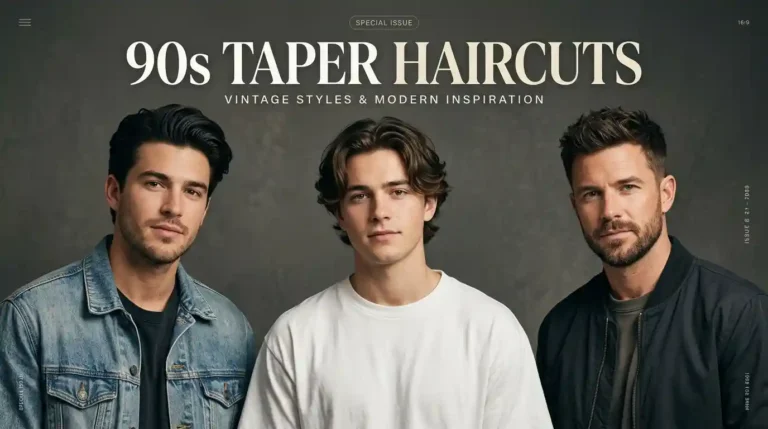
Some professionals also take inspiration from vintage hairstyles, including the taper haircut 90s look, which emphasizes fuller sides, natural movement, and softer shaping.
A more expressive haircut can still be well maintained.
Even with longer hair or additional texture, thoughtful shaping around the temples, sideburns, and neckline helps create an intentional result.
Adjusting Your Style for Meetings and After-Work Events
One of the strongest advantages of a business taper is its adaptability.
You can change the finish without necessarily changing the haircut.
For a client meeting, a defined side part with controlled shine may create a traditional appearance.
For an ordinary office day, a lighter styling cream can maintain the shape without making the hair feel stiff.
After work, the same top length can be loosened with your fingers for a more relaxed look.
Consider these combinations:
| Occasion | Suggested Finish |
| Formal client meeting | Smooth side part with low-to-medium shine |
| Boardroom presentation | Controlled comb-over or brushed-back taper |
| Everyday office routine | Natural part with lightweight styling cream |
| Business-casual Friday | Soft textured taper with matte finish |
| Networking event | Executive taper with slightly elevated front |
| Evening dinner | Relaxed slick-back or gently textured quiff |
The amount of product often makes a greater difference than the haircut itself.
A well-cut business taper should remain presentable even when styled more naturally.
Choosing a Taper for Your Face Shape, Hair Type, and Hairline
A professional haircut should complement your natural features rather than force every head of hair into the same shape.
Face shape, hair density, curl pattern, growth direction, and hairline all influence how a taper looks.
Matching the Style to Your Face Shape
Face shape provides a starting point for selecting top volume and side length.
It should not be treated as a strict rule because personal preference matters more than any single styling formula.
| Face Shape | Suggested Business Taper | Styling Consideration |
| Oval | Classic taper, Ivy League, or side part | Most balanced shapes can work |
| Round | Executive taper or restrained quiff | Moderate height may create a longer-looking silhouette |
| Square | Classic side part or textured taper | Soft texture can balance angular features |
| Heart-shaped | Side-part taper or fuller scissor taper | Some side fullness may balance a narrower jaw |
| Oblong | Ivy League or classic taper with modest volume | Avoid excessive height if you want a shorter-looking silhouette |
| Diamond | Medium-length professional taper | Controlled temple fullness may balance facial proportions |
An oval face often accommodates many haircut shapes because its proportions are relatively balanced.
A round face may benefit visually from slightly more top height and less side bulk.
A square face can pair well with clean lines or softer texture, depending on the desired appearance.
For an oblong face, a tall pompadour combined with extremely short sides may exaggerate facial length.
However, these are visual effects rather than requirements.
A skilled barber can adjust the cut to your preferences regardless of face shape.
Taper Options for Straight, Wavy, Curly, and Coily Hair
Hair texture affects both the cutting technique and the daily styling routine.
Straight hair
Straight hair is well suited to side parts, comb-overs, Ivy League cuts, and slicked-back tapers.
It can create clean lines but may need styling support to maintain height.
Fine straight hair often benefits from lightweight products, while thicker straight hair may require controlled weight removal.
Wavy hair
Wavy hair naturally creates movement.
A medium-length executive taper or textured professional taper can preserve that movement while keeping the sides neat.
A small amount of styling cream often helps control frizz without removing the wave pattern.
Curly hair
Curly hair works well with a low taper that maintains enough length on top to preserve curl definition.
The barber should consider shrinkage before determining the cutting length.
A natural curly top with neatly shaped sides can be just as polished as a straight side-part hairstyle.
Choose products based on moisture needs and curl definition rather than attempting to flatten the hair unnecessarily.
Coily hair
Coily hair can be shaped into a clean professional taper, short natural top, or structured style with a precise outline.
The barber should understand the hair’s density, growth pattern, and shrinkage.
A moderate taper can maintain a balanced silhouette while allowing the natural texture to remain visible.
There is no need to straighten coily hair to achieve a professional appearance.
Taper Options for Thick, Fine, and Thinning Hair
Hair thickness and density influence how much weight should be removed.
Thick hair
Thick hair can support executive tapers, pompadours, and fuller side parts.
However, excess bulk around the upper sides may cause the hair to stick outward.
A barber can use scissor-over-comb techniques and careful texturizing to create balance.
Excessive thinning should be avoided if it produces frizz or weakens the intended shape.
Fine hair
Fine hair often benefits from a shorter, structured top.
An Ivy League or classic taper with moderate length can make styling easier.
Lightweight mousse or low-shine styling cream can provide control without making the hair look flat.
Heavy pomade may separate fine strands and make the scalp more visible.
Thinning hair
For thinning hair, the goal is generally to create a balanced shape without relying on artificial-looking coverage.
A short textured taper, Ivy League, or controlled crew cut can be effective.
Leaving the top excessively long may make sparse areas more obvious when the hair separates.
A barber can work with the existing density to create a natural finish.
If thinning is sudden, patchy, or concerning, a dermatologist can help investigate the cause.
Choosing a Style for a Receding Hairline, Cowlick, or Uneven Growth
A receding hairline does not prevent someone from wearing a business taper.
However, it may influence the preferred top length and styling direction.
A short Ivy League or lightly textured crop can reduce the emphasis on a receding frontal hairline.
A natural side part may also work when the remaining hair follows that direction comfortably.
Avoid forcing a very long comb-over across a significantly thinning area if it requires constant adjustment.
Cowlicks present a different challenge.
A cowlick is a section of hair that grows in a different direction from the surrounding hair.
Cutting it too short may make it stand upright.
Leaving some extra length or changing the direction of the part can help manage it.
If your crown grows unevenly, ask your barber to examine it before choosing the final top length.
In many cases, working with the natural growth pattern produces a more reliable professional appearance than fighting it every morning.
What to Tell Your Barber
A successful business taper begins with clear communication.
Simply asking for a “professional haircut” may produce different results depending on the barber.
Explain the taper height, top length, neckline, preferred styling direction, and how much contrast you want.
Choose the Taper Height and Top Length
The height of the taper determines how much hair remains around the sides.
A low taper concentrates the shortest area close to the sideburns and nape.
A mid taper creates a more noticeable transition, while a high taper removes more length farther up the sides.
These terms can vary between barbers, so photographs are helpful.
For a traditional business haircut, a low or regular taper is often a sensible starting point.
Next, choose the top length.
| Top Length | Suitable Hairstyles | General Styling Result |
| 0.5–1.5 inches | Crew cut, short textured crop | Minimal styling |
| 1.5–2.5 inches | Ivy League, short side part | Clean and controlled |
| 2.5–3.5 inches | Classic business taper, comb-over | Flexible professional styling |
| 3.5–5 inches | Slick-back, executive quiff, pompadour | Greater volume and movement |
These are suggested ranges rather than universal measurements.
Curly and coily hair may require different cutting lengths to achieve a similar visible result because of shrinkage.
Describe the Neckline, Sideburns, and Finish
Small details determine whether a business taper looks subtle or highly defined.
Natural tapered neckline: Gradually blends the hair toward the nape and usually grows out softly.
Rounded neckline: Follows a curved outline at the back.
Blocked neckline: Creates a straight or squared edge that may look sharp initially but become more obvious during regrowth.
Short sideburns: Maintain a clean appearance around the ears.
Longer sideburns: Can suit certain classic hairstyles or connect with a beard.
If you have facial hair, ask for a beard taper that blends the sideburns smoothly into the beard without creating an unwanted gap.
A natural hairline is often preferable when you want a traditional gentleman’s taper haircut.
Customize a Barber Request with a Simple Script
Use the following description if you want a classic professional result:
“I’d like a business taper haircut with natural, gradually shortened sides and a clean tapered neckline. Please keep about two and a half to three inches on top so I can style a side part. I want enough fullness above the ears for a classic professional shape, with no skin showing around the sides. Keep the sideburns neat and blend everything naturally.”
For a more contemporary version:
“I want a modern executive taper with controlled texture on top, a clean low taper around the ears and neckline, and enough front length for a small quiff. Keep the overall shape professional rather than creating a dramatic fade.”
For a short, practical version:
“I’d like an Ivy League taper with a slightly longer front, shorter crown, and neat sides. Keep it easy to style and avoid taking the sides too high.”
These scripts provide useful starting points, but your barber may recommend adjustments based on hair texture and growth patterns.
Use Reference Photos and Clipper Guard Numbers
Reference photographs are among the most useful tools for explaining a haircut.
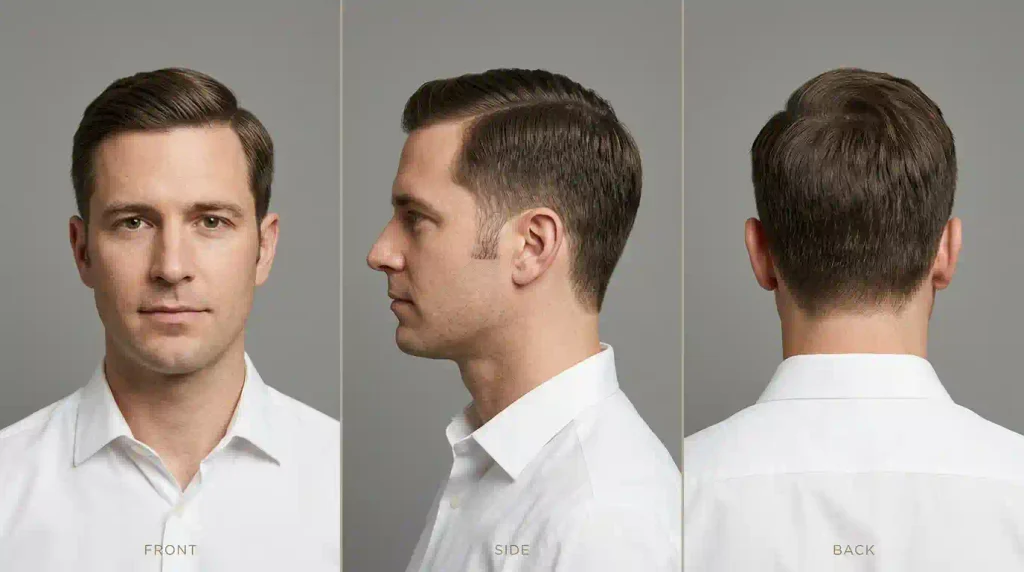
Ideally, bring images showing the front, side, and back of the same hairstyle.
The front shows top length and parting.
The side reveals taper height and bulk.
The back shows the neckline and blending.
Clipper guard numbers can add clarity, but they do not fully define the haircut.
Common nominal guard lengths include:
| Clipper Guard | Approximate Cutting Length |
| #1 | 3 mm / 1/8 inch |
| #2 | 6 mm / 1/4 inch |
| #3 | 10 mm / 3/8 inch |
| #4 | 13 mm / 1/2 inch |
| #5 | 16 mm / 5/8 inch |
| #6 | 19 mm / 3/4 inch |
Actual results vary with the clipper, blade, lever position, guard system, and cutting technique.
A #3 guard does not automatically create a low taper or guarantee a particular business haircut.
For a traditional style, ask the barber to select guards and scissor lengths based on the final shape rather than relying entirely on a single number.
Before your appointment, you can bookmark this business taper haircut guide and save your preferred reference examples.
What to Say If You Want to Avoid a Skin Fade
If you prefer a traditional business haircut, clearly explain that you do not want the sides shaved down to the skin.
You might say:
“Please keep visible hair throughout the sides and neckline. I want a gradual classic taper rather than a skin fade or disconnected undercut.”
Also specify whether you want the barber to retain some fullness around the temples.
Some clients prefer a clipper taper, while others want a softer cut created primarily with scissors.
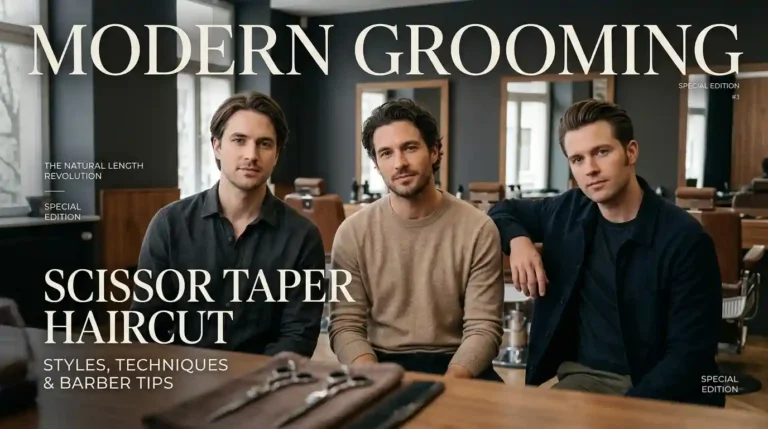
A scissor taper haircut can be particularly suitable when you want more natural texture and fewer sharply defined transitions.
The important point is the finished appearance, not whether scissors or clippers are used exclusively.
Business Taper Examples From Every Angle
Looking at a business taper from multiple angles makes it easier to evaluate the overall silhouette.
A front-facing photograph alone cannot show how the sides and neckline have been blended.
Front View: Top Length and Parting
The front view reveals the hairstyle’s shape around the forehead.
For a side-part taper, look at the natural direction of the combed hair and the position of the part.
For an Ivy League, examine how much length remains at the front.
For a quiff, assess the height and whether the volume appears proportional to the face.
The front view is also useful for deciding whether you prefer a polished combed finish or a more natural textured appearance.
Side View: Taper Height and Blending
The side view shows the transition from the top into the sides.
For a classic business taper, the blend should appear smooth, with no unintended harsh line between longer and shorter hair.
Look at how much fullness remains above the ear and whether the sideburns are neatly shaped.
If you want a low taper, make sure the shortest area stays close to the lower hairline.
A side photograph also helps distinguish a traditional taper from a skin fade.
Back View: Neckline and Finish
The back view reveals the neckline, nape, and crown transition.
A natural tapered neckline creates a gradual finish near the lower hairline.
The back should also show whether the crown blends smoothly into the shorter sides.
For men with cowlicks or uneven growth patterns, the back view is particularly important.
A balanced cut should account for the natural direction of hair growth rather than create awkward protruding sections.
How to Style a Business Taper Haircut
A good business taper should be manageable without an unnecessarily complicated routine.
The right technique depends on your top length, texture, and desired finish.
For most everyday professional styles, a comb, suitable product, and a few minutes of preparation are enough.
Style a Side Part, Comb-Over, or Slick Back
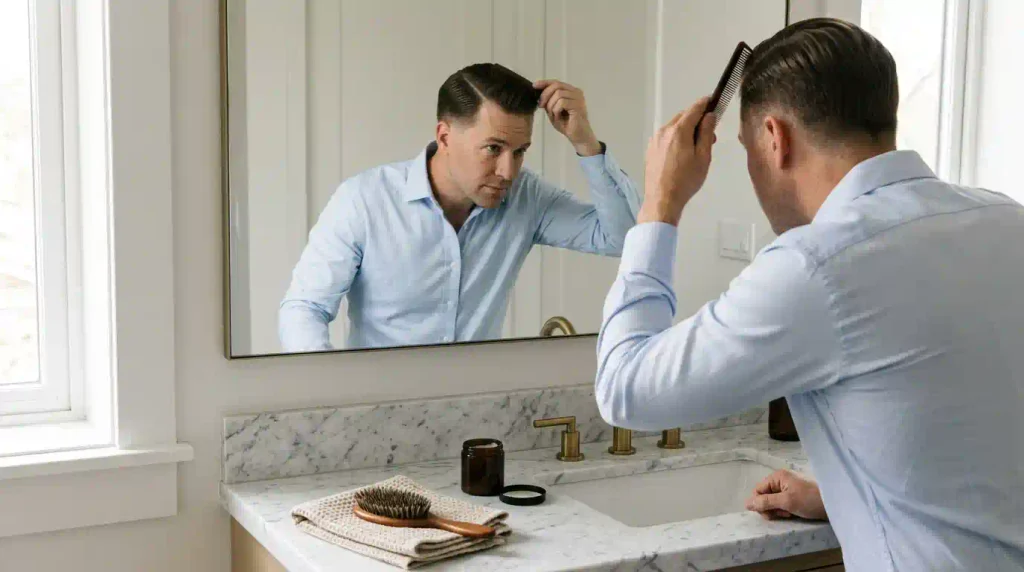
For a classic side part, begin with clean hair that is slightly damp.
Find the natural parting direction, then use a comb to separate the top.
Apply a small amount of pomade or styling cream, spreading it evenly before combing the hair into position.
If you want more volume, gently lift the roots while using a blow dryer on a controlled heat setting.
A comb-over follows a similar process but emphasizes sweeping the hair across the top.
For a slick-back, distribute product through the hair and guide it backward with a comb or your hands.
Avoid pulling the hair tightly or forcing it against its natural growth direction.
For a traditional executive finish, use enough hold to control the style without making it appear saturated with product.
Men with fine hair may prefer a lighter cream, while thicker hair may need a stronger styling product.
Style Textured Hair, a Quiff, or a Pompadour
Textured professional hairstyles require a different approach.
For a short textured taper, work a small amount of matte clay or styling paste through dry or nearly dry hair.
Use your fingers to separate sections and create a natural shape.
Avoid applying too much product at the roots because it may flatten the hairstyle.
For a quiff, start with slightly damp hair and apply a lightweight mousse or suitable pre-styling product.
Lift the front section while blow-drying it upward and backward.
Once the hair has taken shape, use a small amount of styling product to maintain the volume.
A pompadour follows the same principle but requires more intentional shaping through the front.
A round brush may help create the desired lift.
Finish with a cool-air setting if your dryer provides one.
For everyday office wear, keep the height moderate so the overall haircut remains proportional.
Choose a Product for Hold, Texture, or Shine
Different styling products produce different finishes.
| Product | Main Benefit | Best Business Taper Style |
| Pomade | Controlled shape with varying shine | Side part, comb-over, slick-back |
| Matte clay | Texture and low shine | Textured taper, short quiff |
| Hair wax | Flexible hold and separation | Short textured taper |
| Styling cream | Soft control and natural movement | Classic taper, wavy hair |
| Styling gel | Stronger defined hold | Structured slick-back |
| Mousse | Lightweight volume | Fine hair, quiff, pompadour |
| Texture spray | Separation and natural movement | Modern executive taper |
| Lightweight hairspray | Finishing hold | Longer quiff or pompadour |
Choose products according to hair density and texture rather than assuming one product suits everyone.
Fine hair may become weighed down by heavy wax.
Thick hair may require greater control.
Curly and coily hair may benefit more from moisture-preserving creams than products designed for rigid straight-hair styling.
If you blow-dry regularly, consider using an appropriate heat protectant.
The American Academy of Dermatology’s healthy hair-care guidance recommends limiting excessive heat and using low or medium heat settings to reduce hair damage.
How to Maintain a Business Taper
A well-cut business taper can remain attractive as it grows, but regular maintenance helps preserve the original shape.
The ideal haircut schedule depends on hair growth speed, top length, and how sharply defined you want the lower edges.
How Often to Schedule Trims
For many men, a business taper benefits from a full trim approximately every three to six weeks.
Shorter cuts generally require more frequent appointments.
Longer, softer tapers may remain presentable for a greater period.
| Business Taper Style | Approximate Trim Interval |
| Short tapered crew cut | 2–4 weeks |
| Ivy League taper | 3–5 weeks |
| Classic professional taper | 3–5 weeks |
| Side-part taper | 3–6 weeks |
| Modern executive taper | 3–5 weeks |
| Textured taper | 4–6 weeks |
| Longer comb-over taper | 4–6 weeks |
| Slicked-back taper | 4–7 weeks |
| Longer pompadour taper | 4–6 weeks |
These are general estimates rather than fixed requirements.
If your hair grows quickly or you prefer sharply defined sideburns, you may want more frequent cleanups.
If you like a slightly grown-out, natural appearance, you may be comfortable extending the interval.
How the Haircut Changes as It Grows Out
During the first week after a haircut, the taper generally looks its cleanest.
The sideburns and neckline are clearly shaped, while the top maintains its intended proportions.
After two or three weeks, the lower hairline may become less defined.
The upper sides can also gain volume, particularly if you have thick or fast-growing hair.
By the fourth or fifth week, shorter professional styles may start losing their original shape.
The top may become more difficult to part neatly, and the hair around the ears may appear fuller.
One benefit of a classic taper is that it usually grows out more naturally than an extremely short skin fade.
Because the original transition is gradual, the difference between the shortest and longest areas is less dramatic.
When to Get a Cleanup Versus a Full Haircut
Not every maintenance visit requires removing a significant amount of hair.
A cleanup generally focuses on the visible edges of the haircut.
It may include trimming around the ears, refining the sideburns, and neatening the neckline.
A full haircut is more appropriate when the top has lost its shape, the crown has become bulky, or the side proportions need to be reestablished.
For example, a man with a medium-length side-part taper might only need a neckline cleanup after two weeks.
After another few weeks, a full haircut may be necessary to restore the original length and balance.
Ask your barber whether short maintenance appointments are available between regular cuts.
This can be useful when you have an important presentation or formal event before your next scheduled haircut.
Keep the Neckline and Sideburns Neat
The neckline and sideburns often affect the overall appearance more than people realize.
Even when the top remains well styled, overgrown edges can make the haircut look less defined.
For a natural business taper, the neckline should follow the head’s natural shape.
Avoid repeatedly shaving the neckline higher than the original cut, as this can change the intended proportions.
Sideburns should be balanced with your hairstyle and facial hair.
If you have a beard, a gradual transition between the sideburns and beard can create a more cohesive appearance.
For a clean-shaven look, shorter sideburns may give the haircut a sharper finish.
At-home touchups should be limited to areas you can see and manage safely.
If you are unsure about maintaining the outline, professional cleanup is preferable to accidentally changing the taper.
Follow a Simple Daily Grooming Routine
A consistent daily routine helps keep a business taper neat without requiring excessive styling.
Step 1: Assess your hair’s condition. If your hair is clean and manageable, you may only need a quick refresh rather than a full wash.
Step 2: Adjust moisture and shape. Lightly dampen hair when necessary, or apply a suitable product to dry hair according to its instructions.
Step 3: Choose the part or direction. Follow the haircut’s intended shape, whether that means a side part, natural sweep, or brushed-back finish.
Step 4: Apply a small amount of styling product. Begin with a modest quantity and add more only if necessary.
Step 5: Set the style. Use your fingers or a comb to refine the shape. If blow-drying, use controlled heat and avoid unnecessary prolonged exposure.
Step 6: Check the sides and neckline. Make sure no major sections are sticking outward and that the visible edges remain tidy.
Step 7: Review the finish in natural light. Excessive shine or product buildup can become more noticeable outside the bathroom.
Hair-washing frequency should be based on your scalp condition, hair texture, activity level, and product use.
Someone with an oily scalp may need more frequent washing than someone with naturally dry, tightly curled hair.
Conditioning and gentle detangling can help maintain a healthy appearance.
For a professional haircut, consistency matters more than using large amounts of styling product.
Frequently Asked Questions
Is a Business Taper Appropriate for a Formal Workplace?
Yes, a classic business taper is a versatile professional hairstyle, particularly when paired with neat sides, a natural neckline, and controlled top styling.
Can a Business Taper Include a Fade?
Yes, a subtle low taper fade can create a modern business appearance, although a traditional taper generally maintains more hair along the lower sides.
Is a Business Taper Low Maintenance?
Yes, shorter styles such as the Ivy League and classic taper require minimal daily styling, although regular trims help maintain their shape.
How Long Should the Hair Be on Top?
Most business taper styles work with approximately 1.5–4 inches on top, depending on the chosen hairstyle, hair texture, and desired volume.
What Should I Ask My Barber For?
Ask for a classic low or regular taper with smoothly graduated sides, a clean neckline, and enough top length for your preferred professional style.
Final Thoughts
The business taper haircut remains a reliable choice for men who want a polished, versatile hairstyle that works across professional and everyday settings. From the timeless classic taper and Ivy League to the modern executive taper, side part, and textured crop, each variation offers a different balance of structure, styling freedom, and maintenance.
For a traditional gentleman’s appearance, choose a natural low taper with controlled top length. If you prefer something contemporary, a textured or brushed-back executive taper may be more suitable.
The best result comes from matching your haircut to your hair texture, face shape, workplace preferences, and daily routine.
Explore more professional styles at Taper Haircut Hub and browse our Classic & Traditional Tapers collection. Save your favorite reference photos and discuss the exact proportions with your barber before your next appointment.

3 Comments