

Taper Haircut: Types, Styles, How to Choose, and What to Ask Your Barber
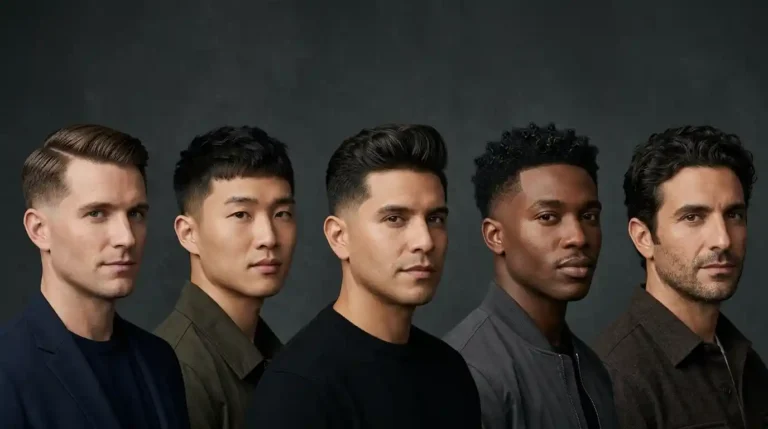
A taper haircut is one of the most versatile hairstyles because it creates a clean, gradual transition from longer hair to shorter lengths around the sides, sideburns, and neckline. Unlike a dramatic skin fade that may expose large areas of the scalp, a traditional taper preserves more hair while giving the haircut a polished, balanced appearance. Whether you prefer a classic side part, textured crop, modern quiff, curly top, Afro, or short crew cut, a taper can complement different hair textures, face shapes, and personal styles. But what does a taper haircut actually look like, and how do you choose between a low, mid, high, classic, or taper fade? The answer depends on how much contrast you want, your natural hair growth pattern, and how often you’re willing to visit the barber. This complete taper haircut guide explains the different types and popular hairstyles, how barbers create the blend, which clipper lengths to request, and how to maintain your haircut as it grows. You’ll also learn what to tell your barber so you leave with the style you expected.
Table of Contents
- Taper Haircut at a Glance
- What Is a Taper Haircut?
- Taper vs. Fade vs. Taper Fade
- Taper Haircut Types and Heights
- How to Choose a Taper for Your Face Shape and Hair
- Taper Haircut Styles and Top Pairings
- How Barbers Cut a Taper
- What to Tell Your Barber
- How to Style a Taper Haircut
- Taper Haircut Maintenance, Grow-Out, and Cost
- Common Taper Haircut Mistakes and How to Fix Them
- Professional Tips for Getting the Taper You Want
- Frequently Asked Questions
- Final Thoughts
Taper Haircut at a Glance
A taper haircut gradually reduces hair length around the lower sides and back while maintaining a smooth connection to the longer hair above.
It can create a subtle, professional appearance or a sharper modern look, depending on the taper height and shortest cutting length.
The haircut works with straight, wavy, curly, coily, thick, and fine hair. It also complements numerous hairstyles, from traditional short cuts to longer textured styles.
| Feature | Taper Haircut Details |
| Haircut definition | Gradual reduction in hair length toward the edges |
| Main cutting areas | Sideburns, temples, ears, and neckline |
| Popular types | Classic, low, mid, high, temple, and taper fade |
| Typical scalp exposure | Minimal with a classic taper; optional with skin variations |
| Suitable hair lengths | Short, medium, and long |
| Suitable hair textures | Straight, wavy, curly, coily, fine, and thick |
| Popular top hairstyles | Side part, crew cut, quiff, pompadour, textured crop, curls |
| Daily styling | Minimal to moderate, depending on the top |
| Typical maintenance | Approximately 2–5 weeks, depending on the style |
| Best overall feature | Versatility with a natural, graduated finish |
What a Taper Looks Like and How It Grows Out
From the front, a taper haircut generally looks clean and balanced, with the hairstyle on top remaining the main focus.
From the side, the hair gradually shortens around the temples, sideburns, and ears.
The transition should appear smooth rather than displaying obvious steps between lengths.
From the back, the haircut tapers toward the nape, creating a neat neckline.
A traditional taper usually leaves more visible hair around the perimeter than a full skin fade.
That extra length affects how the haircut grows out.
As new hair appears, a classic taper generally becomes softer and fuller rather than developing an immediately obvious line of regrowth.
A skin taper, by comparison, may show noticeable stubble sooner because its shortest sections initially expose the scalp.
The overall appearance depends on how high the graduation begins and how much hair remains through the sides.
Main Benefits and Upkeep to Expect
The main advantage of a taper haircut is its adaptability.
You can keep the same general taper while changing the hairstyle on top.
For example, a low taper can accompany a textured crop, natural curls, a side part, or longer flowing hair.
Another benefit is the ability to maintain a polished appearance without removing excessive length.
A classic taper is often suitable for professional settings, while a sharper taper fade offers more noticeable contrast.
The haircut can also provide a more forgiving grow-out than some skin-level fades.
However, not every taper is low maintenance.
A precise skin taper with a line-up may need frequent touch-ups to preserve its sharpness.
A softer classic taper may remain presentable for several weeks.
The ideal choice depends on how often you want barber appointments and how much daily styling you’re comfortable with.
What Is a Taper Haircut?
The simplest taper haircut definition is a hairstyle in which the hair progressively becomes shorter toward the lower edges while blending smoothly into the longer sections above.
In other words, taper refers to a change in hair length rather than one specific hairstyle.
The technique allows a barber to shape the perimeter without necessarily cutting the entire sides and back extremely short.
A taper may be subtle enough to look almost natural or pronounced enough to create visible contrast.
Both approaches rely on gradual graduation.
If someone asks, “What does taper haircut mean?” the answer is that the hair is progressively shortened in selected areas to create a neat transition.
A taper does not require one particular top length.
It can work with a short crew cut, medium-length comb-over, textured curls, or long hair.
The concept also extends beyond men’s barbering.
Some women’s short hairstyles, such as tapered pixie cuts, use similar graduation. Asymmetrical tapered cuts, graduated bobs, and other layered hairstyles may incorporate related shaping techniques, although they are not necessarily the same as a traditional barbershop taper.
How the Hair Is Graduated Around the Sides, Sideburns, Ears, and Neckline
The defining technique of a taper haircut is hair-length graduation.
The barber establishes a longer section and gradually transitions into shorter lengths toward the perimeter.
Around the sides, the taper can begin near the lower temples and sideburns.
The hair becomes progressively shorter as it approaches the natural hairline.
Near the ears, the barber controls the transition to prevent a bulky or disconnected appearance.
At the back, the hair is gradually shortened toward the nape.
A well-executed taper should connect naturally to the longer hair around the crown and upper sides.
The barber may use scissors, hair clippers, a trimmer, or a combination of techniques.
For a traditional taper, the barber usually preserves more hair through the main side panels.
For a closer taper fade, shorter cutting lengths may be used near the temples and neckline.
The exact shape depends on the client’s head contour, hair density, and preferred finish.
A taper haircut all around the head should appear balanced, but that does not mean every section must be cut to exactly the same length.
The barber may adjust the graduation around different head contours to create visual consistency.
For example, one side may need slightly different blending because the hair grows in another direction.
The goal is a balanced appearance rather than identical clipper measurements everywhere.
How a Taper Keeps More Length Than a Skin Fade
A classic taper generally preserves more length through the sides and around the head than a full skin fade.
In a traditional taper, the shortest sections remain concentrated near the sideburns and neckline.
A full skin fade removes hair down to bare skin across a larger section of the sides and back.
This creates a stronger contrast between the longer top and shorter perimeter.
Consider two men wearing the same textured hairstyle.
The first chooses a classic taper with visible short hair around the ears and neckline.
His haircut appears natural, understated, and relatively full through the sides.
The second chooses a mid skin fade.
His haircut has a broader area of very short hair, with more visible scalp and stronger contrast.
Both can look attractive.
However, the taper preserves more of the original silhouette.
That makes a traditional taper particularly useful for men who want a neat haircut without significantly reducing side volume.

Taper vs. Fade vs. Taper Fade
The terms taper, fade, and taper fade are frequently used together, but they can describe different haircut results.
All three involve transitioning from longer to shorter hair.
The distinction usually concerns the location of the shortest section, the amount of hair removed, and the overall coverage of the graduation.
A traditional taper generally concentrates the shortest blending around the sideburns and neckline.
A conventional full fade usually affects a larger area of the sides and back.
A taper fade often combines localized taper placement with closer fade-style graduation.
However, barber terminology varies by region and individual professional.
A client asking for a taper in a U.S. barbershop may receive a different interpretation than someone making the same request elsewhere, including a UK barbershop.
The safest approach is to explain the desired hair length, blending area, and amount of visible scalp.
Where Each Blend Starts and How Short It Goes
A classic taper often begins with a relatively fuller side section and gradually becomes shorter near the edges.
Its lowest point typically retains visible hair.
A low fade blends a broader area closer to the bottom of the head.
A mid fade begins its visible transition higher.
A high fade removes more hair from the upper side sections.
A taper fade may be low, mid, or high, but the shortest areas often remain more localized around the temples and nape.
| Feature | Classic Taper | Taper Fade | Full Fade |
| Main blending area | Sideburns and neckline | Temples, sideburns, and nape | Larger portions of sides and back |
| Upper-side fullness | Usually preserved | Often mostly preserved | Varies with fade height |
| Shortest length | Usually visible short hair | Stubble or skin, depending on request | Visible stubble or skin |
| Overall contrast | Subtle | Subtle to pronounced | Subtle to dramatic |
| Scalp exposure | Usually minimal | Optional | Optional |
| Grow-out | Generally soft | Depends on shortest length | Shorter fades show regrowth sooner |
| Traditional appearance | Strong | Moderate | Depends on design |
A fade does not always mean bare skin.
For example, a shadow fade can retain closely cropped hair rather than exposing the scalp completely.
Likewise, a skin taper specifically describes a taper variation that reaches skin level in selected areas.
If you prefer closer blending, our taper haircut fade guide explores those differences in more detail.
Classic Taper vs. Undercut, Crew Cut, and Ivy League
A classic taper should not be confused with an undercut, crew cut, or Ivy League haircut.
These terms describe different elements of a hairstyle.
A classic taper describes gradual shortening near the perimeter.
An undercut generally features a noticeable difference between the longer top and shorter sides, often without a continuous blend between them.
A crew cut is a short hairstyle in which the top remains relatively closely cropped, sometimes with slightly more length near the front.
An Ivy League haircut is a longer variation of the crew cut that usually leaves enough front length for a short side part.
A crew cut or Ivy League can include a taper.
An undercut can also incorporate a small taper near the neckline or sideburns.
This distinction is important because the taper describes how certain sections are blended, while the other names usually describe the overall hairstyle.
For example, asking for an Ivy League with a classic taper communicates both the top shape and the perimeter finish.
Asking only for an Ivy League may leave the barber to choose the side and neckline details.
Taper Haircut Types and Heights
Taper haircuts are commonly categorized by the height of their graduation and the shortest cutting length.
The three most familiar variations are low, mid, and high tapers.
Other options include the classic taper, temple taper, burst taper, and skin taper.
Understanding these differences makes choosing the right hairstyle much easier.
For a more detailed comparison of individual variations, see our taper haircut types guide.
Classic Taper
The classic taper is a traditional haircut with smooth, relatively subtle shortening around the sideburns and neckline.
It generally retains more hair through the upper sides than a close fade.
This creates a natural silhouette that works well with short and medium-length hairstyles.
A classic taper is particularly suitable for side parts, Ivy League cuts, comb-overs, and natural scissor-cut styles.
The haircut can look neat without appearing aggressively short.
Best for: Professional settings, traditional hairstyles, and softer grow-out.
Top combinations: Side part, comb-over, crew cut, and natural flow.
Maintenance: Approximately every three to five weeks for many wearers, depending on hair growth and preferred neatness.
Barber instruction: “I want a classic taper with a soft blend around the sideburns and neckline. Please keep the sides fairly full.”
Low Taper
A low taper concentrates the shortest graduation near the lower temples, sideburns, ears, and nape.
Most of the hair above these areas retains its original length.
This creates a subtle but noticeably cleaner perimeter.
A low taper can work with straight hair, waves, curls, and coily textures.
It is also an excellent starting point for someone receiving a taper for the first time.
Because the blend remains low, the haircut usually preserves the original head silhouette.
Best for: Subtle modern styling, natural texture, and understated contrast.
Top combinations: Textured crop, side part, curly top, and short waves.
Maintenance: Often around two to four weeks, depending on the shortest finish.
Barber instruction: “Keep the taper low around my temples and nape, and don’t remove too much length above the blend.”
Mid Taper
A mid taper places the visible graduation higher than a low taper.
It creates a balance between subtle perimeter detailing and stronger contrast.
The shorter section becomes more noticeable around the sides.
However, the haircut can still preserve considerable upper-side fullness.
A mid taper works particularly well with quiffs, brush-ups, textured crops, and hairstyles that feature moderate volume.
The exact placement should be adapted to the individual’s head shape.
A mid taper that suits one person may look unnecessarily high on another.
Best for: Balanced contrast, textured styles, and men seeking a more noticeable taper.
Top combinations: Quiff, brush-up, textured fringe, and comb-over.
Maintenance: Generally around two to four weeks.
Barber instruction: “Give me a mid taper with a smooth transition, but keep enough weight through the upper sides.”
High Taper
A high taper extends the shorter graduation farther up the sides than low and mid tapers.
It produces stronger visual contrast.
A high taper can complement thick hair, textured tops, spiky hairstyles, and faux hawks.
It may also reduce excessive side bulk.
However, this variation requires careful communication.
Some barbers interpret “high taper” similarly to “high fade.”
If you want localized graduation rather than a full high fade, make that distinction clear.
A high taper may also emphasize particular head contours, especially around the temples and upper sides.
Best for: Bold styling, noticeable contrast, and hairstyles with prominent top texture.
Top combinations: Faux hawk, short textured top, brush-up, and curls.
Maintenance: Often around two to three weeks for a sharp appearance.
Barber instruction: “I want a higher taper around the perimeter, but don’t take the entire side panels down to skin.”
Taper Fade
A taper fade combines traditional taper placement with closer graduation near the edges.
It may finish with short stubble or reach bare skin.
A low taper fade preserves substantial side fullness.
A mid taper fade creates stronger contrast.
A high taper fade can produce a bold appearance, although terminology becomes less standardized at higher placements.
The taper fade is popular because it can create defined edges without necessarily removing hair across the entire side of the head.
It works well with textured crops, curly tops, Afros, and numerous other modern hairstyles.
Best for: Close blending, defined hairlines, and contemporary styling.
Top combinations: Short curls, textured crops, quiffs, and natural waves.
Barber instruction: “Give me a low taper fade around the temples and neckline, with the upper sides kept full.”
Temple Taper and Temp Fade
A temple taper focuses on the hair around the temples and sideburns.
It may also be called a temp fade when the blending is very close.
The transition remains relatively localized rather than extending across the entire side of the head.
This makes it particularly useful for hairstyles that benefit from preserving natural volume.
Temple tapers can complement Afros, curls, waves, twists, braids, and locs.
The barber should avoid cutting too far into the natural hairline.
A clean temple taper can provide definition while allowing the rest of the hairstyle to remain largely unchanged.
Best for: Natural hair, Afro-textured styles, and localized edge definition.
Top combinations: Afro, curly top, short waves, twists, and locs.
Barber instruction: “Taper only around the temples and sideburns. Keep the rest of my hairstyle full.”
Burst Taper
A burst taper creates a rounded transition around the ear.
The shorter section follows an arched shape rather than a simple horizontal graduation.
This style is related to the burst fade, although the terminology may vary between barbers.
A conventional burst fade may affect a broader area around the ear than a localized burst taper.
A burst taper can complement faux hawks, tapered mullets, and curly hairstyles.
It creates an interesting silhouette by preserving more length toward the back while controlling the hair around the ears.
Best for: Rounded side blending, curly tops, faux hawks, and mullet variations.
Top combinations: Faux hawk, curly mullet, and textured longer top.
Barber instruction: “Create a rounded burst-style taper around my ears, but leave more length toward the back.”
Skin Taper and Bald Taper Fade
A skin taper reduces selected areas around the temples, sideburns, or neckline to bare skin.
A bald taper fade generally refers to a similar skin-level result.
The closely shaved sections create sharper contrast than a classic taper.
A barber may use clippers, a trimmer, foil shaver, or carefully handled razor to achieve the shortest finish.
The skin exposure can remain localized around the lower edges.
This helps distinguish a skin taper from a full skin fade, which generally affects a larger area.
A skin taper works well with short textured hairstyles, curls, and defined beard blends.
However, the sharp finish requires more frequent maintenance if you want it to remain freshly shaved.
People with sensitive skin or recurring razor bumps may prefer a guarded finish instead.
Best for: Sharp perimeter detailing and high-contrast styling.
Top combinations: Short textured crop, curls, crew cut, and quiff.
Barber instruction: “I want a low skin taper around the temples and nape, but keep the shaved area small.”

Low vs. Mid vs. High Taper: Visual Differences
The most useful way to compare low, mid, and high tapers is through side and back photographs.
From the front, the differences may appear relatively minor if the hairstyle on top is identical.
From the side, the taper height becomes much easier to identify.
A low taper concentrates the shorter graduation near the hairline.
A mid taper moves the transition higher.
A high taper creates the strongest visual contrast of the three.
| Feature | Low Taper | Mid Taper | High Taper |
| Blend placement | Close to lower edges | Higher around perimeter | Higher along sides |
| Visible contrast | Subtle | Moderate | More pronounced |
| Side fullness | Usually preserved | Partially reduced | Often more reduced |
| Skin exposure | Optional | Optional | Optional |
| Overall appearance | Natural and understated | Balanced and defined | Bold and prominent |
| First-time suitability | Good starting point | Suitable with clear preferences | Best with a clear reference |
| Grow-out appearance | Often softer | Moderately noticeable | May show more shape change |
How Taper Height Changes Contrast and Grow-Out
Taper height determines how much of the perimeter is involved in the shorter graduation.
The higher the taper, the more likely it is to affect the overall silhouette.
However, height is not the only factor controlling contrast.
A low skin taper may create sharper contrast near the temples than a high taper finished with a longer clipper guard.
The shortest cutting length also affects maintenance.
Hair that has been reduced to bare skin becomes visibly stubbly as it grows.
A longer guarded taper usually loses definition more gradually.
If you prefer infrequent barber appointments, a classic or low taper with visible hair at the edges may be a practical choice.
If you prefer consistently sharp detailing, a skin taper can work well when you are comfortable returning more frequently.
How to Choose a Taper for Your Face Shape and Hair
The best taper haircut depends on several factors working together.
Your face shape influences how volume and contrast affect your appearance.
Your hair texture determines how the haircut behaves.
Your head contour, hairline, and growth direction influence where the blend should be placed.
Your lifestyle determines how much maintenance is realistic.
Instead of choosing a haircut solely because it looks impressive in a photograph, consider how it will work with your own features.
Choosing a Taper for Oval, Round, Square, Diamond, Heart-Shaped, and Oblong Faces
Face shape can help guide hairstyle proportions, although it is not a strict rule.
The purpose is to understand how top volume and side fullness affect the overall appearance.
Oval Faces
Oval faces generally have balanced proportions, with the face appearing slightly longer than it is wide.
A classic taper, low taper, or mid taper can work well.
A side part creates a traditional appearance.
A textured crop provides a more contemporary style.
A quiff adds volume for men who prefer a taller silhouette.
Recommended: Low taper with textured quiff, classic taper with side part, or mid taper with short curls.
Round Faces
Round faces often have softer contours and relatively similar width and length.
A taper paired with moderate height on top can create a more elongated appearance.
A mid taper with a quiff or brush-up is a useful combination.
Keeping the sides controlled can reduce excessive width.
However, removing too much side hair is not necessary.
Recommended: Mid taper with textured quiff, low taper with brush-up, or classic taper with a structured side part.
Square Faces
Square faces typically feature a strong jawline and angular proportions.
Classic and low tapers can complement these features without overwhelming the overall shape.
A textured crop creates a modern appearance.
A side part looks polished.
A mid taper can add definition when paired with moderate top volume.
Recommended: Classic taper with side part, low taper with textured crop, or mid taper with quiff.
Diamond Faces
Diamond-shaped faces often feature prominent cheekbones and a comparatively narrower forehead and jaw.
A low taper that preserves some fullness through the upper sides can create balanced proportions.
Textured fringes and natural-flow hairstyles may also work well.
An extremely high taper can emphasize cheekbone width, depending on the individual.
Recommended: Low taper with textured fringe, classic taper with natural flow, or side-swept medium-length hair.
Heart-Shaped Faces
Heart-shaped faces generally have a wider forehead and narrower chin.
A low taper with a soft fringe can help balance the upper face.
A medium-length side part may also work well.
Preserving some upper-side fullness can prevent the haircut from becoming excessively narrow around the lower head.
Recommended: Low taper with fringe, classic taper with side part, or natural wavy flow.
Oblong Faces
Oblong faces appear noticeably longer than they are wide.
If you want a more balanced appearance, avoid combining extremely short sides with excessive vertical height on top.
A classic taper with moderate side fullness can work well.
A textured fringe may reduce the visual emphasis on facial length.
Natural flow and medium-length side parts are also suitable options.
Recommended: Classic taper with scissor-cut top, low taper with fringe, or medium-length side part.
| Face Shape | Suggested Taper | Suitable Top Hairstyle |
| Oval | Classic, low, or mid | Side part, crop, quiff |
| Round | Low or mid | Quiff, brush-up |
| Square | Classic or low | Textured crop, side part |
| Diamond | Classic or low | Fringe, natural flow |
| Heart-shaped | Low | Soft fringe, side part |
| Oblong | Classic or low | Textured fringe, medium-length top |
Choosing a Taper for Straight, Wavy, Curly, Coily, Thick, or Fine Hair
Hair texture has a major effect on the final result.
Two people requesting the same taper may receive slightly different cutting approaches because their hair behaves differently.
Straight Hair
Straight hair often reveals blending lines more clearly.
A classic taper works well with side parts, Ivy League cuts, and comb-overs.
A low taper with a textured crop creates a modern appearance.
If the hair naturally lies flat, a lightweight styling product and blow dryer may help create volume.
Avoid removing excessive length if the hair is already fine.
Wavy Hair
Wavy hair provides natural movement that complements many taper hairstyles.
A low taper can keep the sideburns tidy while preserving the wave pattern.
A classic taper with medium-length hair creates a relaxed look.
A mid taper may work well with a textured quiff.
Wavy hair should be cut with its natural movement in mind.
Shortening the top too aggressively can change how the waves form.
Curly Hair
A taper with curly hair can create strong contrast between natural texture and clean edges.
A low taper is useful when you want to preserve volume.
A temple taper can provide additional definition around the sideburns.
The barber should consider curl shrinkage before choosing the final length.
Hair that appears longer while wet or stretched may look substantially shorter after drying.
Coily Hair
Coily and Afro-textured hair works well with low, temple, and nape tapers.
The taper can complement an Afro, 360 waves, twists, braids, cornrows, or locs.
A wave taper haircut can clean the temples and neckline while preserving the hair needed for the intended wave pattern.
For an Afro, a temple taper can add definition without significantly changing the rounded silhouette.
A fro-hawk can also incorporate tapered sides to create a more pronounced central shape.
Avoid cutting too far into the natural hairline or removing hair needed for protective hairstyles.
Thick Hair
Thick hair offers styling flexibility but may create excess bulk around the sides.
A mid taper can help control some of this fullness.
A classic taper with appropriate scissor work can also create a balanced shape.
The barber should consider how the upper-side hair connects to the shorter perimeter.
Removing too much hair near the ears while leaving excessive weight immediately above can create a shelf-like appearance.
Fine or Thin Hair
Fine hair refers to the diameter of individual strands.
Thin or thinning hair describes lower density.
Both characteristics can affect scalp visibility.
A classic or low taper often works well because it preserves more hair around the sides.
Short textured tops and crew cuts can create a balanced appearance.
For thinning hair, consider where the reduced density occurs before choosing a high skin taper.
Excessively short sides may emphasize differences between fuller and thinner areas.

How Your Natural Hairline and Growth Patterns Affect a Taper
Your natural hairline and growth direction influence how a taper looks.
A cowlick near the crown may cause hair to stand outward when cut too short.
A front cowlick can affect the direction of a quiff or fringe.
Uneven hair growth around the neckline can make one side appear different from the other.
A skilled barber should account for these variations.
A receding hairline also influences taper placement.
Aggressively cutting into the temples can make recession appear more noticeable.
A natural hairline with carefully controlled sideburns may create a better result than an extremely sharp artificial line-up.
The objective is to work with the existing growth pattern.
A taper should refine the hairline rather than unnecessarily move it backward.
Adjusting the Taper for Head Shape, Ears, and Neck Shape
Head shape is an important factor that is sometimes overlooked.
The occipital area at the back of the head affects how the crown transitions toward the nape.
A pronounced head contour may create a stronger visual change if the taper is placed too high.
A flatter back of the head may benefit from preserving some length in selected areas.
The position of the ears also influences how the taper is shaped.
If the ears are more prominent, a barber may preserve some volume through the upper sides to create a balanced silhouette.
The neckline should also follow the natural shape of the neck and hair growth.
A low neckline may require careful blending rather than an aggressively raised outline.
For a tapered head haircut that looks balanced from every angle, the barber may need to adjust the graduation rather than following identical measurements everywhere.
Choosing a Taper for Your Lifestyle, Workplace, and Grooming Preferences
A good haircut should suit your daily routine.
A classic taper with a side part can look polished in professional settings.
A low taper with a textured crop offers a relaxed but tidy appearance.
A skin taper with a line-up can create sharper contrast for men who enjoy detailed grooming.
The best choice also depends on how frequently you visit a barber.
If you prefer appointments every month or longer, a soft classic taper may be more practical than a closely shaved skin taper.
Consider how much time you spend styling your hair.
A crew cut may require only minimal product.
A pompadour may need a blow dryer, brush, and several minutes of styling.
A longer natural-flow hairstyle may require more washing, conditioning, and detangling.
Your workplace dress code may also influence your choice.
However, a taper itself is not inherently formal or informal.
The top hairstyle, contrast, and finishing details determine much of the overall appearance.
When a Taper May Not Suit Your Preferences
A taper is versatile, but it is not necessarily the ideal haircut for everyone.
If you want completely uniform hair length, a simple buzz cut may better match your preferences.
If you want the entire sides and back shaved closely, a full fade may be more appropriate.
If you prefer long hair extending naturally over the ears and neckline, even a subtle taper may remove length you want to preserve.
A taper may also be inconvenient if you want a very sharp finish but dislike frequent barber appointments.
Men growing out certain hairstyles should consider whether shortening the sides will interfere with their long-term goals.
For example, a high taper may make it harder to transition into an evenly layered medium-length hairstyle.
The goal is not to choose a taper simply because it is popular.
It is to choose a haircut that works with your preferences and hair characteristics.
Taper Haircut Styles and Top Pairings
The taper technique can be combined with numerous hairstyles.
The top determines much of the haircut’s character, while the taper creates a refined perimeter.
A traditional side part can become more contemporary with a low taper.
A textured crop can look sharper with a mid taper.
Natural curls can retain their shape while the sideburns and neckline are closely blended.
If you want additional inspiration, our modern taper haircut guide explores contemporary combinations in greater detail.
Short, Medium, and Long Hairstyles With a Taper
Hair length influences which taper combinations are practical.
Short Hair With a Taper
Short hairstyles are useful for men who prefer simple grooming.
Popular combinations include:
- Buzz cut with low taper
- Crew cut with classic taper
- Short textured crop with mid taper
- Caesar cut with subtle taper
- Short curly top with temple taper
A shorter top generally requires less daily styling.
However, very short skin-level edges may still need frequent touch-ups.
Medium-Length Hair With a Taper
Medium-length hair provides greater styling flexibility.
You can wear a quiff, side part, comb-over, pompadour, brush-up, or textured fringe.
A low taper creates a softer appearance.
A mid taper introduces stronger contrast.
The ideal choice depends on how much volume you want through the upper sides.
Long Hair With a Taper
A subtle taper can refine longer hairstyles without significantly reducing the overall length.
Natural flow, long curls, top knots, twists, and locs can all incorporate a taper.
For these styles, the shortest graduation often remains concentrated near the temples and neckline.
This preserves the longer sections while creating clean edges.
If you are growing your hair, tell your barber which areas should remain untouched.
Taper With a Side Part or Comb-Over
A side part with a classic taper is one of the most dependable traditional men’s hairstyles.
The hair on top is directed neatly to one side.
The taper keeps the sideburns and neckline controlled without dramatically shortening the upper sides.
This combination works well with straight and slightly wavy hair.
It can be styled with a lightweight pomade for a polished appearance or matte cream for a softer finish.
A comb-over taper uses a similar side-directed approach but may feature more hair swept across the top.
A mid taper can make the hairstyle appear more contemporary by creating greater contrast.
A hard part may be added for definition, but it is optional.
A shaved hard part becomes less sharp as hair regrows and may require more frequent maintenance.
Recommended barber instruction: “Keep enough length for a natural side part, give me a classic taper, and leave a soft neckline.”
Taper With a Quiff, Pompadour, or Slick Back
Quiffs, pompadours, and slick backs all use longer hair on top but create different silhouettes.
A quiff emphasizes front volume, usually lifting the hair upward and slightly backward.
A pompadour creates fuller, more structured volume through the front.
A slick back directs the hair backward in a smoother shape.
A classic taper with a pompadour creates a traditional appearance.
A mid taper with a textured quiff offers a more contemporary look.
A low taper with a slick back can provide a polished hairstyle without extensive skin exposure.
These styles generally require enough top length for the hair to move into position.
A blow dryer may help establish lift and direction.
Thick hair may benefit from controlled layering.
Fine hair often requires lightweight products rather than heavy pomade.
Recommended barber instruction: “Leave enough length on top for a textured quiff and give me a mid taper with some fullness through the sides.”
Taper With a Textured Crop, Fringe, or Curls
A textured crop combines a relatively short top with visible movement and separation.
The fringe may fall forward over the forehead.
A low taper keeps the perimeter clean without overpowering the hairstyle.
A mid taper creates stronger contrast.
This combination works particularly well with straight or wavy hair.
For curly hair, the top may be shaped into a rounded style, loose fringe, or more voluminous silhouette.
A temple taper can clean the edges while preserving curl volume.
Coily hair can also be shaped into a textured top, Afro, or fro-hawk with tapered sides.
The barber should consider shrinkage before removing length.
Recommended barber instruction: “Keep my natural texture on top, leave the fringe soft, and give me a low taper around the sideburns and nape.”
Taper With a Crew Cut or Longer Layered Top
A crew cut is an excellent pairing for a traditional taper.
The top remains short, with slightly more length near the front in many versions.
This creates a neat, practical haircut suitable for numerous routines.
A classic taper adds subtle perimeter definition.
A low taper provides slightly sharper edges.
For men who want additional styling options, a longer layered top can be combined with a classic taper.
The layers create movement while the tapered lower sections maintain a tidy shape.
This approach works well with straight, wavy, and some curly textures.
It is also useful for men transitioning from a short haircut toward medium-length hair.
Recommended barber instruction: “Give me a short crew cut with a classic taper, keeping the front slightly longer for texture.”
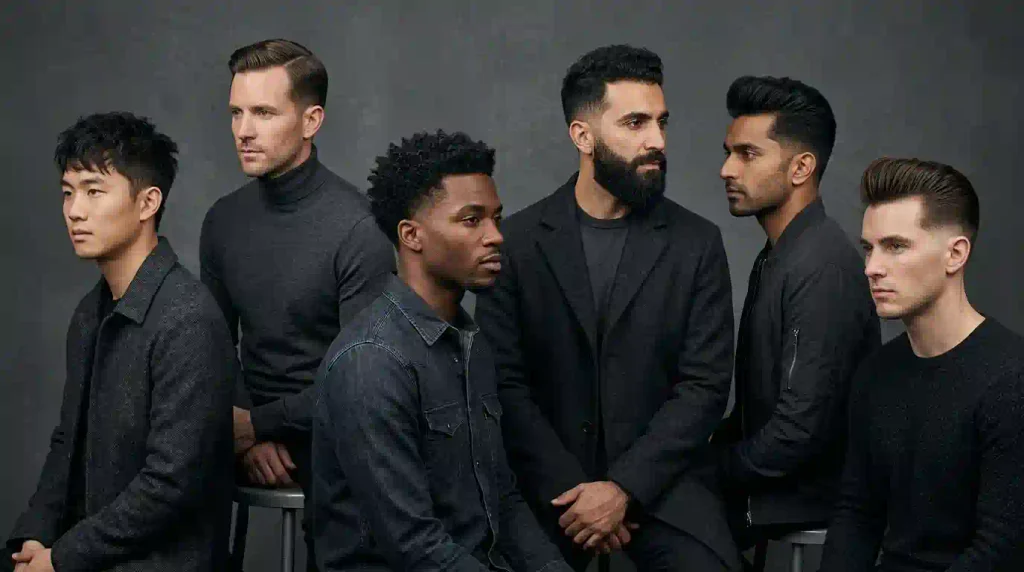
Taper With a Beard Blend
A taper with a beard can create a smooth connection between head hair and facial hair.
Instead of ending the haircut abruptly at the sideburns, the barber gradually transitions into the beard.
This is commonly called a beard blend.
A low taper with short stubble creates a subtle appearance.
A mid taper can provide stronger definition when paired with a full beard.
The shape of the beard also influences facial proportions.
A fuller beard around the jaw can add visual weight to a narrow lower face.
A shorter, carefully shaped beard may create a cleaner outline.
The transition should look intentional rather than disconnected.
Recommended barber instruction: “Give me a low taper and blend the sideburns naturally into my beard without creating a harsh line.”
Taper Styles for Different Ages and Dress Codes
A taper haircut can work across different age groups because the graduation can be adapted to the desired appearance.
For younger boys, a simple crew cut or short textured top with a low taper can provide a tidy, manageable hairstyle.
For teenagers, textured crops, curls, quiffs, and other contemporary styles can be paired with low or mid tapers.
For adults, the choice may depend more on workplace expectations and daily styling preferences.
A classic taper with a side part is a versatile professional option.
A low taper with textured hair can provide a relaxed but polished appearance.
For older men, a soft taper can complement gray hair, thinning hair, or a traditional scissor-cut top.
There is no fixed age at which a particular taper becomes inappropriate.
The haircut should reflect the individual’s preferences, hair characteristics, and grooming routine.
For military-inspired styles, a short taper may resemble a regulation cut, but official military grooming standards vary by service and may change over time.
A haircut should not be assumed compliant solely because a barbershop describes it as military-style.
How Barbers Cut a Taper
Creating a smooth taper requires control over hair length, blending, and natural growth direction.
Professional barbers use different tools depending on the desired result.
A classic taper may rely heavily on scissors and guarded clippers.
A skin taper may require additional detailing with trimmers or specialized finishing tools.
The overall goal is to connect different lengths without creating visible steps.
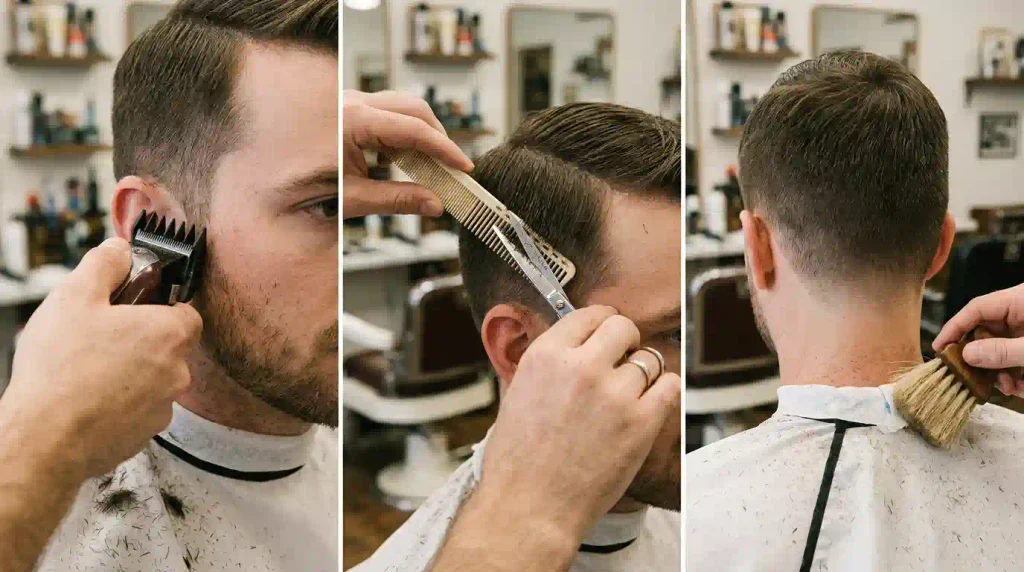
Clipper and Scissor Techniques for Blending
A barber usually begins by evaluating the client’s hair density, texture, and head shape.
The top hairstyle and overall silhouette are established before the shorter perimeter is finalized.
Clippers are commonly used to create the basic graduated lengths.
Different guard attachments allow the barber to cut hair to approximate measurements.
The clipper lever provides smaller adjustments between lengths.
A controlled flicking motion can help soften the transition between two cutting areas.
Scissor-over-comb techniques may be used to blend fuller side sections into shorter hair.
For longer traditional tapers, scissors can create a natural transition without excessive clipper work.
A trimmer may be used for sideburns and neckline detailing.
A straight razor or foil shaver may be used when a skin-level finish is requested and appropriate for the scalp.
The barber should also examine the haircut from multiple angles.
An even blend should appear consistent rather than identical in every small measurement.
Clipper Guard Numbers and Approximate Lengths
Clipper guard numbers help communicate the approximate length of hair left after cutting.
Smaller guard numbers generally leave shorter hair.
Common approximate measurements include:
| Clipper Guard | Hair Length | Typical Appearance |
| #0.5 | 1.5 mm | Very short stubble |
| #1 | 3 mm | Closely cropped |
| #2 | 6 mm | Short visible hair |
| #3 | 10 mm | Fuller short length |
| #4 | 13 mm | Natural short appearance |
| #5 | 16 mm | Fuller side hair |
| #6 | 19 mm | Longer guarded length |
| #7 | 22 mm | Substantial short-hair length |
| #8 | 25 mm | Approximately one inch |
These measurements are approximate.
Not every clipper system uses identical guard sizes.
A traditional taper may involve several progressively shorter cutting lengths near the perimeter.
However, there is no single guard sequence required for every taper.
The correct approach depends on hair density, growth direction, and desired finish.
Why Guard Numbers Can Vary by Barber and Clipper
Guard numbers are useful, but they are not perfectly standardized across all equipment.
Different clipper brands may have slightly different attachment lengths.
Blade adjustments also affect the final cutting length.
Some clippers have adjustable levers that change the blade position.
A no-guard clipper cut can leave short stubble rather than bare skin.
A trimmer or foil shaver may create a closer finish.
For this reason, asking for a “#1 taper” does not provide a complete description.
You should also explain how high the taper should reach and whether you want visible scalp.
A photograph can help communicate the desired result more accurately than guard numbers alone.
Choosing a Natural, Tapered, Blocked, or Rounded Neckline
The neckline influences how the haircut appears from the back.
A natural neckline follows the existing growth pattern with relatively little artificial reshaping.
A tapered neckline gradually shortens the hair toward the nape.
A blocked neckline creates a clear lower boundary.
A rounded neckline uses a curved outline rather than sharp corners.
A blocked neckline can be squared or rounded.
These options affect both appearance and maintenance.
A natural or softly tapered neckline generally produces a gradual grow-out.
A sharply blocked neckline may reveal new growth below the original outline more clearly.
If you prefer fewer touch-ups, a natural tapered neckline may be suitable.
If you prefer a crisp geometric shape, a blocked neckline may match your style.
Shaping the Sideburns and Hairline
Sideburns are a defining part of many taper haircuts.
A barber may shorten the sideburns gradually or blend them into facial hair.
The ideal length depends on personal preference and the overall haircut.
A line-up can add definition around the temples and forehead.
However, a line-up should respect the natural hairline.
Pushing the outline too far backward can create an artificial shape that becomes more noticeable as hair grows.
For men with a receding or uneven hairline, a softer finish may be preferable.
The aim is to enhance the natural outline rather than remove unnecessary hair.
What to Tell Your Barber
Clear communication is one of the most important steps in getting the taper haircut you want.
Simply saying “give me a taper” may not provide enough information.
Different barbers can interpret the same haircut name differently.
A complete request should explain the taper height, shortest length, hairstyle on top, side fullness, and neckline shape.
How to Specify Taper Height, Length, and Finish
Start by choosing where you want the shortest graduation.
A low taper stays near the lower temples and nape.
A mid taper brings the graduation higher.
A high taper creates more prominent contrast.
Next, explain how short you want the perimeter.
For a natural finish, ask to retain visible hair.
For a sharper result, request a closer taper fade or skin-level finish.
Then specify the hairstyle on top.
For example:
“I want a low taper with a textured top, keeping approximately three inches of hair above and leaving a natural neckline.”
This instruction communicates far more than the haircut name alone.
Barber Request Examples for Low, Mid, and High Tapers
Low taper request:
“I want a low taper around my temples and neckline. Keep the sides full, leave enough length on top for a textured crop, and don’t take the edges down to skin.”
Mid taper request:
“Give me a mid taper with a smooth transition and moderate contrast. Keep enough length on top for a quiff and preserve some fullness above the blend.”
High taper request:
“I want a high taper with noticeable contrast, but please don’t turn it into a full high skin fade. Keep the top textured and make sure the transition is smooth.”
Classic taper request:
“I’d like a traditional classic taper with a neat side part. Keep the upper sides relatively full and finish with a natural tapered neckline.”
Curly taper request:
“Keep my curls and natural volume on top. Taper the temples and nape without taking too much hair from the sides.”
The exact wording can be adjusted according to your hairstyle.
The important point is to describe the finished result clearly.
Barber Consultation Checklist: Height, Length, Neckline, and Sideburns
Before the haircut begins, confirm the following details:
- Taper type: Classic, low, mid, high, temple, or fade.
- Shortest length: Visible hair, close stubble, or skin.
- Top hairstyle: Crew cut, side part, crop, quiff, curls, or another style.
- Top length: How much hair should remain.
- Side fullness: Whether the upper sides should stay relatively full.
- Neckline: Natural, tapered, squared, or rounded.
- Sideburns: Short, natural, or blended into facial hair.
- Hairline: Natural outline or defined line-up.
- Maintenance: How frequently you can return.
- Reference photos: Front, side, and back views.
This checklist helps prevent misunderstandings before the barber removes any hair.
Questions to Confirm Before the Cut Begins
Ask your barber where the taper will start.
Confirm whether the shortest section will expose skin.
Ask how much length will be removed from the top.
Discuss how the haircut will behave with your natural hair texture.
If you have a cowlick or unusual growth direction, ask how it will affect the shape.
For longer hair, confirm that the barber will preserve sections you are growing out.
You should also discuss the neckline.
A natural tapered neckline may grow out differently from a sharply blocked shape.
If you’re uncertain, ask the barber to explain the proposed haircut before cutting.
An experienced professional should be able to describe the expected result and any adjustments needed for your hair.
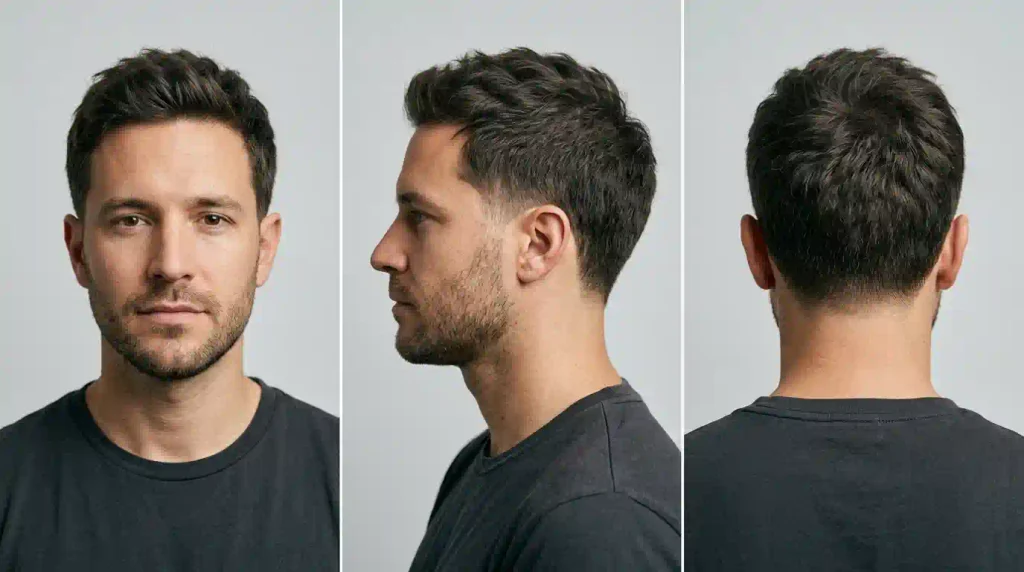
How to Choose and Use a Clear Reference Photo
A haircut photograph is most useful when it shows the details you want to reproduce.
The front view shows the hairstyle on top, fringe, and hairline.
The side view reveals taper height, blending, and side fullness.
The back view shows the neckline and nape.
Try to choose photographs featuring hair texture similar to yours.
A dense curly taper may look different from the same haircut on fine straight hair.
If you prefer the top from one photograph and the taper from another, explain that distinction.
Do not assume the barber will know which part of the picture you like.
A clear reference helps, but the final haircut should still be adapted to your face shape, head contour, and growth pattern.
How to Style a Taper Haircut
A taper haircut can be simple to style, but the hairstyle on top determines the amount of daily effort required.
A buzz cut may need no styling product.
A textured crop might require a small amount of matte paste.
A quiff or pompadour may need a blow dryer and additional control.
The goal is to choose a routine that supports your natural hair texture.
Styling Short, Medium, and Long Hair on Top
Short Hair
For a short taper with a crew cut or textured crop, begin with clean, slightly damp hair.
Apply a small amount of matte clay or paste if needed.
Use your fingers to create light separation through the top.
Avoid applying excessive product, especially if your hair is fine.
A buzz cut may not require any styling product at all.
Medium-Length Hair
Medium-length hairstyles provide more styling options.
For a quiff, use a blow dryer to lift the front.
For a side part, comb the hair into the desired direction.
For a pompadour, use a brush and controlled airflow to create volume.
Choose a product according to the amount of hold and shine you prefer.
Long Hair
Longer taper hairstyles often benefit from softer products.
A lightweight styling cream can support natural flow.
Curly hair may benefit from suitable curl cream or leave-in conditioner.
For tied hairstyles, avoid pulling the hair tightly enough to create discomfort or excessive tension.
The taper itself generally requires little daily styling, but the longer top may need additional care.
Styling Products and Techniques
The right styling product depends on hair texture and desired finish.
| Styling Product | Suitable Hairstyles | Main Purpose |
| Matte clay | Textured crops, quiffs, crew cuts | Texture and control |
| Hair paste | Short and medium hairstyles | Flexible shaping |
| Pomade | Side parts, slick backs, pompadours | Hold and shine |
| Styling cream | Wavy hair, natural flow | Soft movement |
| Mousse | Fine hair, quiffs | Volume |
| Texture powder | Short or medium straight hair | Root lift |
| Curl cream | Curly and coily hairstyles | Curl definition |
| Leave-in conditioner | Dry, curly, or longer hair | Conditioning and manageability |
| Hair oil | Some dry hair types | Softness and conditioning |
| Gel | Defined or structured hairstyles | Stronger hold |
Use products sparingly until you understand how your hair responds.
A blow dryer can help establish direction and volume.
Use moderate or low heat rather than unnecessarily high temperatures.
For curls, a diffuser may help preserve natural definition.
For thick hair, careful blow-drying can control unwanted volume.
For fine hair, lightweight products are generally preferable to heavy waxes and oils.
A Simple Daily Styling Routine
A basic daily routine does not need to be complicated.
Step 1: Assess your hair. Determine whether it needs washing, light dampening, or simply reshaping.
Step 2: Start with the natural growth direction. Work with the way your hair falls rather than forcing it into an unsuitable shape.
Step 3: Apply a small amount of product. Focus on the top hairstyle rather than coating the short tapered edges unnecessarily.
Step 4: Shape the hair. Use your fingers, comb, brush, or blow dryer according to the hairstyle.
Step 5: Check the silhouette. Examine the front and side to ensure the top volume looks balanced with the taper.
Step 6: Avoid excessive manipulation. Repeated brushing, aggressive heat, or heavy product layering can make the hair harder to manage.
For many short taper hairstyles, this process takes only a few minutes.
Longer or more structured hairstyles may require additional time.
Taper Haircut Maintenance, Grow-Out, and Cost
The maintenance requirements of a taper depend on the style and shortest cutting length.
A classic taper generally grows out more softly than a closely shaved skin taper.
However, the hairstyle on top can also affect how frequently you need a trim.
Choosing a suitable maintenance schedule helps keep the haircut balanced.
Touch-Up Schedule for a Crisp Versus Natural Look
If you prefer extremely sharp edges, you may need more frequent appointments.
A skin taper can lose its freshly shaved appearance within a relatively short period.
A classic taper may remain presentable for several weeks.
| Taper Style | Typical Touch-Up Interval |
| Skin taper | 1–2 weeks for a very sharp finish |
| Low taper fade | 2–3 weeks |
| Mid taper | 2–4 weeks |
| High taper | 2–3 weeks |
| Classic taper | 3–5 weeks |
| Longer hairstyle with subtle taper | 4–6 weeks |
These are approximate guidelines.
Your hair growth rate, preferred neatness, and styling habits may justify shorter or longer intervals.
What to Expect as a Taper Grows Out
As hair grows, the shortest sections gradually become fuller.
A classic taper typically loses its crisp outline but maintains a relatively natural silhouette.
A skin taper begins showing visible stubble.
A mid or high taper may develop additional bulk near the upper sides as the graduated sections grow.
The top hairstyle also changes.
A short fringe becomes longer.
A quiff may require additional control.
A pompadour can become heavier.
Instead of judging the haircut only by the edges, evaluate its overall shape.
If the top and sides still look balanced, a full haircut may not yet be necessary.
How to Maintain the Outline Between Barber Visits
A few simple habits can help keep a taper looking tidy.
Wash your hair according to your scalp condition and hair texture.
Use conditioner when appropriate.
Avoid excessive heat styling.
If you use pomade, clay, or other styling products regularly, cleanse as needed to prevent buildup.
A clarifying shampoo may occasionally help remove stubborn product residue, but it should not be overused if it leaves your hair dry.
For dry hair or scalp, use a suitable moisturizing product rather than automatically applying heavy oil.
The American Academy of Dermatology’s healthy hair-care tips provide guidance on choosing products for different hair types, conditioning, gentle detangling, and reducing heat damage.
For the neckline, avoid repeatedly trimming into the original blend.
Removing too much hair at home can create an uneven shape.
If the perimeter needs reshaping, a professional touch-up is usually safer than attempting complex clipper blending without experience.
What Affects the Price of a Taper Haircut?
The cost of a taper haircut varies according to location, barber experience, haircut complexity, and additional services.
In the United States, many standard barbershop haircuts may cost approximately 30–65, although simpler cuts can cost less and premium services can cost substantially more.
These figures are general planning estimates, not fixed prices.
A classic taper may require less detailed finishing than a skin taper with a line-up and beard blend.
Longer scissor-cut hairstyles may also take more time.
Additional services can increase the total cost.
Examples include beard shaping, hair washing, styling, razor detailing, and customized designs.
When comparing barbers, prioritize experience with your hair texture and the particular taper you want.
A higher price does not automatically guarantee a better haircut.
What to Confirm When Booking
Before scheduling an appointment, check whether the service includes the top haircut and taper detailing.
Some barbers may categorize skin fades separately from standard cuts.
Ask whether beard blending costs extra.
Confirm whether washing or styling is included.
If you want a design, line-up, or razor finish, mention it before booking so sufficient time can be allocated.
You may also want to review recent examples of the barber’s work.
A portfolio showing clean transitions and consistent results is more informative than haircut names alone.
Common Taper Haircut Mistakes and How to Fix Them
A disappointing taper haircut often results from unclear instructions or an unsuitable combination of taper height and top hairstyle.
Understanding common mistakes can help you avoid unnecessary corrections.
What to Do About an Uneven Blend or an Overly High Taper
An uneven blend may appear as a visible dark band, disconnected patch, or noticeable difference between the two sides.
Comparing the different blending techniques and heights shown in our Core Taper Haircuts collection can help you identify where the transition differs from the intended style.
If you notice the problem during the appointment, ask the barber to evaluate it.
A minor transition issue may be correctable with careful blending.
However, corrections can require removing additional hair.
If the taper is already too high, cutting more hair may make the result worse.
A high taper cannot be lowered immediately once the relevant hair has been removed.
In that situation, regrowth is the main solution.
You may be able to adjust the styling on top temporarily to create a more balanced appearance.
When to Return to the Barber and When to Let It Grow
Return to the barber when the haircut has a correctable problem, such as a visible blending line or uneven neckline.
Ask how the correction will affect the overall length.
If the haircut is substantially shorter than requested, waiting may be preferable.
As the hair grows, the contrast generally becomes softer.
Avoid requesting repeated corrective trims that continually remove more hair from the problem area.
Take photographs of the haircut and identify what you disliked.
At your next appointment, explain the desired adjustment.
For example:
“Last time the taper reached too high above my ears. This time, keep the blend lower and preserve more hair through the sides.”
This feedback helps the barber understand the difference between your original request and the actual result.
What Not to Try Fixing at Home
Avoid trying to recreate an entire taper fade without the necessary experience.
Professional blending involves controlling multiple clipper lengths, lever settings, and cutting angles.
Attempting to remove one visible line can create a larger uneven area.
Do not repeatedly shave the neckline higher to make it appear straighter.
Avoid pushing the natural hairline backward with a trimmer.
If you have skin irritation after a very close taper, avoid further shaving of the affected area until it has settled.
For persistent irritation or recurring bumps, seek appropriate professional advice.
A small haircut imperfection is often easier to correct than a large section removed during an unsuccessful home adjustment.
Professional Tips for Getting the Taper You Want
The most successful taper haircuts begin with realistic expectations and clear communication.
Before visiting your barber, decide what you want the haircut to achieve.
Do you want a professional appearance, stronger contrast, or a low-maintenance style?
Choose the taper height based on that goal.
If you are uncertain, begin with a conservative low or classic taper.
You can request a shorter or higher graduation later, but removed hair cannot be immediately restored.
Consider how your natural hair behaves.
Straight hair may make blending lines more visible.
Thick hair may require careful weight control.
Curly and coily hair may shrink considerably when dry.
Fine or thinning hair may benefit from preserving additional side fullness.
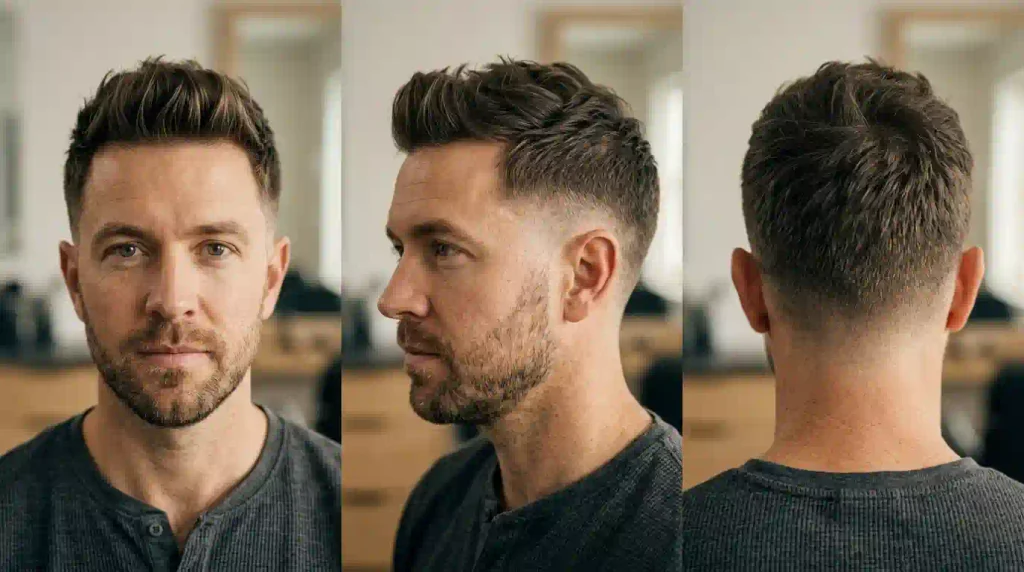
Bring multiple reference photographs.
The front shows the top hairstyle.
The side reveals taper height.
The back shows the neckline.
Tell your barber which details from the photographs matter most.
Also consider how the haircut will look after two or three weeks of growth.
A style that remains balanced during regrowth may be more practical than one that depends on freshly shaved edges.
If you are still comparing options, our best taper haircut guide can help you choose according to face shape, hair texture, and styling preferences.
Frequently Asked Questions
Is a Taper the Same as a Fade?
No. A traditional taper usually concentrates shortening near the sideburns and neckline, while a fade generally blends a larger area of the sides and back.
Which Taper Height Should I Choose?
A low taper is a practical starting point for subtle styling, while mid and high tapers create progressively stronger contrast.
Does a Taper Work With Curly or Thin Hair?
Yes. Low and temple tapers work well with curls, while classic or subtle tapers can create balanced proportions for fine or thinning hair.
How Long Does a Taper Haircut Last?
A taper generally remains reasonably neat for about two to four weeks, although softer classic tapers may remain presentable longer.
Can I Grow a Taper Into a Longer Hairstyle?
Yes. A classic or low taper can support hair growth, although previously shortened side sections need time to catch up with longer hair.
Can I Cut or Maintain a Taper at Home?
Simple grooming is possible at home, but creating a smooth professional taper requires clipper control and blending experience.
What Is the Difference Between a Classic Taper and a Regulation Cut?
A classic taper describes gradual hair shortening, while a regulation cut is a broader short-haircut style associated with military-inspired grooming; actual military compliance depends on current service rules.
Final Thoughts
A taper haircut is a versatile choice for anyone who wants a clean, balanced hairstyle without committing to an aggressive full fade. From classic and low tapers to mid, high, temple, and skin variations, the right cut depends on your face shape, natural hair texture, head contour, and grooming routine. A subtle taper can complement a professional side part, while a closer taper fade can add definition to a textured crop, quiff, or curly top. Before visiting your barber, decide how high the taper should reach, how much hair to preserve, and what neckline finish you prefer. Bring clear reference photos and explain the result you want from every angle. With the right consultation and maintenance routine, a taper can remain stylish, practical, and easy to wear as your hair grows.



4 Comments