
Skin Taper Haircut: Styles, Barber Guide, and Maintenance
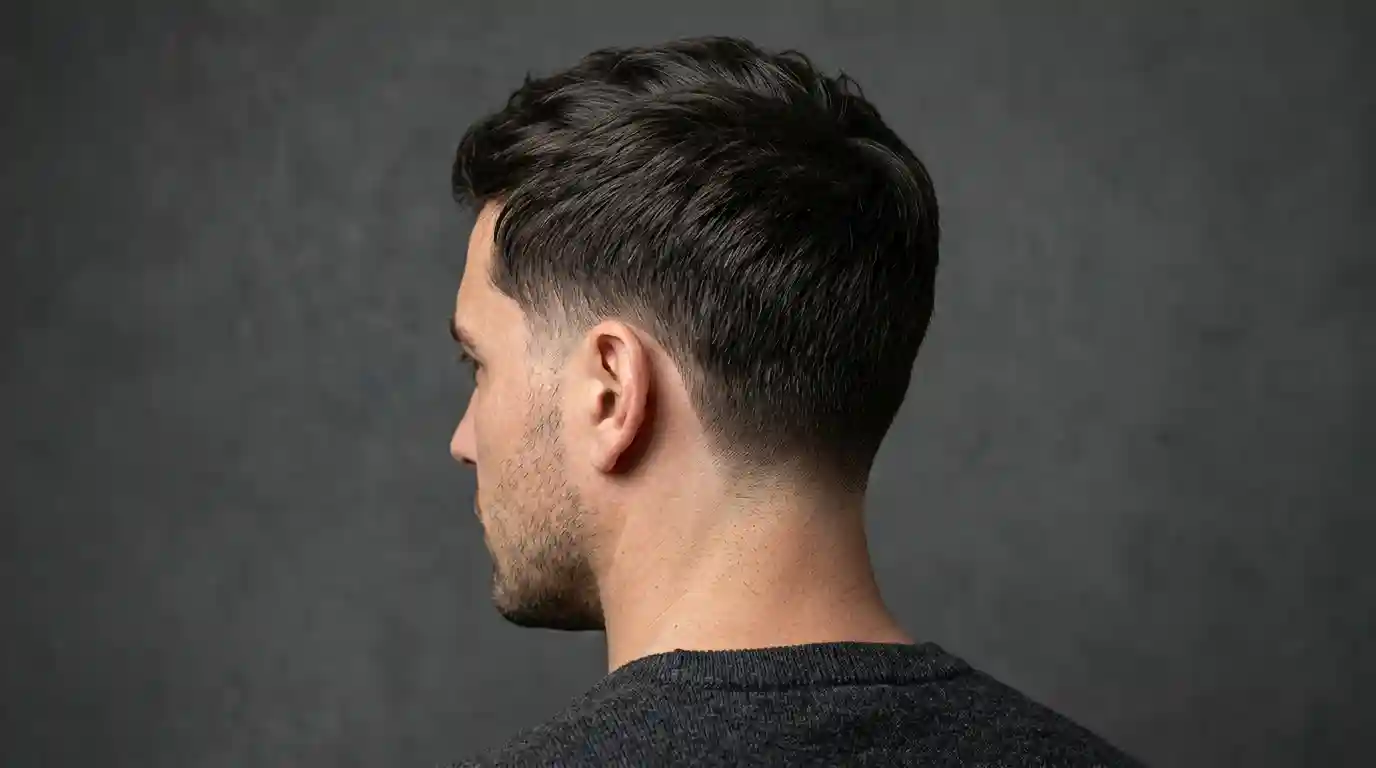
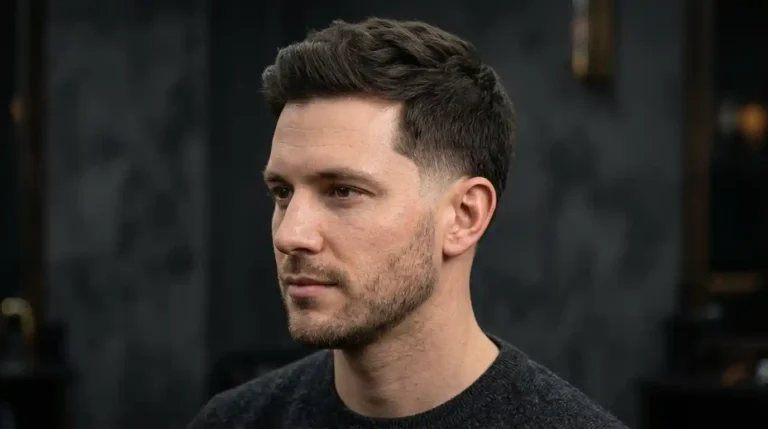
The skin taper haircut is a sharp, modern men’s hairstyle that combines gradual blending with clean, skin-level finishing around the sideburns, temples, and neckline. Unlike a traditional taper that leaves short hair at the edges, a skin taper blends selected areas down to bare or nearly bare skin while preserving more length throughout the upper sides and back. This creates a precise, high-contrast appearance without necessarily removing as much hair as a full skin fade.
Whether you prefer a low skin taper with a textured crop, a temple skin taper with natural curls, or a bald taper haircut paired with a pompadour, the style offers considerable flexibility. It can complement straight, wavy, curly, and coily hair, and its placement can be adjusted to suit different face shapes and grooming preferences.
However, a skin taper is not exactly the same as a low skin fade, and understanding the difference can prevent an unwanted haircut. This guide explains skin taper haircut styles, fade placement, barber instructions, suitable hair types, maintenance, pricing, and scalp-care considerations so you can choose the right variation before your next appointment.
Table of Contents
- What Is a Skin Taper Haircut?
- Skin Taper vs. Similar Haircuts
- Skin Taper Placement and Variations
- Skin Taper vs. Low Skin Fade: Visual Guide
- Popular Skin Taper Hairstyles
- How to Choose a Skin Taper
- How to Explain a Skin Taper to Your Barber
- How Barbers Create a Skin Taper
- Adjusting a Skin Taper for Hairlines and Growth Patterns
- How to Style a Skin Taper
- Skin Taper Maintenance and Grow-Out
- Skin Taper Cost in the United States
- Benefits and Trade-Offs of a Skin Taper
- Skin Taper Haircut FAQs
- Final Thoughts
What Is a Skin Taper Haircut?
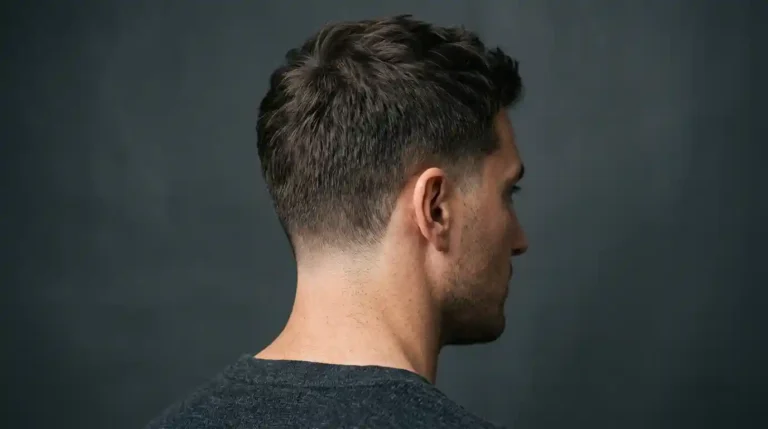
A skin taper haircut is a variation of the traditional taper in which the hair gradually becomes shorter near selected areas of the head until it reaches bare or nearly bare skin.
The taper usually concentrates on the temples, sideburns, and neckline rather than extending across the entire sides and back.
The word skin describes the shortest finish, while taper describes the gradual reduction in hair length.
Together, they create a precise transition that combines the clean appearance of a skin fade with the more conservative placement of a traditional taper.
A skin taper fade can be subtle when the faded area is small or dramatic when the transition extends higher.
It is particularly popular with textured tops, curls, waves, afros, comb-overs, and short modern hairstyles.
How a skin taper blends down to bare skin
The defining characteristic of a skin taper is its smooth transition from longer hair into a skin-level finish.
The barber begins with a very short section near the hairline and gradually blends upward using different clipper lengths.
The shortest point may be finished with a trimmer, foil shaver, or razor, depending on the desired result and the client’s skin sensitivity.
Above this section, progressively longer clipper guards are used to create a smooth gradient.
A successful skin taper should not have noticeable lines, harsh steps, or uneven dark patches.
The hair should appear to transition naturally from bare skin into short stubble and eventually into the longer surrounding sections.
The result is a clean, defined finish that emphasizes the shape of the hairline without requiring the entire side of the head to be shaved.
Where the taper sits: sideburns and neckline
A conventional skin taper usually focuses on two main areas.
The first is the sideburn and temple region.
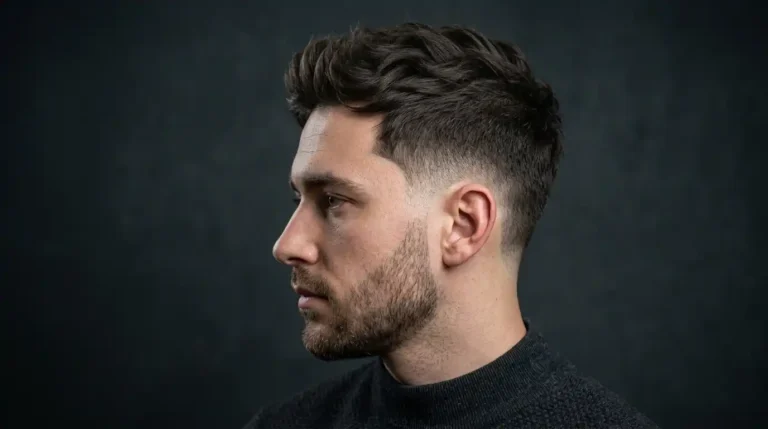
Here, the barber gradually reduces the hair length toward the lower sideburns, creating a small faded section beside the ear.
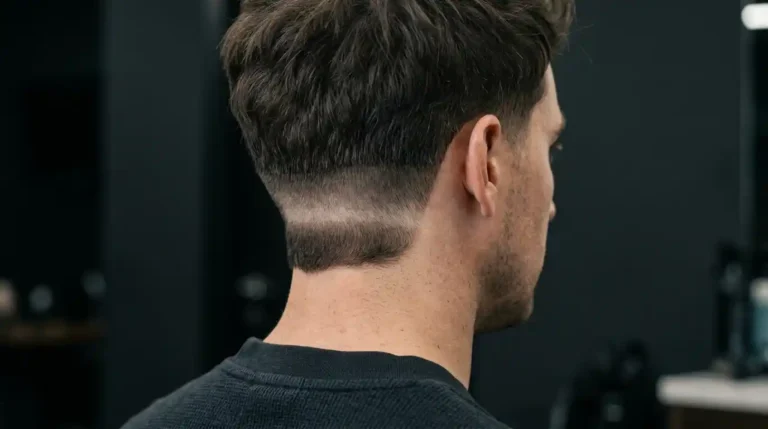
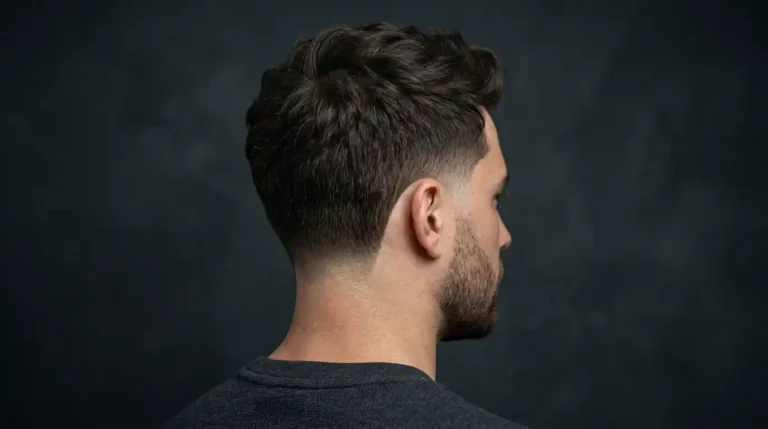
The second is the neckline or nape.
The hair becomes progressively shorter toward the lower neck, eventually reaching a skin-level finish.
Depending on the haircut, these faded areas may remain separate rather than connecting through a continuous fade across the sides.
This localized approach distinguishes a skin taper from many full skin fades.
The exact placement depends on the desired taper height and the natural shape of the head.
A low skin taper concentrates on the lower edges, while a higher variation removes more hair around the temples or upper nape.
How a skin taper keeps more length on the sides
One of the biggest advantages of a skin taper is the amount of hair it can preserve.
Unlike a conventional skin fade that may remove a significant portion of the sides and back, a skin taper can leave most of these areas relatively full.
For example, a man with medium-length hair may keep several inches on the upper sides while only the sideburns and lower neckline are tapered down to skin.
This creates a balanced silhouette that combines sharp detailing with natural volume.
The extra side length can also support hairstyles that require fuller proportions, including a side part, comb-over, pompadour, or textured fringe.
For curly and coily hair, maintaining this coverage helps preserve the natural shape of the hairstyle.
A well-planned skin taper should therefore emphasize the perimeter without unnecessarily changing the overall haircut.
Skin Taper vs. Similar Haircuts
Skin tapers share techniques with traditional tapers, skin fades, and other modern styles, but their placement and amount of scalp exposure can differ.
Understanding these differences helps you explain exactly what you want to your barber.
Skin taper vs. regular taper
A regular taper gradually reduces hair length near the perimeter of the head.
However, it does not necessarily expose bare skin.
The shortest section may retain visible stubble or a longer guarded finish.
A skin taper takes the shortest section further, creating a bald or nearly bald finish near the sideburns and neckline.
Both haircuts can preserve considerable length throughout the sides.
The main difference is the shortest cutting length.
A regular taper is usually more understated, while a skin taper creates greater contrast at the edges.
Choose a regular taper if you want clean blending without visible scalp exposure.
Choose a skin taper if you prefer sharper perimeter definition.
Skin taper vs. low taper
A low taper describes where the gradual transition is positioned.
It normally concentrates on the lower hairline, temples, and neckline.
However, a low taper can finish at different cutting lengths.
A low skin taper combines this conservative placement with bare-skin finishing.
Therefore, low and skin describe different features of the same haircut.
The word low identifies the fade height, while skin identifies the shortest length.
A low skin taper can provide strong definition without removing excessive hair from the sides.
Skin taper vs. taper fade
A taper fade gradually reduces hair length and often blends more visibly into the surrounding hairstyle.
Depending on the barber, the term may describe a localized taper or a more extensive fade.
A skin taper specifically identifies a skin-level finish at the shortest point.
The two terms can overlap when a taper fade is cut down to bare skin.
However, not every taper fade is a skin taper.
Some taper fades stop at a short guarded length.
If you ask for a taper fade without specifying the shortest finish, your barber may choose a different level of scalp exposure than you expect.
Skin taper vs. skin fade and bald fade
A skin fade, also called a bald fade, gradually blends hair down to bare skin.
The difference between a skin taper and a full skin fade is primarily the area being faded.
A skin taper generally concentrates on the temples, sideburns, and neckline.
A full skin fade usually extends across a larger portion of the sides and back.
| Feature | Skin Taper | Full Skin Fade |
| Shortest length | Bare or nearly bare skin | Bare or nearly bare skin |
| Main cutting area | Temples, sideburns, neckline | Larger sections of sides and back |
| Side coverage | Usually more hair preserved | Usually more hair removed |
| Overall contrast | Localized, sharp transitions | More extensive high contrast |
| Top styling | Highly flexible | Highly flexible |
| Professional appearance | Often easier to keep subtle | Depends on fade height |
| Grow-out | Localized regrowth | Wider faded area grows out |
| Maintenance | Regular edge touch-ups | Often more extensive fade touch-ups |
The skin fade taper haircut combines elements of both approaches, but terminology varies between barbershops.
For the most accurate result, describe how much of the sides should be faded rather than relying only on the haircut name.
Skin taper vs. undercut
An undercut creates a noticeable difference between longer hair on top and much shorter hair around the sides.
The transition may be disconnected rather than gradually blended.
A skin taper, by contrast, uses a progressive change in length.
The upper sides can remain relatively full, while only the edges receive the skin-level treatment.
An undercut can be combined with a skin taper, but the two techniques serve different purposes.
Choose an undercut for a stronger separation between the top and sides.
Choose a skin taper when you want cleaner edges without necessarily creating a disconnected hairstyle.
Skin taper vs. drop taper and burst taper
A skin taper describes the shortest finish, while drop and burst tapers describe different fade shapes.
A drop taper haircut uses a descending curve behind the ear that follows the natural contour of the head.
A burst fade taper haircut creates a semicircular transition concentrated around the ear.
Both can incorporate skin-level finishing.
A drop skin taper may feature a small curved section descending toward the nape.
A burst skin taper may expose bare skin within the semicircular area surrounding the ear.
The best choice depends on whether you prefer a traditional perimeter taper, a descending fade curve, or a rounded ear-framing shape.
Skin Taper Placement and Variations
Skin tapers are available in different heights and placements.
The variation you choose determines how much hair is removed and how noticeable the transition becomes.
Low skin taper
The low skin taper haircut is one of the most versatile and restrained variations.
The skin-level area remains close to the sideburns and lower neckline.
The barber creates a smooth transition into longer hair above, preserving most of the side coverage.
This produces a clean outline without dramatically changing the overall hairstyle.
A low skin taper works particularly well with textured crops, side parts, curls, afros, waves, and medium-length tops.
It is also a practical option for men who want the sharpness of a bald taper haircut while maintaining a professional appearance.
Because the fade remains low, the haircut can grow out more naturally than a higher skin fade.
Best for: First-time skin taper wearers, professional grooming, and people who want more hair preserved around the sides.
Styling tip: Pair the cut with a short textured top or neatly combed hairstyle to emphasize its clean perimeter.
Mid skin taper
A mid skin taper extends the blended area higher around the temples and neckline.
The skin-level section becomes more noticeable, creating stronger contrast between the shortest and longer hair.
This version removes more bulk near the lower sides while preserving some fullness above.
A mid skin taper can complement quiffs, textured crops, curly hairstyles, and short modern cuts.
The barber should balance the fade placement with the head shape to avoid removing excessive hair near the temples.
Best for: Men who want a noticeable fade without committing to a full mid skin fade.
Styling tip: Maintain moderate volume on top to balance the cleaner sides.
High skin taper
A high skin taper positions the transition farther upward around the temples or back.
This creates a larger area of short hair and stronger contrast.
However, the term can overlap with a high skin fade when the blending extends across most of the sides.
If you want a high taper rather than a full fade, explain which areas should remain longer.
A high skin taper works well with high-volume curls, thick textured tops, pompadours, and certain mohawk-inspired hairstyles.
It may require more frequent barber touch-ups because the visible contrast changes as the hair grows.
Best for: Bold hairstyles, thick hair, and people who prefer pronounced fading.
Styling tip: Avoid excessive top height if the shortened sides already make the head appear narrow.
Temple skin taper
A temple skin taper concentrates on the front sideburn and temple area.
The shortest section reaches skin level near the sideburns before gradually blending into the surrounding hair.
The neckline may remain natural or receive a separate taper.
This creates a sharp front-side outline without removing much hair elsewhere.
A temple taper haircut provides a related option if you want to explore different temple-focused blending techniques.
Temple skin tapers are particularly suitable for afros, waves, twists, locs, and hairstyles that benefit from a clean perimeter.
Best for: Men who want defined temples while preserving natural side volume.
Skin taper mullet
A skin taper mullet combines closely tapered temples or neckline details with longer hair toward the rear.
The longer back creates the mullet silhouette, while the skin taper keeps selected perimeter areas clean.
The barber must decide whether the nape should remain long or receive skin-level blending.
An aggressive nape taper may remove too much length and change the appearance of the mullet.
For this reason, many skin taper mullets emphasize the temples while preserving the rear section.
Curly, wavy, and textured mullets can all complement this variation.
Best for: Modern mullets, medium-length textured hairstyles, and people who want a combination of clean edges and longer hair.
Styling tip: Use lightweight styling cream to maintain movement through the longer rear section.
Skin Taper vs. Low Skin Fade: Visual Guide
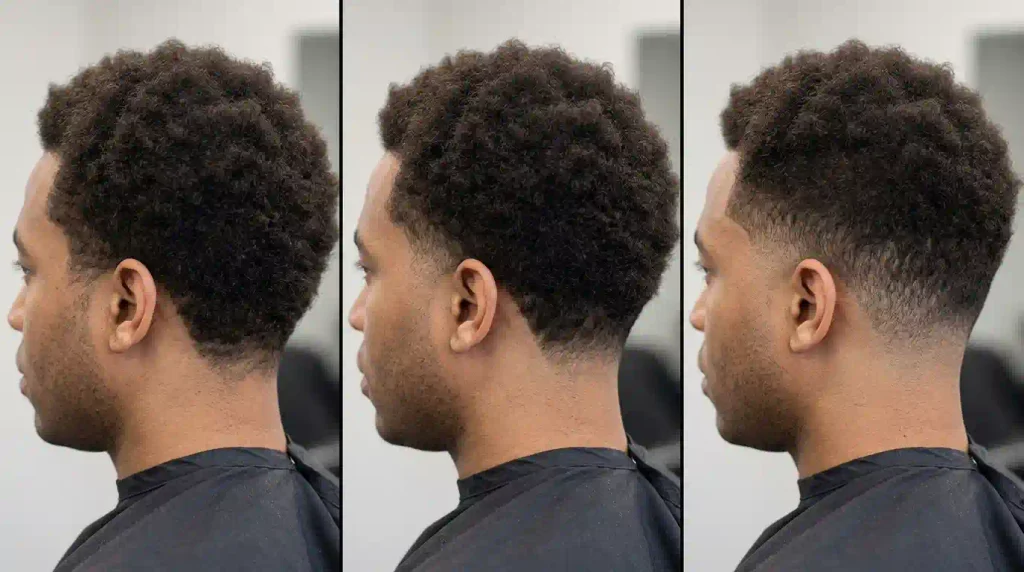
A skin taper and low skin fade can appear similar, especially when both use skin-level finishing.
The difference becomes easier to recognize when examining the sides and back.
Where the bare-skin area begins and ends
In a skin taper, the bare-skin area is generally concentrated around the lower sideburns and nape.
It may consist of relatively small faded sections.
In a low skin fade, the skin-level transition usually continues more extensively around the lower sides and back.
Both can begin close to the lower hairline, but the amount of connected fading differs.
A taper haircut low skin fade combination may retain a relatively small skin-level area while connecting the transition more broadly around the rear.
Because barbers use these terms differently, visual references are important.
How much hair remains on the sides
A skin taper typically preserves more hair between the temples and back of the head.
The upper sides may remain at scissor-cut length while the sideburns and neckline are tapered.
A low skin fade normally creates a continuous short-to-long gradient around more of the lower head.
If preserving side length is important, a skin taper is usually the more conservative option.
Front, side, and back view comparison
From the front, a skin taper may show small clean transitions at the temples.
A low skin fade may produce a more noticeable short section along the lower sides.
From the side, the skin taper’s localized sideburn blend becomes easier to identify.
From the back, the skin taper may show a separate nape transition, while a low skin fade generally continues across a broader area.
When choosing between them, ask your barber to show the haircut from the side and rear.

Popular Skin Taper Hairstyles
A skin taper can complement numerous top hairstyles because it focuses primarily on the edges.
The following combinations work with different hair textures, lengths, and styling preferences.
Textured crop with a skin taper
A textured crop skin taper combines short, layered hair on top with clean skin-level transitions around the perimeter.
The top may feature a slightly uneven fringe, choppy layers, or relaxed texture.
The skin taper provides definition without removing excessive hair from the sides.
This combination creates a modern hairstyle that requires relatively little daily styling.
Thick straight and wavy hair often respond well to textured crops.
For fine hair, the barber should avoid excessive thinning because it may reduce the appearance of density.
Best for: Short hairstyles, natural texture, and men who prefer minimal styling.
Styling tip: Apply a small amount of matte clay or styling paste to dry hair and separate the strands with your fingers.
Side part with a skin taper
A side part skin taper combines classic grooming with modern perimeter fading.
The top is divided along a natural or carefully established parting line.
The hair is directed toward one side while the temples and neckline receive clean skin-level blending.
A low skin taper usually produces the most understated appearance.
A higher variation can add stronger contrast.
The style works particularly well with straight or wavy hair and can complement formal clothing or business-casual environments.
Best for: Professional hairstyles, classic grooming, and medium-length tops.
Styling tip: Use lightweight pomade or styling cream and comb along the natural part.
Slick back or pompadour with a skin taper
A slick back skin taper keeps the top relatively long and directs it toward the back.
The skin taper adds sharp definition around the sideburns and neckline while preserving enough side hair for a smooth overall silhouette.
A pompadour uses a similar concept but introduces greater volume at the front.
The hair is lifted upward and backward, creating a fuller shape.
Both hairstyles benefit from controlled transitions.
A very high skin taper can make the top appear disconnected, so the barber should preserve enough upper-side weight when a classic appearance is desired.
Best for: Medium-length hair, polished hairstyles, and men who enjoy structured styling.
Styling tip: Use a blow dryer for volume, followed by pomade for shine or matte paste for a more natural finish.
Skin taper with curls or waves
A skin taper works particularly well with curly and wavy hair because it creates clean edges while preserving natural texture.
For curly hair, the top can remain full while the sideburns and neckline gradually fade to skin.
The contrast between defined curls and closely tapered edges creates a distinctive silhouette.
For wave hairstyles, including 180 waves and 360 waves, the barber should avoid cutting unnecessarily high into the established pattern.
A low skin taper can preserve more wave coverage.
The barber must also consider curl shrinkage before removing length.
Best for: Natural curls, waves, textured tops, and men who prefer defined perimeter grooming.
Styling tip: Use curl cream or a suitable leave-in conditioner for curls and maintain a consistent brushing routine for wave styles.
Skin taper with an afro, locs, or blowout
A skin taper can complement afro-textured hair by cleaning the perimeter without removing the main volume.
For an afro, the barber may taper the temples and lower neckline while preserving the rounded upper shape.
For locs, the fade should be planned around the existing parting sections.
The barber should avoid removing hair needed to maintain the base of the locs.
For a blowout-style haircut, the skin taper creates contrast beneath a fuller textured top.
Sponge curls can also complement a temple-focused skin taper when the longer hair remains thick and defined.
A low taper often provides the most flexibility because it preserves additional coverage around the sides.
Best for: Afros, locs, sponge curls, blowouts, and natural coily hairstyles.
Styling tip: Maintain hair moisture and avoid excessive pulling or tension near the tapered hairline.
Skin taper with a beard blend
A skin taper with a beard creates a smooth connection between the haircut and facial hair.
The barber may fade the sideburns into the upper beard so the transition appears intentional.
For a short beard, the sideburns may be blended gradually into slightly longer facial hair.
For a full beard, the barber can retain density around the jaw while cleaning the upper connection.
A low skin taper paired with a natural beard can provide a balanced appearance.
The beard blend should complement the face shape rather than create unnecessary gaps between the haircut and facial hair.
Best for: Men with short, medium, or full beards.
Styling tip: Maintain the beard neckline and cheek line while allowing the sideburn connection to remain smooth.
How to Choose a Skin Taper
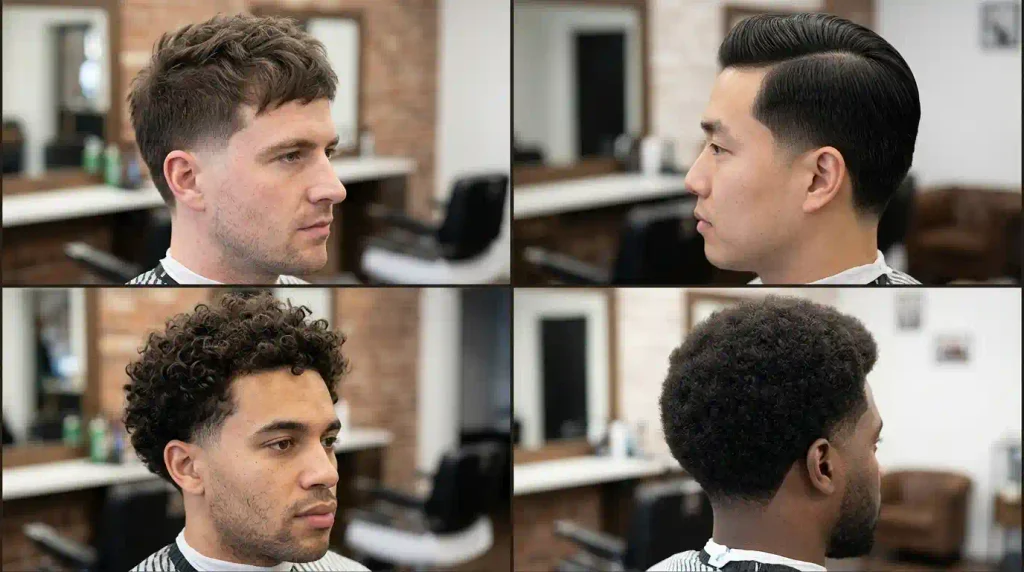
Choosing the right skin taper requires considering the hair texture, facial proportions, fade height, and preferred maintenance routine.
The best version should complement the whole hairstyle rather than simply produce the sharpest possible fade.
Choose placement for your face shape
Face shape can help guide the amount of volume to preserve around the sides and top.
| Face Shape | Suggested Skin Taper | Styling Approach |
| Oval | Low, mid, or high | Most combinations can work with balanced proportions |
| Round | Low or mid | Add controlled height on top |
| Square | Low or mid | Preserve balanced texture to complement the jawline |
| Oblong | Low | Avoid excessive vertical height |
| Heart-shaped | Low | Maintain enough side fullness for balance |
| Diamond | Low with fuller temples | Avoid removing too much upper-side weight |
These are general styling recommendations rather than strict rules.
An oval face can usually support several taper variations.
For round faces, a modest quiff may create additional vertical emphasis.
For longer faces, a textured fringe may be preferable to a tall pompadour.
A skin taper should also be adjusted to the natural head shape and the position of the ears.
Choose a style for straight, wavy, curly, or coily hair
Different hair textures affect how the taper appears.
Straight hair: Creates a clean gradient, but uneven clipper transitions may be visible. Textured crops and side parts are practical combinations.
Wavy hair: Adds natural movement and works well with loose quiffs, textured fringes, and medium-length hairstyles.
Curly hair: Produces noticeable contrast between the longer curls and skin-level perimeter.
Coily hair: Works well with afros, high tops, sponge curls, waves, twists, and locs.
The barber should account for density and shrinkage when deciding the length above the taper.
Consider thick, fine, or thinning hair
Thick hair can create a strong contrast between the skin-level sections and the surrounding density.
However, excessive weight near the upper blend zone may create a visible ridge.
Careful clipper-over-comb work can help maintain a smooth transition.
Fine hair requires more conservative placement.
A high skin taper may expose too much scalp and emphasize low-density areas.
For thinning hair, a low taper can preserve more side coverage while maintaining a clean perimeter.
The barber should also avoid unnecessary thinning shears when the hair already lacks density.
Choose a subtle or high-contrast finish
A skin taper always includes a very close finish, but the overall contrast can still vary.
A low skin taper with a small exposed area can appear relatively subtle.
A higher skin taper covering more of the temple or nape creates a bolder appearance.
If you want even less scalp exposure, a shadow taper haircut may be more suitable because it retains a thin layer of visible hair at the shortest point.
The shortest finish and the size of the faded area should be chosen separately.
Match the cut to work or formal settings
A low skin taper can provide a clean appearance suitable for many professional environments.
The localized fading allows the upper sides to remain relatively full.
A neat side part, textured crop, or short comb-over can create a polished look.
However, workplace grooming standards vary.
A high-contrast skin taper with designs or disconnected sections may be less appropriate in conservative settings.
Choose a version that matches your workplace expectations and personal style.
How to Explain a Skin Taper to Your Barber
A clear barber consultation is essential because the terms skin taper, bald taper, and skin fade taper may be used differently.
The best approach is to describe the placement, shortest finish, top length, and amount of side coverage.
Specify the taper height and placement
Begin by requesting a low, mid, or high skin taper.
Then explain exactly where you want the skin-level blending.
For a classic look, request the temples, sideburns, and lower neckline.
If you only want the front sides faded, ask for a temple skin taper.
If you want more extensive blending around the sides and back, explain that as well.
Do not assume every barber will interpret the same taper height identically.
Describe how much skin to show
Explain whether you want a narrow bare-skin section or a larger exposed area.
For a subtle result, ask the barber to keep the skin-level portion small and close to the perimeter.
For stronger contrast, request a slightly higher transition.
If you have never had a skin-level haircut before, starting with a low placement is generally easier to adjust.
The barber can take the fade higher during the appointment, but the removed hair cannot be restored immediately.
Choose the top length and shape
Describe your preferred top hairstyle separately.
For a textured crop, explain whether the fringe should be short, blunt, or uneven.
For a side part, specify the direction and approximate length.
For curls, tell the barber how much natural volume you want to preserve.
For a pompadour or quiff, explain the desired front height.
If you are growing your hair, make it clear which sections should not be shortened.
Discuss the neckline, sideburns, and beard blend
The neckline plays an important role in how the skin taper looks from behind.
You may prefer a natural tapered nape, a rounded finish, or a more structured outline.
If you have a cowlick near the neckline, mention it before cutting begins.
For facial hair, explain whether the sideburns should blend into the beard.
The barber should avoid creating an abrupt disconnect unless that is your preferred appearance.
Use reference photos and confirm the finished look
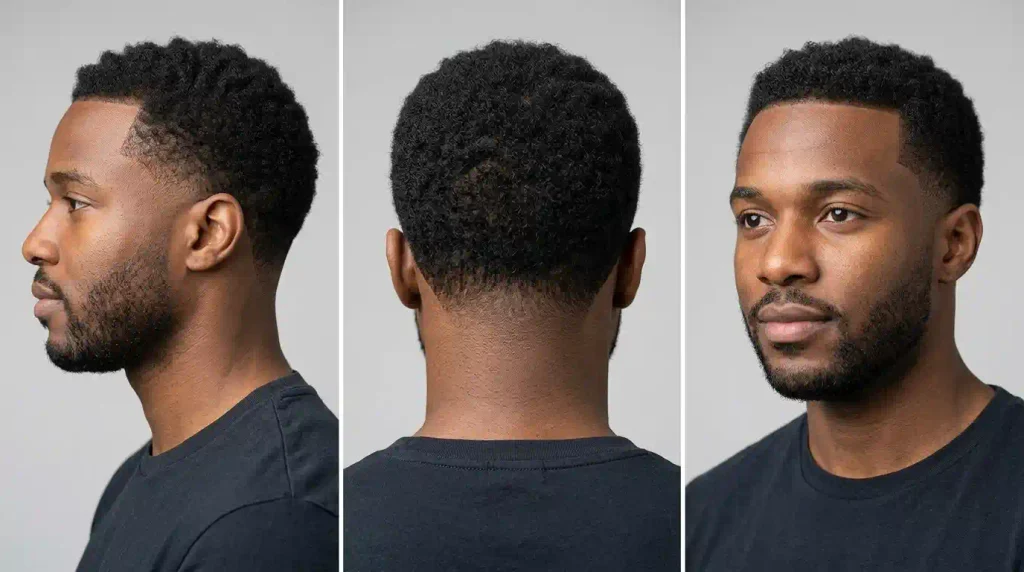
Bring photographs showing the front, side, and back of the haircut.
The side view reveals how much skin is exposed near the temples.
The back view shows whether the fade is localized at the nape or continues around the entire head.
A useful barber request is:
“I want a low skin taper at the sideburns and neckline, with the shortest sections taken down to skin. Keep most of the sides full, blend the edges smoothly, and leave about two inches on top for texture. I don’t want a full skin fade around the entire head.”
This communicates the intended result more precisely than asking for a taper haircut skin fade without additional details.
How Barbers Create a Skin Taper
A skin taper requires accurate sectioning and smooth transitions between bare skin, short stubble, and longer hair.
The technique uses many of the same tools as a skin fade, but the faded areas are generally more localized.
Set the lowest point of the taper
The barber begins by examining the hairline, temples, sideburns, and nape.
The shortest section is planned according to the requested taper height.
For a low skin taper, the exposed area remains close to the lower perimeter.
The barber establishes a guideline that separates the skin-level section from the longer hair above.
This line should follow the natural contours of the head.
A conservative starting position helps prevent the taper from becoming higher than requested.
Blend with clippers and guards
Once the initial guideline is established, the barber uses adjustable clippers and progressively longer guards to create the gradient.
Shorter settings are used near the skin-level area.
Intermediate settings help soften the transition.
Longer guards connect the faded section to the surrounding hair.
The barber may adjust the clipper lever between open and closed positions to refine the blend.
Clipper-over-comb techniques can help connect the taper to scissor-length sides.
A properly blended skin taper should show no visible horizontal lines or abrupt changes in density.
Detail the skin area with a trimmer, foil shaver, or razor
The lowest section may be refined using a detail trimmer, foil shaver, or razor.
The tool depends on the desired closeness and the client’s skin condition.
A foil shaver can create a very close finish, while a trimmer may leave extremely short stubble.
A razor can produce a smooth skin-level result but may not be appropriate for every person.
The barber should use clean tools, avoid unnecessary pressure, and account for sensitivity.
For clients prone to razor bumps, a slightly longer finish may be preferable to repeated close shaving.
Connect the taper to the top and beard
After blending the skin-level sections, the barber shapes the remaining hairstyle.
The top may be cut with scissors, clippers, or a combination of both.
If the client wears a beard, the sideburns can be blended into the facial hair.
The neckline should also be checked from the rear.
The final haircut should be inspected from multiple angles to ensure both sides appear balanced.
Small natural differences in head shape or hair density may require slightly different cutting techniques on each side.
Adjusting a Skin Taper for Hairlines and Growth Patterns
A skin taper should be adapted to the individual’s natural hairline, head shape, and growth direction.
Ignoring these factors can lead to uneven transitions or an uncomfortable grow-out.
Work with uneven sideburns or temples
Many people have naturally uneven sideburns or slightly different temple hairlines.
The barber should aim for visual balance rather than forcing identical cutting movements onto both sides.
If one temple has less hair density, an aggressive skin taper may expose that difference.
A lower taper or softer blend may be more flattering.
Avoid cutting the stronger side excessively short simply to match an area with naturally reduced density.
Adapt the taper for a receding hairline
A skin taper can complement a receding hairline, but placement is important.
If the temples are already thinning, an excessively high taper may emphasize the recession.
A low skin taper can preserve more hair above the faded area.
The barber should avoid creating an artificial front line that extends beyond the natural growth pattern.
A short textured crop or carefully styled fringe may help balance the overall appearance.
The haircut does not treat hair loss, but thoughtful shaping can improve visual proportions.
Account for cowlicks and nape growth direction
Cowlicks can affect how the hair sits after cutting.
A strong nape cowlick may cause short hair to grow upward or outward.
The barber may need to adjust the taper’s placement or leave additional length in selected areas.
The occipital bone also influences how the back of the haircut appears.
A person with a flatter rear head shape may benefit from maintaining more weight above the nape.
The goal is to create a natural silhouette rather than applying identical measurements to every head shape.
How to Style a Skin Taper
The skin-level areas generally require little daily styling.
Most grooming effort focuses on the longer hair above the taper.
The ideal routine depends on hair texture, top length, and preferred finish.
Choose products for your hair texture
| Styling Product | Suitable Hair or Style | Typical Finish |
| Matte clay | Thick hair, textured crops | Matte with firm hold |
| Styling paste | Messy tops, fringes, quiffs | Flexible texture |
| Pomade | Slick backs, comb-overs, side parts | Smooth, often glossy |
| Hair cream | Wavy and medium-length hair | Natural, flexible |
| Curl cream | Curly and coily hair | Defined curls |
| Leave-in conditioner | Dry or textured hair | Moisturized and manageable |
| Mousse | Fine hair needing volume | Lightweight lift |
| Hairspray | Quiffs and pompadours | Additional hold |
For fine hair, lightweight products are generally preferable because heavy waxes and pomades can make strands appear flat.
Thick hair may require stronger hold for structured hairstyles.
Curly hair often benefits from moisture-focused products that support natural definition.
Avoid applying heavy styling products directly to freshly shaved skin if they cause irritation.
Style the top while keeping the taper defined
Start with clean, slightly damp hair.
Apply a small amount of styling product to the longer sections.
For a textured crop, use your fingers to separate strands and create natural movement.
For a quiff or pompadour, lift the roots using a blow dryer and a suitable brush.
For a side part, comb the hair along its natural direction.
For curly hair, apply curl cream while damp and allow the curls to air-dry or use a diffuser on gentle heat.
Avoid excessive high-temperature styling because repeated heat exposure can contribute to hair damage.
The skin taper itself usually does not need styling product.
Keeping the surrounding scalp clean and the top neatly styled is enough to maintain the overall appearance between barber visits.
Skin Taper Maintenance and Grow-Out
A skin taper creates sharp contrast when freshly cut, but the shortest sections change quickly as hair grows.
Regular maintenance helps preserve the skin-level appearance and neat neckline.
How long a skin taper lasts
A skin taper usually looks particularly sharp during the first several days after cutting.
As the hair grows, short stubble becomes visible in the areas that were previously shaved to skin.
The fade gradually becomes softer.
For many people, the freshly cut definition begins to change noticeably within approximately one to two weeks.
However, the haircut can remain presentable for longer, depending on the taper height, hair density, growth rate, and personal preference.
A low skin taper may grow out more naturally than a high-contrast full skin fade because the exposed area is smaller.
How often to book a touch-up
People who want a consistently sharp skin-level finish may prefer touch-ups approximately every one to two weeks.
For a more relaxed appearance, two to three weeks may be sufficient.
A low skin taper can sometimes remain tidy for around three to four weeks if the wearer is comfortable with a softer transition.
These are general estimates rather than fixed requirements.
The top hairstyle also influences appointment frequency.
A short textured crop may need reshaping sooner than a longer layered hairstyle.
If you have a beard blend, line-up, or detailed hair design, those features may require attention separately.
Maintain the cut between barber visits
The best home maintenance focuses on cleanliness and gentle scalp care.
Wash the hair according to its natural texture and scalp needs.
Use a suitable conditioner for dry or longer sections.
Avoid repeatedly shaving the skin-level areas simply to maintain the freshly cut appearance, especially if you are prone to irritation.
Close shaving can cause razor bumps and ingrown hairs in susceptible individuals.
The American Academy of Dermatology’s razor bump prevention guidance explains methods for reducing shaving-related irritation, including paying attention to hair growth direction and using appropriate shaving techniques.
If the scalp becomes red, painful, or inflamed, avoid further aggressive trimming over the affected area.
Persistent irritation or suspected infection should be assessed by a healthcare professional.
Grow out a skin taper into a regular taper or another cut
A skin taper can grow into a regular taper when the closely cut sections gain additional length.
During the first few weeks, the bare-skin area develops short stubble.
As growth continues, the contrast between the faded sections and longer hair decreases.
A barber can gradually reshape the perimeter into a guarded taper.
If you want a softer finish during the transition, ask for light blending without taking the shortest sections back down to skin.
The reverse taper haircut represents a different, unconventional length arrangement rather than a direct grow-out equivalent, so it should be considered separately when exploring alternative styles.
The simplest transition is usually to allow the skin-level sections to grow while maintaining the longer hair around them.
Manage the transition while preserving side length
If your goal is to grow longer sides, avoid repeatedly raising or shortening the taper.
Tell your barber which areas you want to preserve.
The top can still be trimmed and styled while the lower sections regain length.
A low skin taper generally provides more flexibility for growing out the sides because less hair was removed initially.
If the fade was cut too high, several weeks or months of growth may be needed before the sides can blend naturally into a longer hairstyle.
Patience is important because additional cutting cannot restore missing length.
Skin Taper Cost in the United States
The price of a skin taper haircut varies according to location, barber experience, and the complexity of the service.
A straightforward skin taper may be included in the regular men’s haircut price, while more detailed fading and styling can cost extra.
Typical price range
As a broad planning estimate, a professional skin taper haircut in the United States may cost approximately $30 to $85, although prices can fall below or above this range.
| Service Type | Illustrative Price Range |
| Budget or traditional barbershop | 20–40 |
| Standard professional haircut | 30–60 |
| Experienced fade specialist | 45–85 |
| Premium grooming studio | 75–120+ |
These are approximate budgeting ranges, not verified nationwide averages or live barbershop quotes.
A typical appointment may take approximately 30 to 45 minutes.
More detailed cuts involving a full restyle, beard blending, or designs may take an hour or longer.
What may affect the price
Location is an important factor.
Barbershops in major cities may charge more than smaller neighborhood shops.
Barber experience and demand can also influence rates.
A simple low skin taper may require less time than a detailed mid or high skin taper.
The hair’s length and density can affect the amount of blending needed.
Additional services such as washing, blow-drying, and top styling may also influence the final cost.
Possible add-on costs for a beard blend, lineup, or design
Some barbershops charge separately for additional grooming services.
A beard blend may require extra fading and shaping around the sideburns.
A line-up can involve detailed work around the forehead and temples.
Hair designs may require additional trimmer or razor work.
Some shops include basic outlining in the haircut price, while others list it as a separate service.
Confirm the total price before booking, especially when requesting multiple services.
Benefits and Trade-Offs of a Skin Taper
A skin taper offers the sharp appearance of skin-level fading while preserving more hair than many full fades.
However, the exposed-skin finish also introduces maintenance and sensitivity considerations.
Clean, defined finish
One of the main benefits of a skin taper is its precise perimeter.
The transition from bare skin into longer hair creates a clear, modern outline.
The haircut can complement casual, formal, and professional styles depending on its height and top shape.
Additional benefits include:
- More side coverage: A localized taper can preserve substantial hair around the upper sides.
- Styling flexibility: Works with textured crops, quiffs, side parts, afros, curls, waves, and longer hairstyles.
- Customizable contrast: Low versions can remain relatively subtle, while higher versions create stronger definition.
- Beard compatibility: The sideburns can be blended naturally into facial hair.
- Clean neckline: A skin-level nape taper creates a sharp finish around the lower hairline.
The key is selecting a placement that complements the overall hairstyle.
Frequent upkeep and skin sensitivity
The biggest drawback is the maintenance required to preserve the bare-skin appearance.
Hair regrowth becomes visible relatively quickly.
A skin taper may therefore require more frequent barber visits than a longer guarded taper.
Very close shaving can also irritate sensitive skin.
People with tightly curled hair may be more prone to ingrown hairs, although anyone can experience razor bumps.
A skin taper should not be performed aggressively over cuts, inflamed bumps, or irritated areas.
If close shaving consistently causes problems, a guarded or shadow taper may be more comfortable.
What to consider before choosing the cut
Before selecting a skin taper, consider the amount of skin exposure you want and how often you are willing to maintain it.
A low skin taper provides a relatively conservative option.
A mid or high version creates stronger contrast but changes more of the side silhouette.
Hair density and head shape also influence the result.
For fine or thinning hair, preserving additional side coverage may be preferable.
If you have a sensitive scalp, request a gentle finish and discuss alternatives with your barber.
The best skin taper is not necessarily the closest or highest fade. It is the one that suits your hair, grooming routine, and comfort.
Skin Taper Haircut FAQs
Is a skin taper the same as a low skin fade?
No, a skin taper usually fades localized areas around the sideburns and neckline, while a low skin fade generally extends around more of the lower sides and back.
Can you get a skin taper with longer hair on the sides?
Yes, a skin taper can preserve substantial side length while blending only the temples, sideburns, and nape down to skin.
Does a skin taper work on straight or curly hair?
Yes, a skin taper works with straight, wavy, curly, and coily hair when the placement and blending are adjusted to the texture.
How is a skin taper different from a neck taper?
A neck taper focuses on the nape and neckline, while a skin taper may include both the neckline and temples with a bare-skin finish.
How often should you maintain a skin taper?
A skin taper often benefits from touch-ups every one to three weeks, depending on hair growth, fade contrast, and personal preference.
Can you get a skin taper with a beard?
Yes, a skin taper can be connected to a beard through gradual sideburn blending for a clean, unified appearance.
Is a skin taper suitable for a sensitive scalp?
A skin taper may irritate sensitive skin because of close shaving; a longer guarded finish is often worth considering.
Is a skin taper permissible in Islam?
Islamic scholars differ on whether skin tapers fall under qaza’, the prohibited or discouraged practice of shaving part of the head while leaving other parts; some distinguish gradual trimming from complete shaving, so consult a qualified scholar from your school of thought for a ruling on your specific haircut.
Final Thoughts
The skin taper haircut combines the sharp definition of a skin fade with the controlled placement of a traditional taper. By concentrating skin-level blending around the temples, sideburns, and neckline, it creates a clean, modern appearance while preserving more hair throughout the sides and back.
A low skin taper offers subtle definition, while mid and high variations provide stronger contrast. The haircut also works well with textured crops, side parts, pompadours, curls, waves, afros, locs, and beards.
For the best result, choose your taper height, top length, and neckline finish before visiting your barber. Bring clear side and back reference photographs and explain how much skin you want exposed.
Explore more haircut variations, styling advice, and barber guides at Taper Haircut Hub to find the right style for your next appointment.

One Comment